Category: GreatNotion

Great Notion is a consulting group delivering business strategy and communication to the sustainability sector

  • CoViD 19 as Our Crystal Ball

    The future is already here, it is just not evenly distributed

    Bewildered climate activists flood my feed.

    The essential question is ‘Why CoViD19 and not Global Heating?’

    The response we have seen over the last months and weeks is the sort of response we have been waiting for since the turn of the millennium.

    This article contends that while it is important to understand the difference in the responses, it is even more useful to examine those responses to learn the lessons required to build the post-growth world.

    Personal, immediate and real

    The fundamental difference, apparent in all the language used by all authorities, is that the threat from SARS-CoV-2 is immediate and it is personal. ‘If we don’t do this, you will die.’

    The images of Italians and New Yorkers waiting for Intensive Care provides compelling evidence. ‘That could be me.’ There is no doubt of the risk. Global heating, by comparison, will harm us all at some point in the future. It is easy to ignore.

    The other, critically important, difference is that there is a well-funded climate-denialist lobby, actively undermining any policy or action addressing greenhouse gas emissions. Their efforts, the media they control and the toxicity they inject into the debate are systematically documented by Naomi Klein in her 2014 book, This Changes Everything as well as many other places.

    The absence of that truth denying lobby in this pandemic allows us to analyse government, community and individual responses to the pandemic without doubting the self-evident facts. In fact it provides a controlled experiment in which different national responses adjust individual variables providing a rich field for exploration.

    We are all selfish

    Young people did not physically distance as soon as lock downs were decreed: they went out and partied, invited friends over and generally behaved as if they are invincible. As you do.

    Despite admonitions not to, many people hoarded. Some had experienced shortages in wars, some only survive by their wits and some are simply greedy. We do not want to queue for food, go hungry or pay extorted prices to others who are faster to act than we are.

    Anaesthetist Erich Schulz recently told me, “hundreds of people struggle to make sacrifices that will save their lives. They should eat less, drink less, exercise more, but they cannot give up the immediate gratification of their current lifestyle, even though it is a matter of life or death. We cannot change people’s behaviour by telling them what is good for them, let alone what is good for everybody else.”

    Environmental movements have failed to sweep progressive politics partly because they often sit uncomfortably with social justice movements. The environment is perceived as a concern of the affluent. This pandemic has brought home the reality that we all respond to Maslo’s hierarchy of needs, we feed and shelter our family before we look out for the neighbours or build community. Apply your own oxygen mask first.

    In building a sustainable, post-growth future, we first have to build community, the framework to support the change in our behaviour. We cannot dictate what others do, we must invite them to join us in the thriving and sustainable future that we create.

    Lives versus money

    Because the CoViD-19 disease has an obvious impact, offers no immediate profit and has arrived so fast, governments have acted on behalf of their citizens rather than the interests of capital.

    The few outliers calling the “cure worse than the disease” or saying, “I would rather die than harm the … economy” have gradually morphed into the more gentle assertion that “harming the economy will kill more people than the disease.”

    This goes to the heart of our standard left/right political divide. It is not a trivial argument.

    We have enjoyed seventy years of affluence beyond the wildest dreams of earlier epochs. We travel in smooth, fast chariots without making personal effort. We whisper into or wave our hands over polished rocks that transfer our thoughts instantaneously to the other side of the world.

    This affluence has been brought about by scientific ingenuity, plentiful cheap energy, the resulting exponential population growth and the extraction of irreplaceable resources. Capitalism has facilitated this affluence and is dependent on the continuous growth and extractive practices.

     ‘The economy’ is simply the mechanism for tracking and the measuring commercial activity, it is not in itself an entity that requires nurturing. That fiction has been actively promoted by the owners of joint-stock companies over centuries who use ‘the economy’ as the means to control governments and so extract wealth from our individual activity. It is the worship of money that is the root of all evil, not money itself.

    CoViD 19 has shifted the debate from whether we should reduce activity, to how we manage that enforced reduction and its impact on the population at large.

    The role of the state

    Part of the emerging libertarian pushback is on grounds of personal rather than economic freedom. Laws preventing gatherings may ensure public safety in a pandemic but sacrifice hard won freedoms that governments may be reluctant to relinquish.

    This can be subtle. We willingly give up cash to use the more hygienic digital equivalent, even though centralised money systems can be abused. The fictional example of Handmaids Tale reflects the actual, recent experience in Greece. Digital money can be reassigned at the press of a button.

    Conservative governments have gone out of their way to apologise to business and industry for the loss of profit caused by governing in the interests of public safety.

    The important thing to remember is that we call on the state to support us when the situation gets beyond our capacity to manage. If the neighbour’s party turns into a riot, we call the police; when a woman collapsed outside my apartment yesterday, I called an ambulance.

    When the Black Plague swept through Europe in the 14th Century killing over 30% of the population, people blamed God, prayed for deliverance and went to their deaths assuming that He had forsaken (or sacrificed) them. By comparison, in response to the cholera plagues of the 1850s, citizens turned to governments to build better sanitation and water supply and provide compensation and regulation.

    We acknowledge and recognise the apparatus in which we place our faith by supporting it with our loyalty, our cash and our compliance. The neo-liberal project has undermined our faith in government and replaced it with faith in the market. The CoViD 19 crisis exposes the falseness of that proposition. It is an echo of the City’s assumption of control over New York fire brigades in the late nineteenth century to prevent disasters caused by in-fighting between insurance companies.

    Nuance is difficult – Science is hard

    We have watched governments blunder and stumble in their interpretation of the science and converting it to policy. But the messaging, science and policy have gradually converged to make cogent sense.

    A clear example has been the concept of ‘flattening the curve’ and its more nuanced partner, ‘bending the curve’.

    On 20th March, Tomas Pueyo published in Medium.com an article entitled the Hammer and the Dance analysing in detail the actions taken by various governments and the corresponding infection and mortality rates.

    https://medium.com/@tomaspueyo/coronavirus-the-hammer-and-the-dance-be9337092b56

    His article is dense and not easy to explain in a three minute news story.

    Over the subsequent week, though, hand worked examples of exponential growth appeared on free to air television, the rhetoric of ‘flattening the curve’ was used to explain the need to manage demand for a limited resources, such as intensive care beds and then, finally, the rhetorical device of ‘bending the curve’ explained the difference between an exponent of more or less than one.

    This week governments are struggling with the messaging for the reality that until there is a vaccine, we remain locked down or wait until about 70% of the population gains immunity through infection.

    The absence of people actively funding ‘anti-science’ has allowed a widespread dissemination of information and the creation of knowledge and intelligence to understand and accept challenging policy that requires personal sacrifice.

    Toilet paper, sanitizer and spaghetti

    The items we have hoarded during the CoViD 19 pandemic reveal systemic flaws that we must address in the larger project of building the post-growth future.

    We cannot easily direct people to use squares of newspaper instead of super soft, double ply toilet tissue because the modern sewer is not equipped to handle squares of toilet paper, no matter how vigorously they have been softened by the sitter. Hand sanitiser is more convenient than soap and water, our love of meat means we no longer obtain the bulk of our protein from pulses as was traditionally the case.

    When we outline the technological solutions to greenhouse gas pollution and biodiversity, we have to take these dependencies into account.

    Hubs of production

    Cat Green is a PhD student researching food sovereignty. She contributed a chapter called the
    Radical Homemaker to a book on Fair Food. Part of her radical homemaking manifesto is that our
    homes have been constructed as nodes of consumption and that we need to transform them into
    hubs of production.
    We buy stuff and consume it at home, alienating ourselves by consuming alone. If we make stuff to
    share, then we put ourselves at the centre, or hub, of the network instead of at the edge. Our lives
    are filled with people and those people get something tangible from us that builds a relationship.
    By engaging friends and neighbours in shelling the pigeon peas we grow on the spare block next
    door, we build community in ways that have worked for thousands of centuries. That community
    supports us in the present as well as the future. That network makes us resilient and helps us thrive
    instead of simply survive.
    Of course, the choices we make as a consumer can contribute to long term sustainability but we
    would have to buy a lot of hand-made soap to influence the footprint of soap manufacturing. By
    contrast, making the soap for other people spreads the word, increases the volume of hand-made
    soap and encourages soap-manufacturers to respond to the market.

    Creating the future

    This pandemic is just the most recent disaster. While we are battling it, Australia’s Great Barrier Reef is undergoing its fourth major bleaching event in a decade. Bushfires that denuded the landscape of every living thing were still burning in late January. There will be other disasters in the future, probably before we emerge from the pandemic.

    Governments are already saying they will ‘take off the brakes’ on ‘the economy’ to ‘get back to normal’ when we get ‘to the other side’. To maintain control of the agenda, we will have to build on the lessons  outlined in this article.

    There will be fertile ground. Regional manufacturing is re-emerging a couple of weeks into the shutdown, local economies are forming, people are rediscovering the joys of games, reading, learning, playing music and singing together.

    We must support and nurture resilient communities to thrive in a post-growth era and we have a golden opportunity to establish those communities. We must also wrest control of our governing structures from the mega-wealthy who own the capital that controls the systems that, until last month, dominated government policy. That is the larger task, but at least this crisis has offered us a window into what is possible when our governments take control.

    The future is already here and, this time, it is widely distributed

  • Interminable conversations

    Birds do it. Bees do it
    Even educated fleas do it
    Let’s do it, Let’s fall in love
    Cole Porter 1928

    There is no doubting the power of conversation as a communication tool. The best preachers and the biggest stadium rock bands mimic traditional call and response to engage the audience and drive home the memory if not the message.

    Climate for change is the latest grass roots movement to adopt the pattern to drive for specific outcomes.

    1. “What do we do as individuals [to prevent climate change]?’
    2. “How effective is that?”
    3. “Would it be more effective to lobby government to change the regulations than to change our light globes?”
    4. Let’s agree that we should use our collective energy to lobby government.

    Get Up eplored a conversational approach in the 2016 election campaign, refined and rolled it out as a significant component of its 2019 platform.

    The ALP says that it is using it, but it stops short of allowing a second voice in the conversation, so can not be genuinely included as a data point in this analysis.

    The Greens have been using it in one form or another since 2013. Adam Bandt employed what his campaigners called the Barack Obama strategy in his first successful election campaign. Obama had taken his inspiration from Chicago community activist Saul Alinsky and his book Rules for Activists via

    Keep this manual safe and confidential.
    DO NOT SHARE

    Bandt’s campaign manual was taboo in the Australian Greens, for a variety of reasons, some practical, some factional, some relating to inertia. It had the words, “Keep this manual safe and confidential. Do Not Share” emblazoned across the inside cover. As a result, the South Brisbane Greens fought the 2013 campaign against Kevin Rudd in Griffith directly following Saul Alinsky’s principles and simply told everyone we were using the “Bandt model”. When Rudd resigned in 2014 we campaigned against Terri Butler in the by-election using the official playbook and paid Get Up’s Simon Sheikh to send some staff to come and train us in the fine print of the technique.

    Following that, the model has become de-rigueur in The Greens and has spread through other environmental and activist groups as outlined above.

    The most recent incarnation of the two-decade old training by Al Gore’s Climate Action has now added conversational techniques to its armoury.

    The failure of all this conversing to make a “Climate Election” out of the 2019 contest for control of the Australian Federal Parliament simply brings The Greens, Climate Action, Climate for Change and Get Up to the same point.

    The populace is not sufficiently moved by the evidence of the damage they inflict on future generations or the world’s poor to give up their four-wheel drives, steak dinners, international holidays and other benefits of continuous economic growth.

    We need not argue about why this is the case, that is fairly straight forward, we do need, however, to discuss what we can do to engage the natural morals and humanity of the silent majority.

    The reasons that people do not want to engage are spelled out in the uncompromising and terrifyingly honest video snip, “Deep Adapatation” by Jem Bendell. https://www.youtube.com/watch?v=DAZJtFZZYmM&t=2s

    The contract is broken – We are not in control any more,”he points out.

    To paraphrase: the very real and well understood danger that we may become extinct in the lifetime of people living today, leads directly to the breakdown of the fundamental promise that has underpinned liberal democracy. That promise has been that life will continue to get better, as long as we stick to the rules. As a consequence, people are no longer sticking to the rules.”

    The impact is that veteran campaigners are giving up, declaring the end of social democracy and the failure of the climate movement. In April this year John James wrote his final weekly newsletter, opening with the words:

    “For more than three decades I have been spreading news of the climate crisis during the years when we could have made a difference, and at no moment in all that time has the good news outshone the bad.

    “I am 88. I gave my first public talk on ecology and the warming planet in 1982. I am weary of reiterating increasingly miserable news. We all know where we are heading. We won’t be bored in the years that remain to us.”

    These campaigners express disappointment that we did not make the change that had to be made to avoid the position we are in now but in a very real way they have simply switched gear accepting the inevitable. They have not given up campaigning, they have simply given up trying to bring the mainstream with them.

    I interviewed Richard Heinberg in 2008 about his scenario analysis PowerDown. I pointed out to him that based on the political landscape at the time his Lifeboat scenario seemed more likely than any of the others. He was shocked. “I had to include that for completeness in the spirit of scenario analysis, but it is the worst case scenario. That is what we need to do if none of the other scenarios eventuate.” https://thegenerator.news/thegenerator/soundfiles/Heinberg_Lifeboats.mp3

    On the other hand, the youth is newly energised to pick up where their elders have left off.

    The Extinction Rebellion, the Climate Emergency are declarations that reflect the urgency so cogently declared by Greta Thornburg. That does not resolve some of these inherent tensions, though. When Greta declared that Sustainability is dead, Climate Change is everything, the fractious nature of the discussion that emerged must have made fossil fuel magnates extremely warm and comfortable.

    Recently, a number of young women who have expressed serious concern about their decision to bear children in the face of a possible extinction event. I grew up in the shadow of the Atomic era, I was born at the height of the Cold War. I missed being conscripted to Vietnam by five years. As youngsters we expressed intellectual concern about the morals of bringing children into this world, but all the women my age who discussed with me their reasons not to breed were driven by rather more selfish reasons. Children are an expensive luxury in a neo-liberal society.

    These deep, life changing decisions by thoughtful people whom I respect are symptoms of the alarm generated by the possibility of extinction and the certainty that we are at the end of growth.

    The reality is that we have to go far beyond conversations that bring the mainstream voter into the conversation, we absolutely have to take action to begin to build a post-growth, post-carbon world. That requires more than conversations or lobbying politicians, that requires radical action, leading to radical change.

    Simon Sheikh of Future Super in January 2014
    Simon Sheikh of Future Super ex-Get Up acted on establishing an income stream before setting up a business training people in the conversational approach.

    It may well be that the organisations that have engaged directly in the financial system, Future Super, Planet Ark two name just two, despite their flaws, offer a significant clue.

  • The best and worst of recycling

    Agricultural use of single-use-plastics dwarves domestic use, Jenny Brown of Envorinex told a crowd of forty at The Precinct in Brisbane last night. The good news is that the company which she founded and heads as managing director, is doing something about it.

    A manufacturer of plastic goods for industrial and infrastructure applications since 2003, Ms Brown has been waging war on waste by recycling as much plastic as possible and delivering goods made from 100% reclaimed waste in the bulk of her products.

    Jenny Brown of Envorinex at the Circular Economy Meetup - June 2019
    Anshu Sisodia and Jenny Brown of Envorinex with friend at Brisbane’s Circular Economy meetup for World Environment Day in June

    “Plastic can be re-used dozens of times and last for centuries if it is properly processed,” she said, “the important thing is to get it right the first time.”

    Some of Envorinex greatest successes include the processing of tonnes of bags and tubes used to deliver saline solution in hospital and converting that into mats and other products.

    “All of the goods that leave our factory can be recycled again, and again and again,” she said.

    Envorinex is based in northern Tasmania and employs around twelve full time staff on two different production lines, reclaiming and processing waste and producing a range of products from guide posts for roads, antifatigue mats for oil rigs, through to simple clips and accessories for a range of applications.

    Ms Brown is in Queensland to explore the establishment of a processing plant to recycle a significant portion of the agricultural waste from the southern half of the state.

    Her presentation included images of tonnes of single use plastic discarded by strawberry and livestock farmers. Envorinex also processes hard plastics recovered from mines and Tasmania’s very active salmon and oyster farming industry. The stanchions and frames used to contain the fish or on which the oysters grow, are replaced every three to five years and include many tonnes of plastic.

    She said that the enemy of recycling is contamination. This is not so much the organic material that attaches to the plastic as the ropes, nylon clips and other attachments that have to be removed manually, vastly increasing the cost of handling and recycling.

    She also noted that most manufacturers reduce costs by mixing substances such as sawdust with virgin plastics to reduce costs and by skimping on other additives that ensure longevity and recyclability.

    Answering a question from the audience about domestic use of single-use-plastics she said that Envorinex deals exclusively with industrial and agricultural waste because domestic waste is so contaminated that it is extremely difficult to recycle.

    “This is why the waste from Australia and other rich countries has been rejected by China, India and Malaysia. They simply cannot process it,” she said. The problem is partly that packaging is often made from a mixture of products that cannot be effectively separated as well as the poor handling and sorting on the part of domestic users.

    She also noted that there are some applications, such as hospital equipment, where single use plastics are necessary but, that generally speaking, single use packaging items are the major problem.

    More information is available from the Envorinex website

  • Growth, or not, and a little Wisdom

    A public discussion on the Post-Growth Future for Business held at University of Queensland generated far-reaching discussion last Friday, 7th June.

    Dr Cle-Anne Gabriel
    Dr Cle-Anne Gabriel at UQ Business School

    Hosted by Dr Cle-Ann Gabriel, who is researching business models for sustainability, the event outlined the reasons for considering an end to growth, the challenges that poses for business and some approaches that can help business flourish in a post-growth environment.

    Key among the ideas was that individual businesses can grow in a zero growth economy, the challenge is where the degrowth comes from to balance that out.

    Dr Gabriel provided an overview of the philosophical underpinnings of zero-growth, the difference between degrowth (it is a process that can be applied to specific areas, such as developed countries, to move toward a post-Growth economy) and post-Growth, and a list of the challenges facing economists.

    Dr Michelle Maloney

    Dr Michelle Maloney, codirector of the New Economy Network, walked through the recent history of growth and the increasing influence of finance as a result of neo-liberalism and some of the tools being used to replace economic growth in specific communities.

    Associate-Professor Bernard McKenna

    Associate Professor Bernard McKenna focused on the nature and application of wisdom. He pointed out that the application of theory and dogma to economic management and in governance generally can lead to harsh and unintentional harm, if is applied without the ameliorating impact of wisdom.

    The complimentary and thorough talks generated vigorous and wide ranging discussion in the workshops raising a number of interesting questions and observations.

    One very challenging observation was that the exponential curves of the “Great Acceleration” all follow similar trajectories to that of population. If deforestation, plastic pollution, ocean acidification, falling water tables, disappearing ice etc are all functions of overpopulation, then this leads to the challenging idea that reducing population would solve all the other problems on its own. That in turn leads to the uncomfortably cynical observation that the inaction of the world’s richest nations on climate change and their increasing hostility to immigration could well engineer such an outcome by simply letting three quarters of the world disappear in an ecological catastrophe.

    Professor McKenna’s work on Wisdom would obviously not accommodate such a conclusion.

  • Geoff Jnr on deGrowth

    A much younger Geoff Ebbs discusses a Zero Growth economy in 2010
  • Dick Smith and Geoff Ebbs discuss degrowth

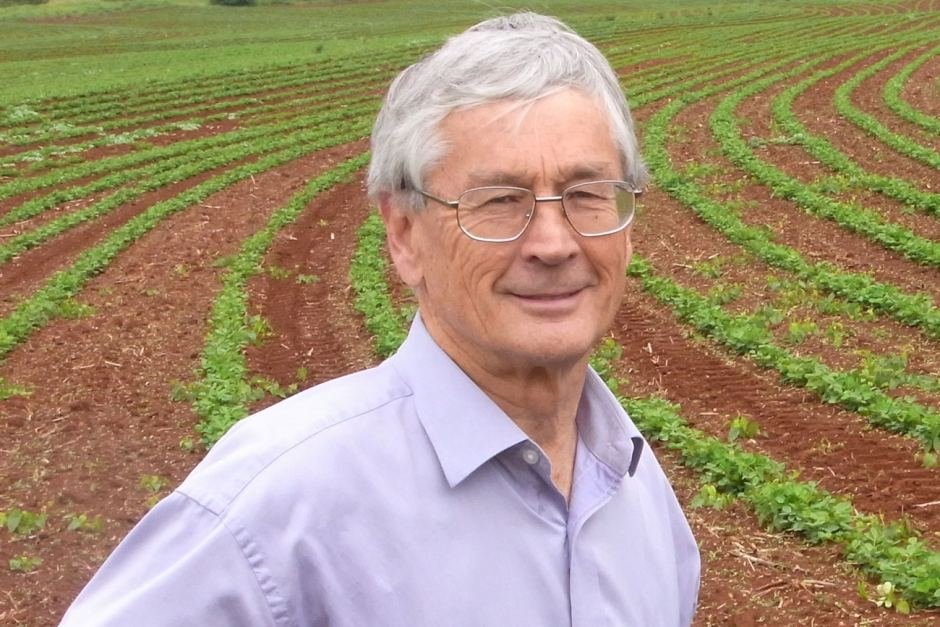
    Entrepreneur and adventurer Dick Smith is no stranger to controversy.

    Dick Smith appeared on the ABC discussing Australian food production

    Over the years he has threatened to run against Tony Abbott, as well as starting a range of ventures that can only be described as profit for a purpose. Dick Smith foods for example was set up with the sole purpose of keeping Australian food processors in Australian hands.

    In this interview with Geoff Ebbs, Dick Smith discusses the end of growth and the challenges inherent for capitalism in that concept.

    Dick and Geoff discuss growth and capitalism in this section of a 15 minute interview.

    The interview was first aired on The Generator, a weekly radio show on Byron Bay’s Bay FM that ran from 2005 until 2009.