Category: Water

  • Snowy problems blamed on financial incentives

    Snowy problems blamed on financial incentives

    Posted March 15, 2012 06:06:18

    Loading…

    Map DataMap data ©2012 GBRMPA, Google, Whereis(R), Sensis Pty LtdTerms of Use
    Map Data
    Map data ©2012 GBRMPA, Google, Whereis(R), Sensis Pty Ltd
    Map data ©2012 GBRMPA, Google, Whereis(R), Sensis Pty Ltd
    Map
    Map
    Satellite

    Map: Jindabyne 2627

    An environment group says the health of the New South Wales Snowy River is being compromised by financial incentives.

    The State Office of Water will not bring forward this year’s environmental flows program in light of the recent rain, but Snowy Hydro says the downpour provides an opportunity to improve the health of the system.

    The Alliance’s Chairman, John Gallard, says the dispute has created tensions between the environment and the well-being of Murray River irrigators.

    He says stakeholders are too focused on the financial bottom line.

    “I think it comes at a loss of profit for Snowy Hydro in hedging the environmental benefits, or the irrigation benefits of water that they can keep and store in their reservoirs for future releases to irrigators,” Mr Gallard said.

    For more, go to the South East News Blog.

  • World Water Forum will pander to corporate self-interest, say critics

    World Water Forum will pander to corporate self-interest, say critics

    Campaigners pan global water conference for allowing business access to senior government officials and raise concerns that delegates are watering down human rights commitments

    • guardian.co.uk, Monday 12 March 2012 13.00 GMT
    • Article history
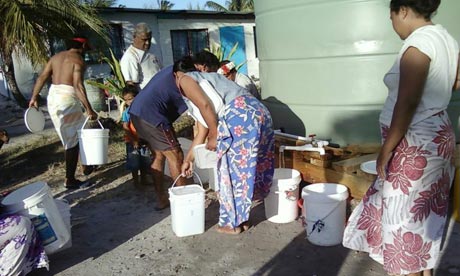
    • MDG : Water shortage in Tuvalu

      Drought on the Polynesian island of Tuvalu offers a stark reminder of the deprivations caused by water scarcity, the theme of the World Water Forum. Photograph: 350.org

      Diplomats, business leaders, and scientific experts are gathering in southern France this week for an international conference billed as a “platform for solutions” to the global water crisis, but denounced by critics for lacking legitimacy and promoting the interests of large transnational corporations.

      Organisers say more than 20,000 delegates from 180 countries will attend the six-day World Water Forum (WWF) in Marseille. French president Nicolas Sarkozy is expected to attend, along with European Commission president José Manuel Barroso, King Mohammed VI of Morocco, and the CEOs of Nestlé and Coca-Cola.

      The meeting comes amid growing global concern about resource scarcity and future water shortages. The UN’s world water development report, published on Monday, warned that unprecedented growth in the demand for water is threatening global development goals and will exacerbate inequalities between and within countries.

      “Because allocation will inevitably go to the highest paying sector or region, this may result in an increasingly significant portion of people not being able to satisfy their basic needs for food, energy, water and sanitation. This would not be mere stagnation, but would likely take the form of a distinctly regressive trend compared to current conditions,” said the report.

      It added that it is no longer sufficient for water experts to draft technical proposals behind closed doors. Instead, it is necessary to open up water management to society as a whole, and recognise that “efficiency and productivity gains alone cannot alter global patterns of unequal supply of resources and consumption or access to benefits”.

      A separate OECD study on global water challenges, published last week, said rapid urbanisation, climate change and shifts in the global economy will push demand for water up by 55% by 2050, when it expects more than 40% of the world’s population to live in areas of severe “water-stress”.

      Both reports say rising resource scarcity will make it more difficult, and more urgent, to address competing demands from farmers, energy producers, and other water users.

      Organisers of the water forum say the event will bring together delegates from government ministries, civil society groups, the private sector and the scientific community to promote concrete proposals for tackling global water issues including access to water and sanitation.

      Some forum delegates view the meeting as an important step on the road to the Rio+20 summit on sustainable development in June.

      But critics say the forum, which costs as much as 700 euros for full access, caters to the interests of big business and gives corporations opportunities to advance their interests by facilitating direct access to high-ranking government officials. Starting on Wednesday, activists are staging an Alternative World Water Forum to promote alternatives to privatisation and share experiences on how to promote public and community-led water management from the bottom-up.

      On Friday, UN special rapporteur Catarina de Albuquerque warned that government delegates to the WWF appeared to be watering down their human rights commitments to water and sanitation. These rights, formally recognised by the UN in 2010, must form the basis of any proposals to expand access to essential services, said De Albuquerque in a statement.

      A draft of the declaration from government ministers gathering at the WWF, seen by the Guardian, fails to explicitly reaffirm the human rights to water and sanitation. Instead, it commits signatories to pursue the implementation of “human rights obligations relating to access to safe and clean drinking water and sanitation”.

      While the declaration, due to be released on Tuesday, will not be legally binding, campaigners argue that this language inserts loopholes for countries to dodge their legal and financial obligations to uphold these rights.

      NGOs, advocacy groups, and civil society organisations said the draft declaration is dangerously ambiguous and that “a small number of states will use [this] to try to undermine progress on the right to safe drinking water and sanitation at the United Nations level and in other international processes”.

      At the 2009 forum in Istanbul, Turkey, which saw riot police turn water cannons on protesters opposing the privatisation of water utilities, delegates opted to describe water as a “basic human need” rather than a right.

      Last week, the UN announced that the international target to halve the number of people without access to safe drinking water – part of the millennium development goals (MDGs) – had been met, five years ahead of the 2015 deadline. The news was tempered, however, with a warning that nearly 800 million people are still without access to safe water and that the MDG target to improve basic sanitation, such as latrines and hygenic waste collection, is still far from being met.

  • Funding for dam safety in doubt

    Funding for dam safety in doubt

    Warragamba Dam spilling

    TIMELAPSE footage shot from Friday, 2nd of March, shows the damn overflowing and spilling

    Full Warragamba Dam ‘to spill over’

    The Sydney Catchment Authority has predicted Warragamba Dam will spill over this evening after heavy rain in catchment areas, and nearby to…

    Warragamba Dam

    Warragamba Dam … spilling after the recent NSW floods. Source: The Sunday Telegraph

    THE state government plans to cut funding for dam safety upgrades by up to $110 million despite official warnings many dams do not comply with the NSW Dams Safety Committee’s (DSC) standards for “extreme floods”.

    A State Water statement quietly tabled to parliament shows Treasury is increasing the dividends to come out of State Water – in breach of a Barry O’Farrell promise to freeze dividends.

    But, at the same time as it makes a grab for more than $200 million in dividends, it is cutting the money for dam upgrades – which typically include building bigger dam walls and extra spillways.

    “State Water has commenced a review of the future dam safety program,” the statement says.

    “The review has identified potential options for revised program delivering savings of over $46.1 million (and possibly as high as $110.8 million) to the current dam safety upgrade costs.

    “State Water will continue to engage the DSC in developing a more fiscally efficient dam safety upgrade program.”

    The statement reveals dividends paid are to rise from $3 million in 2010 to $22.3 million in 2012 and keep rising to $31 million by 2017.


    “Many of State Water’s dams no longer comply with the NSW Dams Safety Committee’s standards and guidelines for extreme floods and earthquakes,” opposition water spokesman Luke Foley said. “Tens of millions of dollars that State Water could and should spend on upgrading dam safety will instead be paid to the state government as dividend payments.

    “Dam safety upgrade capital expenditure will be $120 million lower over the next 10 years than was budgeted under Labor. At the same time, the O’Farrell government is budgeting for an extra $260 million in dividends from State Water over the next 10 years.”


    The head of the DSC Brian Cooper said his committee had held talks with State Water about the cuts and had to be happy with risk assessments to allow them to proceed. Minister of Primary Industries Katrina Hodgkinson said: “State Water is committed to maintaining dams that are safe.”


    2 comments on this story

  • GUEST VIEWPOINT: Does county seek too much power over water?

    News 1 new result for PEAK-OIL
    GUEST VIEWPOINT: Does county seek too much power over water?
    The Register-Guard
    You’ve heard of peak oil? Imagine a future of peak water. We are volunteer members of the Lane County Planning Commission, and speaking as individuals, we feel a responsibility to inform our community of recent local decisions affecting water supplies
    See all stories on this topic »
  • Dam full but desalination plant on line at $500m a year

    initial cost 2 Bn.

    Dam full but desalination plant on line at $500m a year

    Rachel Browne, Heath Aston

    March 11, 2012

    IT WILL be more than four years before the Sydney desalination plant produces a drop of water again, if the water level at Warragamba Dam declines at the same rate as the last time it topped out in August 1998.

    Even if levels drop at the same rate as the fastest decline it would be two years before the dam falls to 70 per cent – the point at which the desalination plant would be turned on.

    Assuming the former rate, a private owner of the plant – to be announced by the State Government this year – will take more than $500 million from NSW taxpayers without producing a litre of water.

    Based on estimates from the Independent Pricing and Regulatory Tribunal, a private sector owner would take $591 million in ”availability charges” from Sydney Water – payment for keeping the plant available.

    Taking away fixed costs, including $1.1 million a month to be paid to the plant’s operator, Veolia Water, and financing debt on the expected $1.1 billion price tag – which excludes a possible privatisation of the $600 million pipeline – a little over $50 million a year will go to the owners in profit.

    The Greens MP John Kaye said: ”Labor’s desalination plant was always a white elephant, but the coalition are now taking away the opportunity to turn the plant off and avoid $600 million of wasted availability charges,” he said.

    Interested bidders include local and international, a number of investment banks and pension funds from Canada and Korea.

    Warragamba Dam, one of the largest domestic water supply dams in the world, is likely to continue to spill if the Bureau of Meteorology’s long-range forecast for more rain proves correct.

    The Bureau of Meteorology NSW climate manager, Dr Aaron Coutts-Smith, warned NSW residents to brace for more wet weather.

    He said there was a 60 per cent chance of above average rainfall throughout autumn when low pressure systems off the east coast are more prevalent.

    ”There are increased odds of above average rainfall over the next three months, but most of that will be west of the divide,” he said.

    ”We can’t tell whether it will come in heavy showers like Thursday’s downpour or whether it will be more evenly spread.”

    Read more: http://www.smh.com.au/environment/water-issues/dam-full-but-desalination-plant-on-line-at-500m-a-year-20120310-1ur5i.html#ixzz1ol59IWyn

  • Faulty weirs blamed for severe floods

    Faulty weirs blamed for severe floods

    Catherine Armitage

    March 10, 2012

    Over $500 million ... Roads minister Duncan Gay's projected damage bill for this year's floods.

    Over $500 million … Roads Minister Duncan Gay’s projected damage bill for this year’s floods. Photo: Adam Hollingworth

    THE state government’s failure to responsibly manage the thousands of weirs and levees which impede the flow of waterways has made flooding worse than it should be, says a water governance expert.

    Jamie Pittock, of the Australian National University, called for urgent action to rectify or remove hundreds of dangerous, redundant or illegal weirs which he said were “pushing water out of channels and onto flood plains and so inundating areas that might not otherwise be flooding”.

    The Roads Minister, Duncan Gay, has put the damage bill for this year’s floods at well over $500 million, and weather forecasts predict even worse weather for next month.

    A NSW government review of weirs starting in the late 1990s found there were 3328 licenced structures built on the state’s waterways. Of the 882 inspected, one-third were assessed as in need of removal, modification or better management to reduce adverse impacts.

    Applying this one-third ratio to the total number of licenced weirs (not just those inspected) suggests as many as 560 weirs might require removal, modification or better management. However, by 2008, according to Dr Pittock’s figures, only 57 had been removed or modified. These figures do not include unlicenced or illegal weirs, the number of which is not known.

    The government relied largely on voluntary action by the infrastructure owners such as farmers and local councils to make improvements, Dr Pittock said, but two-thirds of the known weirs had licences without expiry dates, making intervention difficult. In addition there were legal and financial barriers to removing abandoned, ownerless and illegal weirs. A powerful regulatory system was needed to enforce the necessary improvements, said Dr Pittock, who is director of international programs for the UNESCO chair in water economics and transboundary water governance at the university.

    “The fact that there are so many of these structures out there that the NSW government itself recognises are redundant or dangerous or their records are inaccurate, tells us they are not being competently regulated. You can’t manage what you can’t measure,” Dr Pittock said.

    The Herald called the Office of Environment and Heritage and the Office of Water, the Environment Minister, Robyn Parker, and the Minister for Primary Industries, Katrina Hodgkinson, seeking comment. A spokeswoman for the Minister for Primary Industries said weirs were ”managed by a variety of sources, it could be State Water, it could be local councils, it could be a range of people”. A spokeswoman for the State Water Corporation said: ”All of State Water’s weirs are licenced and all of our weirs are managed under an asset management plan.”

    The flood management system needed to be re-engineered to remove bottlenecks created by antiquated levee systems, Dr Pittock said. He also called for the restoration of ancient flood plains, such as those along the Danube in Europe, to be secondary channels during flooding which could catch flood peaks and release floodwater slowly. While the cost would run into hundreds of millions of dollars, it would be “less expensive than the damage from the sort of floods we are seeing”, he said.

    Read more: http://www.smh.com.au/environment/weather/faulty-weirs-blamed-for-severe-floods-20120309-1upr5.html#ixzz1oepVu392