Category: Water

  • Water policy needs ‘radical’ change to protect people and environment

    Water policy needs ‘radical’ change to protect people and environment

    Ahead of Rio+20, a report is calling for a joined-up approach to managing the world’s water, land and energy demands

    • guardian.co.uk, Wednesday 16 May 2012 13.00 BST
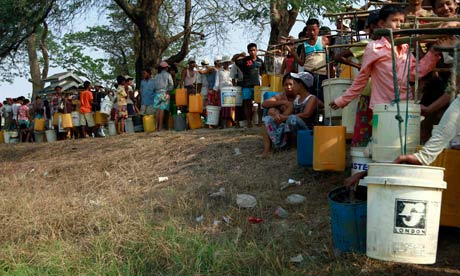
    • MDG : Water policy  : line up to fetch drinking water in Yangon , Myanmar

      Residents carry plastic containers on their shoulders as they line up to fetch drinking water from a lake in Yangon, Burma. Photograph: Khin Maung Win/AP

      The international community needs to “radically transform” the way it manages water, energy and land to ensure the needs of the poorest people are met and the environment is protected, according to the European Report on Development, published on Wednesday.

      The flagship report, Confronting scarcity: managing water, energy and land for inclusive and sustainable growth, calls on the EU to adopt an integrated approach to managing the three elements to achieve universal access to water and energy, and sustainable food security.

      An estimated 1 billion people are still undernourished, around 0.9 billion have no access to safe water and 1.5 billion have no electricity. The demand for water and energy is expected to rise by 40% by 2030 and by 50% for food. Badly managed or scarce resources tend to hit the poorest people hardest.

      “Co-ordination failures between policies on water, energy and land need to be addressed to avoid the negative impacts of these interlinkages,” said the report, which aims to “shape global action” in the run-up to next month’s Rio+20 UN conference on sustainable development.

      “A drop of water, a piece of land, or a kilojoule of renewable energy cannot be seen through the single lens of one sectoral policy or management system. What might appear to be an efficient policy in one dimension can be harmful for others,” it said.

      Achieving this joined-up approach will involve the public and private sectors, and the EU. The public sector would provide the regulatory and legal frameworks for change, including those that make for a more conducive environment for private sector investment, as well as some of the money. The private sector should create more sustainable practices in accessing and consuming natural resources, while the EU will support poorer countries through aid and its wider development policy.

      Launching the report in Brussels, the European commissioner, Andris Piebalgs, said: “This report is particularly relevant and timely ahead of the UN Rio+20 conference and the international year for sustainable energy for all. Water, energy and land are crucial resources for development and human wellbeing, and scarcity cannot be overcome by piecemeal actions.”

      The annual report, compiled by the Overseas Development Institute, the European Centre for Development Policy Management and the German Development Institute, sets out ideas for governments, business and the EU to consider. To strengthen water security for poor communities, for example, it suggests that national governments are supported to implement integrated water resources management programmes.

      It calls for a significant reduction in the environmental footprint of consumption in developed countries – though not exclusively.

      The report also urges governments to ensure land investments contribute to economic development and that deals are not at the expense of weakening ecosystems or people’s livelihoods. It argues for strengthened land tenure to protect customary and collective rights.

      Initiatives that protect the environment, such as halting deforestation, should be rewarded with payments, says the report, offering as an example a scheme operating around Lake Naivasha in Kenya under which companies pay local smallholders who put their land to good use.

      The sentiments of the report chime with an increased focus on joined-up approaches to the challenges of water, land, energy and food security. In March, the ministerial declaration from the World Water Forum called for a greater recognition of the links between water, food and energy in decision-making to improve the “sustainable management of these scarce resources”.

      In November, a report by the International Institute for Environment and Development made an explicit link between water and land. It said African governments were signing away water rights to land investors, who want to profit from water fees and improved agricultural yields and revenues. These “water grabs” show little regard for their impact on people, said the report. “Water managers must seriously consider the extent to which water rights should be linked to land in this way before setting a long-term precedent that could compromise sustainable and equitable supply to all users in the future,” it said.

      Wednesday’s report comes two days after foreign ministers endorsed the European Commission’s Agenda for Change policy, under which more money will be targeted towards the world’s least developed countries and budget support will be made dependent on governments’ human rights and governance records. The new agenda makes clear the EU’s desire to see sustainable, inclusive growth and development, and to increase the involvement of the private sector, which includes allowing them access to development aid.

      Critics have argued that the private sector role lacks clarity. “Will it be local firms in developing countries or foreign multinationals who get access to funds? EU countries need to make sure they don’t divert essential aid support away from those most in need,” said Olivier Consolo, director of the European NGO confederation Concord.

      Last month, the EU pledged €50bn to support clean energy projects in developing countries.

  • Bore water worries for Hendon residents

    Bore water worries for Hendon residents

    Updated May 15, 2012 13:47:07

    Thousands of Hendon residents in Adelaide are being warned about groundwater contamination which was detected 20 years ago.

    The Environment Protection Authority (EPA) says a review of old files has found two reports on a property at Philips Crescent at Hendon.

    They were prepared by environmental consultants in 1992.

    The EPA has held talks with the current property owner, Port Adelaide Enfield Mayor Gary Johanson, and found a third report was prepared that year and showed there were significant chemical levels in groundwater off-site.

    Peter Dolan of the EPA says the current land use is not the cause of the contamination.

    “This site has previously been used for ammunition works, electrical component manufacturing, circuit board manufacturing and possibly electroplating, so potentially there are both on- and off-site sources for the contamination,” he said.

    The Authority has written to 2,900 residents of the area warning them not to use bore water until more testing has been done.

    The affected zone also takes in parts of Seaton, Royal Park and Albert Park.


    Topics:environmental-health, water-pollution, pollution, environment, water-supply, water, water-management, states-and-territories, hendon-5014, adelaide-5000, sa

    First posted May 15, 2012 12:01:01

  • Ontario, Hastings Win $2.32 Billion Sydney Desalination Plant Lease

    Ontario, Hastings Win $2.32 Billion Sydney Desalination Plant Lease

    Hastings Funds Management and Ontario Teachers’ Pension Plan have won the right to a long-term lease of Sydney’s desalination plant after submitting a bid worth 2.3 billion Australian dollars (US$2.32 billion), three people familiar with the matter said Deal Journal Australia.

    Bloomberg News
    A glass of treated drinking water produced at the Kurnell desalination plant is arranged for a photograph in Sydney, Australia

    The pair beat off separate bids by Australia-listed Spark Infrastructure and Industry Funds Management, the people said.

    The New South Wales Government — advised by Goldman Sachs — intends to use the proceeds from the desalination plant long-term lease sale to retire debt and invest in other infrastructure projects.

    At least four consortiums made the shortlist, but the UBS-advised team comprising of Spanish infrastructure group Acciona and Mitsubishi subsidiary Trility, withdrew from the process in March.

    The desalination plant can supply up to 250 million liters a day and is currently operated by Veolia Water Australia.

    It exists so Sydney residents aren’t solely dependent on rainfall for secure water supply. Australia is currently drought-free for the first time in a decade.

    Morgan Stanley and RBC Capital Markets, acted as financial advisers to Hastings and Ontario Teachers’ Pension Plan.

    A consortium of 11 banks including HSBC and RBC were involved in the debt financing of the deal. Australia’s “Big Four” banks –Westpac, National Australia Bank, ANZ Banking Group and Commonwealth Bank of Australia — were also part of the Gilbert + Tobin-advised consortium.

    Part of the appeal for funds acquiring the lease for the desalination plant is its steady cash flows from an AAA-rated counterparty as the NSW government owns the offtake.

    Like us on Facebook or follow us on Twitter @WSJAustralia.

  • Aquifer storage hopes for Murray water supplies

    Aquifer storage hopes for Murray water supplies

    Posted May 08, 2012 14:42:45

    Scientists say there is growing interest from industry and governments in proposals for aquifer storages, as a way to ensure Australia’s future water security.

    Four rivers in three states have been identified as having the potential to test the concept of underground storage.

    Principal investigator with the National Centre for Groundwater Research and Training, Alan Curtis, said the Murray-Darling Basin was losing about 4,000 gigalitres annually to evaporation and another 1,000 GL dried up from dams on private properties.

    He said, to put that loss in context, a city the size of Adelaide drew about 250 GL annually from the Murray.

    Mr Curtis said potential aquifers for storage had been identified along the Murray-Darling system, including in northern Victoria, where shallow storage could minimise the costs of pumping water in and retrieving it later.

    He said there was also great storage potential from boosting the connections between wetlands and aquifers.

    The scientists are keen for wider research to be done.

    They say there are also issues to be resolved over such things as ensuring farmers retain rights to their unused water after its storage and retrieval from an aquifer.

    – ABC Bush Telegraph

    Topics:water, murray-darling-basin, dams-and-reservoirs, rivers, environment, community-and-society, water-supply, water-management, government-and-politics, federal—state-issues, research, research-organisations, irrigation, rural, sa, vic, nsw, australia, wagga-wagga-2650, adelaide-5000, renmark-5341, mildura-3500, wodonga-3690, albury-2640

  • Sense breaks through water debate

    Sense breaks through water debate

    April 24, 2012 – 4:55PM

    Hallelujah! Finally some sense in the water debate.
    After the rush to build desal plants around the country in the grip of the last drought, a new report in Victoria finds this: “the current system does not adequately support the use of alternative water sources (e.g. rainwater and storm water) for non-drinking needs”.
    The Living Melbourne, Living Victoria report must be music to the ears of the many voices who have been banging on for years and years about capturing and re-using rainwater.

    Advertisement: Story continues below

    This report might have been produced for Melbourne, but it should be read by urban planners across Australia.
    Among a raft of other suggestions, the findings push for stronger building controls to catch stormwater at its source and store it – in some cases in rainwater tanks at properties, and in others in storage tanks big enough for a whole urban precinct.
    When we have situations where more storm water flows out of a city each year than the city consumes (as is the case in Melbourne), it does seem crazy not to be tapping into the stuff as it falls from the sky.
    The strategy aims to reduce the demand for mains water by using stormwater for non-drinking functions such as flushing toilets and washing clothes, and continues to support greater water efficiency in homes through low-use appliances and tap fittings.
    The report suggests improved standards should apply to all new and significantly renovated buildings in Victoria.
    The report models the outcomes of capturing more storm water and provides some interesting insights.
    One of the scenarios uses a combination of enhanced household water efficiency and rainwater tanks to provide water for toilets, laundry and gardens. In this scenario, mains water was assumed to be used for personal washing and in the kitchen.
    The modelling estimated these changes would cut potable water demand by 24 per cent, and lead to a 9 per cent drop in stormwater runoff and an 11 per cent fall in the amount of wastewater being discharged across greater Melbourne by 2050.
    In another scenario, domestic rainwater was used for hot water and laundry, while storm water was collected and stored at a precinct or suburb-level, and supplied to households for toilet flushing and gardens.
    The modelling shows the above would deliver a 38 per cent cut in mains water demand, an 11 per cent drop 
in stormwater runoff and a 32 per cent fall in the wastewater being discharged across greater Melbourne by 2050.
    Putting the argument for better water collection in residences, the report noted that larger infrastructure, such as dams and desal plants had a “lumpy, long lead time” and run “much higher risks of saddling customers and/or taxpayers with excessive or unneeded investment” – as many residents across Australia are arguing they are now finding with various desalination plants.
    Do you think it makes sense to collect rainwater in homes, or local storage facilities? If not, why not?

  • Murray-Darling plan ‘deceptive and misleading’

    Murray-Darling plan ‘deceptive and misleading’

    Posted April 23, 2012 21:01:37

    A group of scientists has told a Senate inquiry the draft plan for the Murray-Darling Basin is deceptive and misleading.

    The Wentworth Group of Concerned Scientists has told the inquiry that the draft plan proposed by the Murray-Darling Basin Authority must be withdrawn, arguing it will not prevent a return to drought

    The plan was released in November and an extensive public consultation period ended this month.

    A member of the Wentworth Group, John Williams, has told the inquiry there is not enough information in the draft for Parliament to make an informed decision.

    “To me it’s misleading scientifically, it’s deceptive and I think we are being sold a pup, quite frankly,” he said.

    “It doesn’t deal with climate change and it doesn’t establish what the sustainable limit for a healthy river is over the long term.”

    Meanwhile, the Authority has told the Senate inquiry that climate change science is too uncertain to be used to underpin the initial plan for the river system.

    The draft is based on 114 years of historical weather data and the Authority has left the possibility open for climate change projections to be included in the plan after it is in place for a decade.

    The Authority has closed the 20-week public submission period on the contentious draft basin plan and is now writing a final report for the Federal Government.

    Chief executive Rhonnda Dickson says at this stage the forward figures are too variable.

    Topics: murray-darling-basin, drought, rivers, australia, nsw, act, vic, sa