Category: Population

  • Australia: Increase Migration Quotas to Remedy Skills Shortages in Regional Australia

    Australia: Increase Migration Quotas to Remedy Skills Shortages in Regional Australia

    Australia: Increase Migration Quotas to Remedy Skills Shortages in Regional AustraliaWhen the Australian government’s new budget takes effect on July 1, 2012, fewer foreign workers will qualify for fringe benefit tax exemptions, the number of employer-sponsored permanent migration visas will increase to 129,250 (up from 125,850), and two key permanent residence programs will be revamped to address skills shortages in regional Australia.

    The Australian government announced several initiatives in its Fiscal Year (FY) 2013 budget that will affect employers of foreign workers. Fewer foreign workers will qualify for fringe benefit tax exemptions. The budget also responds to the shortage of skilled local workers in regional Australia by increasing the number of permanent employment-based visas available in Fiscal Year 2013, revamping two key permanent residence programs and creating a streamlined path to permanent residence for temporary workers.

    Strict New Limits on Tax Exemption for Living-Away-From-Home Allowances and Benefits

    Effective July 1, 2012, foreign workers will no longer be able to claim tax exemptions for housing and food benefits unless they have established a residence in Australia for their own use and their employer transfers them to another location in the country. This is similar to the rules on taxable housing and food benefits that apply to Australian workers.

    Currently, foreign workers’ housing and food benefits are generally exempt from both income and fringe benefit taxes. This concession delivers significant tax savings to foreign workers and their employers and has played an integral role in many Australian employers’ recruitment and retention strategies. The practical effect of the change, which was proposed late last year, will be to increase foreign workers’ tax liabilities and reduce their take-home pay unless their employer increases their gross pay to offset the higher tax liabilities.

    Increase in Overall Migration Quota; New Initiatives to Remedy Skills Shortage

    For FY 2013, Australia will increase the overall number of permanent migration visas by 5,000, to 190,000. The total number of employer-sponsored migration visas will be 129,250, an increase of 3,400. The new allocation will be in effect from July 1, 2012 to June 30, 2013.

    The Australia government will continue to focus on attracting skilled workers to regional and low population growth areas. In FY 2013, there will be 16,000 RSMS visas available, the same as this Fiscal Year. As we have reported previously, on July 1, the government is reorganizing the Employer Nomination Scheme (ENS) and the Regional Sponsored Migration Scheme (RSMS) to create a simplified path to permanent residence for foreign workers holding a subclass 457 visa, the principal temporary work visa category. The ENS is Australia’s standard form of employer-sponsored permanent residence. The RSMS is a special program that allows employers in regional and low population growth areas to fill vacancies they have been unable to fill with local workers.

    RSMS applications will continue to receive top processing priority in FY 2013. The budget also allocates AUD 1.3 million over the next two years to improve the application process for the Employer Sponsored Permanent Residence Program, and AUD 5 million over the next three years to pilot distance English language learning programs through the National Broadcast Network to reach foreign nationals living and working in regional areas.

    Restructured Penalties for Employer Compliance Violations

    Other measures announced in the budget will restructure Australia’s employer compliance penalty system, introducing graduated tiers of sanctions for employers that undertake actions that would cause a person to breach their visa conditions or refer for work or hire a foreign national who does not have work rights. Sanctions will range from warnings and infringement notices with financial penalties to civil penalties and criminal prosecution for the most serious breaches. The government will run an education campaign to ensure employers are aware of the new arrangements.

    Other Immigration Initiatives

    The budget will also implement proposed new fees on July 1, 2012. There will be a charge of AUD 60 to place a visa label in a foreign national’s passport where a label is not required by Australian authorities, and an AUD 60 fee to submit a paper application where an online option is available. Each fee will increase to AUD 70 in 2013. There will also be a new surcharge for visas of longer duration and visa extensions sought from within Australia.

    Also beginning July 1, 2012, the government will increase the medical cost limits known as Significant Cost Thresholds, for visa applicants to AUD 35,000, up from AUD 21,000. Regardless of a visa applicant’s financial status, if the estimated cost of treating the applicant’s health condition exceeds the Significant Cost Threshold, the visa application will be denied unless a health waiver is available for that particular visa. The threshold will not apply to humanitarian visa applicants.

    As the Department of Immigration and Citizenship announces additional details of the changes in the FY 2013 budget, Fragomen will update clients.

    This alert is for informational purposes only. If you have any questions, please do not hesitate to contact the global immigration professional with whom you work at Fragomen in Australia or send an email to fragomenclientcorrespondence@fragomen.com.

    Source: Fragomen

    ul.shr-socials li.shareaholic{background-image:url(http://totallyexpat.com/global-immigration-news/wp-content/plugins/sexybookmarks/spritegen_default/sprite.png) !important;}

    Related News Stories:

    1. Australia: Several Changes to General Skilled Migration Program
    2. Australia: Changes for Employer Nomination Scheme
    3. Australia: Permanent Residents Must Spend At Least Two Years in Australia to Qualify for a Five-Year Resident Return Visa
    4. Australia: Temporary Suspension of General Skilled Migration Applications
    5. Australia: Visa Application Charges

    Tags: , , , , , , ,

    Comments are closed.

  • NSW POPULATION STATISTICS

    State summary

    Population change in Sydney

    Population change in the remainder of NSW

    Population density

    Centre of population

    Local government area populations

    STATE SUMMARY

    At June 2011, the estimated resident population of New South Wales (NSW) reached 7.30 million people, representing around one-third of Australia’s population. NSW experienced the second largest population growth of all Australian states and territories, with an increase of 82,200 people since June 2010. However, the state’s growth rate (1.1%) in 2010-11 was lower than its average annual growth rate for the five years to June 2011 (1.4%). The NSW growth rate in 2010-11 was also lower than the national figure of 1.4%.

    SLA POPULATION CHANGE, New South Wales2010-11
    Diagram: SLA POPULATION CHANGE, New South Wales—2010–11


    POPULATION CHANGE IN SYDNEY

    In the year to June 2011, the population of Sydney SD increased by 59,800 people to reach 4.63 million, remaining the largest capital city population in Australia. Sydney SD represented 63% of the total state population and had the highest annual growth rate (1.3%) of any SD in NSW.

    The eleven LGAs with the largest growth in NSW in 2010-11 were all within Sydney SD. Blacktown (C) in Sydney’s west recorded the largest increase (5,800 people), followed by the neighbouring LGA of Parramatta (C) (4,300). Large population growth also occurred in Sydney (C) (3,500), Liverpool (C) (3,400) and the adjacent Bankstown (C) (3,000). All 43 LGAs in Sydney SD increased in population, although Hunter’s Hill (A) in lower northern Sydney and Strathfield (A) in the inner west both grew by less than 200 people.

    In 2010-11, the six fastest-growing LGAs in NSW were all within Sydney SD. These included Canada Bay (A) (3.0%), Parramatta (C) (2.5%) and Auburn (C) (2.4%), all located along the Parramatta River in inner western and central western Sydney. Camden (A) (2.8%) in outer south-west Sydney and Manly (A) (2.2%) on the northern beaches also had fast population growth.

    LGAs WITH LARGEST AND FASTEST POPULATION GROWTH, New South Wales

    ERP at 30 June
    Population Change
    2011p
    2010r-2011p
    LGA
    no.
    no.
    %

    LARGEST GROWTH

    Blacktown (C)
    313 100
    5 800
    1.9
    Parramatta (C)
    176 400
    4 300
    2.5
    Sydney (C)
    185 400
    3 500
    1.9
    Liverpool (C)
    188 600
    3 400
    1.8
    Bankstown (C)
    191 500
    3 000
    1.6

    FASTEST GROWTH

    Canada Bay (A)
    81 000
    2 400
    3.0
    Camden (A)
    58 300
    1 600
    2.8
    Parramatta (C)
    176 400
    4 300
    2.5
    Auburn (C)
    80 400
    1 900
    2.4
    Manly (A)
    42 800
    920
    2.2

    POPULATION CHANGE IN THE REMAINDER OF NSW

    At June 2011, the population in the remainder of NSW beyond Sydney SD was 2.67 million people (37% of the NSW population), an increase of 22,400 people (0.8%) since June 2010. Hunter SD, on the coast north of Sydney, continued to experience the largest population increase of all SDs in the remainder of NSW (up 8,100 people). The next largest increases were recorded in the coastal SDs of Illawarra (up 3,500) and Mid-North Coast (2,700), followed by the inland SD of Central West (1,800) which incorporates the Bathurst-Orange region.

    In 2010-11, Hunter SD (1.2%) and Central West (1.0%) also had the fastest growth rates in the remainder of NSW.

    The Far West, which includes the LGA of Broken Hill (C), was the only SD in NSW to experience population decline in 2010-11, losing 80 people. In addition, the inland SDs of Murray and North Western both recorded annual growth rates below 0.5%.

    Coastal Change

    At June 2011, around 20% of the NSW population (1.43 million people) lived in coastal LGAs (LGAs with a boundary adjoining the sea) outside Sydney SD. Combined, the population of these coastal LGAs grew by 12,300 people (0.9%) between June 2010 and June 2011.

    All 21 NSW coastal LGAs continued to experience population increases in 2010-11, with almost one-half recording growth of more than 500 people during this period. The largest population growth outside Sydney SD was in the coastal LGAs of Lake Macqaurie (C) and neighbouring Newcastle (C), both up 1,800 people and both in the Hunter region. The next largest population increases occurred in Shoalhaven (C) (1,300) and Wollongong (C) (890) both in the Illawarra region, followed by Port Macquarie-Hastings (A) (860) and Port Stephens (C) (800) both located on the NSW north coast. Bellingen (A) and the adjacent LGA of Nambucca (A), both on the mid-north coast, experienced the smallest population growth (increasing by 60 and 80 people respectively).

    Located on the NSW south coast, Shoalhaven (C) and the neighbouring LGA of Kiama (A) both had the fastest population growth at 1.3%. The next fastest population growth occurred in the northern coastal LGAs of Greater Taree (C), Port Stephens (C) and Newcastle (C), all increasing by 1.2%.

    Inland Population Change

    At June 2011, around 17% of the NSW population (1.24 million people) lived in inland LGAs (outside Sydney SD). The combined population growth of these inland LGAs was 10,100 people (0.8%) between June 2010 and June 2011.

    More than two-thirds of inland LGAs in NSW recorded population growth in 2010-11. Maitland (C) (up 1,500 people) and Cessnock (C) (990), both in the Hunter region, experienced the largest population increases of all inland LGAs. Other inland LGAs with large population increases included the regional centres of Tamworth Regional (A) (810) in northern NSW, Orange (C) (800) in the central west, and Wagga Wagga (C) (520) in the Riverina.

    Nine of the ten fastest growing LGAs outside the Sydney SD were in inland NSW, led by Maitland (2.1%) in the Hunter region and Orange (C) (2.0%) in central western NSW. The next fastest growing inland LGAs were Gloucester (A) and Cessnock (C) also in the Hunter region and Yass Valley (A) on the border of the Australian Capital Territory (all 1.9%).

    All population decreases in NSW continued to occur in inland LGAs during 2010-11, and almost nine in ten inland LGAs had growth rates below the NSW rate of 1.1%. The largest decline in NSW was in the western LGA of Wellington (A) (down 140 people), which coincides with a decrease in the prisoner population in this area. The second largest population decline in NSW was in the far west mining city of Broken Hill (C) (down 80 people). During 2010-11, more than four out of five inland LGAs in NSW experiencing a decline in population were in agricultural areas recovering from drought in the Murray and Murrumbidgee SDs, and in north-western NSW.

    POPULATION DENSITY

    The population density of NSW at June 2011 was 9.1 people per square kilometre (sq km), the third highest of all states and territories. The population density of Sydney SD was 380 people per sq km, equal to that for all Australian capital cities combined.

    Six of the ten most densely populated SLAs in Australia at 30 June 2011 were in Sydney SD, with the highest population density recorded in Sydney (C) – East (8,900 people per sq km), which incorporates the inner-city suburbs of Surry Hills, Darlinghurst and Potts Point. Sydney (C) – West (8,000) also in the inner-city and Waverley (A) (7,600) which contains the beach-side suburbs of Bondi and Bronte, also had population densities amongst the highest in the country.

    In 2010-11, the largest increases in population density in NSW occurred in the inner-city SLA of Sydney (C) – Inner (up 200 people per sq km) and Canada Bay (A) – Concord (150) in the inner west. These were followed by the SLAs of Sydney (C) – South (containing the suburbs of Redfern, Waterloo and Alexandria), and Sydney (C) – East (both up 120).

    At 30 June 2011, SLAs with the lowest population densities within Sydney SD were the outer areas of Wollondilly (A) (18 people per sq km), Hawkesbury (C) (23) and Blue Mountains (C) (55). Combined, these three SLAs comprise 56% of the total Sydney SD area and include several national parks, nature reserves and state conservation areas.

    POPULATION DENSITY BY SLA, Sydney SDJune 2011
  • Joint Statement Graph 30 Nov 2011.pdf KELVIN THOMSON

    Good Morning,
    Kelvin has asked me to distribute the attached position statement as an indication of the interest and action about the issue of population around the world.
    Regards,
    Tim Hamilton
    Electorate Officer
    Office of Kelvin Thomson MP
    Member for Wills
    (P) 9350 5777
    (M) 0424 138 558


    Joint Statement Graph 30 Nov 2011.pdf Joint Statement Graph 30 Nov 2011.pdf
    145K   View Download
  • POPULATION STATISTICS


    Population clock

      On 11 June 2012 at 09:10:19 PM (Canberra time), the resident population of Australia is projected to be:

      22,930,685

    This projection is based on the estimated resident population at 30 September 2011 and assumes growth since then of:

    • one birth every 1 minute and 47 seconds,
    • one death every 3 minutes and 35 seconds ,
    • a net gain of one international migration every 2 minutes and 47 seconds, leading to
    • an overall total population increase of one person every 1 minute and 34 seconds .

    These assumptions are consistent with figures released in Australian Demographic Statistics, September Quarter 2011 (cat. no. 3101.0).

    RELATED PRODUCTS:

    States and Territories

    Australian Demographic Statistics (cat. no. 3101.0)

    Animated Population Pyramids


    Local government and other regions

    Regional Population Growth Australia (cat. no. 3218.0)

    Population by Age and Sex, Regions of Australia (cat. no. 3235.0)

    Births and Deaths

    Births, Australia (cat. no. 3301.0)

    Deaths, Australia (cat. no. 3302.0)

    Historical demographic data

    Australian Historical Population Statistics (cat. no 3105.0.65.001)

    Population projections

    Population Projections, Australia, 2006 to 2101 (cat. no. 3222.0)

    Aboriginal and Torres Strait Islander Australians

    Experimental Estimates and Projections, Aboriginal and Torres Strait Islander Australians, 1991 to 2021 (cat. no. 3238.0)

    Migration

    Migration, Australia (cat. no. 3412.0)

    Other statistics

    Demography Releases

    Current World Population

  • Squaring up to difficult truths: how to reduce the population

    LATEST ARTICLES

    Squaring up to difficult truths: how to reduce the population

    By Cliff Hooker, University of Newcastle

    Elephants in the room, part two For all our schemes and mantras about making our lives environmentally “sustainable”, humanity’s assault on the planet not only continues but expands. What are the deep…

  • The folly of US population growth orthodoxy

    The folly of US population growth orthodoxy

    Rather than accept the panicky rhetoric that says we must grow our population to grow our economy, let’s consider alternatives

    • Hot weather in Brighton, Sussex, Britain - 02 Oct 2011

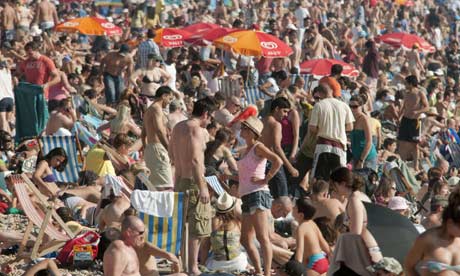
      Overpopulation: in a developed country near you. Photograph: Andrew Hasson/Rex Features

      Of all the fantasies indulged in by a society speeding toward self-destruction, none is as consequential as the idea that continuing growth – both in population and size of our economy – has a happy-ever-after ending. Yet, when overpopulation is discussed at all, it is discussed as a problem limited to the developing world. Indeed, a growing chorus of “pro-natalist” or population growth ideologues insists that, in the US and other parts of the developed world, population stability or decline represents a demographic crisis that needs to be reversed.

      In order to ignore the patently obvious fact that unlimited population growth is neither environmentally or socially sustainable, one would have to be prepared to explain how a resource-gobbling US of 500 million or 700 million people would work. (If you’re not prepared to do so, you’ve already accepted the reality that some limits exist and that the only question is what those limits should be.)

      If, though, you really believe that predictions of overpopulation-induced catastrophe have been overblown, there are still two critical questions to be addressed, both of which are currently verboten as a matter of public debate.

      First, even if ever-increasing population were survivable, is it really desirable? Second, are we really so inflexible that we can’t figure out any adaptations – beyond permanent crowding and permanent austerity for most citizens, that is – to enable a society that is becoming older to be economically and socially robust?

      In fact, more isn’t better, and there are both market-driven and state-driven alternatives to be pursued.

      Smaller has its advantages

      In a well-reported and chilling article on Nigeria’s population explosion last month, Elisabeth Rosenthal quoted a Nigerian demographer:

      “If you don’t take care of population, schools can’t cope, hospitals can’t cope, there’s not enough housing – there’s nothing you can do to have economic development.”

      US society doesn’t face imminent collapse, but aren’t many similar considerations at play? Despite the glut of unsold homes, we are still under-housed, and competition for housing in the most desirable housing markets has made life increasingly unaffordable. Demands on infrastructure – transportation, water, schools – have already reached or passed a breaking point in some parts of the US (just ask any suburban school district whether it is sanguine about the prospect of increased enrolment).

      As anyone who is old enough to recall the 1960s or 1970s can attest, there just aren’t spots available as there used to be. Spots in schools that used to be merely competitive are now virtually impossible to get into. Likewise, spots in secure, well-paying jobs are no longer available except to an increasingly small minority.

      The population of the US – currently estimated at 313 million – was 179 million in 1960, and 203 million in 1970. Does anyone think those were periods when the country was “too small” or economically weak?

      Adapting to the demographic shift

      Most of the secular hysteria that is generated against consideration of the advantages of stable or falling populations concerns the phenomenon of ageing populations. As people live longer, a greater percentage of the population is older, and there are, relatively speaking, fewer young “productive workers” to support everyone else.

      Just last month, the cries of alarm have included one op-ed piece asserting that “population decline poses a danger to the developed world”, and another describing Japan’s declining population as creating “grim consequences for an already-stagnant economy and an already-strained safety net”.

      Japan, by the way, is the poster child for those who want to sell the idea that only a growing country can be prosperous. Conveniently left out of the picture is Germany, whose economy is currently the envy of Europe, and whose demographics, my colleague Michelle Mayer has confirmed with the Federal Statistical Office of Germany, include: a fertility rate of 1.4 children per mother, one of the lowest in the world; a death rate that, since the 1970s, has continuously exceeded the birth rate; and a population projected to shrink to 65 or 70 million from the current 82 million.

      If one steps back from the panic, what comes most clearly into focus is the fact that the pro-natalists’ assumptions proceed from the basic premise that all economies and all societies always need to be organized in the same way. Once one begins to imagine alternatives, a future where fewer people are forced to engage in fierce, dog-eat-dog competition becomes very desirable indeed.

      The pro-natalist concern, in truth, is not that there won’t be sufficient young people to do the work, or that “there are just some jobs that Americans won’t do.” Rather, it is that with labor in greater demand, the work won’t be able to be had cheaply.

      There is nothing “natural” about someone in a parasitic profession (like much of investment banking) earning a lot of money and someone doing necessary but menial work (like garbage collection) earning much less. Where a society is really forced to “incentivize” the latter, the market will dictate a lower-than-current value for the derivatives trader and a higher-than-current value for the sanitation worker. That revaluation may make some people uneasy, but their complaint isn’t really that such a change is unworkable; it is that they find the prospect of different people than usual having to adapt outrageous.

      The nature of work, too, would likely be reorganized. Once, six-day work weeks were routine, as were 10- to 12-hour work days. Pressure from labor caused the developed world to adapt. If, by the middle or latter part of this century, workers who perform hard manual labor can only be secured by offering shorter-than-eight-hour days, we’ll have to adapt again.

      Jobs designed in lockstep with a time when households most typically had one, full-time (male) wage-earner might have to become more flexible (something that is already overdue) to facilitate the part-time participation of older workers in the labor market. And this not as an act of desperation but rather in a way that, consistent with any age-based constraints, facilitates participation in productive activity.

      And, yes, it would cost more as a society to support those who are not working. (News bulletin: it will cost more in any scenario, even if we insist on punishing more older people with decades of life spent at not much better than subsistence level.) The question will be the old one, and one that should be easy to answer for a society that, unlike most others, remains remarkably wealthy: is maintaining massive inequality of wealth on an individual level more important than trying to maximize the quality of life for most citizens?

      Better now than later

      For a long time, India, whose population now exceeds 1.2 billion people, did not act. Its population is estimated to grow to somewhere between 1.5 billion and 1.9 billion people in coming decades. As an article on more recent Indian attempts to control its birthrate pointed out, “Indian leaders recognize that [those massive growth scenarios] must be avoided.” The article quoted a demographer who said, “it’s already late … It’s definitely high time for India to act.”

      The US has the opportunity to be a lot more prescient, but we will have no chance to be so unless we begin to discuss all of the consequences of being a country that continues to grow, and allow ourselves to imagine the potential benefits of alternative futures.

      • This article was originally published by Remapping Debate and is crossposted by permission of the editor