Category: Population

  • Kelvin Thomson on ABC24 Capital Hill

    Kelvin Thomson on ABC24 Capital Hill

    Inbox
    x

    Hamilton, Tim (K. Thomson, MP) Tim.Hamilton@aph.gov.au
    8:58 AM (7 hours ago)

    to Anthony

    Tim Hamilton
    Electorate Officer
    Office of Kelvin Thomson MP
    Member for Wills
    (P) 9350 5777
    (M) 0424 138 558

    YouTube – Videos from this email
    Reply
    Reply to all
    Forward
    Click here to Reply, Reply to all, or Forward
  • Sydney drags the chain on growth

    Sydney drags the chain on growth

    Matt Wade

    March 31, 2012

    Slumping ... it has been a decade of slow population growth in Sydney.

    Slumping … it has been a decade of slow population growth in Sydney.

    POPULATION growth in NSW has slumped to a five-year low, robbing the economy of momentum. The population rose by 1.1 per cent to 7.3 million last financial year but that rate of increase was below the national average and well down on the previous year.

    Neighbourhoods along the Parramatta River in inner- and central-western Sydney had the fastest growing populations. But Melbourne continued to close the population gap on Sydney, thanks to the state’s sluggish growth overall.

    Sydney’s population rose by almost 60,000 in the year to June, more than 15,000 less than 2009-10. Despite its smaller population, Melbourne added 7100 more people than Sydney in 2010-11. Melbourne’s population is now within 500,000 of Sydney’s and possible changes to the way the Bureau of Statistics calculates regional populations could close the gap even further. But the rate of population growth in Australia’s two biggest cities lagged well behind Perth, which grew at nearly twice Sydney’s rate.

    High property prices, restrictive planning laws and lethargic economic growth have been blamed for a decade of relatively slow population growth in Sydney. A significant slowdown in the rate of overseas migration since 2008 is also a factor.

    CommSec’s chief economist, Craig James, said population growth was a key driver of growth. ”Population is power,” he said. ”This is something that the NSW government is going to have to have a look at. If you don’t have people coming into the state you are not going to get the revenue growth you need.”

    The NSW Treasurer, Mike Baird, blamed years of feeble population growth on Labor’s economic mismanagement. ”The government sees the importance of population growth for the state economy, which is part of the reason for the initiative on skilled migrants which we have announced,” he said.

    Mr Baird said there had been encouraging growth momentum recently regardless of the sluggish population growth.

    Canada Bay on the Parramatta River was the fastest-growing council area in NSW, followed by Camden, Parramatta and Auburn.

    An economist at the Housing Industry Association, Harley Dale, attributed Canada Bay’s growth to the high number of medium-density flats built in recent years, coupled with its fairly easy access to the city, which had made it attractive to property buyers.

    Many of the housing developments in Canada Bay have been built on old industrial sites and the bureau said this type of “infill development” was becoming more common in big cities. But Canada Bay ranked only the 23rd fastest growing council area in Australia. The top rate – 7.8 per cent – was recorded in Wyndham, an outer Melbourne suburb. Several neighbourhoods in Perth and mineral-rich regions of Western Australia also had rapid population growth.

    Six of the 10 most densely populated neighbourhoods were in Sydney. The highest density – 8900 people per square kilometre – was in the inner-city suburbs of Surry Hills, Darlinghurst and Potts Point. The statistical division taking in Bondi and Bronte also had population densities among the highest in the country.

    The bureau said Sydney makes up 63 per cent of the NSW population. The centre of population in the Sydney statistical district was Ermington.

    Outside Sydney, parts of the Hunter and Orange experienced the fastest growth rates.

    Read more: http://www.smh.com.au/national/sydney-drags-the-chain-on-growth-20120330-1w3lr.html#ixzz1qdi4Ex9M

  • David Attenborough urges business to protect nature from population boom

    David Attenborough urges business to protect nature from population boom

    Corporations have a leading role to play to make sure ‘mankind doesn’t spread willy nilly over every square yard of the globe’, says naturalist

    • guardian.co.uk, Wednesday 18 January 2012 12.16 GMT
    • Article history
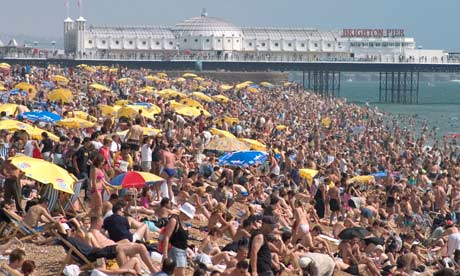
    • Crowded beach by the East Pier in Brighton

      A crowded beach in Brighton … the earth’s population is expected to reach 9 billion by 2050. Photograph: Paul Carstairs/Alamy

      Sir David Attenborough has called on big businesses to protect the natural world from the rapidly expanding human population.

      The broadcaster and naturalist said the population increase is unstoppable and that action must be taken to stop the natural world from being concreted over.

      Distancing himself from conservationists who regard big businesses as the enemy, he said companies and corporations, as the holders of much of the world’s wealth, have a vital and leading role to play.

      “It’s not a mystery. Wealth empowers,” he said. “And businesses have by no means been slow in helping. We’ve [conservationists] gone to multinationals over and over again.”

      He said there were exceptions, but that for the most part businesses that defiled the natural world in the 19th and to an extent the 20th century, such as by dumping waste in the sea, usually did so out of ignorance. “They didn’t know any better,” he said.

      But he warned: “We’ve got to such a situation and dense population that we can no longer make these mistakes. The warning is clear and the job of people in the media like me is to make sure the warning is understood.”

      The human population is calculated to have reached 7 billion last year, a decade after it reached 6 billion, and is forecast to continue to grow throughout the 21st century. By 2050, it is expected to have passed 9 billion.

      Rising population puts additional pressure on resources, especially food production, and the increased demand has contributed to higher prices.

      Attenborough, speaking at an event in London hosted by law firm Charles Russell for the World Land Trust, a charity for which he is patron, said the UK has already used up all its land and must make effective use of what it has got, such as by redeveloping brownfield sites.

      In other parts of the world, however, he believes there are large tracts of the natural world that can still be protected from development, such as tropical forests, mangrove swamps, bogs and high mountains.

      He said: “Without the natural world, mankind is doomed. We are dependent on the natural world for the very air we breathe and every particle of food we eat. Many people, including me, would say we are dependent on it for our very sanity.

      “We can accommodate that by looking after the natural world and making sure mankind doesn’t spread willy nilly over every square yard of the globe.”

      To save many of these areas from development that would destroy the natural ecosystem and wipe out many species of animals and plants, he called on businesses to help buy the land.

      To avoid criticisms of “neo-colonialism”, he called on them to hand the land over to local organisations that will protect it while providing jobs for people living in the area.

      Attenborough told an audience of lawyers, city investors and business people: “Since I became involved in conservation the population of the world has tripled. Nothing we can do will stop that increase. We may be able to slow it, but stop it in our lifetimes we cannot.”

      He added that in the past the attitude has been simply to move on when a resource is used up: “We’ve been grossly extravagant. We’ve been brought up in the time when if one bit of land is ruined we get another.

      “I think it’s about time we dealt with this in a sensible way and we don’t waste land.”

      • Get the Guardian’s environment news on your iPhone with our new app. You can also join us on Twitter, Facebook and Google+

  • Human cost of inaction incalculable

    Human cost of inaction incalculable

    March 21, 2012

    Opinion

    Video settings

    Please Log in to update your video settings

    Video feedback

    Use this form to:

    • Ask for technichal assistance in playing the multimedia available on this site, or
    • Provide feedback to the multimedia producers.
    Video feedback form

    Gittins: The paradox of growth

    Sidelining environmental concerns in our pursuit of economic growth will one day leave us far less well off. Ross Gittins


    Do you ever wonder how the environment – the global ecosystem – will cope with the continuing growth in the world population plus the rapid economic development of China, India and various other ”emerging economies”? I do. And it’s not a comforting thought.

    But now that reputable and highly orthodox outfit the Organisation for Economic Co-operation and Development has attempted to think it through systematically. In its report Environmental Outlook to 2050, it projects existing socio-economic trends for 40 years, assuming no new policies to counter environmental problems.

    It’s not possible to know what the future holds, of course, and such modelling – economic or scientific – is a highly imperfect way of making predictions. Even so, some idea is better than no idea. It’s possible the organisation’s projections are unduly pessimistic, but it’s just as likely they understate the problem because they don’t adequately capture the way various problems could interact and compound.

    <i>Illustration: Kerrie Leishman</i>” /></p>
<p><em>Illustration: Kerrie Leishman</em></p>
</div>
<p>Then there’s the problem of ”tipping points”. We know natural systems have  tipping points, beyond which damaging change becomes irreversible. There are  likely to be tipping points in climate change, species loss, groundwater  depletion and land degradation.</p>
<p>”However, these thresholds are in many cases not yet fully understood, nor  are the environmental, social and economic consequences of crossing them,” the  report admits. In which case, they’re not allowed for in the projections.</p>
<p>Over the past four decades, human endeavour has unleashed unprecedented  economic growth in the pursuit of higher living standards. While the world’s  population has increased by more than 3 billion people since 1970, the size of  the world economy has more than tripled.</p>
<p>Although this growth has pulled millions out of poverty, it has been unevenly  distributed and has incurred significant cost to the environment. Natural assets  continue to be depleted, with the services those assets deliver already  compromised by environmental pollution.</p>
<p>The United Nations is projecting further population growth of 2 billion by  2050. Cities are likely to absorb this growth. By 2050, nearly 70 per cent of  the world population is projected to be living in urban areas.</p>
<p>”This will magnify challenges such as air pollution, transport congestion,  and the management of waste and water in slums, with serious consequences for  human health,” it says.</p>
<p>The report asks whether the planet’s resource base could support  ever-increasing demands for energy, food, water and other natural resources, and  at the same time absorb our waste streams. Or will the growth process undermine  itself?</p>
<p>With all the understatement of a government report we’re told that providing  for all these extra people and improving the living standards of all will  ”challenge our ability to manage and restore those natural assets on which all  life depends”.</p>
<p>”Failure to do so will have serious consequences, especially for the poor,  and ultimately undermine the growth and human development of future  generations.” Oh. That all?</p>
<p>Without policy action, the world economy in 2050 is projected to be four  times bigger than it is today, using about 80 per cent more energy. At the  global level the energy mix would be little different from what it is today,  with fossil fuels accounting for about 85 per cent, renewables 10 per cent and  nuclear 5 per cent.</p>
<p>The emerging economies of Brazil, Russia, India, Indonesia, China and South  Africa (the BRIICS) would become major users of fossil fuels. To feed a growing  population with changing dietary preferences, agricultural land is projected to  expand, leading to a substantial increase in competition for land.</p>
<p>Global emissions of greenhouse gases are projected to increase by half, with  most of that coming from energy use. The atmospheric concentration of greenhouse  gases could reach almost 685 parts per million, with the global average  temperature increasing by 3 to 6 degrees by the end of the century.</p>
<p>”A temperature increase of more than 2 degrees would alter precipitation  patterns, increase glacier and permafrost melt, drive sea-level rise, worsen the  intensity and frequency of extreme weather events such as heat waves, floods and  hurricanes, and become the greatest driver of biodiversity loss,” the report  says.</p>
<p>Loss of biodiversity would continue, especially in Asia, Europe and southern  Africa. Native forests would shrink in area by 13 per cent. Commercial forestry  would reduce diversity, as would the growing of crops for fuel.</p>
<p>More than 40 per cent of the world’s population would be living in  water-stressed areas. Environmental flows would be contested, putting ecosystems  at risk, and groundwater depletion may become the greatest threat to agriculture  and urban water supplies. About 1.4 billion people are projected to still be  without basic sanitation.</p>
<p>Urban air pollution would become the top environmental cause of premature  death. With growing transport and industrial air emissions, the number of  premature deaths linked to airborne particulate matter would more than double to  3.6 million a year, mainly in China and India.</p>
<p>With no policy change, continued degradation and erosion of natural  environmental capital could be expected, ”with the risk of irreversible changes  that could endanger two centuries of rising living standards”. For openers, the  cost of inaction on climate change could lead to a permanent loss of more than  14 per cent in average world consumption per person.</p>
<p>The purpose of reports like this is to motivate rather than depress, of  course. The report’s implicit assumption is there are policies we could pursue  that made population growth and rising material living standards compatible with  environmental sustainability.</p>
<p>I hae me doots about that. We’re not yet at the point where the sources of  official orthodoxy are ready to concede there are limits to economic growth. But  this report comes mighty close.</p>
<p><strong> Ross Gittins is the economics editor.</strong></p>
</div>
</div>
<p>Read more: <a href=http://www.smh.com.au/opinion/politics/human-cost-of-inaction-incalculable-20120320-1vhrv.html#ixzz1ph6zBmQl

  • Big Sydney bid to boost number of migrants

    The big question here is how will we house these migrants in a city that is already bursting at the seams.


    Big Sydney: bid to boost number of migrants

    Anna Patty

    March 21, 2012

    In demand ... skilled migrants.

    In demand … skilled migrants. Photo: Louie Douvis

    THE former premier Bob Carr once declared Sydney was full, but now the O’Farrell government wants to swing the door wide open to skilled business migrants and international students.

    The government hopes to attract thousands of ”high-value” migrants and students to NSW as part of a strategy – to be launched today – to boost economic development.

    The Deputy Premier and Minister for Trade and Investment, Andrew Stoner, said the government would simplify its sponsorship requirements for investors using 165 visas – for business people from overseas who are required to invest $750,000 to $1.5 million in Australia.

    Calling for skilled business migrants and international students ... NSW Premier Barry O'Farrell.

    Calling for skilled business migrants and international students … NSW Premier Barry O’Farrell. Photo: Michel O’Sullivan

    It would discuss with the Commonwealth the introduction of a new visa to make investing in NSW more attractive.

    And it would ask the Commonwealth to reduce temporary residency rules, which require people to live in Australia for a set period. It also wants to make it easier for business migrants to extend their residency from four to eight years.

    Under the strategy, the definition of investments would be extended to include Waratah Bonds and similar investments which the government hopes to use to help fund infrastructure in the state.

    Mr Stoner said NSW would work with Victoria and the federal government to streamline visa processing and extend post-study work rights to international students to help them access a broader range of ”high-quality, low-risk” education and training providers.

    Reducing red tape for international students to access quality training would provide an incentive for oversees students to study in Australia, the plan said.

    The NSW government will press the federal government for a greater share of state-government sponsored visas to raise its share from 11 per cent this year – 2640 people – to as high as 30 per cent.

    This would increase the annual intake of skilled migrants in NSW from 1750 in 2010-11 to 7200.

    Mr Stoner said he wanted to better align occupations with skills shortages identified by industry.

    “To boost economic activity in NSW, we would like the state’s allocation of state- and territory-sponsored skilled migrants increased to around 30 per cent, in line with our share of the economy and population,” Mr Stoner said.

    “Bob Carr said Sydney is full, but it’s a city that has always been a magnet for people. We want the best and brightest from around the world to help fill skills shortages and turn our economy around.

    ”Regardless of the views Bob Carr held when he was NSW premier, we are keen to work co-operatively with the federal government, particularly [the] Immigration Minister, Chris Bowen, to improve the current arrangements.”

    Mr Stoner said ”high-value” migration had a critical role in improving the state’s economy and migrants could provide skills needed in Sydney and regional NSW.

    ”NSW is already the preferred Australian destination for the majority of long-stay business migrants, skilled migrants and international students, but there’s more we must do to realise the full economic and cultural benefits,” he said.

    ”Investor migration is also an increasingly important area of focus for NSW but has only been used to attract relatively few migrants to the state in the past.

    ”Business migrants, in particular, bring with them experience, international connections, entrepreneurial skills and capital to establish new businesses.”

    The Premier, Barry O’Farrell, has long been an advocate for a ”big Australia” and has blamed poor planning by governments, not high immigration, for population pressures.

    Before his election Mr O’Farrell rejected Mr Carr’s declaration in 2000 that Sydney was full. He said immigration and population growth would boost economic growth and infrastructure development.

    A spokesman for Mr O’Farrell yesterday said he stood by those comments, made in February last year.

    The chief executive of the NSW Business Chamber, Stephen Cartwright, yesterday said he supported the government’s push for more skilled migrants to boost the economy.

    ”NSW needs to become more active in making clear that the state welcomes skilled migrants, investor migrants and visitors undertaking international education,” he said.

    Read more: http://www.smh.com.au/nsw/big-sydney-bid-to-boost-number-of-migrants-20120320-1vi1r.html#ixzz1ph49HtOl

  • Labor MP Kelvin Thomson: address on Population Growth

    From Labor MP Kelvin Thomson, Population
    Growth issue protagonist. He has campaigned
    solidly against population growth.

    ———- Forwarded message ———-
    From: Hamilton, Tim (K. Thomson, MP) <Tim.Hamilton@aph.gov.au>
    Date: Wed, Feb 22, 2012 at 4:20 PM
    Subject: Is Bigger Better?
    To: “Hamilton, Tim (K. Thomson, MP)” <Tim.Hamilton@aph.gov.au>

    Tim Hamilton
    Electorate Officer
    Office of Kelvin Thomson MP
    Member for Wills
    (P) 9350 5777
    (M) 0424 138 558