Category: Articles

  • Oil price daily news update

    Oil Price Daily News Update


    Blame to Spare on Tar Sands Debate

    Posted: 15 Feb 2012 01:47 PM PST

    Environmental groups in Maine have decided that tar sands oil from western Canada wasn’t their cup of tea even though the pipeline company behind the scenes said it really wasn’t there’s either, at least for now. As the Sierra Club was saying “no sir” to tar sands oil in Maine, one of the former GOP hopefuls, Rick Perry, was saying “yes sir” in The Wall Street Journal, describing the planned Keystone XL as an economic panacea not seen since the New Deal brought the U.S. economy out of the Great Depression in the 1930s. With tar sands pipelines…

    Read more…

    Shale Gas Revolution to Free Eastern Europe from Reliance Upon Russia?

    Posted: 15 Feb 2012 09:40 AM PST

    Major players including the United States, the EU, Russia, and China are vying for control and influence over scarce energy resources that will only become more valuable and in demand going forward. These powers will play a critical role in the global energy sector that will largely shape the political and economic context of this century. Holding the largest reserves of natural gas in the world, it appears Russia will continue to be the dominant energy supplier to much of Europe in the foreseeable future. Quite simply, the massive Soviet-era Druzhba…

    Read more…

    Lack of Power Lines Prevents New Offshore Wind Farms in Germany

    Posted: 15 Feb 2012 08:53 AM PST

    The German government plans to increase the share of its energy produced from renewable sources from the current level of 20 percent to 35 percent by 2020. A large portion of this increase will be delivered by offshore wind farms. However there is a problem. E.on, the German energy giant warned that progress to install power lines connecting offshore wind farms to the mainland power grid is far too slow and will result in delaying the countries green energy ambitions. E.on has been waiting 15 months for power lines to be constructed that will connect…

    Read more…

    Dominican Republic Turns to Gazprom for Help on Energy Strategy

    Posted: 15 Feb 2012 08:51 AM PST

    Last week the Russian energy giant, Gazprom, sent a delegation to the Dominican Republic following an invitation to perform geological surveys and help in the development of electrical power projects. A group of deputies from the republic’s National Congress, including the chairman of the parliamentary energy commission, Pelegrin Seman, stated that their nation’s reliance upon foreign fuels is too high. They are forming legislation to help develop oil and gas reserves on the Haitian Shelf, to construct renewable energy projects, and…

    Read more…

    South Africa Caught in Fallout from Increased Sanctions Against Iran

    Posted: 14 Feb 2012 04:01 PM PST

    The U.S. new sanctions initiative, strongly supported by Israel, to impose new sanctions against Iran, is designed to punish it for its purported covert nuclear weapons program by imposing new restrictions on Tehran. As a result, many of Iran’s oil customers are scrambling to avoid collateral damage to their economies. The sanctions’ potential fallout is now hitting South Africa, Africa’s biggest economy, which receives nearly 25 percent of its needs from Iran, roughly 98,000 barrels per day (bpd), or about 4 percent of Iran’s…

    Read more…

    With Friends Like Moscow, Who Needs Venezuela’s Oil?

    Posted: 14 Feb 2012 03:58 PM PST

    Venezuela said it was ready to welcome a Russian energy company into the giant Orinoco oil belt, solidifying a relationship propped up by a multi-million investment from Moscow last year. Both sides announced recently they’d starting working through a Caracas-controlled joint venture in a 21,000-square-mile section of the vast oil reserve. When the Iranian president paid a visit to the region, House Republicans cried foul over the “tour of tyrants” though Russia’s relationship with Caracas barely makes headlines. While Moscow is certainly no Tehran,…

    Read more…

    Fracking and Water: A New Way To Profit from the Industry’s Biggest Problem

    Posted: 14 Feb 2012 03:55 PM PST

    While oil and water don’t mix, for the fracking industry… the two go hand-in-hand. You see, while WATER is one of the oil industry’s biggest threats – it’s also one of investors’ biggest opportunities. Consider this:  Each horizontal well in North America that uses hydraulic fracturing, or fracking, uses 2-6 MILLION gallons of sweet fresh water. And the entire North American industry will use an estimated 72 BILLION gallons in 2012. The cost involved in handling that water could be in the billions of dollars within…

    Read more…

    Why We Shouldn’t be Worrying About Peak Oil

    Posted: 14 Feb 2012 03:50 PM PST

    Everything you think you know about energy security and energy independence is wrong. All too often you hear that fossil fuels will soon reach their peak, that our consumption of oil causes global insecurity vis-a-vis rogue states and terrorist organizations, and that the United States would benefit tremendously from becoming completely energy independent. Under closer scrutiny, however, the alarmist scenarios, political correctness, and chic notions of sustainability that dominate today’s energy discourse simply do not stand up to actual…

    Read more…

    Regenerative Agriculture: Feeding the Future

    Posted: 14 Feb 2012 03:46 PM PST

    It is an illusion to think we can continue to use as much energy as we do now. No one can entirely rule-out that some extravagant technology will be forthcoming, e.g. solar power or nuclear fusion on the full-scale of 500 EJ/year as we get through now, but the particular issue of matching liquid fuels derived currently almost entirely from petroleum appears insurmountable. The “solution” is probably the collective of individual solutions, and that means adopting a completely different paradigm of human philosophy and intention. The most pressing…

    Read more…

    Searching for a Cost Effective Way to Deal with Air Pollution

    Posted: 14 Feb 2012 03:40 PM PST

    It costs $50 million per gigawatt to put 99% effective particulate air pollution control onto coal plants. China has about 650 GWe of coal power installed in 2011. It would probably be cheaper for China to do the particulate retrofits (say $30 million per GWe). Therefore $20 billion would enable a 99.5% reduction in particulates. The United States has 315 GWe of coal power installed in 2011. It would cost about $16 billion for electrostatic precipitators on all coal plants in the United States. There needs to be combination of mitigation devices…

    Read more…

    You are subscribed to email updates from OilPrice.com Daily News Update
    To stop receiving these emails, you may unsubscribe now.
    Email delivery powered by Google
    Google Inc., 20 West Kinzie, Chicago IL USA 60610
  • Council wants to retain control of windfarm proposal

    Windfarms are essential to the renewables sector.

    Council wants to retain control of windfarm proposal

    Updated February 16, 2012 08:11:09

    Loading…

    Map DataMap data ©2012 GBRMPA, Google, Whereis(R), Sensis Pty LtdTerms of Use
    Map Data
    Map data ©2012 GBRMPA, Google, Whereis(R), Sensis Pty Ltd
    Map data ©2012 GBRMPA, Google, Whereis(R), Sensis Pty Ltd
    Map
    Map
    Satellite

    Map: Bendigo 3550

    The Moyne Council in south-western Victoria, is embroiled in a debate with a neighbouring council over a windfarm proposal.

    The Southern Grampians Council has asked Planning Minister Matthew Guy to call in the application for a 223-turbine windfarm at Penshurst, north of Port Fairy.

    The windfarm straddles the two municipalities.

    Moyne Mayor Jim Doukas says his council wants to maintain planning control over the proposal.

    He says it would be one of the largest windfarms in the state and local government should have a major say.

    “If the minister decides to become the responsible (authority) and we don’t know whether he will or won’t because we haven’t made a decision yet, that takes a lot of power out of the hands of local government,” he said.

    “They’re the ones that make all the assessments, they’re the ones who make the decision.”

    Topics:environment, environmental-impact, environmental-management, environmental-policy, mining-environmental-issues, bendigo-3550, penshurst-3289, port-fairy-3284, hamilton-3300

    First posted February 15, 2012 14:42:29

  • Oakeshott’s call for wood-powered electricity means more logging

    This clearly displays how out of touch with the environment Oakeshott is.

    Neville

    15 February 2012, 2.23pm AEST

    Oakeshott’s call for wood-powered electricity means more logging

    We are poised at a pivotal moment for native forests, the wood products industry and climate change. Australia is moving away from a damaging native forestry industry – and a damaging conflict over its future – to a plantation industry with broad-based support. Rob Oakeshott’s push this week to promote…

    Author

    Disclosure Statement

    Judith Ajani does not work for, consult to, own shares in or receive funding from any company or organisation that would benefit from this article, and has no relevant affiliations.

    Our goal is to ensure the content is not compromised in any way. We therefore ask all authors to disclose any potential conflicts of interest before publication.

    Icon-cc Licence to republish

    We license our articles under Creative Commons — attribution, no derivatives.
    Click here to get a copy of this article to republish.

    Ym83nk6h-1329262961 There are dark days ahead for Australian forests if renewable energy plan gets the nod. jwbenwell/Flickr We are poised at a pivotal moment for native forests, the wood products industry and climate change. Australia is moving away from a damaging native forestry industry – and a damaging conflict over its future – to a plantation industry with broad-based support. Rob Oakeshott’s push this week to promote burning native-forest wood for electricity production could kick off more logging, and more conflict.
    Rob Oakeshott and Tony Windsor, together with all other members of the Multi-Party Climate Change Committee, agreed in July 2011 to exclude native forest wood from being subsidised as a renewable energy resource. This decision put in place a crucial backstop to see the end of Australia’s forest wars. But now Oakeshott has changed his position.
    The Multi-Party Climate Change Committee, chaired by PM Gillard and including the Greens and Independents Tony Windsor and Rob Oakeshott, agreed to amend the Renewable Energy Target regulations. Native forest biomass would no longer be regarded as “renewable” when burnt to generate electricity.
    Forestry policy making has rarely been so thorough: the exclusion included products, by-products, and waste associated with or produced from, clearing or harvesting of native forests, subject to appropriate transitional arrangements for existing accredited power stations. The Committee’s decision was an environmentally sensible policy correction for a forestry industry that is exiting native forest wood resourcing.
    Oakeshott’s change of heart betrays a misunderstanding of Australia’s forest industry. AAP The removal meant that native forest electricity producers could still produce electricity but they would not receive Renewable Energy Certificates (RECs). The government created the RECs market to achieve its Renewable Energy Target: wholesale electricity retailers and some generators must source at least 20% of their electricity from renewable sources backed by RECs.
    For native-forest-based energy projects, the RECs could constitute up to 50% of the project’s income.
    Having signed the multi-party agreement in July, in late October 2011 Rob Oakeshott had second thoughts. With the exposure draft of the Renewable Energy Target regulations in hand and what appears to be some local business lobbying, Oakeshott asked “local residents to have their say on new rules which ban the use of native forest waste as an accredited RET energy source.”
    A month later, Oakeshott appears to have turned from seeking comments to becoming a native forestry lobbyist. He said that “[b]usinesses with potential investment projects using wood waste for biomass energy should use this time [before moving his disallowance motion] to make detailed representations to the federal government and MPs who represent electorates with viable commercial forestry contracts and processing mills.”
    Oakeshott’s hope from this lobbying was that “all MPs seek best policy”. From his statement, “best policy” refers to the local abattoir wanting to use some local sawmill offcuts for power. There is nothing in the regulations stopping the abattoir from using the offcuts for power. What the regulations aim to do is prevent the revenue from the RECs market opening a new and very large market for native forest wood around Australia.
    Hardwood chip exports – Australia’s opportunity to end the conflict Judith Ajani/ABARES statistics

    Click to enlarge

    This is not a local or peripheral issue. It is nationally important. On Friday 10 February, Oakeshott wrote to Members of Parliament explaining his move to disallow the regulations. He stated that with all aspects of the Agreement having been introduced, he has honoured the Multi-Party Climate Change Committee Agreement and is now free to vote against the agreement as expressed in a bill or regulation.
    Oakeshott’s letter conveys no understanding of the Australian forestry industry situation and outlook. He states that sawn timber and paper (including woodchip exports) drives native forest logging, with energy being a sensible use of “waste”.
    Missing from his account is Australia’s plantation competition: sawn timber stopped driving Australia’s native forest logging in the 1980s and woodchip exports are no longer driving native forest logging. And so evaporates the “waste”. Opening native forest wood to the energy market will turn the economically and environmentally desirable trend decline in native forest logging into increasing logging levels.
    Australia’s plantation industry is about to completely displace native forest wood from the major commodity markets of sawn timber, paper and woodchip exports. Today, between 85 and 90% of Australia’s production of sawn timber and wood panels is plantation based.
    As the native forest sector lost these markets to the softwood plantation competition, it became more dependent on export markets for woodchips. Now, Australia’s hardwood plantations are displacing, with ferocious speed, native forest chip exports (see figure above). In the very near future we can expect very little commodity-based logging of Australia’s native forests, as long as governments resist engineering new commercial opportunities for native forest wood.
    As members of the House of Representatives decide whether to support Oakeshott’s disallowance motion they should reflect on 40 years of conflict over native forest woodchipping. If native forests are opened to burning for “renewable energy”, Australia’s forest wars will rage for many more decades.

    Share

    Articles by This Author

    December 22, 2011 Is using native forests for energy really carbon-neutral?

    Tags

    Forests, Renewable energy, Biofuels

    Share

    Related articles


  • Obama revives green agenda with push to end oil industry tax breaks

    Cynical of me, but an election is coming up!!!!

    Obama revives green agenda with push to end oil industry tax breaks

    President plans to spend big on green cars and biofuels as Steven Chu says US wants to lead in clean energy technology

    Lake Michigan

    The Environmental Protection Agency said it was flatlining the plan to restore some bays of the Great Lakes. Photograph: Jeffrey Phelps/AP

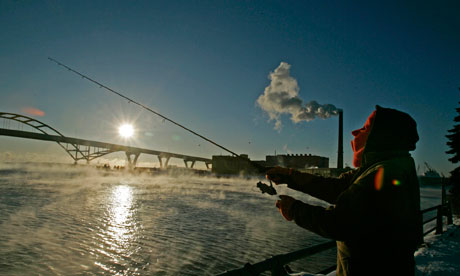
    Barack Obama knew a budget proposal to end $40bn in tax breaks for the oil and gas industry would get him into an election-year fight with Republicans over his energy agenda.

    It’s at least the fourth time the president has called for rolling back the subsidies.

    And, predictably, Republicans and the oil industry were spoiling for a fight. The main industry lobby, the American Petroleum Institute, attacked the proposal as “punitive and unfair”.

    Like Obama’s earlier proposals to cut subsidies to the fossil fuel industry, this one is highly unlikely to pass through Congress.

    What the revival of the proposal demonstrates, however, is that Obama, despite his earlier half-hearted support for action on climate change and other environmental measures, is willing to put up a fight now.

    He has just chosen to redefine the battle lines, using the budget to highlight clean energy while trimming support for environmental regulation.

    The energy budget proposes a 3.2% increase over the current year to $27.2bn in spending including a big bump in research funds, 21% or $2.3bn, for energy efficiency, advanced vehicles, and biofuels.

    In a conference call with reporters, the US energy secretary, Steven Chu, said the adminstration would be redirecting funds from some previous favourites such as electric car batteries – because the projects were now approaching commercial viability – to emerging areas such as offshore wind power.

    Some research funds were also being pulled from projects that did not work, Chu admitted. He said 35 projects “did not reach research milestones”. However, the overall strategy remained. “We want to lead in clean energy technology,” he said.

    The budget would also set aside $12m for research into risks associated with hydraulic fracturing, the controversial process used in the booming natural gas industry.

    However, there was no repeat of last year’s request of $36bn in loans for the nuclear industry – which Congress turned down.

    Even so, clean energy came out ahead. Not so for the Environmental Protection Agency, a favourite target of Republicans who argue environmental regulations are destroying jobs.

    The EPA sufered its third straight budget cut this year, down 1.2% on existing spending.

    The budget proposal barely mentions the agency’s work in reducing the greenhouse gas emissions that cause climate change.

    In her conference call with reporters, the head of the EPA, Lisa Jackson, admitted some of the administration’s most touted environmental projects – such as restoring some areas of the Great Lakes – had also been flatlined.

    “It was one of the most difficult choices we have had to make in this budget,” she said.

  • Bulgaria becomes second state to impose ban on shale gas-exploration

    Bulgaria becomes second state to impose ban on shale-gas exploration

    Government in Sofia makes a U-turn after nationwide protests

    • Guardian Weekly, Tuesday 14 February 2012 14.09 GMT
    • Article history
    • bulgaria lavender

      Thought worth protecting … workers harvest lavender flowers on a farm in Bulgaria. Photograph: NIKOLAY DOYCHINOV/AFP

      Shukri Hussein was only 23 when he first bought some land, with a friend, to start a farm at Praventsi, a village close to Novi Pazar, in north-east Bulgaria. Ten years later the biology graduate heads a 110-hectare organic farm with a workforce of 35.

      He was pleased with what he had achieved and had no intention of letting anyone spoil his dream. At the beginning of January he joined thousands of others to protest against plans to explore the huge shale-gas reserves in his region. Their efforts were crowned with success. In June last year the Bulgarian government had granted a permit to the US firm Chevron to prospect across 4,400 sq km around Novi Pazar.

      But in January parliament withdraw the permit issued to Chevron, and also decided to ban exploration of shale-gas reserves using the controversial hydraulic-fracturing (fracking) technique.

      MPs cited as a precedent a French ban enacted last July, as Bulgaria became only the second state to ban the procedure.

      The government had hoped that the new energy source would reduce the nation’s almost complete dependence on imported Russian gas, supplied by Gazprom. Bulgarian shale-gas reserves are estimated to amount to at least 300bn cubic metres, according to the economy and energy ministry.

      “To begin with everyone was really enthusiastic,” says Hussein. “We thought we’d get rich overnight. But when I realised the hazards this technology entails I was very concerned. I’ve worked hard for the past 10 years to build up the farm. If they start drilling for shale gas I’ll lose everything.”

      Bulgaria’s reserves are several thousands of metres deep. Injecting water, sand and chemicals under high pressure to fracture the bedrock and release the gas involves a serious risk of groundwater contamination.

      The risk is particularly serious in the Novi Pazar area, due to its particular geology. But looking further afield, fracking could affect the whole of the north-eastern Dobrudja region. “We were promised lots of jobs and other miracles,” says Vessko Dimov, a dental surgeon from Novi Pazar who launched the anti-fracking protest movement. “But when we woke up to the hazards involved we decided to oppose the project.”A petition collected 15,000 signatures in a month and, much to the protesters’ surprise, several councils in the area decided to oppose fracking.

      The campaign spread to Veliki Preslaz, a small town about 40km southeast of Novi Pazar. This historic stronghold is a tourist attraction and feared that trade might suffer.

      From 893 to 972 the town was the Bulgarian empire’s second capital and the ruins of the old citadel are testimony to its past splendour. “The travel trade is vital for our town,” says the leader of the local council Aleksandar Gorchev, elected three months ago. “Shale-gas exploitation is a real danger for us. Everyone would be OK if this technology did not pose any problems, but that’s not the case.”

      In mid-January the anti-fracking demonstrations spread to the capital Sofia and a dozen other towns across Bulgaria. “I have to admit that at first, I didn’t believe we could do it,” says Hussein. “It’s a big victory for us. In Dubai, they spend a fortune to make the desert inhabitable, whereas here in Europe we have everything we need. We don’t want to turn it into a desert.”

      This article originally appeared in Le Monde.

  • Nuclear Issues.

    News 10 new results for DANGER TO US NUCLEAR PLANTS
    Feds Approve Unsafe New Nuclear Reactors Requiring Billions of Taxpayer Dollars
    eNews Park Forest
    Friends of the Earth stated today that the decision to give the green light to building two nuclear reactors at Vogtle, Georgia raises fundamental safety and economic concerns. The NRC ruling, the first such approval in the US in more than 30 years,
    See all stories on this topic »
    Critic: Proposed MidAmerican nuclear plant is “socialism”
    DesMoinesRegister.com
    A steady critic of MidAmerican Energy’s proposed nuclear plant in Iowa said legislation backing the project amounts to “socialism” and would cost average ratepayer more than $800 a year. Iowa lawmakers are considering a bill, House File 561,
    See all stories on this topic »
    Michigan Nuclear Plant Downgraded Over Safety
    Wall Street Journal
    AP The Nuclear Regulatory Commission assigns the more than 100 nuclear reactors in the US to one of five categories based on their safety performance. Most are in the top-performing group. Palisades was bumped to the No. 2 category last month and now
    See all stories on this topic »
    Hokkaido Electric seeks dismissal of demand for decommissioning of Tomari reactors
    Mainichi Daily News
    1 Nuclear Power Plant — Hokkaido Electric said, “It is impossible to seek absolute safety in the use of advanced science and technology.” According to the plaintiffs, there has been no case in past lawsuits on nuclear power plants of an electric power
    See all stories on this topic »

    Mainichi Daily News
    Scientists warn of seismic fault in Fukushima
    ABC Online
    By North Asia correspondent Mark Willacy Scientists are urging the operators of the Fukushima nuclear plant to improve safety measures, warning that a dangerous seismic fault has been re-activated near the site. In the seven months after last year’s
    See all stories on this topic »
    Spot Uranium Grinds To A Halt
    Ninemsn
    For the first time since 1978, when the Three Mile Island reactor accident brought the nuclear danger to the point of reality and prompted Jane Fonda and Jack Lemmon to film The China Syndrome, the US Nuclear Regulatory Commission has approved the
    See all stories on this topic »
    Closing No. 2 N-plant would add to woes
    The Daily Yomiuri
    With the additional assistance from the state-backed Nuclear Damage Liabilities Facilitation Fund, TEPCO can be free, for now at least, from the danger of reaching negative net worth, or liabilities exceeding assets. Uncertainties, however
    See all stories on this topic »
    Tubes shut down at San Onofre nuclear plant
    San Francisco Chronicle
    The San Onofre nuclear power plant in Southern California is shutting down some of the tubes in a reactor because of premature wear. Southern California Edison spokesman Gil Alexander announced Monday that an undisclosed number of tubes will be taken
    See all stories on this topic »
    Activists target Asheville power plant
    Asheville Citizen-Times
    The law requires no formal security requirements at coal-fired power plants, said James McLawhorn, head of the electricity division of the NC Utilities Commission. Nuclear power plants are required to have tight security because of the threat radiation
    See all stories on this topic »
    US naval battle group crosses Strait of Hormuz
    CBS News
    The US and allies fear Iran’s uranium enrichment program could eventually lead to the production of weapons-grade nuclear material. Iran claims it only seeks reactors for energy and medical research. “I wouldn’t characterize … us going through the
    See all stories on this topic »


    Tip: Use a minus sign (-) in front of terms in your query that you want to exclude. Learn more.

    Delete this alert.
    Create another alert.
    Manage your alerts.