Category: Articles

  • Greenpeace calls for a ban on Arctic oil drilling

    Greenpeace calls for a ban on Arctic oil drilling

    Ecologist

    25th January, 2010

    Immediate moratorium on all activity by oil and gas industries would help safeguard the local community and ecosystem as well as reduce potential carbon emissions

    Plans by the EU, US and China to exploit oil and gas reserves in the Arctic have been criticised by Greenpeace as ‘unsustainable’ and a threat to the region’s ecosystem.

    Countries have rushed to lay claim to areas of the Arctic Ocean during the past few years, following predictions such as those made by the US Geological Survey that as much as 22 per cent of the world’s undiscovered fossil fuel resources could lie there.

    Boom and bust

    Speaking at the annual Arctic Frontiers conference, Greenpeace’s Nordic Executive Director, Mads Flarup Christensen, said oil and gas drilling would bring ecological boom-and-bust to the Arctic.

    ‘In the shorter term there is economic development and jobs, but they do not come with a guarantee that the ecosystem won’t be affected and in turn, negatively affect communities.’

    He called for an immediate ban on industrial oil and gas exploration to protect ecosystems and the communities that depend on them for their survival.

    ‘We see the moratorium as an immediate measure to address the current governance gap in the Arctic Ocean, and something that will remain in place until a more permanent, overarching treaty or agreement is established to protect this part of the Arctic Ocean from additional damage,’ said Christensen.

    No whaling or sealing ban

    Christensen added that Greenpeace was not seeking a ban on traditional or subsistence activities like whaling, sealing or fishing but only industrial activities.

    ‘It’s the oil and gas activities, industrial fishing, shipping, mining and other industrial activities that pose threats to the ecosystem. If such industrial activities are allowed without a proper governance system for the Arctic Ocean as a whole, and even before the environmental values hidden under the sea ice have been mapped or understood, it will be another tragic example of our human inability to respect the precautionary principle.’

    Christensen also criticised claims that the oil and gas extraction could be sustainable and said it was not possible because of the, ‘routine spills, leaks, emissions to air and waster, vessel and air traffic, industrial noise and all manner of disturbance that takes place during the exploration, extraction and transportation of oil and gas’.

    Shell opposition

    Meanwhile, an alliance of conservation and Alaskan indigenous groups have issued a legal challenge in the US in an attempt to block drilling plans by the oil giant Shell.

    The alliance accuses the minerals management service (MMS), part of the federal Department of the Interior, of waving through permission to allow Shell to invest £1.3 billion in Alaskan exploration, disregarding the environmental dangers.

    The executive director of Pacific Environment, one of the plaintiff organisations, David Gordon, said:
    ‘Shell’s plan for the Arctic is too much, too soon, too fast, especially in light of community concerns and the effects of climate change that we are already seeing in the Arctic.’

    Useful links

    Arctic Frontiers conference
  • Car makers ‘failing consumers’ on emission data


    The online survey involving members of the public found that only half (52% of attempts by consumers to find CO2 figures for specific UK cars were successful. Less than 5% of the 363 people who took part came across the widely recognised A-G energy efficiency label while attempting to look up emissions data.

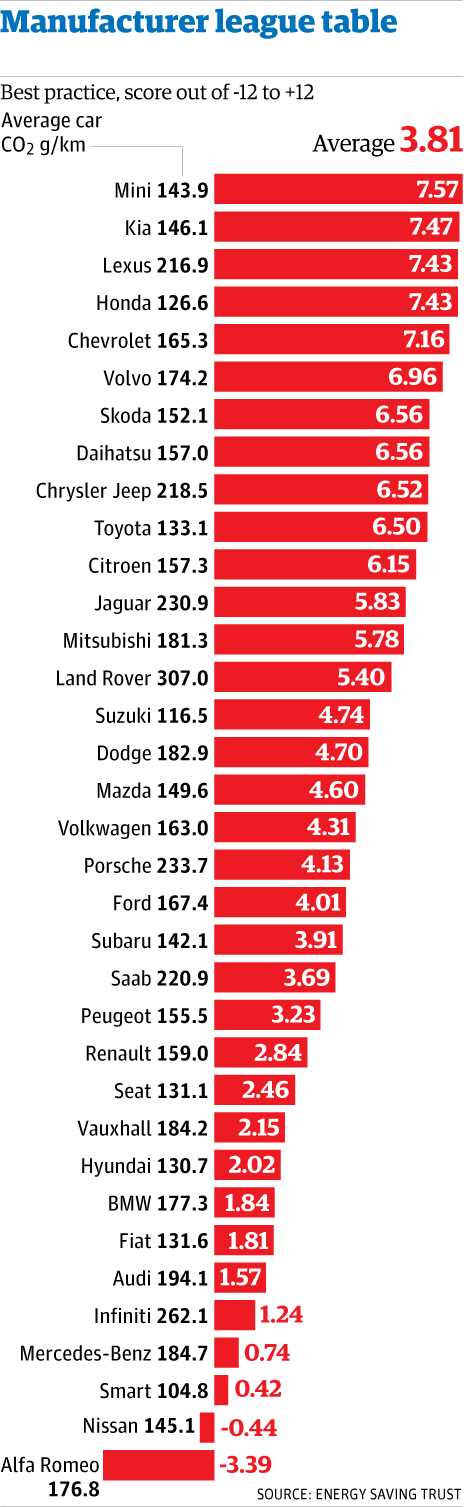
    Mini, Kia, Lexus and Honda were lauded for the ease of use and accessibility of finding CO2 data on their sites, while the worst – ranked by user experience criteria – were Alfa Romeo, Nissan, Smart, and Mercedes-Benz.

    The consultancy Ecolane, which carried out the survey, rated the websites on five “design principles” including site navigation; providing CO2 data alongside core data such as performance; how clearly individual models and different “trims” are described; whether comparative emissions information was provided (such as the A-G label); and whether the sites relied on large downloads of PDF files. The report also evaluated how long it took survey respondents to find the data.

    car league table

    The average time taken to find CO2 figures for cars ranged from 74 seconds for Lexus to nearly eight minutes for Alfa Romeo, whose site came bottom of the overall usability table. Other sites coming in for criticism included the low ranking Smart site – “very slow and difficult to find correct model. CO2 not given high importance compared to other car features such as equipment and style” and the Seat site which received the ultimate condemnation “about as easy as dealing with the civil service”. At the opposite end of the spectrum was Peugeot. One tester said: “Very easy to find the emissions data, all sites should be like this.”

    Car makers must display a car’s fuel consumption and CO2 data in their showrooms but are not legally required to do so on their sites. Marian Spain, the director of strategy at the Energy Saving Trust, said: “Nowadays most people do initial online research when looking into buying a new car. Our research shows that in many cases, finding out the running costs of cars and their impact on the environment from the car manufacturer website is like looking for a needle in a haystack.”

    Blake Ludwig, managing director for the We Are Futureproof group, said: “More and more people want to choose greener, more efficient cars, but our study shows that some car makers expect them to spend time hunting around confusing websites for information. Other car markers have got it right, putting the data upfront and easy to find, and we think all companies should have to follow this model.”

    A spokesperson for the Society of Motor Industry Manufacturers and Traders said: “Vehicle manufacturers are highly aware of the important role driver information can play in reducing road transport emissions and the significant influence this data has on a person’s purchasing decision.”

    A Department for Transport spokesperson said the government recognised that people wanted “clear information on the environmental credentials of new cars” and pointed to the requirements to show figures for new cars in showrooms and government’s voluntary scheme for used cars. But they said the government was not looking to mandate car makers to improve CO2 data on their own websites.

    Consumers can also find CO2 figures elsewhere online, such as on the government’s Act On CO2 site and the VCA website.

  • Opposition seeks migration rethink

    Opposition seeks migration rethink

    STEPHANIE PEATLING

    January 24, 2010


    AUSTRALIA should consider whether immigration levels can continue to remain at existing levels as part of a comprehensive population policy to determine how many people the country can support, the federal Opposition says.

    Infrastructure, housing and environmental sustainability should be considered when setting the numbers of people allowed to immigrate each year, immigration spokesman Scott Morrison said.

    ”Population policy is a legitimate debate we have to have and it should be free from any suggestion that it’s related to race,” Mr Morrison said.

    Population policy was a ”void” that needed to be filled, he said. ”It’s getting to the point where we can’t afford not to [have one]. We can’t just keep going as is.”

    Treasury modelling released last year forecast that the population would increase by more than half to 35 million by the middle of the century.

    The increases will come from migration, more women reaching child-bearing age and higher fertility rates.


    Prime Minister Kevin Rudd welcomed the modelling, saying he was in favour of a ”big Australia”. But it prompted criticism from Labor backbencher Kelvin Thomson, who has asked whether Australia can support such a large number of people. Mr Thomson has called for dramatic cuts to immigration levels.

    Mr Morrison said he did not believe Australia should ”shut the door” to immigrants but ”given that immigration accounts for almost 60 per cent of population growth, we can do something about it”.

    He acknowledged population was a difficult issue because it was often railroaded into a debate about racism. ”I don’t want to see it frustrated by people either bringing that element to the debate or trying to stop that debate by attributing that motive to people,” Mr Morrison said. ”The debate is so tough because it’s so easy for people to bring that element into it.”

    Mr Morrison’s comments follow a speech given by Opposition Leader Tony Abbott on Friday night in which he said Australians were worried about the rise in the number of boat people, the ability of migrants to obey the law and the strain arrivals put on the nation’s resources.

    Mr Morrison called on state and local governments to take a greater role in planning for the numbers of people living in their areas. ”The Federal Government has to take responsibility for (immigration numbers) but state and local governments need to be more part of how that decision is made because they’re the ones who have to live with it,” he said.

    Concerns about roads, housing, the strain on the health system and environmental sustainability all needed to be considered as part of a population policy, he said.

  • History of the electric vehicle

    Electricity is one of the oldest automobile propulsion methods still in use today. The invention of the electric vehicle is attributed to various people, including the Hungarian inventor of the electric motor, Ányos Jedlik, Vermont blacksmith Thomas Davenport, Professor Sibrandus Stratingh of Groningen, the Netherlands, and Scotsmen Robert Davidson and Robert Anderson. The invention of improved battery technology, including efforts by Gaston Plante in France in 1865, as well as his fellow countryman Camille Faure in 1881, paved the way for electric cars to flourish in Europe. France and the United Kingdom were the first nations to support the widespread development of electric vehicles, while the lack of natural fossil resources in Switzerland resulted in the rapid electrification of its railway network to reduce its dependence on foreign energy. English inventor Thomas Parker, who was responsible for innovations such as electrifying the London Underground, overhead tramways in Liverpool and Birmingham, and the smokeless fuel coalite, claimed to have perfected a working electric car as early as 1884. Before the pre-eminence of internal combustion engines, electric automobiles also held many speed and distance records. Among the most notable of these records was the breaking of the 100 km/h (62 mph) speed barrier, by Camille Jenatzy on April 29, 1899 in his ‘rocket-shaped’ vehicle Jamais Contente, which reached a top speed of 105.88 km/h (65.79 mph). Before the 1920s, electric automobiles were competing with petroleum-fueled cars for urban use of a quality service car.[2]

    German electric car, 1904, with the chauffeur on top

    It was not until 1895 that Americans began to devote attention to electric vehicles, after A.L. Ryker introduced the first electric tricycles to the US, many innovations followed, and interest in motor vehicles increased greatly in the late 1890s and early 1900s. In 1897, electric vehicles found their first commercial application as a fleet of electrical New York City taxis, built by the Electric Carriage and Wagon Company of Philadelphia, was established. Electric cars were produced in the US by Anthony Electric, Baker, Columbia, Anderson, Edison [disambiguation needed], Studebaker, Riker, and others during the early 20th century. In 1917, the first gasoline-electric hybrid car was released by the Woods Motor Vehicle Company of Chicago. The hybrid was a commercial failure, proving to be too slow for its price, and too difficult to service.

    1912 Detroit Electric advertisement

    Despite their relatively slow speed, electric vehicles had a number of advantages over their early-1900s competitors. They did not have the vibration, smell, and noise associated with gasoline cars. Changing gears on gasoline cars was the most difficult part of driving, and electric vehicles did not require gear changes. Electric cars found popularity among well-heeled customers who used them as city cars, where their limited range proved to be even less of a disadvantage. The cars were also preferred because they did not require a manual effort to start, as did gasoline cars which featured a hand crank to start the engine. Electric cars were often marketed as suitable vehicles for women drivers due to this ease of operation.

    Thomas Edison and an electric car in 1913 (courtesy of the National Museum of American History)

    Acceptance of electric cars was initially hampered by a lack of power infrastructure, but by 1912, many homes were wired for electricity, enabling a surge in the popularity of the cars. At the turn of the century, 40 percent of American automobiles were powered by steam, 38 percent by electricity, and 22 percent by gasoline. 33,842 electric cars were registered in the United States, and America became the country where electric cars had gained the most acceptance. Sales of electric cars peaked in 1912.

  • Glowing walls could kill off the light bulb


    The Carbon Trust has awarded a £454,000 grant to Lomox, a Welsh company that is developing the organic light-emitting diode technology. The trust said it would be two and a half times more efficient than energysaving bulbs and could make a big contribution to meeting Britain’s target of cutting carbon emissions by 34 per cent by 2020. Indoor lighting accounts for a sixth of total electricity use.

    The chemical coating, which can be applied in the form of specially treated wallpaper or simply painted straight on to walls, can also be used for flat-screen televisions, computers and mobile phone displays.

    As the system uses only between three and five volts, it can be powered by solar panels or batteries. Lomox, which will use the grant to prove the durability of the technology, believes it could be used in the first instance to illuminate road signs or barriers where there is no mains electricity.

    Ken Lacey, the chief executive of Lomox, said that the first products would go on sale in 2012. “The light is a very natural, sunlight-type of lighting with the full colour range. It gives you all kinds of potential for how you do lighting,” he said.

    Although organic light-emitting diodes (LEDs) have been available for several years, Mr Lacey said that concerns over cost and durability had prevented further development. He said that Lomox had developed a much cheaper process and discovered a combination of chemicals that were not vulnerable to the oxidation that shortened the operating life span of other types of organic LEDs.

    Mr Lacey said the technology could be used to make flexible screens that could be rolled up after use, or carried into a presentation, for example.

    Mark Williamson, director of innovations at the Carbon Trust, said: “Lighting is a major producer of carbon emissions. This technology has the potential to produce ultra-efficient lighting for a wide range of applications, tapping into a huge global market.

    “It’s a great example of the innovation that makes the UK a hotbed of clean technology development.”

  • Qatar to use biofuels? What about the country’s energy consumption?


    Qataris have the highest carbon footprint on the planet. The country’s per-capita emissions from burning fossil fuels are way ahead of any other nation, and almost three times those of everybody’s poster bad boy, the US. This is all the more extraordinary since Qatar’s electricity is mostly generated from burning natural gas, which has half the emissions of coal.

    Those emissions have also risen almost fourfold since 1990. But, thanks to the vagaries of the Kyoto Protocol, the country is not penalised for this. Qatar is by some measures the second richest country in the world, but for the purposes of climate law, it is classified as a developing nation. And so it has no emissions targets.

    How come Qatar’s emissions are so high? The main reason is its soaring use of energy. By the end of next year Qatar will have six times the electricity-generating capacity it had as recently as 1995. One outlet for all this power is industry, based round its huge natural gas reserves. Just this week, the national gas company announced a deal with ExxonMobil for a new $6bn (£3.69bn) petrochemicals plant.

    A lot of Qatar’s gas is exported as liquefied natural gas – the country is the world’s largest producer of the stuff. It’s a fairly clean fuel at our end, but takes a lot of energy to liquefy in Qatar. So to that extent Qatar is taking a hit to allow Europe and North America to cut their emissions – handy for helping us meet the Kyoto Protocol, but not much good for the planet.

    The Qatari government recently used this argument to downplay its emissions. In its recent Human Development Report, it called them “relatively modest”.

    But that is not the real story. Those Qatari emissions are so extraordinarily high for another reason. Qataris just don’t seem to care.

    Sure, there is the biofuels initiative from the state airline. Sure, a year ago Qatar held a conference to discuss how to cut its emissions without damaging the economy.

    But if its rulers were serious about cutting emissions they might charge for their energy supplies. Yes, you read that right. Qatari households get their electricity free. So why would they cut down on how much they burn?

    Oh, and they get their water free as well. And in Qatar, even more than most places in the Middle East, water is liquid electricity. Almost every drop coming out of the taps is produced from desalinating seawater. This is extremely expensive in energy – and therefore expensive in carbon emissions.

    But because the water is free, Qataris waste it like, well, water. Despite being a desert state with virtually no rainfall, the country has among the highest per-capita water uses in the world. Use averages around 400 litres per head per day. According to Hassan Al-Mohannadi, a geographer at the University of Qatar, people in “big, often palatial houses” consume up to 35,000 litres per day.

    Even here, they have a way of blaming foreigners. According to Hassan Al-Mohannadi, one reason water use is so high is that “the large number of foreign domestic servants, who come from water-rich countries, are not educated in water conservation”.

    Water consumption continues to rise, so Qatar is building more desalination plants. If Qatar was serious about cutting its carbon footprint it would do something about water demand. At the least, it might charge for the stuff.

    Will Qatar’s emissions carry on up? Looks Likely. Electricity demand is currently rising by about 7% a year. That is not as fast as the national economy, which is growing by 11% annually – the fastest boom on the planet.

    But stopping this out-of-control carbon-emitting juggernaut will take more than an Airbus full of biofuels.