Category: Articles

  • Bishops Tackle FG Over US$11.3 Million Family Planning Fund

    Bishops Tackle FG Over US$11.3 Million Family Planning Fund
    AllAfrica.com
    “We are appalled at what appears to be a shocking lack of critical thinking on the whole dynamics of population growth, technological development, social stability and the economic fortunes of a people.” They maintained that the issue of population
    See all stories on this topic »
    Nielsen, NNPA Release Report on Growth of Black Consumers
    Politic365
    A consumer group which continues to experience population growth, has unique generational behavioral trends and characteristics, and a projected buying power of $1.1 trillion by 2015, African-Americans are still a viable market segment full of business
    See all stories on this topic »
    Crash puts brakes on boom in region’s population
    Yorkshire Post
    THE economic crash has dramatically slowed the population boom which was expected to help drive growth in Yorkshire over the next 25 years, a new study reveals today as a North-South divide opens up over demographic change. Statisticians have been
    See all stories on this topic »
    Controlling The Pet Population
    WCHS
    The continual growth of the pet population in Kanawha County has been a great concern to the Kanawha County Commission. “The failure of proper ownership of pets and the failure of having your pets spade or neutered, I understand the economy of it, but
    See all stories on this topic »
    The 6 million question
    TODAYonline
    SINGAPORE – With older towns being rebuilt and efforts to increase Singapore’s land area, a population of six million is possible, said Prime Minister Lee Hsien Loong in a Mandarin dialogue with 30 participants televised yesterday. Asked by moderator
    See all stories on this topic »
    Dyson Spheres: The Ultimate Energy Shell Game
    Discovery News
    The world’s exponential population growth will soon need to flatten out otherwise within a few hundred years every square foot of the Earth’s surface will be taken up by a human. (Which reminds me of one of my favorite bumper stickers from a space
    See all stories on this topic »
    Growth in notes shows cash is king – RBA
    Stock and Land
    The latest Reserve Bank figures show our holdings of plastic notes grew 7 per cent in the year to June, at a time when the population grew 1.4 per cent. Australians now hold an average of seven $5 notes per person, up from five a decade ago, and five
    See all stories on this topic »


    Tip: Use a minus sign (-) in front of terms in your query that you want to exclude. Learn more.

    Delete this alert.
    Create another alert.
    Manage your alerts.

  • How Melbourne’s city will turn into Manhattan

    How Melbourne’s city will turn into Manhattan
    Herald Sun
    The Baillieu Government is driving population growth inwards and upwards, with more than 13,000 apartments under construction or awaiting approval in central Melbourne. Construction is already under way on 6000 apartments in the CBD and Southbank,
    See all stories on this topic »
    UAE’s population boom breeds rising demand in healthcare services
    AME Info
    Given that healthcare is a necessity and not a luxury, it is hardly surprising that population growth would spark greater healthcare demand. However what makes the situation more complex is that the UAE is already a favorite among medical tourists
    See all stories on this topic »

  • Surviving without ice: Arctic crustaceans use currents, deep-water migration to survive sea ice melts

    Surviving without ice: Arctic crustaceans use currents, deep-water migration to survive sea ice melts

    Posted: 13 Sep 2012 02:30 PM PDT

    With sea ice in the Arctic melting to record lows in summer months, marine animals living there face dramatic changes to their environment. Yet some crustaceans, previously thought to spend their entire lives on the underside of sea ice, were recently discovered to migrate deep underwater and follow ocean currents back to colder areas when ice disappears.

  • Weather extremes: the new normal

    More

    6 of 15
    Why this ad?
    Samsung Smart CameraSamsung.com/au/smart-cameraWB150F with stunning Samsung Features. Only $249 RRP. Info here

    Google Alert – SEVERE WEATHER EVENTS

    Inbox
    x

    Google Alerts googlealerts-noreply@google.com
    6:54 PM (41 minutes ago)

    to me
    News 4 new results for SEVERE WEATHER EVENTS
    Weather extremes: the new normal
    European Voice
    It has been another summer full of reports of extreme weather events of unparalleled scope and severity. Among the highlights: one of the warmest years on record in the US, record-high temperatures in central and eastern Europe, the wettest summer in
    See all stories on this topic »
    TV Forecasters: Connect Climate and Extreme Weather!
    Huffington Post
    When that weather goes off the charts, so to speak, because global warming has increased the chances of extreme events, weather forecasters can play a crucial role in helping the public to understand that connection. But there’s one little hurdle to
    See all stories on this topic »
  • How Population, Energy Supply, and the Economy Depend on Each Other

    How Population, Energy Supply, and the Economy Depend on Each Other
    OilPrice.com
    Population growth rate prior to the year 1 C. E. based on McEvedy & Jones, “Atlas of World Population History”, 1978; later population as well as GDP based on Angus Madison estimates; energy growth estimates are based on estimates by Vaclav Smil in
    See all stories on this topic »

  • Why business is locked into unsustainable and carbon-heavy cycles

    Why business is locked into unsustainable and carbon-heavy cycles

    Worldwide cynicism about official inaction over sustainability was hardly surprising, but capitalism locks us all into a system that feeds our carbon-hungry lives

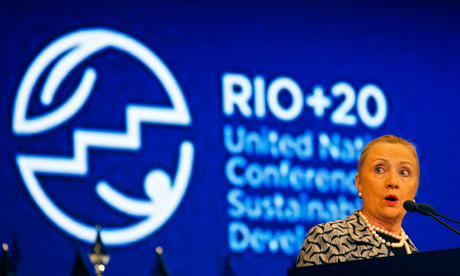
    US Secretary of State Hillary Clinton at Rio+20

    Hillary Clinton at Rio+20. The world has become very cynical about what such conferences can achieve. Photograph: Paulo Whitaker/Reuters

    After disappointing results in Copenhagen (2010) and Durban (2011), the world awaited Rio+20 with far less anticipation than we had for the Euro 2012 semi-finals, the successful crossing of Niagara Falls by Nik Wallenda, or the return of lunch blogger Martha Payne. Sustainable business, like all other business, has been riveted by the electoral politics of Greece and France and the more or less fictional pronouncements of G20 finance ministers. It was never likely that Rio+20 would change anything.

    We know that the international discourse about sustainability will not reverse decades of inaction, that governments will not likely guide us from economic and environmental disaster into a new world order of hope and quality of life. Our deep cynicism is well founded; we have seen too many pronouncements fail.

    Yet there is no human who does not prefer to live in hope. No business wants to discount its calculations of the net present value of future income streams by the absence of a future. No political leader wants to see the local impact of economic and environmental decline.

    How is it that time and again we are unable to achieve what so many of us want? Why can we not achieve an agenda which is likely the only way forward into prosperity?

    At the recent conference of the International Society of New Institutional Economists, Shi-Ling Hsu presented a paper looking at why we cannot get the answer right. In Physical, Human, and Social Capital as Barriers to Environmental Policy Change, he theorises that “environmentally harmful products and practices persist because firms and people have so much invested in their persistence”. We lock in unsustainable technologies and ways of life because capital is too expensive to write off without threatening the viability of a firm or a consumer. Oil companies and coal mine operators cannot afford to lose the value of their investments. State-owned enterprises are no less dependent on the value of carbon deposits than are for-profit companies.

    Fishing villages and logging towns around the world want to maintain their livelihoods which depend on the extraction of decreasingly available stocks. Families who are making large mortgage and loan payments on suburban homes and cars are not easily convinced to leave their commitments and reinvest in housing and transport with a smaller carbon footprint.

    Hsu suggests that we are locked into our carbon-hungry lives and our extractive livelihoods by specific and pervasive public policies which favour the creation and stability of capital. Grandfathering the use of old technology allows firms and their customers to get by with processes and equipment which are far worse than their replacements. Tax credits for extractive industries slow the movement of our economies into more sustainable industries. Capital gains taxes provide incentives to retain capital long past its “best before date” to avoid triggering tax penalties.

    Too often firms must retain their holdings in assets that unnecessarily deplete natural resources or burn carbon in order to maintain healthy balance sheets. They cannot easily invest in new capital when governments allow them generous tax concessions on outdated technology.

    We can better align incentives so that business will move out of the status quo and into more sustainable methods. Governments need not continue to support and subsidise outdated industries and processes. Instead, they might identify “environmentally-stranded capital” and let it be written down to zero over a relatively short period of time – if it is taken out of operation forever. If we really want companies to change, we must demand accelerated write-off schedules for investments in coal mines and trawlers.

    One way forward is through better accounting standards. GDP+, the UK environment minister’s proposal to enter natural resources into a national chart of accounts, had the potential to resolve some of the tension between the desire of business to innovate and capital policies which lock us into old technology. When a nation assigns a value to its natural resources, it may be more likely to drop incentives which encourage resource depletion. Nick Clegg took the proposal to Rio. After appeals by Clegg and Joseph Stiglitz, the final text of the conference recognised the need for “broader measures of progress to complement GDP”. It referred the problem to the UN Statistical Commission.

    Until our various legislators and regulators reconsider their capital-related policies, we will have fewer financial incentives than we need. Until we stop being rewarded for maintaining old equipment, investments and industries, we have little reason to reinvest or to favour the substantive change which Rio+20 might have brought. Without fixing financial regulations and accounting schemes, we cannot easily fix the earth.

    Alison Kemper teaches management at York University and has worked with the Michael Lee-Chin Institute for Corporate Citizenship at the Rotman School since 2005. Her professional background is in advocacy and NGO management.

    Roger Martin is dean of the University of Toronto’s Rotman School of Management and is academic director of the school’s Michael Lee-Chin Family Institute for Corporate Citizenship. His research work is in integrative thinking, business design, corporate social responsibility and country competitiveness. His most recent book is Fixing the Game.

    This content is brought to you by Guardian Professional. Become a GSB member to get more stories like this direct to your inbox