Category: Articles

  • More prime farmland feared to be lost to population growth

    More prime farmland feared to be lost to population growth
    Daily Democrat
    “California’s population is approaching 40 million people. Population growth in and of itself is one of the most significant forces in the quest to develop land for interests other than agricultural production and open space,” said John Lowrie of the California 
    See all stories on this topic »

    Daily Democrat
    “California’s population is approaching 40 million people. Population growth in and of itself is one of the most significant forces in the quest to develop land for interests other than agricultural production and open space,” said John Lowrie of the California 
    See all stories on this topic »

  • Climate Code Red Beyond Coal and Gas Forum

    climate code red


    Beyond Coal and Gas Forum

    Posted: 05 Aug 2012 05:46 PM PDT

    by Ellie Smith, Mackay Conservation Group

    Over the weekend of 28-29 July, over 80 people from all over Queensland, along with some visitors from NSW and Victoria, gathered just south of Mackay to learn about and discuss the impacts of the Central Queensland coal and CSG boom on our environment, communities and economy at the Beyond Coal and Gas Forum.

    The weekend was an extremely energising event. Participants went home feeling more powerful and optimistic about their chances of protecting their communities and their livelihoods from the impacts of the massive boom in coal and CSG that is planned for Central and North Queensland.

    Stories were told, experiences shared, and valuable connections were made that will hopefully help to break down the feeling of isolation that so many people feel when they are confronted by mining developments on their doorstep.
    Experts presented on topics including the health impacts of coal dust, social impacts of the expansion of a fly-in-fly-out workforce, economic impacts of the two-speed economy and environmental and groundwater impacts of mining and gas developments. Seasoned campaigners and activists shared tips and tools for effective action.
    The full program can be found at www.beyondcoalandgas.org/program
    The forum was held in Louisa Creek, a sleepy beach-side community neighbouring the Hay Point and Dalrymple Bay coal terminals 40km south of Mackay. It was a fitting venue for the gathering.
    The communities around Louisa Creek have been fragmented by the existence of Queensland’s biggest coal export facilities and plans for two more terminals in the close  vicinity. Local community members expressed their relief that the participants at the forum were now aware of their plight and they could see how their efforts to protect their communities fit into a larger story of the coal and CSG industries taking liberties across the coal bearing regions of the State.
    On Monday some participants stayed on for a day of strategic planning. Plans were made for coordinating better communication and collaboration across the movement, more support for landholders and communities opposing mines and related infrastructure and a concerted campaign to stop new export facilities from being approved.
    For more information contact forum organiser Ellie Smith at the Mackay Conservation Group on (07) 4953 8080

    http://www.beyondcoalandgas.org/summary.html

    You are subscribed to email updates from Climate Code Red
    To stop receiving these emails, you may unsubscribe now.
    Email delivery powered by Google
    Google Inc., 20 West Kinzie, Chicago IL USA 60610
  • Solar Parabolic trough


    Parabolic trough

    A parabolic trough consists of a linear parabolic reflector that concentrates light onto a receiver positioned along the reflector’s focal line. The receiver is a tube positioned directly above the middle of the parabolic mirror and filled with a working fluid. The reflector follows the sun during the daylight hours by tracking along a single axis. A working fluid (e.g.molten salt[13]) is heated to 150–350 °C (423–623 K (302–662 °F)) as it flows through the receiver and is then used as a heat source for a power generation system.[14] Trough systems are the most developed CSP technology. The Solar Energy Generating Systems (SEGS) plants in California, the world’s first commercial parabolic trough plants, Acciona’s Nevada Solar One near Boulder City, Nevada, and Andasol, Europe’s first commercial parabolic trough plant are representative, alongside with Plataforma Solar de Almería‘s SSPS-DCS test facilities in Spain.[15]

    [edit]Fresnel reflectors

    Liddell Power Station‘s Compact Linear Fresnel reflectors are not as efficient as parabolic mirrors but are much cheaper.

    Fresnel reflectors are made of many thin, flat mirror strips to concentrate sunlight onto tubes through which working fluid is pumped. Flat mirrors allow more reflective surface in the same amount of space as a parabolic reflector, thus capturing more of the available sunlight, and they are much cheaper than parabolic reflectors. Fresnel reflectors can be used in various size CSPs.[16][17]

    [edit]Dish Stirling

    A dish Stirling or dish engine system consists of a stand-aloneparabolic reflector that concentrates light onto a receiver positioned at the reflector’s focal point. The reflector tracks the Sun along two axes. The working fluid in the receiver is heated to 250–700 °C (523–973 K (482–1292 °F)) and then used by aStirling engine to generate power.[14] Parabolic-dish systems provide the highest solar-to-electric efficiency among CSP technologies, and their modular nature provides scalability. TheStirling Energy Systems (SES) and Science Applications International Corporation (SAIC) dishes at UNLV, andAustralian National University‘s Big Dish in Canberra, Australia are representative of this technology.

    [edit]Solar power tower

    A solar power tower consists of an array of dual-axis tracking reflectors (heliostats) that concentrate sunlight on a central receiver atop a tower; the receiver contains a fluid deposit, which can consist of sea water. The working fluid in the receiver is heated to 500–1000 °C (773–1273 K (932–1832 °F)) and then used as a heat source for a power generation or energy storage system.[14] Power-tower development is less advanced than trough systems, but they offer higher efficiency and better energy storage capability. The Solar Two in Daggett, California and the CESA-1 in Plataforma Solar de Almeria Almeria, Spain, are the most representative demonstration plants. The Planta Solar 10 (PS10) in Sanlucar la Mayor, Spain is the first commercial utility-scale solar power tower in the world. eSolar‘s 5 MW Sierra SunTower, located in Lancaster, California, is the only CSP tower facility operating in North America.

    [edit]Deployment around the world

    The commercial deployment of CSP plants started by 1984 in the US with the SEGS plants until 1990 when the last SEGS plant was completed. Since 1990 to 2007 there were no more CSP plants built in the world.


    Year 1984 1985 1989 1990 2006 2007 2008 2009 2010 2011 2012*
    CSP power (MW) 14 60 200 80 1 74 55 178.50 306.50 625 180
    ISCC power (MW) 22 97 40
    Total (cumulative) (MW) 14 74 274 354 355 429 484 622.50 991 1713 2183


    Figures for 2012 are as of July. [18]

    [edit]Efficiency

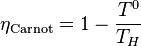
    For thermodynamic solar systems, the maximum solar-to-work (ex: electricity) efficiency eta can be deduced by considering boththermal radiation properties and Carnot’s principle.[19] Indeed, solar irradiation must first be converted into heat via a solar receiver with an efficiency eta_{Receiver}; then this heat is converted into work with Carnot efficiency eta_{Carnot}. Hence, for a solar receiver providing a heat source at temperature THand a heat sink at temperature T° (e.g.: atmosphere at T° = 300 K) :

    eta = eta_mathrm{Receiver} cdot eta_mathrm{Carnot}
    with eta_mathrm{Carnot} = 1 - frac{T^0}{T_H}
    and eta_mathrm{Receiver} = frac{Q_mathrm{absorbed}-Q_mathrm{lost}}{Q_mathrm{solar}}
    where Q_mathrm{solar}Q_mathrm{absorbed}Q_mathrm{lost} are respectively the incoming solar flux and the fluxes absorbed and lost by the system solar receiver.

    For a solar flux I (e.g. I = 1000 W/m2) concentrated C times with an efficiency eta_{Optics} on the system solar receiver with a collecting area A and an absorptivity alpha:

    Q_mathrm{solar} = eta_mathrm{Optics} I C A  ,
    Q_mathrm{absorbed} = alpha Q_mathrm{solar} ,

    For simplicity’s sake, one can assume that the losses are only radiative ones (a fair assumption for high temperatures), thus for a reradiating area A and an emissivity epsilon applying the Stefan-Boltzmann law yields:

    Q_mathrm{lost} = A epsilon sigma T_H^4

    Simplifying these equations by considering perfect optics (eta_mathrm{Optics} = 1), collecting and reradiating areas equal and maximum absorptivity and emissivity (alpha = 1, epsilon = 1) then substituting in the first equation gives

    eta = left(1 - frac {sigma T_H^4 }{IC} right) cdot left( 1 - frac{T^0}{T_H} right)

    Maximum solar-to-work efficiency for a simplified solar receiver relative to the temperature for various concentrations

    One sees that efficiency does not simply increase monotonically with the receiver temperature. Indeed, the higher the temperature, the higher the Carnot efficiency, but also the lower the receiver efficiency. Hence, the maximum reachable temperature (i.e.: when the receiver efficiency is null, blue curve on the figure below) is:  T_mathrm{max} = left({frac {IC}{sigma}} right)^{0.25}

    There is a temperature Topt for which the efficiency is maximum, i.e. when the efficiency derivative relative to the receiver temperature is null:

    frac{deta}{dT_H}(T_mathrm{opt}) = 0

    Consequently, this lead us to the following equation:

    T_{opt}^5-(0.75T^0)T_mathrm{opt}^4-frac{T^0IC}{4sigma} = 0

    Solving numerically this equation allows to obtain the optimum process temperature according to the solar concentration ratioC (red curve on the figure below)

    Maximum (top, blue) and optimum (bottom, red) temperatures for a solar receiver relative to its concentration ratio


    C 500 1000 5000 10000 45000 (max. for Earth)
    Tmax 1720 2050 3060 3640 5300
    Topt 970 1100 1500 1720 2310


    [edit]Costs

    As of 9 September 2009, the cost of building a CSP station was typically about US$2.50 to $4 per watt,[20] while the fuel (the sun’s radiation) is free. Thus a 250 MW CSP station would have cost $600–1000 million to build. That works out to $0.12 to $0.18/kwh.[20]. New CSP stations may be economically competitive with fossil fuels. Nathaniel Bullard, a solar analyst at Bloomberg New Energy Finance, has calculated that the cost of electricity at the Ivanpah Solar Power Facility, a project under construction in Southern California, will be lower than that from photovoltaic power and about the same as that from natural gas.[21] However, in November 2011, Google announced that they would not invest further in CSP projects due to the rapid price decline of photovoltaics. Google spent $168 million on BrightSource.[22][23] IRENA has published on June 2012 a series of studies titled: “Renewable Energy Cost Analysis”. The CSP study shows the cost of both building and operation of CSP plants. Costs are expected to decrease, but there are insufficient installations to clearly establish the learning curve. As of March 2012, there were 1.9 GW of CSP installed, with 1.8 GW of that being parabolic trough.[24]

    [edit]


  • UN weighs in on Philippine birth control debate

    News 9 new results for POPULATION GROWTH
    Hampton Roads highway use outpacing population growth, roadway capacity
    Daily Press
    During the decade that ended in 2010, increases in Hampton Roads highway use significantly outpacedpopulation growth and road capacity improvements. No wonder trying to navigate the region’s roads feels much like trying to force a marble through a 
    See all stories on this topic »
    REGION: Latino voter registration trailing population increase
    Press-Enterprise
    Mi Familia Vota volunteers Juan Ruiz, Elizabeth Sanchez and Tania Chavez talk with resident Juan Garcia about registering to vote on Prospect Ave in Riverside on July 21, 2012. The Inland area is nearly half Latino, but many Latinos are not citizens and 
    See all stories on this topic »

    Press-Enterprise
    Philippine Catholics rally against population controls
    ABC Online
    Thousands of Catholics have rallied in the Philippines against a measure to control the country’spopulation growth. The rally against the Reproductive Health bill is being held before Congress votes next week whether or not to stop deliberations on the 
    See all stories on this topic »
    Nigeria’s population stands at 167 million —NPC
    The Punch
    Speaking further on the growth rate of the population per annum, Zubema said, “You know the inter-census growth rate is established between the two censuses: 1991 and 2006 and it stands at 2.3 per cent per annum. “The birth rate as established in the 
    See all stories on this topic »
    Anti-mining and population control
    Philippine Star
    NSSM 200 states that population growth in the developing world threatens US security in four basic ways: “First, certain large nations stand to gain significant political power and influence as a result of their growing populations. Second, the United States and 
    See all stories on this topic »
    UN weighs in on Philippine birth control debate
    FRANCE 24
    Philippine nuns and priests led thousands of Catholics in a protest in Manila against a proposed law that would provide free contraceptives in a bid to curb population growth. Some 7000 Catholic people attend an anti reproductive health (RH) bill rally in 
    See all stories on this topic »

    FRANCE 24
    UN urges Catholic Philippines to approve family planning law
    The Nation
    Manila – The United Nations on Sunday warned the Philippines that development gains could “turn to dust” if the legislature fails to approve a law to provide government funding for contraceptives to curbpopulation growth. The UN statement came ahead of a 
    See all stories on this topic »
    Grand Forks housing supply lower, costs higher
    Grand Forks Herald
    The east has seen a more moderate population growth, complemented by a steady housing expansion. But then there is Grand Forks, where home building has been cautious and home prices higher than in the Fargo metro area. A result has been what some 
    See all stories on this topic »
    Indian economy’s growth uneven, says Union minister
    Business Standard
    Terming the India’s growth as “uneven”, a Union minister today said, although the Indian economy has grown rapidly over the last decade, significant percentage of the population lacks adequate food and clothing. “Although the Indian economy has grown 
    See all stories on this topic »


    Tip: Use a minus sign (-) in front of terms in your query that you want to exclude. Learn more.

    Delete this alert.
    Create another alert.
    Manage your alerts.

  • Employment Gains Keep Pace with Population Growth, but Leave Job Deficit …

    News 10 new results for POPULATION GROWTH
    Employment Gains Keep Pace with Population Growth, but Leave Job Deficit 
    Brookings Institution (blog)
    Since January labor market gains have been fast enough to keep pace with population growth, but not fast enough to put a dent in the nation’s unemployment rate. The number of unemployed and the unemployment rate were essentially the same in July as 
    See all stories on this topic »
    NSSO Data: Strong rural growth in 2010-12 or base effect?
    Moneycontrol.com
    There has to be some kind of an increase in rural consumption, there was some of an increase that was happening to the bottom sections of the rural population and the urban population. The kind of picture that you see between 2004-2005 to 2009-2010 and 
    See all stories on this topic »
    Taxi population growth rate slashed until end-2013
    Straits Times
    Land Transport Authority said Singapore’s taxi fleet – which has grown by more than 40 per cent to more than 27000 since the industry was liberalised in 2003 – will only be allowed to grow 2 per cent per annum up to end-2013. — ST PHOTO: CHEW SENG 
    See all stories on this topic »

    Straits Times
    Population control is crucial
    Ottawa Citizen
    Re: Curb population growth, July 27. I heartily agree with the opinion of letter writer Roderick Taylor. I too have noticed the scrupulous way that, not only the media, but politicians, scientists and activists avoid mentioning population control when discussing 
    See all stories on this topic »
    ADEA Awarded Grant to Increase Diversity Among Dental Faculty
    Dentistry IQ
    all student and faculty populations, while developing leadership in new dental faculty. “We must work together at a systems level to address the oral health inequities among vulnerable children and families, and to do this, it’s critical to increase the diversity 
    See all stories on this topic »
    US economy adds 163K jobs, unemployment rises
    Crain’s New York Business
    Still, the economy has added an average of 151000 jobs a month this year—enough to keep up withpopulation growth but not enough to drive down the unemployment rate. “After a string of disappointing economic reports … we’ll certainly take it,” said James 
    See all stories on this topic »
    Scottish GPs demand premises investment as population soars
    GP online
    He said: ‘At present there is no requirement for planning departments to consider the impact ofpopulation growth on local health services, we believe that it would make sense to include this as part of the planning process. ‘General practice is very much at the 
    See all stories on this topic »
    From Youth Bulge to Food and Family Planning, Los Angeles Times’ “Beyond 7 
    New Security Beat
    Los Angeles Times correspondent Kenneth Weiss and photographer Rick Loomis examine these numerous and interconnected challenges in a five-part series on population growthand consumption dynamics. Speaking to demographic and health experts 
    See all stories on this topic »

    New Security Beat
    Scottish GPs call for more practices to cope with rise in population
    Management in Practice
    Scottish GPs have called upon the government to support their plea in building new GP surgeries in areas where there is “significant” population growth. In his annual report published yesterday (2 August), the Registrar General found Scotland’s population 
    See all stories on this topic »
    Taxi fleet growth capped at 2% per year until 2013
    Channel News Asia
    But despite the growing taxi population, commuters are still complaining about not being able to get a cab when they need one. To address these complaints, the government is taking steps to improve taxi availability. After January 2014, taxi operators will be 
    See all stories on this topic »


    This once a day Google Alert is brought to you by Google.

    Delete this alert.
    Create another alert.
    Manage your alerts.

  • The implications of overpopulation are terrifying. But will we listen to them?

    The implications of overpopulation are terrifying. But will we listen to them?

    The Royal Court’s new play about overpopulation, Ten Billion, could be seen as a wake up-call – or just a cry of despair

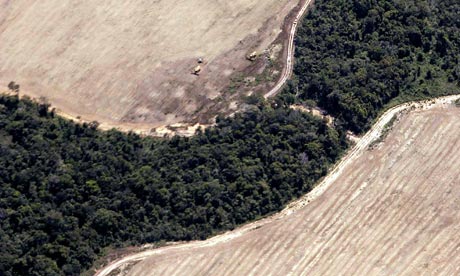
    Aerial view of advancing deforestation in the Amazon Basin

    A tide of frightening facts … increased demand for food leads to deforestation, as pictured here in the Amazon. Photograph: RICKEY ROGERS/REUTERS

    Sitting on my own in the bar of the Royal Court theatre on Wednesday with my orange juice and lightly sea-salted packet of crisps, I remembered that I was first here more than 50 years ago, as a teenager down on holiday from Scotland and determined to witness England’s cultural revolution. In 1961 that still meant John Osborne, whose new play, Luther, had just opened at the Court with Albert Finney. I queued at the box office and got two tickets to stand at the back of the stalls, where my brother and I were so thrilled (so this is what the Reformation was like!) that when the play came to the Edinburgh festival later that year, I bought another ticket and stood through it all over again.

    The contrast between Luther and the performance I was about to see couldn’t have been starker. Luther was intensely theatrical – as gorgeous as a pantomime – the stage filled sometimes with pious monks and at other times with flag-waving knights. Finney’s Luther grappled loudly with his faith and his constipation, while a cynical huckster sold the weirdest of Papal indulgences. Comedy, seriousness, noise, colour and, above all, those biting monologues that were Osborne’s trademark: they made for that thing called “a wonderful night at the theatre”, but the play’s message, whatever it was, would never have fitted under the rubric “news you can use”. When you left the theatre, you stepped out of the Reformation and into the relevance of the present day.

    Ten Billion, on the other hand, is a piece of theatre only because it occurs in a theatre. The curtain rises on a reconstruction of a modern office; we hear the melancholy sound of a cello; a middle-aged man walks on stage, opens his laptop and begins to talk. He says he’s a scientist and not an actor – that will become obvious – but that the set is a “depressingly accurate” reproduction of his office in Cambridge. His name is Stephen Emmott. He’s head of computational science at Microsoft Research in Cambridge and professor of computational science at Oxford, and what he wants to tell us about is the future of life, particularly human life, on Earth. And for the next 75 minutes that’s what he does, moving just a little around the set with the help of a stick (because a disc in his lower spine has popped out) as visuals appear on screens to illustrate what soon becomes a tide of frightening facts and predictions.

    Taken singly, few of these facts would be new to even the most casual Monbiot reader or the least faithful friend of the Earth, but their accumulation and the connections between them are terrifying. Rarely can a lay audience have heard their implications spelled out so clearly and informally: a global population that was 1 billion in 1800 and 4 billion in 1980 will probably have grown to 10 billion by the end of this century; the demand for food will have doubled by 2050; food production already accounts for 30% of greenhouse gases – more than manufacturing or transport; more food needs more land, especially when the food is meat; more fields mean fewer forests, which means even more carbon dioxide in the atmosphere, which means an even less stable climate, which means less reliable agriculture – witness the present grain crisis in the US.

    On and on he goes, remorselessly. It takes 3,000 litres of water to make a burger and the UK eats 10bn burgers a year. A world population of 10 billion will need 960 new dams, each of them the size of the world’s largest in China’s Three Gorges, plus 15,000 nuclear power stations and/or (my note-taking in the dark isn’t up to his speed) 11m wind farms. The great objective of intergovernmental action, such as it is, has been to restrict the rise in average global temperature to no more than 2C, but a growing body of research suggests a warming by 6C is becoming more and more likely. In which case, Emmott says, the world will become “a complete hellhole” riven by conflict, famine, flood and drought. Go to a climate change conference these days, he says, and as well as all the traditional attendees there will usually be a small detachment of the forward-looking military.

    What’s to be done? Emmott takes us through the ideas offered by “the rational optimists” who believe that, faced with the species’ near extinction, human inventiveness will engineer a solution. Desalination plants, a new green revolution, seeding the oceans with iron filings to absorb more CO2: all of these threaten to produce as many problems as they solve. He believes the only answer is behavioural change. We need to have far fewer children and consume less. How much less? A lot less; two sheets of toilet paper rather than three, a Prius instead of a Range Rover – that kind of sacrifice won’t really do it. And does he believe we’re capable of making this necessarily far bigger curb on our desires? Not really. He describes himself as a rational pessimist. “We’re fucked,” he says. If a large asteroid were on course to the Earth and we knew when and where it would hit – say France in 2022 – then every government would marshal its scientific resources to find ways of altering the asteroid’s path or mitigating its damage. But there is no asteroid. The problem is us.

    Recently he asked one of his younger academic colleagues what he thought could be done. “Teach my son how to use a gun,” said the colleague.

    And there the performance ends. Emmott steps forward to take the applause and then the audience files down the stairs to Sloane Square, busy with taxis and young people standing on the pavement with plastic beakers of white wine, as though there would be infinite tomorrows. It isn’t quite clear what we’ve seen – a lecture or a theatrical event – but what its ominous content most resembled, or so it seemed to me, was the kind of Protestant sermon brought about by the Reformation, in which humankind was told to repair its ways if it wanted to avoid damnation. In retrospect, this looks a relatively easy matter of regular churchgoing, refraining from obvious adultery and not doing the washing on Sundays. Light qualifications for entry to heaven compared to the levels of material renunciation needed to save the species.

    The speed at which our likely future has arrived is the frightening thing. How little we realised, leaving Luther in 1961, that the atmosphere’s carbon content had been increasing since the industrial revolution, which you might argue was a Lutheran/Calvinist byproduct. We had our worries, of course, but the cold war and nuclear weapons didn’t seem intractable threats. They produced protest rather than the fearful depression that touches some of us from time to time, when every distraction has failed. Emmott sees his performance as a wake-up call and it has apparently had that effect on its young audiences (its entire run is sold out). But it would be just as easy to see it as a well-articulated piece of despair, a scientist’s soliloquy in front of the final curtain.