Category: Articles

  • An issue that has been long neglected

    Plumb: True sustainability achievable only with population stabilization, even 
    vtdigger.org
    With the world population now over seven billion and well on its way to reaching nine to 10 billion in just a few more decades, we should definitely be aware of the impacts of future population growth on the earth. However, population growth is also a 
    See all stories on this topic »
    US Job Growth Remains Flat
    FITSNews
    Employment growth remained sluggish in June as the American economy once again failed to create enough jobs to keep up with the growth of its population. Only 80000 jobs were created in June – up from an adjusted 77000 in May. Both of those numbers 
    See all stories on this topic »

    FITSNews
    An issue that has been long neglected
    Financial Times
    Unless countries decided also to “talk fertility down”, as Australian demographer John Caldwell put it, rapidpopulation growth was poised to undermine development. Many countries, particularly in Asia and Latin America, embarked on organised family 
    See all stories on this topic »
    China’s growth can benefit Michigan
    Battle Creek Enquirer
    It’s hard to utter the word ‘sustainability’ without following it with ‘China.’ Because it has 1.3 billion people, or one-fifth of the world’s population, most building projects are done on a grand scale — everything from skyscrapers to factories and 
    See all stories on this topic »
  • Inquiry demands more detail on Murray-Darling plan

    Inquiry demands more detail on Murray-Darling plan

    By Timothy McDonald, ABCJuly 6, 2012, 7:20 pm


    A parliamentary inquiry into the proposed Murray-Darling Basin Plan wants a better explanation of how the Government intends to return water to the river system.

    The inquiry says the Government has outlined how much water it wants to return but has so far failed to say where it will get about half of it.

    Irrigators have welcomed the inquiry’s findings and they agree that Parliament should not consider legislation on the issue without more detail.

    But one group of environmental scientists says the inquiry failed to address a much bigger issue.

    The head of the inquiry, independent MP Tony Windsor, says water policy is incredibly complicated and at the moment the Murray-Darling Basin Plan does not do much to take the mystery out of it.

    “A lot of the planning documentation is based on modelling and a lot of that modelling is not easily explained to the community,” he said.

    “So we’re arguing that one of the key things that the Government and the Murray-Darling Basin Authority should do is make it very clear how they intend or would prefer to put together their water recovery plan so that not only is it feasible for that water to be delivered to some of the environmental icon sites and some of the productive uses, but the community actually understands how that water would be delivered.”

    Under the plan, 2,750 gigalitres should be returned to the Murray-Darling Basin.

    The National Irrigators Council has backed the inquiry’s findings, but spokesman Tom Chesson says it is not clear where at least 1,000 gigalitres of that water will come from.

    “Is it coming from Victoria, New South, South Australia and which valleys is it coming from?” he said.

    “Potentially you know that could wipe valleys out if a good proportion of that was to come from one individual valley.

    “So I think that is a good recommendation. My understanding is that that also means how do they make that recovery? Is it through buy backs? Is it through improvements in the way the river operates? Is it in infrastructure?”

    Water savings

    The inquiry has made a number of recommendations.

    It wants the Government to release a water recovery strategy and its proposal for environmental water trading before it introduces a plan to Parliament.

    Mr Windsor also wants a mechanism that will automatically take into account water savings.

    “When savings are made that if there’s a target, say in the case 2,750 gigalitres is the target,” he said.

    “But if there are environmental works and measure efficiencies make that that figure automatically drop, that’s what’s called a sustainable diversion limit.”

    Opposition spokesman Simon Birmingham agrees there is a great deal of community concern over what the Murray-Darling Basin plan will mean.

    He says at least some of those worries could be addressed with more information.

    “The problem to date is that all the focus has been on planning on how much water needs to be recovered and none of it from the Government has been on planning how that water will be recovered,” he said.

    “If they actually do both things at once then there’s a far greater chance of enjoying community support and being able to get cross party support for this plan when it reaches the Parliament.”

    Exploring all options

    Tim Stubbs, an environmental engineer with the Wentworth Group of Concerned Scientists, is less than impressed.

    “We’ve never had a more educated Parliament and that inquiry didn’t give that impression. It appeared that people were really there just to get a quote for their local newspaper and push their barrow forward,” he said.

    “It didn’t appear to be trying to address the big issues of the Murray Darling and how we need to tackle this problem.”

    He says the inquiry should be considering returning more water to the river system.

    “The Authority has failed to provide information to anyone on what volume of water we actually need for a healthy river system,” he said.

    “It’s given a volume but that volume is highly adjusted for constraints that are believed to be in the system.

    “And a range of them are legal and rules-based constraints. So we don’t actually know from the Authority, or anyone, what the scientific value is that we need for a healthy Murray-Darling system.

    “Now there’s other work that indicates that that’s around 4,000 gigalitres. The Murray-Darling Basin Authority have only really looked at the number of 2,750 gigalitres.

    “His inquiry was the prime opportunity to take that up and really look into what is the difference and what volumes do we need for a healthy river. It hasn’t done that.”

    Environment Minister Tony Burke is yet to say if the Government will agree to the inquiry’s findings.

    But he says he will work through the committee’s recommendations.

  • GT Energy and E.ON to Develop Five New Geothermal Projects in the UK

    ROVs: A High-Tech Win-Win Investment in the Offshore Drilling Boom

    Posted: 06 Jul 2012 10:24 AM PDT

    An increase in offshore, deep-sea oil drilling and a nod to Shell to proceed in the Alaskan Arctic will drive demand for remotely operated underwater vehicles (ROVs) through 2015. An ROV is a tethered underwater vehicle often employed in offshore hydrocarbon extraction. ROVs are linked to ships via a tether of cables that carry electrical power and video and data signals back and forth. The more technologically advanced ROVs also employ hydraulics, sonars, magnetometers and other equipment used to take water samples. The offshore oil and gas industry…

    Read more…

    U.S. Arrogance Triples Fuel Prices for Troops in Afghanistan

    Posted: 05 Jul 2012 03:51 PM PDT

    Most days, writing about energy issues is less interesting than watching paint dry, as a mind-numbing procession of barrels per day, investment infrastructure costs and bilateral memos of understanding make one wish that their current topics was Britney Spears.But every now and again, a news item illuminates the landscape like a star shell fired over a midnight battlefield.Such an event occurred late last week when Vice Admiral Mark Harnitchek stated on 27 June that logistical supplies for U.S. and NATO International Security Assistance Forces…

    Read more…

    Business as Usual for Big Oil Despite Falkland Tensions

    Posted: 05 Jul 2012 03:44 PM PDT

    While tensions between Britain and Argentina have been rising as a natural response to the 30th anniversary of the Falkland War, oil is the primary driver of a renewed Falkland dispute that will determine the fate of tens of billions of dollars in black gold.At the same time, while Argentine President Cristina Kirchner and British Prime Minister David Cameron are trading serious barbs over the sovereignty issue, big oil companies are largely ignoring the implications and conducting business as usual.The Falkand Islands (Islas Malvinas) were reclaimed…

    Read more…

    Cities that are Paving the Way for an EV Revolution

    Posted: 05 Jul 2012 03:37 PM PDT

    Sixteen cities around the world have set a cumulative target to sell almost six million electric and plug in hybrid electric vehicles by 2020. If they reach this goal, EVs would account for about 6% of total vehicle sales and about 20 million cars on the road.A new report called the EV City Casebook highlights how these leading cities are putting the right pieces into place to encourage the adoption of EVs:“Cities are also leading by example. Many have already added electric vehicles to municipal fleets and incorporated hybrid buses into…

    Read more…

    Burning Ultra-Low Sulphur Jet Fuel Could Actually Increase Global Warming

    Posted: 05 Jul 2012 03:26 PM PDT

    In an effort to reduce acid emissions from the aviation industry, preventing an annual number of between 1,000 and 4,000 deaths, it is planned to burn very low-sulphur jet fuel in planes. However, although better air quality is anticipated, such low sulphur fuels might also reduce the formation of sulphate aerosols, particles of which reflect solar energy back into space and help cool the planet.Such ultra-low sulphur jet fuels (ULSJ) contain just 15 ppm of sulphur, to be compared with a high of 3,000 ppm for some jet fuels. Indeed, the sulphur…

    Read more…

    Energy Development Could Hold the Key for America’s Unemployed Masses

    Posted: 05 Jul 2012 03:24 PM PDT

    “For many American families, struggling to make ends meet in the jobless recovery, energy development is an answer to a prayer. The fact that the oil and gas boom has been done without taxpayer subsidies—and despite reactionary public policies at the federal level and in some states (such as New York)—means that more economic opportunity is on tap.”In this so-called “jobless” recovery, aka the Great Recession, an estimated 20 million American workers are unemployed or underemployed. One out of every two college…

    Read more…

    $26 A Gallon for Biofuel – Is the Navy Paying too Much to be Green?

    Posted: 05 Jul 2012 03:22 PM PDT

    At the current RIMPAC, the world’s largest international naval exercise, the US are testing the use of biofuel as part of their plan to ‘green the fleet’ by 2016. The USNS Henry J. Kaiser is carrying 900,000 gallons of biofuel/petroleum mix; 700,000 in the form of hydro-treated renewable diesel fuel, and 200,000 gallons of hydro-treated renewable aviation fuel. The biofuel has been developed from waste cooking oil and algae oil, and cost a staggering $26 a gallon. Republicans in Washington are not happy.The Navy released a statement…

    Read more…

    China to Quadruple 2015 Solar Energy Target

    Posted: 05 Jul 2012 03:21 PM PDT

    Due to the massive in-balance between supply and demand for solar cells, largely due to the huge manufacturing output of China, prices of PV panels have fallen to unprofitably low levels. Solyndra was the biggest and most famous of the companies to fall due to the low profit margins. Whilst the low prices can stimulate demand, they also deter new companies from entering the market, which means fewer teams researching solar technologies; a move that could harm the promising growth both in size and efficiency that the solar industry has seen lately.It…

    Read more…

    GT Energy and E.ON to Develop Five New Geothermal Projects in the UK

    Posted: 05 Jul 2012 03:20 PM PDT

    As part of plans to increase operations in the UK and benefit from the government’s Renewable Heat Incentive (RHI) programme, Ireland’s GT Energy has signed a Memorandum of Understanding with E.ON UK, one the largest power and gas companies in the kingdom to develop five new deep-geothermal projects.Padraig Hanly, the managing director of GT Energy, said that “government backing in the UK is already making a huge difference to a fledgling industry. The UK’s Renewable Heat Incentive is a welcome and positive step.”…

    Read more…

  • FW: Uh oh, a new head on the Growth Lobby Monster

    FW: Uh oh, a new head on the Growth Lobby Monster

    Inbox
    x

    Thomson, Kelvin (MP) Kelvin.Thomson.MP@aph.gov.au
    11:44 AM (20 minutes ago)

    to Tim

    Uh oh, a new head on the Growth Lobby Monster

    Posted July 5th, 2012 by Sheila Newman

    Housing prices are going down and the small coterie of people who profit from unaffordable housing and land costs and the other forms of resource inflation and associated human misery have found it necessary to invent yet another force to massage unwanted population growth and high immigration in Australia. This one, the New Migration Council to advocate for a bigger Australia” calls itself an NGO rather than a think-tank or an association or a foundation, but it has multi-million dollar backing and is way out of the league of traditional advocates of community causes most people associate with NGOs.


  • Peak oil and the lost message of the carbon tax

    Peak oil and the lost message of the carbon tax
    On Line opinion
    Whether or not one believes in human-induced climate change, with the Carbon Tax’s introduction on Sunday, it is worth remembering the fundamental reasons for its conception. The Carbon Tax debate, which has been memorable for its hyperbole, but not
    See all stories on this topic »

  • Fracking: where’s the debate about its climate change risks?

    Fracking: where’s the debate about its climate change risks?

    Fracking looks set to be given the green light in the UK, but there is a worrying lack of discussion about its climate implications

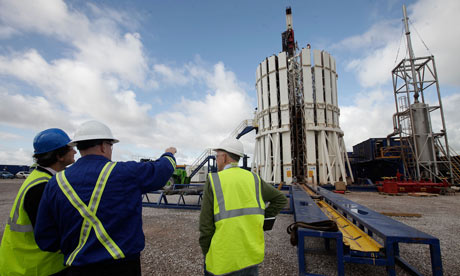
    Engineers look at the Cuadrilla shale fracking facility in Preston, Lancashire

    Engineers look at the Cuadrilla shale fracking facility in Preston, Lancashire. Photograph: Matthew Lloyd/Getty Images

    Rarely a day goes by, it seems, when “fracking” isn’t in the news. It’s either being hailed as a miracle energy source, or it is being condemned as yet another polluting fossil fuel.

    Today’s headlines largely focus on the findings of a joint report (pdf) by the Royal Society and the Royal Academy of Engineering which concludes that hydraulic fracturing of shale gas – “fracking” – should be allowed to proceed in the UK, but only with tight regulation and monitoring. Published ahead of the government’s anticipated “green light” for fracking later this summer, the report calls for a long parade of checks and balances, as you might expect it to:

    Monitoring should be carried out before, during and after shale gas operations to inform risk assessments. Methane and other contaminants in groundwater should be monitored, as well as potential leakages of methane and other gases into the atmosphere. The geology of sites should be characterised and faults identified. Monitoring data should be submitted to the UK’s regulators to manage potential hazards, inform local planning processes and address wider concerns. Monitoring of any potential leaks of methane would provide data to assess the carbon footprint of shale gas extraction.

    But what is missing from much of today’s media coverage is mention of – for me at least – the most important paragraph in the whole report:

    This report has analysed the technical aspects of the environmental, health and safety risks associated with shale gas extraction to inform decision making. Neither risks associated with the subsequent use of shale gas nor climate risks have been analysed. Decision making would benefit from research into the climate risks associated with both the extraction and use of shale gas. Further benefit would also be derived from research into the public acceptability of all these risks in the context of the UK’s energy, climate and economic policies.

    Yes, there are plenty of concerns about the possible localised environmental impacts of fracking, such as earth tremors, aquifer contamination, and surface leaks. As the report concludes, these need constant and tightly-regulated assessment if extraction is to get under way on a commercial scale. But this is a side salad compared to the picnic hamper of unanswered questions that still hang over fracking when it comes to its possible contribution to climate change.

    With nice timing – but largely ignored by the media – is a report out today by the Committee on Climate Change, a statutory body set up to advise the UK government on greenhouse gas emissions. It urges the government to give up on its “dash for gas” in order to help avoid dangerous levels of greenhouse gas emissions. Its chief executive, David Kennedy, said:

    [Ministers] must rule out the dash for gas, and set clear carbon objectives in the context of draft energy legislation and the forthcoming gas generation strategy. Our analysis shows that power sector decarbonisation is economically sensible, even in a shale gas world.

    To frack, or not to frack, is arguably the most pressing environmental decision facing the “greenest government ever” at present. There are clearly huge temptations to proceed: its advocates say it is an abundant and cheap source of energy that could help to re-ignite our flailing economy. And voices such as James Lovelock say that fracked gas is a lesser evil than coal so we should use it as a bridging technology to “buy us some time”.

    But there are plenty of legitimate environmental concerns, too, not least that the climate risks have yet to be fully analysed or face democratic scrutiny. And there are worries that fracking will likely hinder or damage the fledgling renewables sector.

    Visit the Department for Energy and Climate Change’s webpage on shale gas and there is no mention of climate risks. The only direct reference I can find is an archived article by the former energy secretary Chris Huhne from last November:

    Every national scientific academy in the world agrees: climate change is a real and growing threat. We face ambitious, legally binding carbon emissions and renewable energy targets. Yes, gas will help us meet them. But we should not bet the farm on shale.

    He didn’t say, though, how this was to be achieved, other than earlier stating: “With carbon capture and storage technology, [shale gas] can provide a significant amount of low-carbon electricity in the long term.” And we all know how well CCS is coming along, don’t we?

    Is the UK government really going to breezily “green light” fracking, as seems highly likely, given what the Committee on Climate Change has said today? Is it really going to push ahead, without having fully investigated and discussed the possible climate implications of fracking?

    I, for one, don’t feel we have even begun having this important national debate.