Category: Articles

  • Oil rush in the Arctic gambles with nature and diplomacy

    Oil rush in the Arctic gambles with nature and diplomacy

    In Svalbard politicians and scientists talk of global warming and a low carbon economy. Outside, the drilling rigs are moving in

    • A polar bear near Longyearbyen, the capital of Svalbard, Norway, where an oil rush is threatening

      A polar bear near Longyearbyen, the capital of Svalbard, Norway, where an oil rush is threatening the environment. Photograph: Andrew Stewart/Rex Features

      The small group of international scientists, politicians and business leaders are using the Arctic research station as a makeshift conference centre for urgent talks on how to fast-forward a low carbon economy. They have come to the snowy archipelago of Svalbard, a few hundred miles from the North Pole, to hear the latest bad news on melting glaciers and climate change.

      “Nowhere are the implications of global warming more visible than in the Arctic. Ecosystems as well as livelihoods are presently undergoing rapid change. In spite of all the evidence provided by science, most governments in the world have failed to take the necessary action,” warns Anders Wijkman, the Swedish MEP who is chairman of this special symposium.

      After hearing predictions that 30% of species could be extinct and a fifth of Bangladesh underwater before 2100, he urges the removal of “all subsidies on fossil fuels” and a much stronger commitment to renewable power in measures to build a sustainable future.

      Yet outside the room, in the grey Arctic waters, an oil rush looms which threatens more carbon emissions and the risk to the natural world of an accident similar to the 2010 Deepwater Horizon spill in the Gulf of Mexico.

      The drilling also threatens to spark territorial disputes and sabre rattling, such as the bellicose noises made by Argentina over British companies seeking oil off the Falkland Islands.

      While the polar bears and arctic fox of Svalbard have grazing rights, the legal standing of different human groups in the region is more fuzzy.

      Ny-Alesund research station is a base not just for the Norwegians, who have political jurisdiction, but also for British, Indian and Chinese scientists. Few believe the national bases – Beijing’s has huge stone lions outside – are there just for science. They are symbolic political and economic stakes in the future of Svalbard and the Arctic.

      Drilling is also under way in earnest off Greenland to the west and in the Barents Sea to the east of Svalbard. Oil price rises and melting ice caps have made the region more accessible for mining, shipping and drilling. Yet ownership of the Arctic seabed is far from clear.

      The 1920 Spitsbergen treaty, drawn up after the first world war, gave onshore mineral rights to more than a dozen signatories, including the UK. Yet there are arguments whether Svalbard’s coastal waters are part of the Norwegian continental shelf and fall within Oslo’s jurisdiction. Fishing rights are disputed between Norway and Russia.

      Trond Giske, Norway’s trade minister, says the uncertainty should not be exaggerated. “On our part we have no problem interpreting the treaty. We have very few conflicts with other countries in this area,” he argues, pointing to agreement with Russia last year to settle territorial boundaries in the Barents Sea.

      The impact of that deal over the “grey zone” only brings oil drilling wealth closer to Svalbard’s islands – and increases pressure on Oslo to debate limits to its sovereignty.

      Diana Wallis, a British lawyer and former MEP, touched a raw nerve with Norway in a speech to the local European Movement in Tromso. She talked of “unresolved disputes around Spitsbergen” and insisted the EU had a legitimate interest in this and the wider Arctic.

      Wallis said: “The position of Svalbard needs to be discussed openly and I can’t see why everyone is nervous about this. They seem to be waiting for a trigger event [like an oil find] and then we are going to have a real problem.”

      A wider debate does not seem to be what countries licensing drilling operations off Alaska, Russia and Greenland want to hear. They have been happy to confine dialogue to an Arctic Council largely composed of states surrounding the Arctic Ocean. And they say territorial disputes – for example, between Canada and the US over seaways – are all being handled through the UN convention on the law of the sea.

      They are determined to defend their right to introduce national oil regulations – which environmental groups and the global community are beginning to challenge.

      “Like it or not, what is happening in the Arctic and how it is dealt with becomes everyone’s business,” said Wallis. “This is an issue which Norway and other Arctic states have to accommodate. A growing number of players have a legitimate interest in what happens in the Arctic and therefore the governance regime there.”

      While Greenpeace has physically tried to halt drilling off Greenland and future operations off Alaska, Norwegian environmental group Bellona is waging a war of words with Oslo. Its leader, Frederic Hauge, said: “It’s a big, big, big gamble exploring for oil in this area. There are so many stress factors here – be it the fish, the nuclear waste from the cold war and the fragility of the ecosystem. I am also very worried about the geopolitics of the Arctic. We are acting like petroholics and I do not believe there is widespread support for it.”

      Norway’s state energy company, Statoil, has its commercial compass pointing north, believing there is nothing to stop its deep water experience of the northern North Sea being safely applied to the Arctic or sub-Arctic.
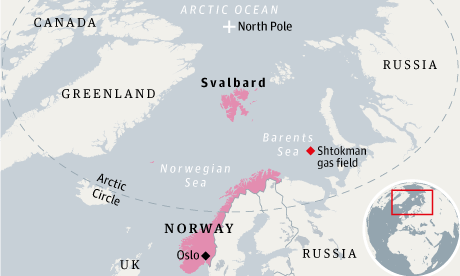
      Svalbard map Svalbard and the Shtokman gas field, where Norway’s Statoil is helping the Russians.

      Statoil points out it has been operating the first Arctic offshore gas field at Snohvit, using subsea technology and underwater links to shore, since 2007. The company – 67% owned by the government – has signed a strategic exploration and production deal with Russia’s state-owned oil group, Rosneft. Statoil is also helping another Russian state company, Gazprom, build the huge Arctic offshore gas field, Shtokman – said to hold more gas reserves than remain in all Norway.

      Hauge points to the irony of more fossil fuels being developed in an area where the impact of their carbon production is most acute.

      Giske sees no contradiction between Norway’s physical search for hydrocarbons and the hunt for low carbon solutions at Ny-Alesund. “We are all going to be dependent on fossil fuels for a long period and natural gas is the bridge into a low carbon world,” he says. “If the EU replaced all its coal-fired power stations with natural gas it would easily meet its 20/20 (20% reduction in carbon emissions by 2020) goal.”

      He is more concerned about EU energy commissioner Günther Oettinger’s recent visit to Oslo to push a new regulatory regime. Oettinger is arguing that Europe is a key customer of Norwegian oil and gas and points to Norway’s membership of the European Economic Area as a reason why a common offshore safety regime would make sense.

      Giske said Norway and Britain had more experience than anyone else in Europe – over 40 years – so why change a system that has worked well.

      Meanwhile, Norway has moved the headquarters of its army from Oslo to a northern town, Bardufoss, and signed its biggest ever single military contract for jets to be located there.

      Who is the enemy? Russia? “No,” says Giske. China? He almost chokes at the suggestion. “Look we don’t need to identify an enemy to justify defence expenditure. We are after all part of the Nato alliance.”

      In Ny-Alesund, there is no discussion of a new cold war over Arctic minerals, with Wijkman more worried about warming. He urges ministers to “raise awareness among the public about the serious risks posed by climate change and the necessity of urgent action”.

      The Norwegian government contributed to the cost of flying Terry Macalister to Svalbard

  • An 80-Year License to Kill?

    An 80-Year License to Kill?
    CounterPunch
    James Bovard on our latest local excursion into fascism: the TSA. by KARL GROSSMAN The US Nuclear Regulatory Commission will be holding a meeting this week to consider having nuclear power plants run 80 years—although they were never seen as running
    See all stories on this topic »

  • Carving Up Iraq, Barrel by Barrel

    Carving Up Iraq, Barrel by Barrel

    Posted: 01 Jun 2012 02:54 PM PDT

    Iraq’s latest energy auction was a flop, and while major international companies balked at everything from unattractive contract terms to security concerns, the failure of the auction highlights how the struggle for power between north and south is shaping the future of energy in the region and beyond. Earlier this week, Iraq held its fourth round of energy auctions with disappointing results that reflect the global gas glut, the rise of unconventional oil and gas and some very particular geopolitical maneuverings. During the two-day auction…

    Read more…

  • Arctic Oil: 2 Perspectives

    Arctic Oil: 2 Perspectives

    To the Editor:

    Opinion Twitter Logo.

    Connect With Us on Twitter

    For Op-Ed, follow @nytopinion and to hear from the editorial page editor, Andrew Rosenthal, follow @andyrNYT.

    Re “Offshore Oil Drilling’s New and Frozen Frontier” (“The Energy Rush” series, front page, May 24):

    News that North Dakota has overtaken Alaska in oil production tells the story of shale oil’s ascendancy in the country’s oil supply. But the potential of Alaska’s offshore resources could put Alaska back on top.

    Some would like us to believe that it’s too risky to explore the 25 billion barrels of potential oil in the Beaufort and Chukchi Seas. They argue that we should leave nearly a quarter of our known, technically recoverable outer continental shelf resources in place. This ignores science and the facts.

    One example: the Bureau of Ocean Energy Management “found no evidence that the proposed action would significantly affect the quality of the human environment.” Coastal communities will be protected while the country benefits. America still needs to say yes to new Arctic oil. The issue is vital for Alaska and for America.

    MEAD TREADWELL
    Lieutenant Governor
    Juneau, Alaska, May 25, 2012


    To the Editor:

    Imagine: a president who ignores the advice of his own scientists on a key environmental issue, dredging for votes in an election year. Sound familiar?

    As you report, Shell orchestrated a years-long lobbying effort that is likely to result in the first drilling for oil in the Arctic. Shell even joined a climate change advocacy coalition to open doors at the White House and in Congress. We were in those rooms; we saw Shell’s cynical tactics.

    The administration is ignoring warnings from the Coast Guard, the United States Geological Survey, the Government Accountability Office and hundreds of scientists. All say the industry is not prepared to drill safely in Arctic waters. Their nightmare scenario: a BP-like blowout in an ice-locked sea.

    America’s Arctic is a national treasure. Every June, what you call the North Slope’s “flat, white emptiness” transforms into one of the world’s most prolific nurseries, where birds from six continents converge to raise their young.

    You can’t blame native Alaskans when they hear echoes of “Damn Yankees”: “Whatever Big Oil wants, Big Oil gets.”

    DAVID YARNOLD
    President and Chief Executive
    National Audubon Society
    New York, May 24, 2012

  • Squaring up to difficult truths: how to reduce the population

    LATEST ARTICLES

    Squaring up to difficult truths: how to reduce the population

    By Cliff Hooker, University of Newcastle

    Elephants in the room, part two For all our schemes and mantras about making our lives environmentally “sustainable”, humanity’s assault on the planet not only continues but expands. What are the deep…

  • The folly of US population growth orthodoxy

    The folly of US population growth orthodoxy

    Rather than accept the panicky rhetoric that says we must grow our population to grow our economy, let’s consider alternatives

    • Hot weather in Brighton, Sussex, Britain - 02 Oct 2011

      Overpopulation: in a developed country near you. Photograph: Andrew Hasson/Rex Features

      Of all the fantasies indulged in by a society speeding toward self-destruction, none is as consequential as the idea that continuing growth – both in population and size of our economy – has a happy-ever-after ending. Yet, when overpopulation is discussed at all, it is discussed as a problem limited to the developing world. Indeed, a growing chorus of “pro-natalist” or population growth ideologues insists that, in the US and other parts of the developed world, population stability or decline represents a demographic crisis that needs to be reversed.

      In order to ignore the patently obvious fact that unlimited population growth is neither environmentally or socially sustainable, one would have to be prepared to explain how a resource-gobbling US of 500 million or 700 million people would work. (If you’re not prepared to do so, you’ve already accepted the reality that some limits exist and that the only question is what those limits should be.)

      If, though, you really believe that predictions of overpopulation-induced catastrophe have been overblown, there are still two critical questions to be addressed, both of which are currently verboten as a matter of public debate.

      First, even if ever-increasing population were survivable, is it really desirable? Second, are we really so inflexible that we can’t figure out any adaptations – beyond permanent crowding and permanent austerity for most citizens, that is – to enable a society that is becoming older to be economically and socially robust?

      In fact, more isn’t better, and there are both market-driven and state-driven alternatives to be pursued.

      Smaller has its advantages

      In a well-reported and chilling article on Nigeria’s population explosion last month, Elisabeth Rosenthal quoted a Nigerian demographer:

      “If you don’t take care of population, schools can’t cope, hospitals can’t cope, there’s not enough housing – there’s nothing you can do to have economic development.”

      US society doesn’t face imminent collapse, but aren’t many similar considerations at play? Despite the glut of unsold homes, we are still under-housed, and competition for housing in the most desirable housing markets has made life increasingly unaffordable. Demands on infrastructure – transportation, water, schools – have already reached or passed a breaking point in some parts of the US (just ask any suburban school district whether it is sanguine about the prospect of increased enrolment).

      As anyone who is old enough to recall the 1960s or 1970s can attest, there just aren’t spots available as there used to be. Spots in schools that used to be merely competitive are now virtually impossible to get into. Likewise, spots in secure, well-paying jobs are no longer available except to an increasingly small minority.

      The population of the US – currently estimated at 313 million – was 179 million in 1960, and 203 million in 1970. Does anyone think those were periods when the country was “too small” or economically weak?

      Adapting to the demographic shift

      Most of the secular hysteria that is generated against consideration of the advantages of stable or falling populations concerns the phenomenon of ageing populations. As people live longer, a greater percentage of the population is older, and there are, relatively speaking, fewer young “productive workers” to support everyone else.

      Just last month, the cries of alarm have included one op-ed piece asserting that “population decline poses a danger to the developed world”, and another describing Japan’s declining population as creating “grim consequences for an already-stagnant economy and an already-strained safety net”.

      Japan, by the way, is the poster child for those who want to sell the idea that only a growing country can be prosperous. Conveniently left out of the picture is Germany, whose economy is currently the envy of Europe, and whose demographics, my colleague Michelle Mayer has confirmed with the Federal Statistical Office of Germany, include: a fertility rate of 1.4 children per mother, one of the lowest in the world; a death rate that, since the 1970s, has continuously exceeded the birth rate; and a population projected to shrink to 65 or 70 million from the current 82 million.

      If one steps back from the panic, what comes most clearly into focus is the fact that the pro-natalists’ assumptions proceed from the basic premise that all economies and all societies always need to be organized in the same way. Once one begins to imagine alternatives, a future where fewer people are forced to engage in fierce, dog-eat-dog competition becomes very desirable indeed.

      The pro-natalist concern, in truth, is not that there won’t be sufficient young people to do the work, or that “there are just some jobs that Americans won’t do.” Rather, it is that with labor in greater demand, the work won’t be able to be had cheaply.

      There is nothing “natural” about someone in a parasitic profession (like much of investment banking) earning a lot of money and someone doing necessary but menial work (like garbage collection) earning much less. Where a society is really forced to “incentivize” the latter, the market will dictate a lower-than-current value for the derivatives trader and a higher-than-current value for the sanitation worker. That revaluation may make some people uneasy, but their complaint isn’t really that such a change is unworkable; it is that they find the prospect of different people than usual having to adapt outrageous.

      The nature of work, too, would likely be reorganized. Once, six-day work weeks were routine, as were 10- to 12-hour work days. Pressure from labor caused the developed world to adapt. If, by the middle or latter part of this century, workers who perform hard manual labor can only be secured by offering shorter-than-eight-hour days, we’ll have to adapt again.

      Jobs designed in lockstep with a time when households most typically had one, full-time (male) wage-earner might have to become more flexible (something that is already overdue) to facilitate the part-time participation of older workers in the labor market. And this not as an act of desperation but rather in a way that, consistent with any age-based constraints, facilitates participation in productive activity.

      And, yes, it would cost more as a society to support those who are not working. (News bulletin: it will cost more in any scenario, even if we insist on punishing more older people with decades of life spent at not much better than subsistence level.) The question will be the old one, and one that should be easy to answer for a society that, unlike most others, remains remarkably wealthy: is maintaining massive inequality of wealth on an individual level more important than trying to maximize the quality of life for most citizens?

      Better now than later

      For a long time, India, whose population now exceeds 1.2 billion people, did not act. Its population is estimated to grow to somewhere between 1.5 billion and 1.9 billion people in coming decades. As an article on more recent Indian attempts to control its birthrate pointed out, “Indian leaders recognize that [those massive growth scenarios] must be avoided.” The article quoted a demographer who said, “it’s already late … It’s definitely high time for India to act.”

      The US has the opportunity to be a lot more prescient, but we will have no chance to be so unless we begin to discuss all of the consequences of being a country that continues to grow, and allow ourselves to imagine the potential benefits of alternative futures.

      • This article was originally published by Remapping Debate and is crossposted by permission of the editor