Category: Articles

  • Geothermal energy could meet a fifth of UK’s power needs – report

    We have the capacity for “HOT ROCKS POWER GENERATION”  in South Australia. It is not being developed.

    Geothermal energy could meet a fifth of UK’s power needs – report

    The study found that subsidising geothermal technology initially would help to bring down costs rapidly as UK sites were developed

    • guardian.co.uk, Wednesday 30 May 2012 18.52 BST
    • Comments (33)
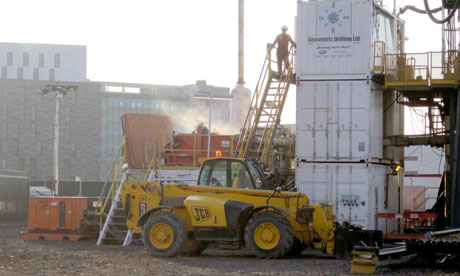
    • Geothermal energy : Construction site of new Newcastle University buildings

      Construction site of new Newcastle University buildings which will be carbon neutral. Among other energy efficient measures, they will have space heating using geothermal heat from a borehole that is being drilled 6000 feet beneath the site. Photograph: Hugh Macknight/PA

      The UK could meet a fifth of its power needs – the equivalent of nine nuclear power stations – by exploiting geothermal power, a new report into the technology has found.

      But the report found that the current subsidy regime does not provide sufficient incentive to develop the technology in the UK – even as Charles Hendry, minister of state at the Department of Energy and Climate Change, flew to Iceland on Wednesday afternoon and signed a Memorandum of Understanding with his Icelandic counterpart Oddný G. Harðardóttir to explore a possible new interconnector that could be used to import geothermal electricity from the country’s volcanoes.

      Geothermal power stations use water pumped down to hot rocks under the earth that returns to the surface heated, fuelling electricity generation or to be used for space heating.

      There are promising sites for geothermal power spread throughout the UK, from Cornwall to the Lake District, East Yorkshire, Northern Ireland and Scotland.

      Another plus is that geothermal power, while renewable and low-carbon, can provide baseload electricity. That means it can be used to back up intermittent sources of renewable energy such as wind and sun. The study found geothermal could supply 9.5GW of electricity, about 20% of current demand, but also 100GW of heat, which would be enough for the whole of the UK’s space heating needs. The government has struggled to encourage the take-up of renewable forms of heat, such as wood-fired boilers and underground heat pumps.

      However, geothermal power receives a relatively low level of subsidy – less than that offered to wave and tidal power, and less than that offered in rival countries such as Germany and Switzerland – according to the report, commissioned by the Renewable Energy Association and written by the engineering consultancy Sinclair Knight Merz. The study, published on Wednesday, found that subsidising geothermal technology initially would help to bring down costs rapidly as sites around the UK were developed. It recommended a different system of subsidy, targeting support at the exploration drilling phase.

      Ryan Law, chair of the REA’s deep geothermal group, said: “We don’t want to be left out of a global industry which is estimated to be worth £30bn by 2020. We could be at the forefront of this industry given the strength of British engineering skills. If the UK wants to seize a share of this booming global market we must prove our competence at home. Clearly investment at home could also go a long way to meeting our future energy needs cleanly and safely.”

      There are potential problems to be overcome, however. Geothermal technology is still expensive, can only work in certain sites and the process of drilling and pumping water to the underground rocks has been linked to seismic activity in some areas. The two small earthquakes that hit Blackpool following drilling in the area for shale gas exploration did not stop advisors recommending that ministers should allow shale drilling to go ahead – but local residents may have concerns.

      Separately, the UK has been advised to extract as much of its remaining reserves of oil and gas as possible, in a report by the International Energy Agency. While praising the UK’s low-carbon strategy, the agency said oil and gas would still be needed and should be exploited.

      Maria van der Hoeven, executive director of the IEA, said that the UK needed a more liquid wholesale electricity market, with more competition. She commended government plans for a “green deal” to encourage households to insulate their homes, but warned that its success would depend on making the public “sufficiently aware of its benefits”.

      She also warned that plans for electricity market reform, which will include companies entering contracts to supply power at a price above the market rate, were “pioneering” and would be “closely observed by other countries in their efforts to ensure continuing reliability of electricity systems while promoting timely decarbonisation of electricity supplies”.

  • US sees window for Iran nuclear talks closing

    US sees window for Iran nuclear talks closing
    Outcome Magazine (blog)
    05/30/2012 The window for dialogue over Iran’s nuclear programme is closing, the US ambassador to Israel said on Wednesday, insisting that Washington is under no illusions about Tehran’s agenda in the talks. Model of the Bushehr Nuclear Power Plant
    See all stories on this topic »
    Nuke power: greens see red
    Independent Online
    Activists dressed in nuclear emergency suits dumped marked nuclear waste bags and placed look-a-like nuclear barrels at the entrance of the Industrial Development Corporation to highlight the dangers associated with nuclear.
    See all stories on this topic »

    Independent Online
    Fusion Energy
    Huffington Post (blog)
    How about fission, the nuclear power source we use now? Fission and fusion can claim many of these same advantages, but fission comes with some serious and all too apparent risks. Fission plants are fueled with enough enriched uranium to run for a year
    See all stories on this topic »
    Protesters beaten, detained by guards
    Independent Online
    By KRISTEN VAN SCHIE This was the rallying cry of a group of environmental activists who protested outside a pro-nuclear power conference in Sandton on Tuesday. The Greenpeace activists, dressed in nuclear emergency suits, arrived outside the
    See all stories on this topic »

    Independent Online
    Fukushima gov. slams evacuation instructions / Sato calls central govt
    The Daily Yomiuri
    1 nuclear power plant just after the crisis began, Sato said: “We had no prior notice. No grounds for the instructions were presented and the instructions were announced one after another. It was totally beyond us.” Sato’s appearance at the hearing
    See all stories on this topic »
  • CSG expert challenges company’s gas claim

    CSG expert challenges company’s gas claim

    ABCMay 31, 2012, 6:41 am

    An environmental engineer has questioned Origin Energy’s assertion that gas bubbling in a Queensland river is a naturally occurring phenomenon.

    A video by anti-coal seam gas group (CSG) Lock the Gates shows gas bubbling to the surface of the Condamine River near Chinchilla.

    Origin Energy, which owns a number of test wells near the site, says it is a natural phenomenon caused by a shallow coal seam.

    But CSG expert Dr Gavin Mudd from Monash University says “it beggars belief that there could be no contribution by industry”.

    Dr Mudd says there is no evidence to support Origin’s claim and the case needs further investigation.

    The Queensland Government says it is investigating the matter, and Dr Mudd says there is a lot of monitoring bore between the Condamine River and where the CSG projects are located.

    He says he expects the gas leak is the result of CSG activity, but pinpointing the cause will be difficult.

    “They need to go and test a lot of the groundwater bores in the region and make sure they test bores that are between the Condamine and where the coal seam gas activities are,” Mr Mudd said.

    Dr Mudd says the CSG industry is poaching a lot of expertise from the Government.

  • The Huge Renewable Energy Potential of Alaska

    The Huge Renewable Energy Potential of Alaska

    Posted: 29 May 2012 03:23 PM PDT

    Alaska is a vast state that would stretch from California to Florida if superimposed over the lower 48 states; it has twice the shoreline of all the lower 48 states combined, and boasts a varying geography that includes rivers, volcanoes, and windswept tundras.Most of the lower states just think of Alaska as an oil state, but it actually has the potential to produce massive amounts of energy from hydro, wind, geothermal, and other renewable sources. John Podesta a former chief of staff under President Bill Clinton chaired a meeting at the Centre…

    Read more…

    Energy & Risk: Why We Are Experiencing an Energy Boom

    Posted: 29 May 2012 03:22 PM PDT

    The convergence of forces creating profound changes in domestic energy production is being driven by technology, globalization, demographic changes and by economies turning things upside down. But only recently and only in selected places across the energy value chain has it hit critical mass.  One of them is reflected in the graphic above from the US EIA showing the growth in US domestic oil production.Opportunity is born today out of the risk-induced realization that insight can be extracted from the visual data predictive analysis of the…

    Read more…

    China Pledge to Invest $27 Billion in Renewable Energy in 2012

    Posted: 29 May 2012 03:11 PM PDT

    In 2011 global carbon dioxide emissions rose to the highest level ever recorded. The increase was mainly driven by the world’s largest emitter of CO2, China, who experienced their own record increase of emissions due to the high use of coal. According to the IEA, the 9.3 percent that Chinese emissions increased by, offset the decreased emission levels achieved in the United States and Europe.In an attempt to reduce their carbon emissions and promote energy conservation, China has pledged to invest $27 billion in renewable energy projects…

    Read more…

  • Government accused of water tax grab

    Government accused of water tax grab

    ABCMay 31, 2012, 6:05 am

    The State Opposition has accused the Government of concealing a tax hike for household water bills in the latest budget papers.

    The Opposition says the budget includes a $50 million increase in the environmental contribution levy, which will come into effect in July next year.

    But the Opposition says the budget does not outline what environment projects the money will be spent on.

    Opposition spokesman John Lenders says it is a sneaky tax grab.

    “This is the opportunity Mr Baillieu has to gouge another $47 million out of Victorian families for this year,” he said.

    “There are no projects in the Department of Sustainability and Environment for it.

    “In fact [of] last year’s amount, only two thirds of it was spent. It is simply an opportunity for him to put another tax hike on families.”

    Water minister Peter Walsh says the environmental contribution levy increases by a fixed percentage every four years.

    He says the money will be spent on environmental projects.

    “Not all projects have been identified at this stage,” he said.

    “[It] is not appropriate to say that we know what we need to spend that money on in four years time.

    “I don’t think is a good decision-making process.”

    ABCMay 31, 2012, 6:05 am

    The State Opposition has accused the Government of concealing a tax hike for household water bills in the latest budget papers.

    The Opposition says the budget includes a $50 million increase in the environmental contribution levy, which will come into effect in July next year.

    But the Opposition says the budget does not outline what environment projects the money will be spent on.

    Opposition spokesman John Lenders says it is a sneaky tax grab.

    “This is the opportunity Mr Baillieu has to gouge another $47 million out of Victorian families for this year,” he said.

    “There are no projects in the Department of Sustainability and Environment for it.

    “In fact [of] last year’s amount, only two thirds of it was spent. It is simply an opportunity for him to put another tax hike on families.”

    Water minister Peter Walsh says the environmental contribution levy increases by a fixed percentage every four years.

    He says the money will be spent on environmental projects.

    “Not all projects have been identified at this stage,” he said.

    “[It] is not appropriate to say that we know what we need to spend that money on in four years time.

    “I don’t think is a good decision-making process.”

  • Transition Milwaukee: “we’re all in this together”

    Transition Milwaukee: “we’re all in this together”
    OnMilwaukee.com
    By Royal Brevväxling Transition Milwaukee (TM) is part of an international movement formed, in part, in response to the peak oil crisis and more generally around issues of climate change, economic security and permaculture principles.
    See all stories on this topic »

    OnMilwaukee.com
    Letter: Impact of oil problems on future generations is tenuous at best
    St. Augustine Record
    Having passed Peak Oil, as global oil supplies decline, gasoline/energy prices will rise. As gasoline/energy prices rise, industrialized economies, namely the United States, will falter. As our economy falters, unemployment rises.
    See all stories on this topic »
    YARDENI: Cheap Natural Gas Is Great News For US Manufacturing Jobs
    Business Insider
    No one is talking about “peak oil” anymore. Instead, the buzz is all about the technological revolution in the energy industry, which is dramatically boosting the proven reserves of oil and natural gas. The epicenter of this revolution is the United
    See all stories on this topic »