Category: Articles

  • Solar power generation world record set in Germany

    Australia is falling behind the 8 ball, why can’t we do this?

    Solar power generation world record set in Germany

    Plants produced 22 gigawatts at midday hours on Friday and Saturday, meeting half country’s electricity needs on second day

    • guardian.co.uk, Monday 28 May 2012 18.03 BST
    • Comments (37)
    • Damian in Germany : Sustainable housing : Solar Energy  : Solar Energy Of Energy-Producing Housing

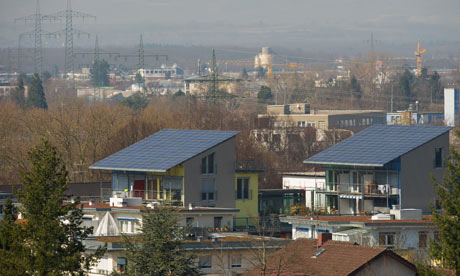
      Solar panels stand on the roofs of the Sun Ship part of the Freiburg Solar Settlement in Freiburg im Breisgau. Photograph: Harold Cunningham/Getty Images

      German solar power plants produced a world record 22 gigawatts of electricity – equal to 20 nuclear power stations at full capacity – through the midday hours of Friday and Saturday, the head of a renewable energy think tank has said.

      Germany‘s government decided to abandon nuclear power after the Fukushima nuclear disaster last year, closing eight plants immediately and shutting down the remaining nine by 2022. They will be replaced by renewable energy sources such as wind, solar and bio-mass.

      Norbert Allnoch, director of the Institute of the Renewable Energy Industry in Muenster, said the 22 gigawatts of solar power fed into the national grid on Saturday met nearly 50% of the nation’s midday electricity needs.

      “Never before anywhere has a country produced as much photovoltaic electricity,” Allnoch told Reuters. “Germany came close to the 20 gigawatt mark a few times in recent weeks. But this was the first time we made it over.”

      The record-breaking amount of solar power shows one of the world’s leading industrial nations was able to meet a third of its electricity needs on a work day, Friday, and nearly half on Saturday when factories and offices were closed.

      Government-mandated support for renewables has helped Germany became a world leader in renewable energy and the country gets about 20 percent of its overall annual electricity from those sources.

      Germany has nearly as much installed solar power generation capacity as the rest of the world combined and gets about four percent of its overall annual electricity needs from the sun alone. It aims to cut its greenhouse gas emissions by 40% from 1990 levels by 2020.

      Some critics say renewable energy is not reliable enough nor is there enough capacity to power major industrial nations. But the country’s leader, Angela Merkel has said Germany is eager to demonstrate that is possible.

      The jump above the 20 GW level was due to increased capacity this year and bright sunshine nationwide. The 22 GW figure is up from about 14 GW a year ago. Germany added 7.5 GW of installed power generation capacity in 2012 and 1.8 GW more in the first quarter for a total of 26 GW capacity.

      “This shows Germany is capable of meeting a large share of its electricity needs with solar power,” Allnoch said. “It also shows Germany can do with fewer coal-burning power plants, gas-burning plants and nuclear plants.”

      Allnoch said the data is based on information from the European Energy Exchange, based in Leipzig.

      The incentives provided through the state-mandated feed-in-tariff (Fit) are not without controversy, however. The tariff is the main support for the industry until photovoltaic prices fall further to levels similar for conventional power production.

      Utilities and consumer groups have complained the Fit for solar power adds about 2 cents per kW/h on top of electricity prices in Germany that are already among the highest in the world, with consumers paying about 23 cents kW/h.

      German consumers pay about €4bn per year on top of their electricity bills for solar power, according to a 2012 report by the country’s environment ministry.

      Critics also complain of growing levels of solar power make the national grid more less stable due to fluctuations in output.

      Merkel’s centre-right government has tried to accelerate cuts in the Fit, which has fallen by between 15% to 30% per year.

  • Vertical living is the answer to the world’s population growth

    Very good article for group discussion. This would not suit me.

    Vertical living is the answer to the world’s population growth

    Barangaroo

    TED founder Chris Anderson said population was set to rise to 10 billion within 70 years. Picture: Supplied Source: Supplied

    • Founder of TED said population set to rise to 10 billion within 70 years
    • One million people a week are moving to cities
    • He said urbanisation would save humanity

    CITIES will save humans – we just need to lose the family car, have less kids, and move into apartments to achieve a sustainable population.

    The founder of international talkfest TED Chris Anderson told a Sydney audience last night the world’s population was set to rise to 10 billion within the next 70 years, and only cities would stem a population growing too fast to feed and resource itself.

    “I think urbanisation is going to save humanity,’ he said.

    “One million people a week, every week, are moving into cities. That will go on for the next 70 years. There will be seven billion, out of nine or 10 billion people living in cities.

    “The global population is going to stabilise at 10 billion. In a village, an extra kid is an asset, to help work on the farm, but in a crowded city not so much.”

    He said education, and women being exposed to medical services, would see family sizes reduce from six or seven people, to just two or three.

    “We can get to a sustainable number of people,” he said.

    With two thirds of the population living in cities, the forest could regrow itself where settlements once were, he said.

    Mr Anderson cited New York City as one of the most sustainable on earth – where residents produce half the amount of carbon emissions as Sydneysiders.

    “They walk to work, they settle for smaller living spaces,” he said.

    While nations grew more frustrated at their federal governments floundering on major decisions, Mr Anderson said: “At a city level, things can get done.”

    He said the future would depend on the kind of city that developing nations chose to live in.

    “If they pick suburbia, big houses, lives build around driving a car, we’re screwed,” he said.

    “That is a lifestyle we have chosen in the west.

    “Vertical living has so many of the answers.”

    He said it was important architects realised that people did not want to live in a rat trap, or in a box jammed together.

  • New Streetlamp can Provide Mobile Phone Services, WiFi, Charge EV’s, and more

    New Streetlamp can Provide Mobile Phone Services, WiFi, Charge EV’s, and more

    Posted: 25 May 2012 03:24 PM PDT

    Modern society is based upon technology. The internet and telecommunication systems are vital for the smooth running of most economies. The problem is that mobile phone towers and other forms of wireless technology signal transmitters are unsightly and bulky.A Canadian novelist has designed a new utility tower which could provide all the necessary wireless communication services, as well as other modern services, in a sleek, lamp post.Vancouver Mayor Gregor Robertson with an illustration of a V-Pole. Martin Tessler & Mathew Bulford/V-Pole.comThe…

    Read more…

  • Irrigators say Murray-Darling Basin Authority ignored farmers’ concerns

    Irrigators say Murray-Darling Basin Authority ignored farmers’ concerns

    0
    Morshead family

    “The gloves are off”…Chris Morshead (left) with his father Harry and children Harry and James. Picture: Brad Hunter Source: The Daily Telegraph

    Murray Darling basin irrigation

    The Hume Dam on Murray River, providing lifeblood for irrigation farmers using Murray-Darling Basin. Source: Supplied

    < Prev

    2 of 2

    Next >

    IRRIGATORS feel the Murray-Darling Basin Authority has not listened to farmers concerns when it released the revised plan of the water system this morning nearly two years after the first guide was announced.

    The Authority’s initial figures in slashing 2750gl a year to be returned back to the environment remains the same, however, groundwater limits have been revised down from 4340gl to 3184gl.

    In its revised plan the authority says the 2750gl was a “robust starting point” and was the right place to start to return enough environmental water to the Basin to achieve most environmental objectives.

    But NSW Irrigators Council CEO Andrew Gregson said the authority had fundamentally failed to listen to the communities.

    He also urged Federal Water Minister Tony Burke that he could change the plan to stop thousands of job losses, the closure of family farms and the upward pressure on food prices.

    “That role has fallen to you. Their future lies in your hands. You’re all that stands between them and social economic Armageddon,” Mr Gregson said.

    “Change the Basin Plan, Minister.”

    Griffith farmer Chris Morshead said farmers had shown they were willing to work with the Authority to come up with a different figure but they had failed to listen.

    “We have given them an opportunity to work with us and come to an agreement with a meaningful outcome they have disregarded that,” Mr Morshead said.

    “It’s on now and the gloves are off.

    “We are not interested, they should put it in the bin as the numbers are too high.”

    Since the release of the draft in November, Authority chair Craig Knowles said it had continued to consider and test ideas and information to revise the draft plan that it was now presenting to Basin governments.

    “We’re confident that the Plan is well balanced and presents a way forward on management of the Murray–Darling system,” Mr Knowles said.

    “It is now over to the Basin ministers and the Federal water minister to lead the next stage of the Basin Plan process.”

    This version of the plan, titled the ‘Proposed Basin Plan – A Revised Draft’, now enters its ministerial and parliamentary process.

    It goes to all Basin water ministers for consideration for a maximum of six weeks, as stipulated by the Water Act. Following this, the Basin Plan will be given to the Federal Water Minister.

    In the Authority’s statement today it said over the course of 20 weeks formal consultation it had met with stakeholders holding a total of 24 public meetings, 56 round table and technical meetings, 18 social and economic briefings, five regional briefings, 31 bilateral and a tailored Indigenous consultation process in more than 30 towns in the Basin.

    By the end of the 20 weeks it had received nearly 12,000 submissions from individuals, organisations and governments across Australia, as well as some from overseas.

    AS a result of the feedback it says it has made more than 300 further changes to the draft plan ranging from new provisions to the draft plan to redrafting it to improve clarity.


  • Greek crisis sees new wave of migrants

    Greek crisis sees new wave of migrants

    ABCUpdated May 27, 2012, 10:19 am

    Video Player Controls

    The face of Australia’s Greek community is rapidly changing because of the economic crisis crippling Greece.

    Immigration statistics show around 280 expatriates – mostly families and skilled migrants – have come back to Australia over the past year but the total number of Greek citizens in Australia is expected to be higher, with many more here on holidays.

    The Honorary Consul for Greece in the Northern Territory, John Anictomatis, says there has been a huge influx of new Greeks in Darwin.

    “For the last six months, the figures show that on average about 10 new arrivals a week are coming back to Darwin, whether it’s family groups or people coming back on their own before they bring their families back to Australia,” he said.

    Drossos Tavlarios, 27, came to Darwin from his home on a Greek island after being unable to get work.

    He says he is one of the lucky ones.

    “Everything is okay, very nice in Darwin,” he said.

    Mr Anictomatis says he gets desperate calls from Greece every week.

    “They’re mainly desperate about employment, their children’s future,” he said.

    The influx to the Top End has prompted Territory Government minister Kon Vatskalis to call on the Federal Government to consider special working visas for Greeks who have been affected by the economic crisis.

    Mr Vatskalis says the Territory is set to face a major skills shortage when a major gas project starts.

    He says it makes sense to bring Greeks over on working visas to help fill the gap.

    “We’re talking about an exodus of people from the industry now because they are going to get well-paid jobs with Inpex,” he said.

    “How are we going to replace these people? We can’t replace them out of nothing.”

    Meanwhile, the British government is drawing up emergency immigration controls to combat any surge in economic migrants from Greece and other European Union countries if the euro collapses.

    Interior minister Theresa May has told a UK newspaper that it is right for Britain to do some contingency planning, but did not say what steps could be applied.

    An increasing perception that Greece or other debt-laden countries might have to leave the eurozone has brought concerns that millions could lose their jobs and go abroad in search of work.

  • Former MP says State Govt neglecting Snowy

    Former MP says State Govt neglecting Snowy

    Posted May 25, 2012 11:38:05

    Loading…

    Map DataMap data ©2012 GBRMPA, Google, Whereis(R), Sensis Pty LtdTerms of Use
    Map Data
    Map data ©2012 GBRMPA, Google, Whereis(R), Sensis Pty Ltd
    Map data ©2012 GBRMPA, Google, Whereis(R), Sensis Pty Ltd
    Map
    Map
    Satellite

    Map: Jindabyne 2627

    The former Labor Member for Monaro, Steve Whan, has accused the State Government of neglecting the New South Wales Snowy River.

    It has been a year since the first term of the Snowy Scientific Committee came to an end.

    The Office of Water says the Minister for Primary Industries, Katrina Hodgkinson, will be in a position to make an announcement soon.

    Mr Whan in now a Member of the State Upper House and says the key advisory group should have been reinstated a year ago.

    “This is clearly a ministerial-level failure,” he said.

    “Minister Hodgkinson doesn’t have much idea about the Snowy River.

    “She’s never shown an interest in it.

    “I think if you go back, you will find that she, amongst other Nationals, actually opposed the water being returned to the River.”

    Greens MP John Kaye says it should have been a simple administrative process to reinstate the group.

    The Energy and Resources Department handed the matter to the Primary Industries Minister earlier this year, but the ABC has been told the Finance Minister could now be involved.

    Dr Kaye says he is concerned about the level of confusion.

    “We’re very concerned that this has just gotten lost in a major administrative bungle within the O’Farrell cabinet,” he said.

    “It appears that the responsibility for appointing the committee has moved at least once, but possibly twice between Ministers.”

    The Primary Industries and Finance Ministers have been contacted for comment.

    For more, go to the South East News Blog.

    Topics:environment, water-management, government-and-politics, jindabyne-2627