Category: Articles

  • Luxembourg by e-bike: a natural high

    Luxembourg by e-bike: a natural high

    The ability to flick a switch and top up pedal power with battery power gives me the extra push I need to master the Ardennes

    Bike blog : E-biking in Luxembourg

    E-biking in Luxembourg. Photograph: Frederika Whitehead

    Gust Muller, president of Luxembourg’s cycling advocacy group LVI, promised me that “hills will just melt away” if I used an e-bike to tour Luxembourg. And this wasn’t far from the truth.

    Although it has many miles of extremely pretty, pancake-flat leisure routes that follow old tram lines or run alongside its rivers, Luxembourg can also be hilly, particularly in the north of the country around the Ardennes.

    Using an e-bike, Muller assured me, would mean that I – and I’m no Andy Schleck – could cycle in the Ardennes region. He didn’t promise that I’ll be able to summit the highest peaks, but he said the ability to flick a switch and top up pedal power with battery power would give me the extra push I needed to master the Ardennes – a region which would normally be out of my league.

    The city of Luxembourg itself is on an incredibly steep sandstone perch – its base starts 750ft above sea level, and it peaks at 1,319ft – and though I did make it up to the top on an ordinary bike, this was one single climb without baggage, and I was a sweaty mess when I got there.

    On day two we took a bus to Beckerich to collect our e-bikes and we rode along routes 12, 16 and 3 to Vianden. We didn’t really need e-bikes for this ride. At least not until the end of the day when we reached Vianden, when I was very pleased to be on one.

    For most of the day we rode a traffic-free route along a former tram track through gently undulating farmland. But it was good to have the opportunity to get used to the bikes. This being the continent, the bikes we rented had backpedal brakes, which took me ages to get used to, I never realised before how frequently I back-pedal when I ride. I suppose I do it to get into the coasting position, but with the unfamiliar backpedal brakes this meant that whoever was cycling behind me had to be constantly aware of me inadvertently slamming my brakes on when I meant to coast.

    Despite the fact the slopes on day one were fairly gentle, it was too much of a temptation not to try the motor. Muller was right, battery assistance did melt the hills away. Riding up a small hill with the motor on felt like riding on the flat. It’s not like being on a moped, you still have to pedal hard to make it up hills, and you still get out of breath, it’s just that you make it up there a whole lot faster so overall it’s less tiring. It makes a sound like an electric milk float but it’s barely audible with the wind rushing past. Muller warned us against over using our batteries: weighing in at 25kg “it’s an awful lot of bike to push up a hill if you run out,” he said.

    On day three we left the exquisitely pretty medieval town of Vianden and headed north through the Ardennes to Kautenbach. This was the day when ordinary mortals like myself needed motor assistance.

    We saw only four other, “proper” cyclists in 35km, and they were all going downhill. Otherwise, apart from the occasional dog walker, the paths were completely empty.

    Ultimately e-bikes are a good thing – they make cycling possible in areas where it would otherwise be off-limits to all but the fittest people. Personally, I wouldn’t buy one for daily riding where I live because it’s flat enough to manage without one, but for holidays e-bike rental means that hilly places, like Luxembourg’s Ardennes, become possible.

    How to do it

    Frederika took the Eurostar to Brussels, and an intercity from Brussels Midi to Luxembourg. She hired her e-bike from Rent-a-bike Miserland for €17 a day. She stayed in the Bed+Bike hotels, Hotel Châtelet in the city of Luxembourg, and Auberge Aal Veinen, in Vainden.

  • Nuclear Safety Debate Between Industry, Regulators Focuses On Radiation Filters

    Nuclear Safety Debate Between Industry, Regulators Focuses On Radiation Filters
    Huffington Post
    Nuclear safety advocates, however, argue that the industry is simply jockeying to avoid added costs as the commission begins to implement tougher safety guidelines for US reactors in the aftermath of last year’s meltdown at a Japanese power plant.
    See all stories on this topic »

  • Only biofuels will cut plane emissions

    Only biofuels will cut plane emissions

    We need something that can deliver emission reductions from existing fleets of planes – and the solution already exists

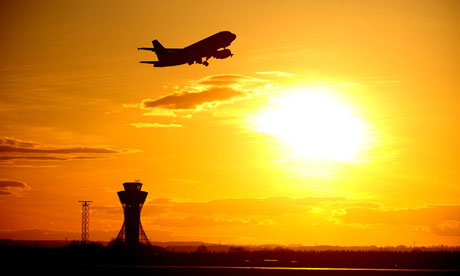
    • A plane taking off from Newcastle airport

      A plane taking off from Newcastle airport. Photograph: Owen Humphreys/PA

      As a small, maritime trading nation Britain has always been some distance from big international markets. Our ability to visit far-off places and people, and their access to us, has always been at the heart of our ability to punch above our weight in the world, whether that’s commercially, culturally or diplomatically.

      In the past we were dependent on ships, now we are reliant on commercial airlines, as well as the Channel Tunnel and secure data networks. This infrastructure is critical for our future, particularly as we look to major economies like India, China and Brazil for export opportunities. But it is also vital for sustaining our outward facing society and culture; one that’s confident engaging with the world and welcoming of its diversity.

      Rail and video-conferencing will help, but air travel will remain absolutely essential and more people are going to fly, especially to and from a networked, diverse, outward-facing island nation like our own.

      We should embrace this, but we must also recognise that flying more will also have negative consequences, in particular greenhouse gas emissions. The positive progress on including aviation in Europe’s carbon trading scheme this week is welcome, but neither that nor more efficient aircraft will deal with the industry’s climate problem. As I will argue, only biofuels can do that. Aviation currently accounts for a relatively small proportion of global carbon emissions: 6% of UK, 4% of European Union and 2% of world. This will change fast though, with global aviation expected to grow at 5% a year for at least the next 15 years. If so, by 2050 aviation emissions will account for up to 20% of global emissions, making tackling global warming significantly harder.

      Though new airport capacity in the UK is essential, plans for it must convincingly address this important pollution challenge.

      Including aviation in the Europe’s Emissions Trading Scheme is a step in the right direction, but at current carbon prices it will not spur the innovations needed to cut pollution. Some say the aviation sector has a good track record of improving the fuel efficiency of new aircraft, achieving an average annual improvement of about 1.5%. But these emissions savings will be completely overwhelmed by growing global demand for aviation.

      So we desperately need something that can deliver a step-change in emission reductions from existing fleets, particularly as planes built today will be in service for many years to come. The only option is to replace existing jet fuel (kerosene) with an alternative that can deliver deep emission reductions and be used to current aircraft. Fortunately, this technology exists: sustainable bio jet fuels. Made from advanced feedstocks and able to provide significant life-cycle emission reductions and meet other stringent sustainability standards, these fuels can be produced today and have already received certification for use in commercial jet aircraft. They can also be produced now at costs not far above the high and volatile price of jet fuel, with Bloomberg predicting that they could potentially reach price parity with kerosene in 2016.

      There is an opportunity for the UK to align its need to develop new airport capacity with the development of sustainable bio jet fuels at scale. We should work to ensure that any new airport provide airlines with the best biofuels available.

      Airport operators should have to provide airlines with a blend of jet fuel that has a significant and rising proportion of sustainable bio jet fuel. This would significantly reduce emissions from flights. The mandate should start at an achievable level, say where the blend would have to be 15% less polluting than jet fuel today based on the strictest sustainability standards. It could then ratchet up to reach a point where the blend was 60% less polluting within a reasonable time-frame.

      Airlines would benefit from a genuine and cost-effective emission reduction strategy, which might even attract environmentally conscious flyers. Not many hubs would need to follow the UK before the majority of international flights used sustainable bio jet fuel blends, perhaps only New York, Dubai, Hong Kong and Singapore need change, in addition to London.

      An ambitious blending mandate would send exactly the signal required to accelerate the development of sustainable bio jet fuels. Airport operators would be required to demonstrate they had a plan to meet the incoming mandate and would sign supply contracts with developers, which would spur innovation and investment. The UK government could also ensure that our leading biotech, aviation and university sectors work in unison to create solutions, through targeted research programmes and tax relief for collaborative work.

      The luddite wing of the environmental movement will think such proposals sacrilegious – their only solution is to stop flying. But the reality is that there will be and should be more international travel, particularly to and from the UK. The challenge is to make this as least polluting as is possible, while also minimising local airport impacts. By aligning the debate about airport capacity sensibly with environmental objectives, we can make a significant dent in aviation emissions globally as well as guarantee sufficient airport capacity to keep UK plc open for both business and pleasure.

      • Ben Caldecott is head of policy at Climate Change Capital and co-author of ‘Green Skies Thinking: Promoting the development and commercialisation of sustainable bio-jet fuels


  • Water policy needs ‘radical’ change to protect people and environment

    Water policy needs ‘radical’ change to protect people and environment

    Ahead of Rio+20, a report is calling for a joined-up approach to managing the world’s water, land and energy demands

    • guardian.co.uk, Wednesday 16 May 2012 13.00 BST
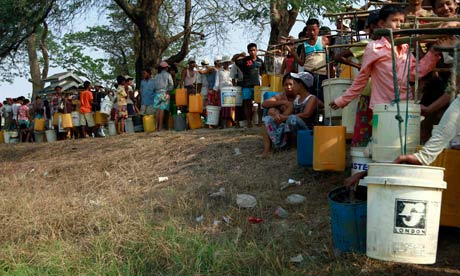
    • MDG : Water policy  : line up to fetch drinking water in Yangon , Myanmar

      Residents carry plastic containers on their shoulders as they line up to fetch drinking water from a lake in Yangon, Burma. Photograph: Khin Maung Win/AP

      The international community needs to “radically transform” the way it manages water, energy and land to ensure the needs of the poorest people are met and the environment is protected, according to the European Report on Development, published on Wednesday.

      The flagship report, Confronting scarcity: managing water, energy and land for inclusive and sustainable growth, calls on the EU to adopt an integrated approach to managing the three elements to achieve universal access to water and energy, and sustainable food security.

      An estimated 1 billion people are still undernourished, around 0.9 billion have no access to safe water and 1.5 billion have no electricity. The demand for water and energy is expected to rise by 40% by 2030 and by 50% for food. Badly managed or scarce resources tend to hit the poorest people hardest.

      “Co-ordination failures between policies on water, energy and land need to be addressed to avoid the negative impacts of these interlinkages,” said the report, which aims to “shape global action” in the run-up to next month’s Rio+20 UN conference on sustainable development.

      “A drop of water, a piece of land, or a kilojoule of renewable energy cannot be seen through the single lens of one sectoral policy or management system. What might appear to be an efficient policy in one dimension can be harmful for others,” it said.

      Achieving this joined-up approach will involve the public and private sectors, and the EU. The public sector would provide the regulatory and legal frameworks for change, including those that make for a more conducive environment for private sector investment, as well as some of the money. The private sector should create more sustainable practices in accessing and consuming natural resources, while the EU will support poorer countries through aid and its wider development policy.

      Launching the report in Brussels, the European commissioner, Andris Piebalgs, said: “This report is particularly relevant and timely ahead of the UN Rio+20 conference and the international year for sustainable energy for all. Water, energy and land are crucial resources for development and human wellbeing, and scarcity cannot be overcome by piecemeal actions.”

      The annual report, compiled by the Overseas Development Institute, the European Centre for Development Policy Management and the German Development Institute, sets out ideas for governments, business and the EU to consider. To strengthen water security for poor communities, for example, it suggests that national governments are supported to implement integrated water resources management programmes.

      It calls for a significant reduction in the environmental footprint of consumption in developed countries – though not exclusively.

      The report also urges governments to ensure land investments contribute to economic development and that deals are not at the expense of weakening ecosystems or people’s livelihoods. It argues for strengthened land tenure to protect customary and collective rights.

      Initiatives that protect the environment, such as halting deforestation, should be rewarded with payments, says the report, offering as an example a scheme operating around Lake Naivasha in Kenya under which companies pay local smallholders who put their land to good use.

      The sentiments of the report chime with an increased focus on joined-up approaches to the challenges of water, land, energy and food security. In March, the ministerial declaration from the World Water Forum called for a greater recognition of the links between water, food and energy in decision-making to improve the “sustainable management of these scarce resources”.

      In November, a report by the International Institute for Environment and Development made an explicit link between water and land. It said African governments were signing away water rights to land investors, who want to profit from water fees and improved agricultural yields and revenues. These “water grabs” show little regard for their impact on people, said the report. “Water managers must seriously consider the extent to which water rights should be linked to land in this way before setting a long-term precedent that could compromise sustainable and equitable supply to all users in the future,” it said.

      Wednesday’s report comes two days after foreign ministers endorsed the European Commission’s Agenda for Change policy, under which more money will be targeted towards the world’s least developed countries and budget support will be made dependent on governments’ human rights and governance records. The new agenda makes clear the EU’s desire to see sustainable, inclusive growth and development, and to increase the involvement of the private sector, which includes allowing them access to development aid.

      Critics have argued that the private sector role lacks clarity. “Will it be local firms in developing countries or foreign multinationals who get access to funds? EU countries need to make sure they don’t divert essential aid support away from those most in need,” said Olivier Consolo, director of the European NGO confederation Concord.

      Last month, the EU pledged €50bn to support clean energy projects in developing countries.

  • Sustainable energy for all focus of summit- Peak OIl

    Sustainable energy for all focus of summit- Peak OIl
    Cherry Creek News
    Nearly two billion people, about one-third of the world’s population, don’t have access to energy, according to the United Nations. So the leading goal for the upcoming 2012 United Nations Earth Summit is “energy for all” by the year 2030,
    See all stories on this topic »
    Drink the water
    MarketWatch
    Peak oil and the feeling everyone has that we are running out has made everyone net buyers, every year. So forget peak oil. Today I want you to think about peak water. Americans are probably never going to buy less than 7 million cars a year.
    See all stories on this topic »

    MarketWatch


    This once a day Google Alert is brought to you by Google.

    Delete this alert.
    Create another alert.
    Manage your alerts.

  • Science daily: Earth Science News

    ScienceDaily: Earth Science News


    Sulfur finding may hold key to Gaia theory of Earth as living organism

    Posted: 15 May 2012 05:31 PM PDT

    Is Earth really a sort of giant living organism as the Gaia hypothesis predicts? A new discovery may provide a key to answering this question. This key of sulfur could allow scientists to unlock heretofore hidden interactions between ocean organisms, atmosphere, and land — interactions that might provide evidence supporting this famous theory.

    Statistical analysis projects future temperatures in North America

    Posted: 15 May 2012 10:16 AM PDT

    For the first time, researchers have been able to combine different climate models using spatial statistics — to project future seasonal temperature changes in regions across North America.

    Arctic seabirds adapt to climate change

    Posted: 15 May 2012 06:39 AM PDT

    The planet is warming up, especially at the poles. How do organisms react to this rise in temperatures? Biologists have now shown that little auks, the most common seabirds in the Arctic, are adapting their fishing behavior to warming surface waters in the Greenland Sea. So far, their reproductive and survival rates have not been affected. However, further warming could threaten the species.
    You are subscribed to email updates from ScienceDaily: Earth Science News
    To stop receiving these emails, you may unsubscribe now.
    Email delivery powered by Google
    Google Inc., 20 West Kinzie, Chicago IL USA 60610