Category: Articles

  • Overseas aid to Africa being outweighed by hefty costs of importing oil

    Overseas aid to Africa being outweighed by hefty costs of importing oil

    Sub-Saharan states need to move to renewable energy sources as $15bn in aid is outstripped by $18bn in oil imports, says IEA

    • guardian.co.uk, Sunday 1 April 2012 19.28 BST
    • Article history
    • A NIGERIAN CHILD IS SILHOUETTED AGAINST THE GAS FLARE AT UTOROGU SHELL FACILITY IN NIGERIA'S DELTA

      A child stands near a gas flare at the Utorogu facility in the Nigeria. Many poorer sub-Saharan countries are ‘running at standstill’ in development terms because they are paying too much of energy imports. Photograph: George Esiri/Reuters/Corbis

      Developing countries in Africa received less in overseas aid last year than they paid for oil imports, new figures show.

      Sub-Saharan Africa received about $15.6bn (£9.7bn) in overseas development aid last year, but this was outweighed by the $18bn cost of importing oil, according to the figures compiled by the International Energy Agency and seen by the Guardian.

      A decade of soaring oil prices has created huge problems for development efforts in countries whose attempts to industrialise have left them heavily dependent on fossil fuels. Even though overseas aid has increased, poor nations are effectively “running to stand still” in development terms, because they are paying so much for energy imports.

      With oil prices likely to remain high, the only answer is for developing countries to move to cleaner renewable sources of energy, Fatih Birol, chief economist at the IEA, told the Guardian.

      “If you diversify the sources of energy, that is a good thing and clean energy means using free, homegrown resources so that will bring down the import bills,” he said.

      When industrialised economies were developing, oil was the equivalent of $13 a barrel, but now developing countries must pay $120 to $130, noted Birol, which leaves developing countries “hamstrung” – so if more people are to be lifted out of poverty, clean energy must be an imperative.

      The data from the IEA, widely regarded as the gold standard for energy analysis, rang alarm bells for campaigners, and is likely to be closely examined by donor governments, which have not tended to prioritise clean energy in the past.

      A DFID spokesperson said: “The whole world is affected by rising oil prices, but no country can pull itself out of poverty until it has a decent and reliable energy service. British aid is helping to improve the health, education and welfare of millions of the poorest, including providing cleaner, greener energy such as solar power to help grow their economies. Renewable and efficient energy can reduce dependency on fossil fuels, as well as helping to create new jobs in emerging low carbon sectors.”

      Ruth Davis, chief policy adviser at Greenpeace UK, said: “People in poorer countries are being hit twice by the oil industry. They are the first to suffer the impacts of climate change, while their economies are blighted by the rising cost of imported fuel. Instead of giving taxpayer handouts to the fossil fuel industry through World Bank aid programmes and Export Credit Guarantee schemes, countries like the UK should be investing in renewable energy and energy efficiency projects in developing countries, which will improve access to energy for the poor and help build stronger economies.”

      While rapidly emerging economies such as China and India are forging ahead on wind and solar power, little has been invested in Africa. This is not because of a lack of renewable energy resources, but because private sector investors see the continent as a riskier proposition.

      Under the United Nations scheme to give poor countries access to low-carbon technology – the clean development mechanism – the lion’s share of the billions of investment has gone to China, followed by India and other big emerging economies, but a paltry sum has gone to build projects in Africa.

      Birol, one of the world’s foremost authorities on energy economics, added that the problem of oil addiction was compounded by distorting subsidies for fossil fuels, common in many developing countries. These subsidies will reach a record $630bn this year, according to the IEA’s latest data, which Birol said represented not only a market distortion that would exacerbate climate change, but a drain on the Treasuries of poor countries, which could better spend the money on social projects such as in education or health.

      Although such subsidies are supposed to protect poor people from the impact of rising energy prices, in fact they usually disproportionately benefit the better-off, and in some cases are hijacked by profiteers.

      Birol also warned that putting off renewable energy investment because of the financial crisis and recession was “a false economy”. Many countries have scaled back their investment in low-carbon energy – the UK, Spain and Germany have slashed support for renewables, for instance. But Birol’s analysis shows that for every $1 that countries do not spend on cleaner fuel, they will have to spend $4.3 within the next two decades to make up, for their reliance on fossil fuels.

      Developed countries are far from immune to the problems of oil dependence – Birol noted that last year’s bill to the EU for oil imports topped $500bn for the first time, and that these payouts were a substantial drain on European economic resources.

      “That is the equivalent of a Greek crisis – every year,” he warned.

  • The dangerous implications of India’s nuclear romance

    News 2 new results for DANGER TO US NUCLEAR PLANTS
    The dangerous implications of India’s nuclear romance
    Cogeneration & On-Site Power Production Magazine
    Efforts are on to squelch the months-long peaceful movement by villagers living in the neighbourhood of the Kudankulam nuclear plant in Tamil Nadu which has delayed its commissioning. What brought the people out of their homes is the fear that the
    See all stories on this topic »
    Feds eyeing Chalk River site for nuclear waste burial
    CTV.ca
    A warning sign posted at the AECL plant in Chalk River, Ont. is seen in this Dec. 19, 2007 file photo. (Fred Chartrand / THE CANADIAN PRESS) OTTAWA — Enough nuclear waste to fill more than a hundred Olympic-sized swimming pools could be buried in an
    See all stories on this topic »


    This once a day Google Alert is brought to you by Google.

    Delete this alert.
    Create another alert.

  • Scientists refine earth’s clock

    ScienceDaily: Earth Science News


    Scientists refine Earth’s clock

    Posted: 29 Mar 2012 11:19 AM PDT

    New research has revealed that some events in Earth’s history happened more recently than previously thought. Scientists have refined the data used to determine how much time has passed since a mineral or rock was formed. They report uranium isotopic composition of minerals, used to date major geological events, which are more accurate than previously published.
    You are subscribed to email updates from ScienceDaily: Earth Science News
    To stop receiving these emails, you may unsubscribe now.
    Email delivery powered by Google
    Google Inc., 20 West Kinzie, Chicago IL USA 60610
    Reply
    Forward
    Click
  • Nuclear google alerts

    News 4 new results for DANGER TO US NUCLEAR PLANTS
    Feds: Calif. nuke plant to remain shut for probe
    Las Vegas Sun
    AP The troubled San Onofre nuclear plant in Southern California will remain shut down until federal regulators can determine why tubes carrying radioactive water in the plant’s massive generators are rapidly decaying.
    See all stories on this topic »
    Would you buy a reactor from the firm that gave you this
    Daily Mail
    It was clear that when Britain needed a new nuclear capability, the only workforce on hand would be an army of redeployed pensioners. It is not even clear other countries would allow us to have a new set of reactors. Last year, an editorial in The
    See all stories on this topic »

    Daily Mail
    Seoul Dilemma: Nuclear Power Production And Nuclear Security – OpEd
    Eurasia Review
    But humanity is increasingly aware of the dangers resulting from nuclear power generation for peaceful purposes. There was the Chernobyl nuclear power plant accident of 1986, nuclear power plant accidents in the US and France, and also last year’s
    See all stories on this topic »
    The boomerang effect: Could American cyberweapon be turned against us?
    Fox News
    After the Stuxnet virus hit Iran’s nuclear power plants in 2010, it was collected and disseminated, falling into the hands of hackers and code-crafters worldwide. Richard Clarke, the former counterterrorism chief, is confident that the US wrote the
    See all stories on this topic »
  • Richard Branson off to the ‘ centre of earth’

    News 9 new results for volcanoes
    Magna charter: Scientists have new way of predicting when volcanoes will erupt
    Mirror.co.uk
    Predicting when volcanoes will blow could be made easier after a study explored their “plumbing systems”. Two years ago flights out of the UK were suspended by an ash cloud from the Eyjafjallajoekull volcano eruption in Iceland.
    See all stories on this topic »
    Richard Branson off to ‘centre of earth’
    The Daily Telegraph
    Never mind: Cameron will eat his heart out hearing that Branson says he will take Black Eyed Peas singer will.i.am in a special capsule down into a volcano and from there to the molten centre of the planet. “I have long held a fascination with
    See all stories on this topic »
    Eruption Update for March 30, 2012: Alaska and Hawai’i
    Wired News
    Two volcanoes dominate the news from Alaska these days: Cleveland and Iliamna. Both have jumped back and forth from Yellow/Advisory to Orange/Watch status over the past few months. Right now, Cleveland has returned to Orange/Watch status after new
    See all stories on this topic »
    British billionaire Richard Branson plans trip to ‘centre of Earth’ after
    Daily Mail
    Branson teased about his less-than-serious plans on his website: ‘I have long held a fascination with volcanoes having read Jules Verne’s “Journey to the Centre of the Earth” as a young boy.’ He went on to say: ‘Volcanoes are the next great unexplored
    See all stories on this topic »

    Daily Mail
    Explore Landmannalaugar and Iceland volcano with SuperJeep tour
    IceNews
    SuperJeep.is, a leading Iceland tour provider, is now offering tours to the beautiful area of Landmannalaugar in combination with a stop-off at Mount Hekla – one of Iceland’s most active volcanoes. Before reaching Landmannalaugar, the tour heads to
    See all stories on this topic »

    IceNews
    Richard Branson headed to ‘center of Earth’
    Economic Times
    “I have a long held a fascination with volcanoes having read Jules Verne’s ‘Journey to the Centre of the Earth’ as a young boy,” Branson said on the website. “Volcanoes are the next great unexplored terrain. What can I say, I lava challenge!
    See all stories on this topic »
    Volcanic plumbing exposed
    Science Codex
    Two new studies into the “plumbing systems” that lie under volcanoes could bring scientists closer to predicting large eruptions. International teams of researchers, led by the University of Leeds, studied the location and behaviour of magma chambers
    See all stories on this topic »
    Bali: Perfect holiday island
    Moneylife Personal Finance site and magazine
    Bali’s list of attractions are many—perfect palm-fringed beaches, endless coral reefs and scuba dive sites, wonderful cone-shaped volcanoes, ancient temples, highly developed crafts, a rich Dutch colonial heritage and friendly people,
    See all stories on this topic »

    Moneylife Personal Finance site and magazine
    Mars’ mystery cloud explained
    msnbc.com (blog)
    This photo from amateur astronomer Wayne Jaeschke shows cloud cover on the right side of the Martian disk, with the tops of the planet’s huge shield volcanoes sticking through the clouds. For more from Jaeschke, check out his Exosky website.
    See all stories on this topic »
  • Source of North Sea gas leak found

    Source of North Sea gas leak found, says Total

    Oil company says Elgin rig is still at risk of explosion but situation now ‘bad case’ rather than ‘worst-case’ scenario

    • guardian.co.uk, Thursday 29 March 2012 20.29 BST
    • Article history
    • Gas leak on Total platform 28/3/12

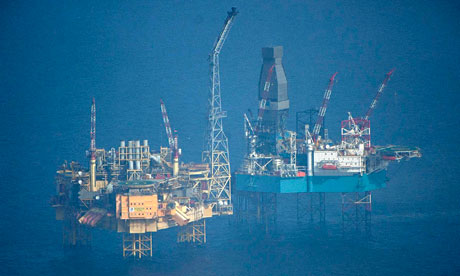
      Total’s Elgin platform, about 150 miles off the coast of Aberdeen. The leak is from a gas pocket 2.5 miles underground, the company says. Photograph: Martin Langer/Greenpeace/PA

      Oil company Total believes it has found the source of the gas leak from its North Sea platform, as it sent two fire-fighting vessels to the edge of the emergency exclusion zone.

      The French fuel group said it had traced the leak to a gas pocket in a rock formation 4km (2.5 miles) below the seabed but 1km above the gas reservoir being tapped by the Elgin platform, which was evacuated on Sunday when the leak was discovered.

      In an attempt to quell fears about the risks of explosion from the gas cloud which has settled above the area, it said there were now fire-fighting ships on standby at the edge of the two nautical mile (2.3 mile) exclusion zone.

      Marine experts and oil industry unions are alarmed about the dangers of the gas cloud being ignited by a flare still burning on the platform, about 100 metres from the leak, if the wind changes direction in coming days.

      Union leaders have urged oil companies to evacuate every rig and platform within five miles of the Elgin as a precaution. Total said the wind was expected to continue blowing the gas away from the flare, which was well above the gas cloud, and predicted the flare could burn itself out within a few days.

      In a statement on Thursday evening, the company said the flare was burning off evaporating liquids still in the platform’s system. “As these liquids evaporate the flow of hydrocarbons to the flare will exhaust itself and the flare should burn out,” it said.

      Total disputed allegations that the gas was leaking from the seabed and that it was toxic. It said the gas was escaping from the deck level of the platform, about 25 metres above sea level, and was natural gas.

      “This means that we now know the source of the leak, we know the problem,” a company spokesman said. “We can now look at solving that problem as quickly as possible. All our focus is now on fixing it as soon as we can.”

      Frederic Hauge, head of Norwegian environment group Bellona, told Reuters: “The bad news is that the leak is continuing and that it reduces the possibility it could be plugged by sand or other material.

      “The good news is that the flow rate of gas coming to the surface is not increasing.”

      Total has a team of engineers working on contingency plans, including the potential for drilling a relief well to siphon off the gas, or to suppress the leak by injecting mud down the well.

      The site remains off-limits, however, because of the potentially explosive gas cloud.

      Hauge said that since the leak appeared to come from a gas pocket at lower pressure and smaller volume than Elgin’s main reservoir “we move from a worst case scenario to a bad case scenario. But this is not a good case scenario as long as gas is leaking.”

      In a question and answer session on the company’s Facebook page for the Elgin emergency, Jacques-Emmanuel Saulnier, Total’s head of communication, said: “The wind is pushing the gas cloud in the opposite direction [from the platform]. At this time, the circumstances are rather favourable.”

      He added: “A gas cloud is always a fire hazard.”

      Admitting there was still a risk of explosion, Saulnier added that the firm’s first priority had been to evacuate the 238 workers on the platform. He added: “Now, our priority has to be stopping the leak in order to avoid all risk of explosion and also to limit the impact on the environment.”