Category: Articles

  • Oil firm given go-ahead for Canary Islands drilling

    Oil firm given go-ahead for Canary Islands drilling

    Anger at Spanish government’s decision to allow drilling 60km from Lanzarote and Fuerteventura

    • guardian.co.uk, Tuesday 20 March 2012 13.36 GMT
    • Article history
    • Lanzarote

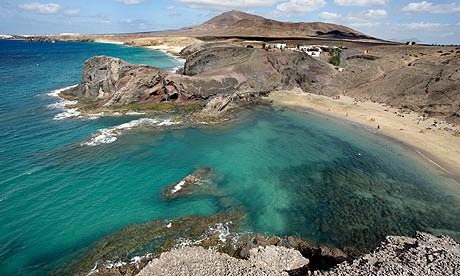
      Playa Papagayo beach in Lanzarote. Opponents of the drilling warn an oil spill would wreck beaches on the islands and drive away tourists. Photograph: B.A.E. Inc./Alamy

      One of Britain’s best-loved holiday destinations is under threat from oil prospectors who have been given permission to drill for offshore fields, according to local authorities and hoteliers in the Canary Islands.

      The area’s authorities have reacted angrily to a Spanish government decision that allows the giant Repsol company to look for oil 60km (37 miles) off the coasts of Lanzarote and Fuerteventura, warning that a spill would wreck beaches and drive tourists away.

      “This is not compatible with the kind of sustainable tourism we want,” said regional prime minister Paulino Rivero, of the Canary Coalition party. “It only benefits Repsol.”

      TUI, owner of Thomson and First Choice holiday brands, has already expressed worries that an oil spill might permanently damage the Canary Islands’ reputation as a holiday spot.

      “A tragedy of this kind would not just ruin a single tourist season, but would see the Canary Islands forever associated with oil,” TUI’s head of sustainability, Harald Zeiss, said in a letter to the island government of Fuerteventura.

      But Spain‘s new conservative government, which gave the go-ahead for drilling, hopes oil and gas fields hidden under the Atlantic seabed will allow it to reduce oil imports.

      “Apart from reducing our almost total dependency on imported gas and petrol, it also has great potential to create highly qualified jobs and benefit the islands’ economy,” a government statement said.

      Repsol would be expected to pay for any clean-up operation caused by an accident, and extraction licences would have to be approved separately. The company claims it would create up to 5,000 jobs.

      Local environmentalists said the only jobs would be for specialists from abroad.

      “This is a threat to the islands’ economy, which is based on tourism, and to a rich source of maritime biodiversity,” said Iván Darias of the Ecologists in Action group. “Both the technology and the depth of the fields they seek are similar to those used in Louisiana in 2010.” Fears over oil spills have increased since the explosion on BP’s Deepwater Horizon rig off the Louisiana coast in 2010 which killed 11 people and released millions of barrels of crude into the Gulf of Mexico.

      “The government is creating the same sort of risks that can lead to accidents like the one seen in the Gulf of Mexico,” agreed Greenpeace spokesman Mario Rodríguez.

      Around 2.6 million British holidaymakers visit the Canary Islands every year.
  • David Attenborough urges business to protect nature from population boom

    David Attenborough urges business to protect nature from population boom

    Corporations have a leading role to play to make sure ‘mankind doesn’t spread willy nilly over every square yard of the globe’, says naturalist

    • guardian.co.uk, Wednesday 18 January 2012 12.16 GMT
    • Article history
    • Crowded beach by the East Pier in Brighton

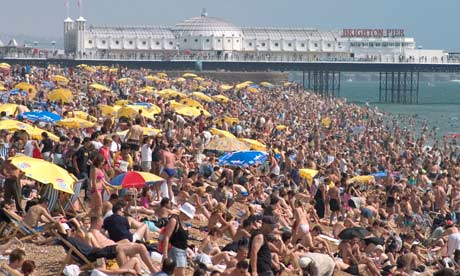
      A crowded beach in Brighton … the earth’s population is expected to reach 9 billion by 2050. Photograph: Paul Carstairs/Alamy

      Sir David Attenborough has called on big businesses to protect the natural world from the rapidly expanding human population.

      The broadcaster and naturalist said the population increase is unstoppable and that action must be taken to stop the natural world from being concreted over.

      Distancing himself from conservationists who regard big businesses as the enemy, he said companies and corporations, as the holders of much of the world’s wealth, have a vital and leading role to play.

      “It’s not a mystery. Wealth empowers,” he said. “And businesses have by no means been slow in helping. We’ve [conservationists] gone to multinationals over and over again.”

      He said there were exceptions, but that for the most part businesses that defiled the natural world in the 19th and to an extent the 20th century, such as by dumping waste in the sea, usually did so out of ignorance. “They didn’t know any better,” he said.

      But he warned: “We’ve got to such a situation and dense population that we can no longer make these mistakes. The warning is clear and the job of people in the media like me is to make sure the warning is understood.”

      The human population is calculated to have reached 7 billion last year, a decade after it reached 6 billion, and is forecast to continue to grow throughout the 21st century. By 2050, it is expected to have passed 9 billion.

      Rising population puts additional pressure on resources, especially food production, and the increased demand has contributed to higher prices.

      Attenborough, speaking at an event in London hosted by law firm Charles Russell for the World Land Trust, a charity for which he is patron, said the UK has already used up all its land and must make effective use of what it has got, such as by redeveloping brownfield sites.

      In other parts of the world, however, he believes there are large tracts of the natural world that can still be protected from development, such as tropical forests, mangrove swamps, bogs and high mountains.

      He said: “Without the natural world, mankind is doomed. We are dependent on the natural world for the very air we breathe and every particle of food we eat. Many people, including me, would say we are dependent on it for our very sanity.

      “We can accommodate that by looking after the natural world and making sure mankind doesn’t spread willy nilly over every square yard of the globe.”

      To save many of these areas from development that would destroy the natural ecosystem and wipe out many species of animals and plants, he called on businesses to help buy the land.

      To avoid criticisms of “neo-colonialism”, he called on them to hand the land over to local organisations that will protect it while providing jobs for people living in the area.

      Attenborough told an audience of lawyers, city investors and business people: “Since I became involved in conservation the population of the world has tripled. Nothing we can do will stop that increase. We may be able to slow it, but stop it in our lifetimes we cannot.”

      He added that in the past the attitude has been simply to move on when a resource is used up: “We’ve been grossly extravagant. We’ve been brought up in the time when if one bit of land is ruined we get another.

      “I think it’s about time we dealt with this in a sensible way and we don’t waste land.”

      • Get the Guardian’s environment news on your iPhone with our new app. You can also join us on Twitter, Facebook and Google+

  • Ireland oil strike raises hopes for exploration boom

    Ireland oil strike raises hopes for exploration boom

    Providence Resources boss Tony O’Reilly Junior said: ‘I think this discovery also creates a reappraisal in the minds of global oil corporations about coming back to Irish waters to drill for oil’

    • guardian.co.uk, Thursday 15 March 2012 15.51 GMT
    • Article history
    • Providence Resources oil rig operating in Barryroe, off County Cork

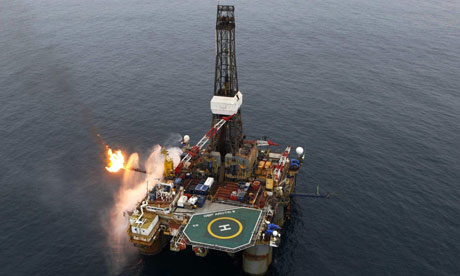
      Providence Resources oil rig operating in Barryroe, off County Cork. The company’s oil is expected to trigger an oil exploration boom in the Republic. Photograph: Finbarr O’Rourke/Providence Reso/PA

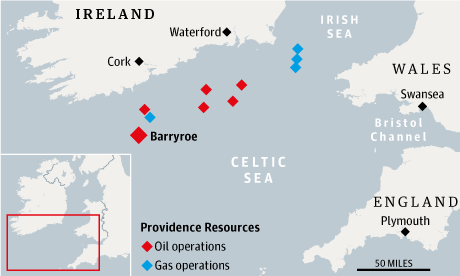
      Oil has been struck off the County Cork coast in a potentially multibillion-pound discovery that could help to drag Ireland‘s recession-stricken economy out of the mire.

      Dublin-based Providence Resources announced on Thursday that oil has successfully started to flow from its Barryroe well in the first big find in Irish territorial waters.

      The oilfield, which is about 50 kilometres off the Cork coast, has a flow of more than 3,500 barrels a day, a number which exceeds the company’s original projections of 1,800 barrels.

      One recent audit of the area found that it might contain the potential to produce almost 1bn barrels of oil, making the field worth billions at today’s crude prices of well over $100 a barrel.

      The test area off the Cork coast covered 300 sq km, which according to Providence is equivalent to a medium-to-large North Sea oil field. The oil was discovered at a depth of about 100 metres in the sea bed.

      Successful drilling at the Barryroe well will increase pressure on the Irish government to grant permission for oil exploration at five further sites in Irish waters. These include the most controversial site, at Dalkey Island in Dublin Bay, close to an exclusive stretch of the capital’s coastline which is home to Irish rock stars such as Bono and Enya.

      If an oil rig were constructed near the uninhabited island it would be in the line of sight of homes belonging to celebrities on Dublin’s so-called “gold coast”. An alliance of community groups in one of the richest parts of Ireland as well as conservation groups such as Birdwatch Ireland and An Taisce, the republic’s National Trust, are understood to be planning a campaign against the drilling project. The island is home to a seal colony and the waters around it are used for fishing pollock and mackerel as well sea diving.

      Providence Resources, whose chief executive is Tony O’Reilly Jr, the son of the former boss of Independent News and Media, said it was pleased the flow rates from Barryroe were higher than the pre-drilling target.

      O’Reilly said the discovery was a “seminal day for Ireland, especially in the runup to St Patrick’s Day”. Of the higher than expected oil flows he said: “As the Americans say, ‘We didn’t hit a home run, we knocked the ball out of the park’. I think this discovery also creates a reappraisal in the minds of global oil corporations about coming back to Irish waters to drill for oil. Irish territorial waters are massively under-explored.” The oil was of good quality, described as “light but waxy crude”.

      O’Reilly said the company was exploring for oil in Northern Ireland near Rathlin Island and he hoped the Barryroe find would lead to the creation of an onshore oil industry in Ireland.

      “We’ve always said as an Irish company we want to use as much Irish infrastructure and resources as we can. We don’t have an oil industry in Ireland at present but I hope something like Barryroe and the success we are getting in that will thrive more interest in creating more of an infrastructure in Ireland.”

      While the find is small by the standards of the Middle East or even the North Sea it could reduce the republic’s national energy bill and have a significant spinoff for the entire economy.

      Ireland is heavily dependent on imported oil and gas. The Irish Offshore Operators’ Association points out that more than 90% of Irish gas is imported while oil accounts for nearly 60% of overall Irish energy consumption.

      Fergus Cahill of the Irish Offshore Operators’ Association said: “It’s very encouraging and positive. First of all it’s the first discovery in Irish waters that looks to be declared commercial. The flow rates are encouraging. Secondly, it will encourage other explorers because one of the problems that have dogged Ireland has been the explorations in the past. Almost all of these discoveries were of gas, not oil. If it gets developed, which we hope it will, it will reduce our dependency on imports, increase taxation revenue and create jobs.”

      The Irish exchequer will benefit from the potential oil boom as the republic’s department of finance gains a 25% tax take from any oil or gas revenues.

      Celtic Sea Oil

  • SHELL AGREES SHALE GAS DEAL IN CHINA

    Shell agrees shale gas deal in China

    Oil company signs production sharing contract with China National Petroleum Corporation to develop a shale gas block

    • guardian.co.uk, Thursday 22 March 2012 17.39 GMT
    • Article history
    • Shell logo

      Shell have agreed a production gas deal with China which is in the early stages of tapping its shale gas resources. Photograph: David Sillitoe for the Guardian

      Shell has signed a production sharing contract with China National Petroleum Corporation to develop a shale gas block in China, the first deal of its kind in the country.

      China is in the very early stages of tapping its shale gas resources and the government wants to identify the right technology to unlock them in the next few years, aiming for a leap in shale production by 2020.

      China’s top energy agency, the National Energy Administration, has set a target to produce 6.5bn cubic metres of shale gas by 2015, or roughly 6% of China’s current total gas production. Zhang Yuqing, head of NEA’s Oil and Gas Department, has said foreign firms can enter product sharing contracts with Chinese firms or provide engineering services. Shell has already conducted some exploration work on the Fushun-Yongchuan block covering 3,500 square kilometres in the southwestern province of Sichuan, the statement said, without giving further details.

  • Water wars between countries could be just around the corner, Davey warns

    Water wars between countries could be just around the corner, Davey warns

    Energy secretary tells conference that growing pressure on water resources could worsen existing war and lead to new ones

    • guardian.co.uk, Thursday 22 March 2012 19.12 GMT
    • Article history
    • Water wars : Tribal Water Wars Could Be Looming in Ethiopia's Omo Valley due to water scarity

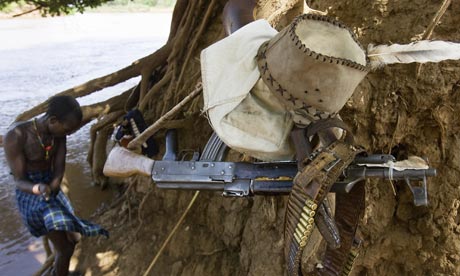
      A member of the Karo tribe by the Omo river in Ethiopia. Three hydropower dams are planned – the resulting scarcity could quickly lead to violent conflict. Photograph: Dean Krakel/Getty Images

      Water wars could be a real prospect in coming years as states struggle with the effects of climate change, growing demand for water and declining resources, the secretary of state for energy and climate change warned on Thursday.

      Ed Davey told a conference of high-ranking politicians and diplomats from around the world that although water had not been a direct cause of wars in the past, growing pressure on the resource if climate change is allowed to take hold, together with the pressure on food and other resources, could lead to new sources of conflict and the worsening of existing conflicts.

      “Countries have not tended to go to war over water, but I have a fear for the world that climate instability drives political instability,” he said. “The pressure of that makes conflict more likely.”

      Even a small temperature rise – far less than the 4C that scientists predict will result from a continuation of business as usual – could lead to lower agricultural yields, he warned, at a time when population growth means that demand for food was likely to be up by 70% by 2060. By the same time, he noted, the number of people living in conditions of serious water stress would have reached 1.8 billion, according to estimates.

      “Climate change intensifies pressures on states, and between states,” he told the conference, gathered to discuss whether climate change and natural resources should be regarded as a national security issue. “[Its effects] can lead to internal unrest … and exacerbate existing tensions. We have to plan for a world where climate change makes difficult problems even worse.”

      But Davey recalled previous global catastrophes that had been averted, including the threat of nuclear armageddon during the cold war, and successes such as the elimination of smallpox. He urged governments to work on adapting to climate change as a matter of urgency, as well as striving for an international agreement to cut greenhouse gas emissions.

      His call was echoed by Ali Bongo Ondimba, president of the Gabonese Republic. He told the conference that Africa was the most vulnerable part of the world to climate change, but that African people had been responding to a changing climate for thousands of years – his own Bantu people had been forced, centuries ago, to move around Africa as areas dried out and food became scarcer.

      Gabon had already started to take action to protect the 88% of its land that is covered by rainforest, and to reduce carbon emissions by its industries, with a view to a “transformation” by 2025.

      He warned that seeking to lift people out of poverty could not be achieved at the expense of degrading natural resources. He warned that policies for economic growth across the continent must reflect this immediately: “The impact [of degradation] cannot be reversed by policies conceived too late.”

  • Nuclear News

    News 4 new results for DANGER TO US NUCLEAR PLANTS
    Critical Koodankulam
    Deccan Chronicle
    After a devastating combination of a magnitude 9 earthquake and a 14-metre high tsunami in Fukushima broke the defences of the Daichi nuclear power plant on that day, causing reactors to blow up and spill dangerous levels of radioactivity into the air,
    See all stories on this topic »

    Deccan Chronicle
    In nuclear crisis with Iran, GCC has a duty to be heard
    The National
    He said that while the article is not broad enough to ban attacks on uranium enrichment plants, it would appear to protect the Iranian Bushehr nuclear power plant, which is in operation and contains nuclear fuel that could be dispersed and cause danger
    See all stories on this topic »
    Israel will strike Iran before November
    Institute for Ethics and Emerging Technologies
    The difference in treatment is obvious: a nuclear-armed Iran would be treated with much higher deference than it is now. Israel views a nuclear Iran as a mortal danger. The USA views it as a destabilizing factor that would lead to an arms race in one
    See all stories on this topic »
    Tel Aviv: 1000 march against Iran strike
    Ynetnews
    Right is dangerous for Israel.” One protester, Sherry Shein, told Ynet: “We treat the Iranians like they’re mad, but we’re no less mad… Anyone who thinks that it’s possible to strike a nuclear plant without repercussions is naïve, and an idiot.
    See all stories on this topic »

    Ynetnews