Google Alert – PEAK-OIL
Inbox
x
Inbox


|
|
|
|
||
|
||||
|
||
|
||
|
|
Inbox
|
x | |||
|
|
|
|
||
|
||||
|
||
|
||
|
Radioactive material set to be dumped in remote Aboriginal community, despite ongoing court case into legality of proposal
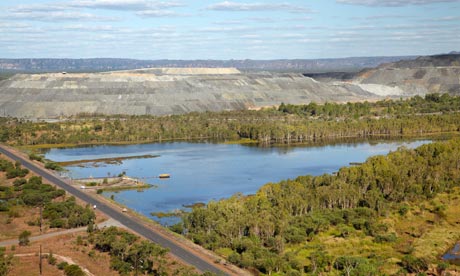
The Australian government has passed legislation that will create the country’s first nuclear waste dump, despite fierce opposition from environmental and Aboriginal groups.
The passage of the National Radioactive Waste Management Bill 2010 through the Senate paves the way for a highly controversial plan to store nuclear waste in Muckaty Station, a remote Aboriginal community in the arid central region of the Northern Territory.
The ruling Labor party received support from the conservative coalition opposition to approve the bill, despite an ongoing federal court case over the legality of using the Muckaty site to store radioactive material.
Currently, nuclear waste from the medical and mining industries is stored in more than 100 “temporary” sites in universities, hospitals, offices and laboratories across Australia.
Anti-nuclear protesters disrupted proceedings in the Senate as the legislation was debated earlier on Tuesday, with the group heckling lawmakers from the public gallery over their support for the bill.
A recent medical study warned that transporting nuclear waste over long distances to such an isolated location, which is 75 miles north of the Tennant Creek township, could endanger public health.
“The site is in an earthquake zone, it floods regularly, there are very long transport corridors, there are no jobs being applied and it’s opposed from people on the ground, on the front line from Tennant (Creek) all the way up to the NT government and people around the country,” said senator Scott Ludlam of the Greens, which successfully added an amendment to the bill that bans the importing of foreign nuclear waste to the site.
Aboriginal groups launched legal action after claiming that traditional owners of the land around Muckaty do not approve of the dump, despite the government maintaining that the local Ngapa indigenous community supports the plan.
Under Australian Native Title law, indigenous groups recognised as the traditional owners of land must be consulted and compensated for any major new infrastructure.
Although the Australian government insists that it has not decided on a site for the dump, Muckaty is the only option under consideration and the Northern Territory government has already been offered AUS$10m if it accepts the facility.
Finding a location for a national nuclear waste dump has proved a major headache for successive Australian governments, with former prime minister John Howard rebuffed in his attempt to situate the facility in South Australia in 2004.
The Northern Territory government has complained that it is being strong-armed into taking the dump due to it being a “constitutional weak link” and not having the same rights as full Australian states.
Nuclear power remains a highly contentious issue in Australia, which, despite having the largest uranium deposits in the world, has steadfastly refused to shift its largely coal-fired energy generation to nuclear.
|
||
|
||
| Volcano erupts violently in Japan Telegraph.co.uk Sakurajima volcano in southern Japan has erupted for a second day, spewing hot rocks and ash for over a mile around. The Japanese Meteorological Agency said the eruption on Monday was the most forceful since 2009. Foot-wide rocks were expulsed over a … See all stories on this topic » |
||
|
||
|
||
|
||
|
||
| Sakurajima Volcano Erupts; Foot-Wide Rocks Land Mile Away (VIDEO) Huffington Post Mt. Sakurajima, one of Japan’s most active volcanoes, has erupted several times in the past 48 hours, sending 18 inch-wide rocks flying over a mile away. Residents from the southwestern town of Kagoshima were warned about dangerous debris, however, … See all stories on this topic » |
||
| Bulldogs burned by Volcanoes Corning Observer By Craig Purcell/Corning The Los Molinos High baseball team welcomed seven others to town over the weekend while hosting the annual Glenn Cox Tournament, but the Bulldogs’ 7-1 loss to Chester on Saturday marked the third loss for the tourney hosts, … See all stories on this topic » |
||
|
This once a day Google Alert is brought to you by Google.
Delete this alert.
Tip: Use quotes (“like this”) around a set of words in your query to match them exactly. Learn more.
Ads – Why this ad?
New 2.5L Engine With More Power, Torque & Better Fuel Efficiency.
512
|
Ads – Why these ads?
|
 1
1
Brutal lesson … Gunnedah Mayor Adam Marshall, right, and Real Estate agent Ben Hennessy / Pic: Peter Lorimer Source: The Daily Telegraph
WITH instant wealth, often comes unexpected hardship.
It’s that brutal lesson the once-blithe township of Gunnedah is now attempting to swallow.
The true heart of the northwestern town is dying on the inside; a victim of its own success and the mining dollars that have flooded into its streets, transforming it into one of the most expensive places to live in the nation.
While six coal mines surround the town providing a jobs boom, many of its long-term residents can no longer afford to stay there, with rents tripling and businesses closing down as the town’s young men give up their professions to chase the coin down the mine shaft.Some rental properties are now commanding $1350 a week, giving middle and low-income families no alternative but to move out of the district.
Gunnedah mayor Adam Marshall said the exodus is growing.
“Locals are getting priced out of the market and I’m fully aware that those who can’t afford the rent are leaving town just to survive,” he said. “Council approved 82 residential dwellings in the last financial year, the best figures since 1981, but rent keeps going up.”
Long-time locals, brothers Shannon and Chris O’Shea, have packed up their respective families and moved to Newcastle, where they found employment immediately.
“We are looking at renting a house on the water cheaper than we can in Gunnedah,” Shannon said. “Chris and I both love Gunnedah, especially the fishing, camping and shooting, but we saw the writing on the wall when the mines starting opening up and look at the ridiculous rent now. We know plenty of other people who are thinking of moving out of the town for the same reasons.”
Mr Marshall last week toured Roma in Queensland to get a grasp on what coal mines and coal seam gas booms over the recent years have done to the town of 8000.
“Roma is in all sorts of trouble. The town has lost its character as locals left in droves, forced out by high rents and big industry,” he said. “We don’t want this to happen in Gunnedah and we need to act quickly before it’s too late.”
Local real estate agent Ben Hennessy is dealing first hand with the rental crisis and also agrees that something needs to be done quickly.
“We have three to four inquiries each day for rentals and there is no argument that locals are getting priced out of the market,” Mr Hennessy said.
Mr Marshall describes the rental market as a machine snowballing out of control.
“If the mining companies pay top dollar for rental houses everyone with a rental investment thinks they can get the same money, and that’s when the real problems start,” he said.
“I live alone in a four-bedroom house and I’m probably better off moving in with my grandparents and renting it out for $350-$400 a week.”
|
||
|
Tip: Use site restrict in your query to search within a site (site:nytimes.com or site:.edu). Learn more.
Delete this alert.


15 comments on this story