Category: Articles

  • Oil Price News Update

    Oil Price Daily News Update


    American Energy Company to Invest $1 billion in Egypt

    Posted: 01 Mar 2012 10:54 AM PST

    The Arab Spring, which began early last year and swept eastwards across Africa’s Magreb, has completely upended the region’s politics. Responses range from the relatively benign outcome in Tunisia, where it all began, to Egypt, where President Hosni Mubarak was forced from office and now faces trial by the military government that succeed him, to Libya, where former leader Muammar Gadhaffi was killed following his capture. The final result in Syria has yet to emerge. Seeing opportunity where others see risk, Houston-based oil and…

    Read more…

    GOP Should Claim Victory on Keystone XL

    Posted: 29 Feb 2012 03:52 PM PST

    Canadian pipeline company TransCanada announced it was building a stand-alone section of the controversial Keystone XL oil pipeline to the southern coast of Texas. This in part addresses one of the primary aims of the project, which is to add pipeline capacity to the refining market along the southern U.S. coast. The White House welcomed the measure, but President Obama’s critics continued to complain. With TransCanada acknowledging Obama isn’t opposing the overall merits of the project, however, it’s odd that White House critics aren’t taking…

    Read more…

    Thailand Moves Into Burma’s Energy Market

    Posted: 29 Feb 2012 03:48 PM PST

    Just when it seems that China has bought every energy asset on the planet, along comes Thailand’s PTT Exploration and Production Plc (PTTEP) to contest Beijing’s presence in one of Southeast Asia’s “final frontiers” – Burma, or, as its rulers prefer, Myanmar. PTTEP expects soon to sign an agreement with Burma to explore for oil and gas in its PSC-G and EP2 onshore petroleum blocks. In January PTTEP, a subsidiary of PTT Plc, Thailand’s largest energy conglomerate, was awarded licenses for the two blocs, which…

    Read more…

    5 Interesting Revelations from the Stratfor Memos

    Posted: 29 Feb 2012 03:43 PM PST

    Wikileaks is publishing internal memos of the Stratfor security analysis firm. A few tidbits have emerged in these very early days, to wit: 1. Up to 12 Pakistani active-duty and retired officers from the Inter-Services Intelligence agency knew that Osama Bin Laden was in Abbottabad and were in regular contact with him. The Pakistani chief of staff is denying the report. 2. Dow Chemicals hired Stratfor to spy on activists in Agra who continue to protest over the Bhopal environmental disaster that blinded many workers and destroyed their health.…

    Read more…

    Hopes Build for Thorium Nuclear Energy

    Posted: 29 Feb 2012 03:37 PM PST

    There is much written to the effect that thorium might prove a more viable nuclear fuel, and an energy industry based upon it, than the current uranium-based process which serves to provide both energy and weapons – including “depleted uranium” for armaments and missiles. There are different ways in which energy might be extracted from thorium, one of which is the accelerator-driven system (ADS). Such accelerators need massive amounts of electricity to run them, as all particle accelerators do, but these are required to produce a beam of protons…

    Read more…

    Some Valuable Remarks About Oil and Speculation

    Posted: 29 Feb 2012 03:32 PM PST

    Several nights ago I participated in a debate (arranged by Russia Today TV – 24-7 –  CrossTalk, and transmitted internationally in English) in which I pointed out – on several occasions – that the aggregate (though unweighted) Brent-WTI (West Texas Intermediate)  price of oil was about 112 dollars a barrel (= $112/b), and I claimed that if this price reaches $130, we could be facing a clear and impending economic danger. Early the next morning, when I checked this aggregate price on the important sites OilPrice.Com…

    Read more…

    Mongolia to Build its First Wind Farm

    Posted: 29 Feb 2012 03:29 PM PST

    Mongolia is an East Asian country about the size of Alaska, with vast potential for wind energy due to the large unpopulated plains that make up most of the land, and the wind corridor of the Gobi desert. The south Gobi region is predicted to contain 300 gigawatts of wind energy potential which Mongolia are now looking to take advantage of based upon the expectation that its electricity demand will double within 15 years due to the fact that it has one of the fastest growing economies of the world, fuelled by its rich natural resources such as…

    Read more…

    You are subscribed to email updates from OilPrice.com Daily News Update
    To stop receiving these emails, you may unsubscribe now.
    Email delivery powered by Google
    Google Inc., 20 West Kinzie, Chicago IL USA 60610
  • New Device heralds potential to turn sewage plants into power stations

    New device heralds potential to turn sewage plants into power stations

    Breakthrough that combines fuel cell with other technologies could provide power for entire water grids, scientists say

    • guardian.co.uk, Thursday 1 March 2012 19.00 GMT
    • Article history
    • Damian blog : Biodigesters at sewage treatment plant : production of biogas or methane

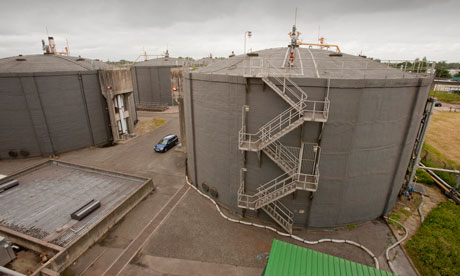
      Biodigesters at United Utilities Daveyhulme plant which processes 714m litres of sewage from Manchester each day. Photograph: Ashley Cooper/Corbis

      Sewage can be used to generate electricity using a new device revealed by scientists on Thursday. It combines a fuel cell with other technologies to convert waste water treatment stations into power plants, which the researchers believe could provide the power for entire water grids.

      “We certainly could take care of the whole water system: the treating and pumping of water, which currently requires substantial amounts of power,” said Prof Bruce Logan at Pennsylvania State University in the US. “We also treated the organic matter much faster.”

      His team’s work is published in the journal Science and is “the proof of concept”, Logan said. “Our hope now is to optimise the electricity generation as much as possible.”

      Switching sewage plants from users to generators of electricity would be especially useful in developing countries, said Logan, an environmental engineer specialising in water systems. “There are 2 billion people in the world who need sanitation, including 1 billion who need access to clean water,” he said. “If you go into a country and give them a waste treatment system – the World Bank and others have done this – they do not keep it going, as it needs power and maintenance. It is a drain on the community. But if you can also provide electricity for lighting, or charging mobile phones, that’s a game-changer.”

      The new device combines two types of energy-producing technology: a microbial fuel cell, in which bacteria consume organic matter to produce a current, and a reverse electrodialysis system, in which positive and negative ions are separated by a series of membranes, also creating a current. Microbial fuel cells are relatively inefficient while reverse electrodialysis requires many specialised membranes, making it expensive.

      “By combining the two technologies, we overcame the limitations of the fuel cell and synergistically generated energy for the reverse electrodialysis system,” said Logan. A crucial factor was using ammonium bicarbonate as the fuel for reverse electrodialysis, which performs better than the seawater typically used. Lastly, said Logan, the combination of technologies meant it was possible to use just five membrane pairs rather than the 20 pairs typically needed to generate electricity.

      The device produced 0.9 kilowatt-hours of electricity per kilogram of organic waste. In contrast, sewage treatment usually consumes 1.2kWh per kilogram.

      “There were a lot of people looking at fuel cells and a completely different group looking at reverse electrodialysis,” said Logan. “We brought the technologies together.”

      The scientists said broths of other organic material, such as crop waste or other sources of cellulose, could be used to generate power in their device. They also said it could be used to produce electricity from the 7-17% of energy used in the US that is lost as waste heat.

      In 2011, British water company Thames Water said it would produce 16% of its electricity by burning sewage flakes. Another company, Wessex Water, has launched a trial running a car on methane gas derived from the sewage treatment process at its Bristol works.

  • Peak Oil News

    News 4 new results for PEAK-OIL
    The Peak Oil Crisis: A Breakthrough?
    Falls Church News Press
    By Tom Whipple For many months, US Energy Secretary Chu, the guy with the Nobel Prize in physics, has been running around the country telling audiences that big breakthroughs were coming for electric vehicles. Well, this week the other shoe dropped
    See all stories on this topic »
    Has the ‘Peak Oil‘ Tipping Point Arrived?
    U.S. News & World Report (blog)
    Peak oil” is one of those ideas that used to be the province of commodity speculators and zanier environmentalists, but is now entering the mainstream of the energy policy debate. The idea is simple on its face: For one reason or another (which one
    See all stories on this topic »
    Peak oil could upset global transition of power
    Straight.com
    The contemporary transition from the American to Chinese hegemony is taking place in the closing decades of the carbon age. The pattern of the power transitions of the past may not be faithful harbingers of the future due to peak oil and climate
    See all stories on this topic »
    Slide in America’s oil production to be stopped by technology and algae
    Torque News
    By Frank Sherosky on Wed, 02/29/2012 – 21:31 for Torque News Peak Oil; American dependence on foreign supplies. Is it possible that the energy crisis is not as bad as America’s politics would have us believe? Yes, worldwide demand for crude oil is
    See all stories on this topic »
  • Mining gas in NSW is viable if it’s controlled

    This item is very controversial/ The writer does not know the true facts

    Mining gas in NSW is viable if it’s controlled

    John Williams

    March 1, 2012

    Opinion

    Important role ... NSW has the potential to build its economy on inexpensive, gas-based electricity.

    Important role … NSW has the potential to build its economy on inexpensive, gas-based electricity. Photo: Ben Rushton

    The transition from coal-based electricity generation to gas-based electricity, which emits less carbon dioxide, has become a fraught issue in NSW.

    The NSW economy was built over the past 50 years on relatively cheap, coal-based electricity. Like Queensland, we have the opportunity to build our economy over the next 50 years or more on low-carbon, relatively inexpensive, gas-based electricity.

    Queensland has taken the lead in developing its coal seam gas resources and is now well advanced to move from coal into large-baseload, combined-cycle gas turbines. And Queensland is moving into gas even though it already has the lowest carbon dioxide-emitting coal-based power stations in Australia.

    By comparison, NSW is lagging, with no clear direction as to where our future baseload electricity generation will come from.

    The development of the coal seam gas industry in NSW obviously requires much closer co-operation between the government, the gas industry and land owners.

    The recent protests by communities directly affected by the potential development of coal seam gas are testimony to the lack of consultation. In the Hunter Valley, for example, winemaker Bruce Tyrrell and others are campaigning for the area to be ”ring fenced” from the industry to protect the wine and tourism industries.

    Our natural heritage of land and water and its ecology must indeed be protected and a way of mining gas found that is in complete harmony with this heritage. I am a member of the NSW Greens and opposed their policy of ”blanket” opposition to coal seam gas.

    Of course some strategic areas of prime farming land and national or state parks should be preserved. But as an engineer, I don’t accept that the problems of water contamination and treatment, and of gas leakage, are insurmountable. These are engineering problems and can be resolved at a cost. If the cost for any gas mine is too high, it won’t be mined.

    There has been a lot of publicity about the development of shale gas in the US – particularly in recent days with an ABC Foreign Correspondent story and an international conference happening now in Canberra – but its experience is of little relevance to Australia. The mining of shale gas is technically different and the legislative framework of American states is of no relevance in NSW.

    Tapping the resource safely in NSW is all a matter of stringent regulation combined with excellent engineering, irrespective of the cost.

    Our Asian neighbours in China and India are planning for a future fuelled by lower carbon emissions by continuing with coal-based electricity from advanced technology power stations and moving into gas and nuclear, with a minor component of renewable energy.

    Renewable installations usually look impressive because the capacity to produce energy is quoted rather than the actual energy produced.

    The cost of renewable energy is very high because these resources have limited availability of wind and of sunlight over the course of a year – about 20 per cent.

    A claim by the Beyond Zero Emissions report that Australia has the opportunity to have a totally renewable-based electricity system within this decade lacks economic and technical credibility. It is extremely unlikely to be a reality this century. Renewable energy is simply not the best economic development strategy for NSW or Australia.

    A low-carbon, sustainable-energy future for the world is possible, according to the International Energy Agency’s World Energy Outlook 2011 report. Carbon dioxide in the atmosphere can be stabilised at 450ppm in 2035 by both a reduction in the use of energy and a primary energy mix in 2035 of coal (16 per cent), oil (25), gas (22), nuclear (11), hydro (3), biomass and waste (16), and modern renewables of wind and solar (8).

    There will be an economic penalty for NSW if it does not develop its gas resources. And there is no need to incur such a penalty from a global atmospheric perspective. I have as much interest as anyone in protecting the home of humanity, planet Earth. It is possible to protect our shared home with a low-carbon sustainable-energy future, and gas is an important part of that future.

    John Williams is a former executive in the NSW electricity industryand a PhD student with Charles Sturt University researching climatechange, energy and its impact on the earth. Paul Sheehan is on leave.

    twitter Follow the National Times on Twitter: @NationalTimesAU

    Read more: http://www.smh.com.au/opinion/politics/mining-gas-in-nsw-is-viable-if-its-controlled-20120229-1u3cm.html#ixzz1noqdPzA7

  • Mobile phone running low on battery? Charge up with water

    Mobile phone running low on battery? Charge up with water

    March 1, 2012 – 7:50AM

    Powertrekk ... allows you to charge your mobile using water.

    Powertrekk … allows you to charge your mobile using water.

    It is the nightmare of the wired world – a smartphone low on battery.

    Now Swedish group myFC says its water-powered charger could be the fix anywhere while battery giant Duracell is championing a push for cars and even stadiums to be built with energy “mats” that would power up phones.

    A Californian firm, meanwhile, has launched a phone that it claims can remain charged for up to 15 years, making it the perfect spare in emergencies or disasters.

    “The difference between the energy on a phone and the energy we consume is increasing. We need to charge more often but you don’t want to be hooked onto a wall,” said myFC chief executive Bjorn Westerholm.

    His firm has therefore come up with a portable fuel cell charger which is slightly larger than a compact camera and which uses just one spoonful of water and a small metallic device called a fuel puck, to fully charge an iPhone.

    The PowerTrekk could appeal most to campers, aid workers or the military, said Westerholm, who is exhibiting the charger at the world’s biggest mobile fair in Barcelona.

    “It could be sea water, fresh water. You need to carry water with you to survive anyway and the PowerTrekk needs just one spoonful,” he said.

    “So you can Facebook, email even when you’re in the outdoors for hours.

    “Our value proposition is that you don’t need to go to the grid. You don’t need to wait to charge your phone.”

    Competition for solutions to power up phones is fierce.

    XPAL Power rolled out a phone with a battery that “lasts 15 years,” said Christian Scheder, chairman of the Californian firm.

    The so-called Spareone, which will be commercialised in March, remains charged for up to 15 years if the phone is turned off, and for two months if it is on.

    “This is great for emergency, disaster situations,” Scheder said.

    Battery giant Duracell meanwhile has its own vision to keep the world charged.

    It is championing the PowerMat system, a mat which looks like a small tablet that plugs into the power source and which has sufficient space to charge two phones which are equipped with special protective covers.

    But that is just the beginning, Stassi Anastassov, Duracell President, said.

    Beyond just targeting consumers with the charging kit, Duracell is at the Mobile World Congress to talk phone manufacturers into designing a slot for a special chip or even build it into the telephone, thereby doing away with the protective covers that are currently required to dock with the mat.

    The company further wants to fit the mats in public places, for instance, build them into tables at fast-food chains, thereby allowing anyone with equipped phones to charge up anytime.

    It already has a deal with General Motors to fit all vehicles from 2013 with the charging mat. Likewise, it has an agreement to equip New York’s Madison Square Garden, starting with bar tabletops.

    “Of course it will take many years, the whole ecosystem will not be up tomorrow,” said Anastassov.

    “But our vision is that you will be able to never go out of power, simply by facilitating the whole charging process for you.

    “It’s very similar to banking and money. If you want to have cash, you can either have a very big wallet full of money or you have an ATM card,” he said.

    AFP

    Read more: http://www.smh.com.au/digital-life/mobiles/mobile-phone-running-low-on-battery-charge-up-with-water-20120301-1u430.html#ixzz1noQ3viUG

  • ScienceDaily: Earth Science News

    ScienceDaily: Earth Science News


    Mysterious electron acceleration explained: Computer simulation identifies source of aurora-causing high-speed electrons in space

    Posted: 28 Feb 2012 12:22 PM PST

    A mysterious phenomenon detected by space probes has finally been explained, thanks to a massive computer simulation that was able to precisely align with details of spacecraft observations. The simulation shows that an active region in Earth’s magnetotail, where “reconnection” events take place in the magnetic field, is roughly 1,000 times larger than had been thought.
    You are subscribed to email updates from ScienceDaily: Earth Science News
    To stop receiving these emails, you may unsubscribe now.
    Email delivery powered by Google
    Google Inc., 20 West Kinzie, Chicago IL USA 60610