Category: Climate chaos

The atmosphere is to the earth as a layer of varnish is to a desktop globe. It is thin, fragile and essential for preserving the items on the surface.150 years of burning fossil fuel have overloaded the atmosphere to the point where the earth is ill. It now has a fever. Read the detailed article, Soothing Gaia’s Fever for an evocative account of that analogy. The items listed here detail progress on coordinating 6.5 billion people in the most critical project undertaken by humanity. 

  • House Passes Bill to Address Threat of Climate Change

    “This legislation will break our dependence on foreign oil, make our nation a leader in clean energy jobs and cut global warming pollution,” said Representative Henry A. Waxman, Democrat of California, a co-sponsor of the bill, adding that Friday’s vote was a “decisive and historic action” that would position the United States as a leader in energy efficiency and technology.

    The bill’s provisions forcing reductions in the use of fossil fuel while increasing production of alternative energy sources would produce millions of new jobs, Mr. Waxman said.

    But the legislation, a patchwork of compromises, falls far short of what many European governments and environmentalists have said is needed to avert the worst impacts of global warming. And it has pitted liberal Democrats from both coasts against more conservative Democrats from areas dependent on coal for electricity and heavy manufacturing for jobs.

    Friday’s vote illustrated that rift: The bill passed by a seven-vote margin, with 44 Democrats voting against it.

    As difficult as passage in the House proved, it is just the beginning of the energy and climate debate in Congress, since the issue now moves to the Senate, where political divisions and regional differences are even starker.

    At the heart of the legislation is a cap-and-trade system that sets an overall limit on emissions of heat-trapping gases like carbon dioxide while allowing utilities, manufacturers and other emitters to trade pollution permits, or allowances, among themselves. The cap grows increasingly tighter over the years, pushing up the price of emissions and presumably driving industry to find cleaner ways of producing energy.

    While some environmental groups supported the legislation, others — Greenpeace, for example — vigorously opposed it. Business groups were also split. Republican leaders called the bill a national energy tax and predicted that those who voted for the measure would pay a heavy price at the polls next year.

    “No matter how you doctor it or tailor it,” said Representative Joe Pitts, Republican of Pennsylvania, “it is a tax.”

    Only eight Republicans voted for the bill, which runs to more than 1,300 pages.

    Apart from its domestic implications, the bill is a show of resolve that American officials can point to when negotiating the new global climate change treaty, after years of American objections to binding limits on carbon dioxide emissions.

    The German chancellor, Angela Merkel, who was in Washington Friday to meet President Obama, strongly endorsed the bill even though it fell short of European goals for reducing the emissions of heat-trapping gases.

    Ms. Merkel, a longtime advocate of strong action to cut carbon dioxide emissions, has been pushing the United States to take a leading role in advance of the global climate negotiations set for December in Copenhagen.

    After meeting with Mr. Obama, she said she had seen a “sea change” in the United States on climate policy that she could not have imagined a year ago when President George W. Bush was in office.

    “This really points to the fact that the United States is very serious on climate,” Ms. Merkel said.

    The compromises in the bill were necessary to attract the support of Democrats from different regions and ideologies. In the months of horse-trading leading to Friday’s vote, the bill’s targets for emissions were weakened, its mandate for renewable electricity was scaled back, and incentives for various industries from automobiles to natural gas were sweetened.

    The final bill intends to reduce overall heat-trapping gases in the United States by 17 percent of 2005 levels by 2020, and 83 percent by midcentury.

    When the program is scheduled to begin in 2012, the estimated price of a permit to emit a ton of carbon dioxide will be about $13. That is projected to rise steadily as emission limits come down, but the bill contains a measure to prevent costs from rising too quickly in any one year.

    The bill grants a majority of the permits free in the early years of the program, to keep costs low. The Congressional Budget Office estimated that the average American household would pay an additional $175 a year in energy costs by 2020 as a result of the provision, while the poorest households would end up with $40 in rebates.

    Several House members expressed concern about the new market to be created in carbon allowances, saying it posed the same risks as markets in other kinds of derivatives. Regulation of such markets would be divided among the Commodity Futures Trading Commission, the Treasury Department and the Federal Energy Regulatory Commission. The bill also sets a national standard of 20 percent for the production of renewable electricity by 2020, although a third of that could be met with efficiency measures rather than renewable energy sources like solar, wind and geothermal.

    It also devotes billions of dollars to new energy projects and subsidies for low-carbon agricultural practices, clean-coal research and electric vehicle development. 
  • India seeks more talks on contentious climate draft

    A top negotiator said the problems mainly related to mitigation measures such as determining the long-term global emissions goals and setting a peak year for global emissions.

    “There are differences on some of these issues, so it’s not a consensus text that is ready to be adopted in one more meeting,” the official told Reuters on Friday on condition of anonymity because he was not authorised to speak to reporters.

    Another Indian official with knowledge of the negotiations said: “There is difference of opinion and approach among the participating countries.”

    The 17 MEF members account for 80 percent of global emissions so any agreement among them would go a long way to defining a new U.N. climate treaty due to be agreed in Copenhagen in December.

    The two-page draft declaration does not set clear goals but says that developed countries, including the United States, the European Union and Japan, would “undertake robust aggregate and individual mid-term reductions in the 2020 timeframe.”

    Developing nations such as China and India say rich nations should cut emissions by “at least 40 percent” below 1990 levels by 2020 — a target developed nations say is out of reach when they are trying to stimulate recession-hit economies.

    The Indian negotiators said there was broad consensus on the need for more funding for climate change adaptation and the transfer of clean-energy technology, but there were differences of opinion on the amount and how to disburse the money.

    “More than the volume of funds it’s the delivery mechanism, the commitment that is important,” one of the negotiators said.

    (Editing by David Fogarty)

  • Growth of global carbon emissions halved in 2008, say Dutch researchers


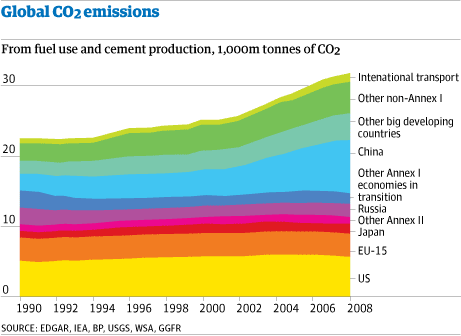
    The slowdown in emissions growth was caused primarily by a 0.6% fall in the consumption of oil – the first decline in global oil use since 1992. This trend was unevenly distributed around the world. In China oil use continued to rise, but at only 3%, down from an average of 8% since 2001. In the US, oil consumption fell by a massive 7%.

    co2

    The falling global demand reflects high prices for oil in the first half of 2008 and the economic slowdown in the second half of the year. Increasing biofuel production also helped displace a substantial volume of fossil-fuel petrol and diesel.

    Jos Olivier, the NEAA researcher responsible for the new data, acknowledged that the environmental benefits of biofuels would look “less favourable” in a broader analysis considering the impact of all greenhouses gases, rather than CO2 alone. Furthermore, the data does not take into account the CO2 released by deforestation, which accounts for almost 20% of all greenhouse gas emissions and takes place overwhelmingly in the developing world.

    Increasing renewable energy capacity and improving energy efficiency in many countries will also have contributed to the reduced rise in CO2 emissions. Olivier said: “The impact of energy and climate policy is hard to distinguish from those of fuel prices and the recession, but policies encouraging renewable electricity generation will have helped avoid around 500 million tonnes of CO2 from fossil-fuel power stations.”

    Coal consumption continued to creep up at a slower rate than in previous years, but the rise in the consumption of natural gas remained unchanged.

    It is too early to determine whether the recession will lead to global emissions flattening off entirely this year. But policymakers are likely to be particularly struck by the second revelation in the NEAA analysis.

    In 2008, the developing-world accounted for 50.3% of CO2 emissions, exceeding developed nations and international travel combined for the first time. With crucial UN climate negotiations over a successor to the Kyoto protocol now less than six months away, this new data will provide useful ammunition for those arguing for binding emissions targets for all nations.

  • Democrats confident as US climate change bill vote looms


    After weeks of attack from Republicans, the energy reform package got an important boost yesterday when its most formidable opponent in Congress – the Democratic chair of the house agricultural committee – said he would now push for its passage.


    “We think we have something here now that can work with agriculture,” Collin Peterson, who led the Democratic opposition to the bill, told a conference call yesterday. “I think we will be able to get the votes to pass this.”


    Within the White House and in Congress, the vote is seen as a historic moment, both for Obama’s political agenda and international efforts to reach a climate change treaty at Copenhagen at the end of the year.


    “This legislation is a game changer of historic proportions,” said Ed Markey, the Massachusetts Democrat who is one of the authors of the bill. “The whole world is waiting to see if Barack Obama can arrive in Copenhagen as a leader of attempts to reduce green house gas emissions.”


    The importance of the bill was underlined by the deep involvement from the White House. Obama earlier this week urged Congress to pass the bill, and aides have been closely involved in efforts to reach yesterday’s compromise. The Democratic House speaker, Nancy Pelosi, took a gamble on moving up the date for a vote on the bill to tomorrow.


    The gamble appeared to have paid off, with the Democratic leadership putting on a high-profile meeting yesterday with environmental, labour, war veterans and religious groups to talk up the bill’s prospects.


    “We are going to get this done,” said Chris van Hollen, a member of the Democratic leadership in the house of representatives. “It’s long overdue.”


    The bill, now swollen to about 1,200 pages, would bind the US to reduce the carbon emissions from burning oil and coal by 17% from 2005 levels by 2020 and more than 80% by 2050.


    It also envisages a range of measures to promote clean energy – from a development bank for new technology to new, greener building codes and targets for expanding the use of solar and wind power.


    The Democratic leadership is now hoping to pass the bill by a comfortable margin. Some environmental organisations have suggested that the bill might even win over a small number of Republicans, which would mean an important victory for Obama.


    For the most part, however, Republicans have almost uniformly opposed the bill, and say it amounts to a hidden energy tax. They have also argued that the bill would drastically raise electricity prices – a claim debunked with the release of a cost-analysis by the non-partisan Congressional Budget Office showing it would cost the average family $175 (£107) by 2020, and would save poor families about $40.


    The study – together with the compromises won by Peterson – have made the bill more palatable to Democrats from coal and oil states and from the old manufacturing areas.


    “We have been taking people out of the ‘no’ column, into the ‘undecided’ column, into the ‘yes’ column,” said Mike Doyle, a Democratic member from a former steel industry town in Pennsylvania. “The momentum is coming to ‘yes’.”


    But Peterson’s support appears to have come only after wringing a number of key concessions on the bill over several days of bargaining, overseen by the White House energy and climate advisor, Carol Browner, and other Obama administration officials.


    The most significant concession would give the US Department of Agriculture – and not the Environmental Protection Agency – control over a programme that would reward farmers for practices that reduce carbon emissions.


    Peterson also forced a four-year delay in a separate environmental regulation that would have cut the profits of corn-based ethanol, and encouraged the development of non-food biofuels instead.


    Those concessions have deepened the concerns of some environmental organisations that the bill is not aggressive enough in cutting emissions. However, Henry Waxman, who has been leading the bill through Congress, argued that the most important element of the bill had come through the hard bargaining process intact.


    “We have not given away the essentials of the bill because the essentials are the reduction of carbon emissions,” he said.

  • Scottish parliament agrees tougher 42% target to cut emissions


    The measures are tougher than the 34% target set in the UK government’s climate change act last year, which has no statutory annual targets. In common with UK government aspirations, the new act also commits Scotland to an 80% reduction on 1990 levels by 2050.

    The campaign coalition Stop Climate Chaos Scotland, which claims its 60 member organisations represent two million people, said this “hugely significant” vote set a new “moral” standard for the rest of the industrialised world.

    It comes the day after the US stated that a 40% cut by 2020 was “not on the cards”: developing nations have demanded this level of cut from rich nations.

    Kim Carstensen, head of WWF International’s global climate initiative, said: “At least one nation is prepared to aim for climate legislation that follows the science. Scotland made the first step to show others that it can be done. We now need others to follow.”

    However, the new measures are already under intense scrutiny. The act allows ministers to reduce the target later this year if the UK government’s advisory panel on climate change says it is unrealistic, or the UN climate change conference in Copenhagen in December fails to agree on a global deal to replace Kyoto.

    Environment groups are critical of the Scottish government’s refusal to abandon road, bridge and airport expansion programmes, its plans for a new coal-fired power station, and its unwillingness to tackle directly increasing car use.

    Furthermore, Scottish ministers only directly control about 30% of Scotland’s total annual emissions of 68m tonnes of CO2 – which only equates to a 700th of the world’s emissions. Most significant policies are controlled in Brussels and London, critics point out.

    About 40% is covered by the European Union carbon emissions trading agreement, while the UK government has policy responsibilities for a further 30% of Scotland’s emissions. That includes fuel taxation, low emission vehicles, VAT on energy efficiency and air taxes.

    The Committee on Climate Change, the panel set up to advise Gordon Brown’s government, has warned Salmond that Scotland is effectively jumping the gun by setting a 42% target in advance of a deal at Copenhagen.

    In a letter to Stewart Stevenson, the Scottish climate change minister, the committee’s chief executive, David Kennedy, said it believes Scotland should follow the UK strategy of waiting until the Copenhagen conference.

    If a deal is reached, it should follow the UK government’s lead and only then set a 42% target.

    The Scottish government had also increased the pressure on itself by including emissions from international aviation and shipping in its target, Kennedy wrote, even though it has no control over policy for these sectors.

    “I would therefore consider that an appropriate Scottish 2020 target could be set slightly below 34% to account for different treatments of international aviation under UK and Scottish approaches.”


    Despite these criticisms, the chairman of Stop Climate Chaos Scotland, Mike Robinson, said the significance of the all-party consensus could not be underestimated.

    “It means Scotland’s climate change bill has the toughest target of any industrialised nation in the world and will be held up as an example, ahead of the climate talks in Copenhagen in December, of what can and should be done,” he said.

    “This is a moral commitment and we hope other developed nations will hear this call for action and follow Scotland’s lead.”

    Although on renewable energy the Scottish National party is very likely to surpass its ambitious targets to deliver half of Scotland’s electricity from renewables by 2020, ministers have failed to embark on any politically unpopular measures to combat car use or the growth in short-haul aviation.

    It has authorised a second road bridge over the Firth of Forth and abandoned bridge tolls, paid to extend the M74 motorway, supports a new ring road around Aberdeen and dualing the A9 and wants a major new coal-fired power station.

    Its most ambitious emissions-reduction policies, such as using carbon capture for all fossil fuel power stations, using marine energy, and a wholesale switch to green transport, either have targets set at 2030 or are largely UK-government controlled. The SNP has also completely ruled out any new nuclear power stations.

  • Senate passes motion on emissions cost modelling


    Senator Milne says if the Government fails to comply, it must explain why the Senate should pass its emissions trading legislation, when it has not examined the cost of alternatives