Category: Climate chaos

The atmosphere is to the earth as a layer of varnish is to a desktop globe. It is thin, fragile and essential for preserving the items on the surface.150 years of burning fossil fuel have overloaded the atmosphere to the point where the earth is ill. It now has a fever. Read the detailed article, Soothing Gaia’s Fever for an evocative account of that analogy. The items listed here detail progress on coordinating 6.5 billion people in the most critical project undertaken by humanity. 

  • Dengue fever at fifty year peak

    Dengue fever in Queensland is at a fifty year high with over 900 confirmed infections and one death from the mosquito borne fever this calendar year. Over 15,000 people were infected in the mid-1950s. The disease causes severe headaches and fevers that culminate in an intense rash on the skin and pain in the joints. This outbreak began last year but has been exacerbated by recent floods. Queensland Health said rainwater tanks in urban areas can also lead to the spread of the disease.

    Detailed story

  • ACF in turmoil after chairman backs Rudd

    The Australian Conservation Foundation ACF will hold an emergency board meeting this week to resolve a split in the group over its president’s support for the Rudd governments carbon pollution reward scheme. The ACF was one of three well-funded environmental groups close to the government that announced support for the delay in an emissions trading scheme and further compensation for the polluters. Prominent members, including head of The Climate Group, Mark Diesendorf, resigned from the group last week.

    Full storyRelated storyBackground analysis

  • ACF splits over backing of Rudd plan

    Greens leader Bob Brown launched a scathing attack on the ACF executive in the wake of its decision.

    “I’m a life member of the Australian Conservation Foundation,” he said.

    “I can tell you that the Australian Conservation Foundation supports the Greens’ target of 40 per cent reduction by 2020. It opposes a delay in implementing this scheme and it’s absolutely opposed to the free kick going to the polluters.”

    Senator Brown said the media would “have to ask Don Henry” about his stand.

    The Greens’ deputy leader Christine Milne said Mr Henry and Mr Lowe would have to “will answer to their members and their constituents for supporting… (the) weakening of the CPRS.

    “I find it difficult to reconcile with their stated positions,” she said.

    See related story
  • Climate change evacuations begin

    The men climbed silently from the boat and into the shallows. They splashed towards us, carrying almost nothing. From beside me, others who had come to meet them walked out quietly in welcome. The air was still, both sad and happy, which seemed to suit the moment. That single boat carrying these five men is the first wave in what is, as far as I can tell, the world’s first official evacuation of an entire people because of climate change. Some say they will be ready to bring their families here next month when the houses are completed. Others that it will be June, when the first crop of sweet potatoes will be ready to feed them.

    It was a combination of a little planning and a lot of luck that allowed me to be among the very few to see this. I heard the evacuation was beginning only yesterday, a day after arriving in Buka. It has been on again and off again many times over the past year, but Papua New Guinea seems to like throwing surprises. Given the chance to be there when it finally began, I leapt and travelled to Tinputz this morning, first by boat across Buka passage, which separates the island on which I am staying from Bougainville, and then through the jungle in the back tray of a Toyota Hilux 4-wheel drive with a crowd of local people. Some were from the NGO the Carterets established to broker their own move. Others were from the Carterets themselves, who had travelled to Buka on trading boats and wanted to be at Tinputz to welcome their friends. There were also a Kiwi and an Aussie, Kim and Kirsten, who have spent months as volunteers working towards today. We arrived only minutes before the boat itself.

    After the arrival, the men sat in the shade of two unfinished timber frame houses among the trees – the beginnings of the homes they are to complete. The women cooked; clams and corned beef sandwiches, greens, rice and cassava wrapped in palm leaves. After hours the two parties came together to eat, to pray and to formally welcome the newcomers to Tinputz. There were speeches in Tok Pisin, only a little of which I followed. The five fathers sat in a line and nodded their heads in silence.
     
    On the ride home, hundreds of children streamed along the road, in bright white shirts above blood red skirts and trousers, proving completely false my first thought that the dense forest on either side must be uninhabited. The only bitter taste to today came also on this return journey, riding high on the tray of the Toyota. We hit and killed a pig and then a dog that scampered out into the jungle road; fortunately our driver had no licence plate, or the call for retribution would have been swift (this is a country that puts a pig on its 20 kina note). A full beer-bottle also came screaming at us from a passing truck, but shattered harmlessly on the road. Possibly it was aimed at me, the only white guy in sight. At least that is what the others with me in the Toyota thought. On the other hand, I saw a man carrying a stone-tipped spear along the road, which is also something you don’t see every day.

  • Help us fight climate change,Dame Elisabeth Murdoch asks first lady

    Help us fight climate change, Dame Elisabeth Murdoch asks first lady

    Stuart Rintoul | May 09, 2009

    Article from:  The Australian

    DAME Elisabeth Murdoch has written to Michelle Obama inviting her to join an environmental “call to arms” she is launching, called Influential Women for Climate Change Action.

    In the letter, the latest signal by the Murdoch family of its commitment on climate change, its matriarch, who turned 100 in February, tells the US first lady the world is facing a “global emergency”.

    Dame Elisabeth says the group will be a “campaign to enlist influential women in Australia and around the world to take the lead in protecting and nurturing Mother Nature by encouraging people to reduce their emissions”.

    “Having seen many challenges in my 100 years, I believe it is time to add my voice to what could be termed ‘a call to arms’, a call for people around the world to act now to reduce our impacts on the planet,” Dame Elisabeth writes.

    “It is plain to see humanity cannot go on living beyond the planet’s means. Climate change is not the first manifestation of this, just the latest and most serious. As recent extreme events like the Victorian fires and the Queensland floods demonstrate, it threatens the future for generations living now, as well as for those to come.

    “From a personal point of view, I have lived long enough to have a great-great granddaughter starting life, and I wonder what her world and her life will be like if we do not act in her defence now.”

    Dame Elisabeth tells Ms Obama of the Global Green Plan Foundation, a project of which she is patron, which is developing an environmentally focused school curriculum warning of the dangers of climate change.

    The curriculum, aimed at middle-years students, was launched yesterday at Williamstown High School in Melbourne, where Dame Elisabeth was described by foundation president Hal Hewett as “the world’s only centenarian climate change campaigner”. The curriculum, Living in 2030: An Experiment in Survival, backed by Fuji Xerox, invites students to imagine the world in 2030 if nothing is done to curb “economic rationalist thinking” with its “lunatic slogan, ‘Grow at all costs”‘ and to find solutions to global warming and diminishing resources.

    Dame Elisabeth was joined at the launch by actress and green campaigner Isabel Lucas.

    Dame Elisabeth’s letter was sent to Ms Obama last week. Mr Hewett said it was now being considered “in both the East Wing and the West Wing” of the White House.

    In November 2006, News Corporation chairman Rupert Murdoch announced a change of heart on climate change, saying that while he remained sceptical of doomsday scenarios, “the planet deserves the benefit of the doubt”. In May 2007, he said News Corporation, owner of The Weekend Australian, would be carbon neutral by 2010, saying climate change posed “clear, catastrophic threats”.
  • Climate change displacement has begun- but hardly anyone has noticed

    Climate change displacement has begun – but hardly anyone has noticed

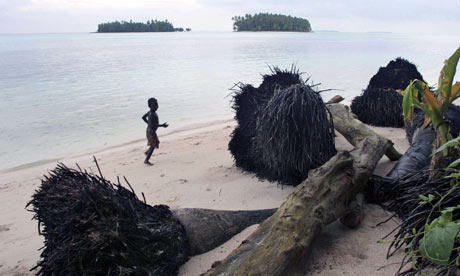
    The first evacuation of an entire community due to manmade global warming is happening on the Carteret Island

    Rising isea levels endangered life on Iolasa island on the Carterets Atoll, Papua New Guinea

    Rising sea levels have eroded much of the coastlines of the low-lying Carteret Islands situated 50 miles from Bougainville Island, in the South Pacific. Photograph: Jeremy Sutton-Hibbert /Greenpeace

    Journalists – they’re never around when you want one. Two weeks ago a momentous event occurred: the beginning of the world’s first evacuation of an entire people as a result of manmade global warming. It has been marked so far by one blog post for the Ecologist and an article in the Solomon Times*. Where is everyone?

    The Carteret Islands are off the coast of Bougainville, which, in turn, is off the coast of Papua New Guinea. They are small coral atolls on which 2,600 people live. Though not for much longer.

    As the Ecologist’s blogger Dan Box witnessed, the first five families have moved to Bougainville to prepare the ground for full evacuation. There are compounding factors – the removal of mangrove forests and some local volcanic activity – but the main problem appears to be rising sea levels. The highest point of the islands is 170cm above the sea. Over the past few years they have been repeatedly inundated by spring tides, wiping out the islanders’ vegetable and fruit gardens, destroying their subsistence and making their lives impossible.

    They are not, as the Daily Mail and the Times predicted, “the world’s first climate-change refugees”. People have been displaced from their homes by natural climate change for tens of thousands of years, and by manmade climate change for millennia (think of the desertification caused in North Africa by Roman grain production).

    Some people ascribe the fighting in Darfur – and the consequent displacement of its people – to climate change, as people struggle over diminishing resources. But this appears to be the first time that an entire people have started leaving their homes as a result of current global warming.

    Their numbers might be small, but this is the event that foreshadows the likely mass displacement of people from coastal cities and low-lying regions as a result of rising sea levels. The disaster has begun, but so far hardly anyone has noticed.

    Monbiot.com

    * thanks to Jon Freeman for alerting me to this story