Category: Climate chaos

The atmosphere is to the earth as a layer of varnish is to a desktop globe. It is thin, fragile and essential for preserving the items on the surface.150 years of burning fossil fuel have overloaded the atmosphere to the point where the earth is ill. It now has a fever. Read the detailed article, Soothing Gaia’s Fever for an evocative account of that analogy. The items listed here detail progress on coordinating 6.5 billion people in the most critical project undertaken by humanity. 

  • Commerce group calls for brake on emissions trade law

    Commerce group calls for brake on emissions trade law 

    Lenore Taylor, National correspondent | May 08, 2009

    Article from:  The Australian

    THE Australian Chamber of Commerce and Industry has sided with the Coalition to argue that it is premature to pass emissions trading legislation this year, and unnecessary because of the Rudd Government’s proposed delay to the scheme’s start date.

    On Monday Prime Minister Kevin Rudd received strong backing for proposed changes to the scheme from business groups including the Business Council of Australia and the Australian Industry Group, both of which agree with the Government’s contention that the scheme needed to pass the Senate this year in the interests of budget certainty.

    But ACCI, which yesterday announced it was commissioning major research into the impact of the scheme on the small and medium businesses it represented, said there was “no policy or timing reason” for the legislation to be passed this year.

    Opposition leader Malcolm Turnbull has said Australia should not finalise its ETS until after the UN Copenhagen meeting in December.

    “Get the scheme right. Get the design right. There is no need to finalise it in the next five or six weeks. They have not done adequate economic modelling, particularly on the impact on jobs in regional Australia,” he said.

    Climate Change Minister Penny Wong insisted yesterday it was essential for the legislation to be passed before Copenhagen.

    “We need to ensure we give the right signals to investors and we also need to ensure we go to Copenhagen with a scheme to match our targets,” she said.

    The Opposition has also been emphasising the potential costs of the scheme for smaller businesses that will not have to purchase emissions permits, but which will still face higher electricity costs.

    ACCI has commissioned a study from Castalia Strategic Advisors on the impact of the scheme on plastic and chemical manufacturing, food processing and freight and transportation, to be finalised in June.

    A document submitted to the UN this week shows most developed countries that are part of the Kyoto Protocol are in the process of setting a 2020 target for the successor agreement to be negotiated at Copenhagen, but only three have announced a target and only one — the European Union — has legislated one.

    In the US Congressman Mike Doyle, a key Democrat working on proposed emissions trading legislation to reduce emissions by 25 per cent of 2000 levels by 2020, said it was likely in the first 10 or 15 years of the scheme most permits would be given to major industries for free.

    Under the revised Australian laws some of the heaviest emitting industries would get up to 95 per cent of their permits for free. Other industries will initially get almost 70 per cent of their permits for free, but these rates will decline over time.
     

  • China ready for post-Kyoto deal on climate change

    China ready for post-Kyoto deal on climate change

    Dramatic reversal in US position under Obama has brought Beijing to the table on emission cuts, says UK climate secretary


    china emissions

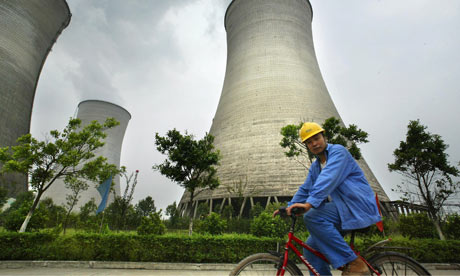
    A worker rides past towers of a coal-fired power plant in Guangan, China. Photograph: Frederic J Brown

    China is ready to abandon its resistance to limits on its carbon emissions and wants to reach an international deal to fight global warming, the Guardian has learned.

    According to Britain’s climate change secretary, Ed Miliband, who met senior officials in Beijing this week, China is ready to “do business” with developed countries to reach an agreement to replace the Kyoto treaty.

    Miliband said he was encouraged by the change in tone since late last year in the country that emits more greenhouse gases than any other. “I think they’re up for a deal. I get the strong impression that they want an agreement,” he told the Guardian.

    “They see the impact of climate change on China and they know the world is moving towards a low-carbon economy and see the business opportunities that will come with that.”

    The shift in the Chinese position significantly improves the chances of an agreement being reached when world leaders meet in Copenhagen in December to negotiate a deal that scientists say is critical if dangerous warming is to be avoided.

    While Britain and the European Union – which have a large historical responsibility for greenhouse gas emissions – are pushing for ambitious reduction targets at home, no global climate deal will be possible in Copenhagen without the agreement of China and the US, which together are responsible for more than 40% of the world’s annual carbon emissions.

    China’s official negotiating position is unchanged, but the government is understood to be preparing a set of targets up to and beyond 2020 to lower the country’s “carbon intensity”. This translates to cutting the emissions needed to produce each unit of economic growth.

    Miliband said Barack Obama’s pledge to reduce US emissions to 1990 levels by 2020 has unblocked the international negotiating process.

    “China used to think the developed world is not serious. That’s what they were saying [at UN talks] in December,” he said. “But now they know the US is on the pitch and ready to engage with them. It has made a real difference to what China is saying.”

    His comments echoed the message from Chinese officials. Su Wei, a senior negotiator, told the Guardian last month that the US had made a “substantive change” under the Obama administration.

    “The message we have got is that the current US administration takes climate change seriously, that it recognises its historical responsibility and that it has the capacity to help developing countries address climate change,” Su said.

    But while the tone may have changed, there is still a long way to go before agreement can be reached on specifics.

    China wants developed nations to commit to more ambitious reduction targets, to share low-carbon technology and to set up a UN fund that would buy related intellectual property rights for use across the world. Beijing’s position is complicated by the fact that it already owns a large share of the patents for wind and solar energy in developed nations.

    Europe and the US accept the Chinese economy should be allowed to grow further, improving the living standards of its millions of poor, before it makes overall emissions reductions. Instead, the western nations are pushing for strong measures to improve efficiency and establish caps for certain industries. One possibility being considered by Chinese officials is to set a carbon intensity goal up to 2040 that would include energy efficiency, renewable energy, transport and afforestation.

    “It would be very welcome for China to set a commitment for carbon intensity,” said Miliband. “It would send a signal around the world.”

    He was visiting Minqin county, a remote area in north-western China threatened by desertification and drought. Along with the melting of the Himalayan glaciers, the spread of deserts and the shortage of water have highlighted the destructive impact of unsustainable development and climate change.

    “We’re very concerned about climate change,” said Xu Wenshan, the deputy mayor of Wuwei, at a welcome banquet. “Living in such an ecologically fragile area, we will feel the impact directly if there is a further rise in the temperature.”

    Jim Watson, of the UK’s Tyndall Centre for Climate Change Research, said it had become the mainstream view in China that global warming was caused by human activity, which was not the view five years ago.

    “We see significant policy shifts and encouraging developments in technology, for example phenomenal development of wind power and plug-in cars. That could be a sign of things to come,” he said. “My impression is that although the negotiators haven’t moved ground officially, there are a hell of a lot of new ideas. They are very interested in low-carbon economy.”

    Last month, the Tyndale centre published research showing that it was possible for China to begin reducing its total emissions from 2020.

    Government officials say that is unrealistic and China has so far resisted announcing a target for when emissions might peak. But the authorities tend towards the later end of the various academic forecasts of between 2020 and 2040.

    Watson noted that if emissions are measured on a historical per-capita basis, China is 78th in the world rather than first.

  • Support splits green group

    Support splits green group

    Tom Arup and Adam Morton

    May 6, 2009

    Divisions are emerging in the Australian Conservation Foundation’s board and council over the foundation’s apparent backing of the Government’s emissions trading scheme.

    ACF executive director Don Henry backed the Government’s legislation after changes announced on Monday. The changes include raising the 2020 emissions reduction target range to 25 per cent in the event of strong global agreement, delaying the scheme, and extra help for industry.

    While Mr Henry was at pains yesterday to point out the ACF still had serious reservations about the scheme, other members of the ACF hierarchy were taken aback by Mr Henry’s support for legislation that included the 25 per cent target.

    The Age was told yesterday the ACF’s 40-member council would harden its position against the scheme rather than back it. The board was not informed of the decision to support the legislation.

    Mr Henry said a decision had been made by himself and ACF president Ian Lowe. “We will be having a discussion with the board at the next sitting in a couple of days,” he said.

    Mr Henry said the ACF would continue to campaign for tougher targets. The decision to back the legislation was made because the tough 2020 target would give greater impetus to global climate negotiations.

    Rank-and-file members of the ACF have also expressed anger. Pablo Brait, a 10-year member, quit in protest over the foundation’s support for a policy that scientists warned would not prevent runaway climate change. He knew of others who had taken a similar stance.

    Environment groups including Greenpeace, the Wilderness Society and Friends of the Earth have joined pressure group GetUp in opposing the proposed scheme. The Climate Institute and the WWF support it.

  • Lobby group ready to get up Rudd’s nose on climate

    Lobby group ready to get up Rudd’s nose on climate


    Ewin Hannan | May 07, 2009

    Article from:  The Australian

    THE organisation that helped deliver young voters to Kevin Rudd at the last election will campaign in marginal seats to pressure Labor to shift ground on climate change.

    Lobby group GetUp warns that the Government faces an electoral backlash from ALP supporters at the next election, due before April 16, 2011.

    GetUp will start door-knocking voters in marginal seats within weeks in the wake of the Rudd Government’s backdown on its emissions trading scheme.

    The changes, announced after secret negotiations with business and green groups over the past few weeks, include a one-year delay on the scheme’s proposed start date of July 1 next year, taking it beyond the next federal election.

    They also include a low $10-a-tonne fixed carbon price for its first year of operation, bringing it much closer to the scheme design advocated by the Coalition since before the previous federal poll.

    Simon Sheikh, the organisation’s national director, said GetUp members were disappointed the Government “seems to be listening to industry more than people”. “What we hear a lot is that the Prime Minister was given a mandate at the last election to act on climate change and now our members are asking, ‘Well, how can we possibly be in a space where no serious climate action will be taken in this term?”‘ he said.

    Mr Sheikh said GetUp had surveyed its members, including ALP voters in marginal seats, and they were prepared to move away from Labor. “Our members had a great degree of optimism in November 2007,” he said.

    “When we have asked the question, ‘Are you prepared to change your vote on the back of any issue, and what is that issue?’, it’s climate change that comes out No 1.

    “People are prepared in huge numbers — certainly the majority of our Labor-voting members are prepared — to switch their vote if they don’t see strong action.”

    Mr Sheikh said GetUp had almost 18,000 members in the seat of Melbourne, which Finance Minister Lindsay Tanner won on preferences by less than 5 per cent from his Greens opponent, and 16,000 in Housing Minister Tanya Plibersek’s seat of Sydney, another with a big Greens vote.

    “These are seats where significant shifts in voting patterns can make an impact,” he said. “We have thousands of members in other marginals across the country and I think it’s very clear that if those members mobilise in any united way, then the Prime Minister will have electoral problems.

    “In the lead-up to Copenhagen (the UN’s climate change meeting in December), who is he going to listen to? Big polluters or people who voted for him?”

    While the campaign was aimed at pressuring the Government, Mr Sheikh ruled out GetUp formally campaigning against Labor at the next election.

  • Bursting the carbon bubble

    Bursting the carbon bubble

    The world economy may be recovering, but inaction on climate change could cost far more than the current financial crisis. 

    A new Economist survey found over 100 articles in the month of April hailing “green shoots” of recovery for the world economy. Not so fast. Ultimately, recovery should be judged by the extent to which global demand is revived in the short term, global imbalances are corrected in the medium term and the world economy is put on a climate-friendly trajectory in the longer term.

    As the IMF’s recent World Economic Outlook shows, most economists predict growth for 2010, the glimmerings of which are now evident in such indicators as mortgage re-financings. Even if this is true, it is only the first step. If we stop here, the effort to date may be a mere bridge loan to the next bubble.

    That’s what happened last time, and what got us into this mess. After the dotcom bubble burst and the US slumped into a recession in 2001, low interest rates and fiscal stimulus (of tax cuts) followed. Such actions made credit cheap and spending in vogue.

    So borrow and spend we did. We borrowed to buy homes. We filled them with goods from China. With the profits, China loaned us more. We spent even more. The results were massive and unsustainable global imbalances – a huge US current account deficit and an equally large Chinese surplus. This, along with deregulation and no regulation in the case of the shadow banking system, sowed the seeds of the crisis.

    True, expansionary policy is needed in the short term to boost global demand. But in the medium and long term, the US has to consume less and the world’s poorer countries have to consume more in order to correct global imbalances. Yet this has to be done in a cleaner way than ever before.

    Global imbalances also swelled the carbon dioxide emissions bubble that is yet to burst. Since the turn of the century, emissions surged as China became the world’s factory, and US emission remained large. China and the US are now the two largest emitters at 46% of the annual world total.

    On climate change, there are true glimmerings of hope amid the response to the financial crisis. Yet we will need to be much more audacious in order to recover.

    In the US, a new ICF study says $52bn of the $787bn stimulus package is “green” (6% of total). The report cites the home weatherisation programme, smart grid, loan guarantees for renewable energy and some of the transportation funding as examples of measures that will remove 61m tons of carbon dioxide from the atmosphere, the equivalent of taking 13m cars off the road.

    Up to 12% of China’s $500bn stimulus package is climate-friendly. China will be spending stimulus funds on high-speed rail, low-carbon car production, renewable energy and energy-efficient buildings. China already leads the world in installed renewable energy capacity with 42 gigawatts of capacity (compared to 23 in the US).

    It is true that China and the US have stimulus packages with climate-friendly components that couldn’t have been dreamed of in either country seven years ago. Yet these measures are far from adequate. China’s green industrial policy is swamped by a “brown” energy policy based on cheap coal – a policy that accounts for over 80% of its emissions.

    The US still hasn’t passed climate legislation, let alone put together a green industrial policy.

    Last week the journal Nature published a study that shows how we may exhaust our “carbon budget” in 20 years. In other words, without a drastic reduction in global emissions within the decade, we lose our chance to prevent dangerous climate change. This could lead to more than two degrees (celsius) of global warming – a tipping point that could trigger catastrophic global change.

    Economist Frank Ackerman points out in a new book, Can We Afford the Future: The Economics of a Warming World, that most economists who look at climate change don’t consider worst-case events. When factored in, the costs of doing nothing on climate change that have been put at 5-20% of global GDP by economists such as Nicholas Stern, don’t look so out of this world.

    In other words, the costs of inaction on climate change could be far worse than affects of the current financial crisis.

    Some shoots may get us through the season, but we have to plant the seeds for medium- and long-run sustainability. Such efforts also need to be treated like a bank bailout. Rather than asking “How much does it cost?”, we need to ask “What does it take?” The benefits of living in a more stable and healthy economy far outweigh the costs of a warming world more susceptible to crises.

  • Anaconda wave-power generator snakes into nexr stage of production

    Anaconda wave-power generator snakes into next stage of production

    The device is said to be at the forefront of a new generation of wave-power machines that could slash renewables cost

    Link to this video

    Giant rubber sea snakes could harness the plentiful clean power off Britain’s coasts within five years, according to the inventors of a new type of wave-energy generator.

    Yesterday, Checkmate Sea Energy unveiled the final stages of a proof-of-concept trial of its Anaconda device, seen by many experts as at the forefront of the next generation of robust, cheap wave-power machines that could slash the costs of making renewable electricity.

    Made from a composite of fabric and natural rubber, the Anaconda rides oncoming waves and uses the motion to drive a turbine in its tail. The test device is nine metres long but its developers say that a full-scale device could be up to 200m in length and be capable of producing 1MW of power, enough for a thousand homes, and cost £2m to build. Farms of 50 or more could be placed underwater a few miles from the coast.

    Harnessing wave power could contribute significantly to the UK’s target of sourcing 15% of its energy from renewable sources by 2020. The Carbon Trust found that wave and tidal stream technologies could add 10-20GW of electricity capacity to the UK by 2050, in particular from areas such as north-west Scotland and south-west England.

    “It’s a completely new kind of wave power machine,” said Rod Rainey, a chief engineer with engineering design consultants Atkins and inventor of the Anaconda. “The beauty of wave energy is its consistency. However, the problem holding back wave energy machines is they tend to deteriorate over time in the harsh marine environment. Anaconda is non-mechanical: it is mainly rubber, a natural material with a natural resilience and so it has very few moving parts to maintain.”

    Each Anaconda device is tethered to the sea floor and positioned head-on into the coming waves. Floating under the sea surface, the water-filled rubber tube swims with the waves – as a swell hits the front of the device, it creates a bulge that travels to the back of the tube, in the same way a pulse of blood travels along an artery. When the bulge wave reaches the Anaconda’s tail, the energy is used to drive a turbine and create electricity.

    “Wave power has always been the poor relation of wind energy, but a lot of people are resentful of wind turbines on their doorstep, or in vast tracts of coastal waters,” said Paul Auston, chairman of Checkmate. “What we’re offering […] is a new technology which you can’t see, it’s under the water so it’s not as intrusive and it’s made of a natural material.”

    The device has already been given a significant vote of confidence by the Carbon Trust. The Anaconda has been chosen as one of only two technologies to take part in the Trust’s marine accelerator programme, which aims to push new low-carbon technology ideas closer commercial reality.

    “We were attracted to it because of its simplicity – in theory it’s just a rubber structure,” said the Carbon Trust’s Stephen Wyatt. “It has the potential to be robust and quite easy and cheap to manufacture. When you look at some of the severe offshore conditions that wave and tidal devices have to face, then we realise that a structure this simple could be quite cheap.”

    Their analysis of the technology concluded that, because of this simplicity, Anaconda could create a “step-change” in how soon wave devices became commercial. Their research showed that, while wave energy in general costs around 25p per KWh to make, the anaconda had the potential to bring prices down to around 9p per KWh. Mains electricity today form fossil fuels costs around 6p per KWh.

    Marine energy devices that are nearing commercial reality today include the SeaGen and Pelamis, a tidal and wave generator respectively. Both went into trials in the sea last year, SeaGen in Strangfod Lough and Pelamis off the coast of Portugal. Like Anaconda, Pelamis also uses a snake-like motion to capture wave energy by flexing its articulated metal sections on the sea surface. Both devices have had technical problems however, mainly due to the harsh conditions at sea.

    The Anaconda’s designers stress that its key advantage is its survivability. “If the worst comes to the worst it’ll only be washed up on the beach, and you can patch it up and put it back out there,” said Rainey.

    The proof-of-concept trials have been carried out for the past few weeks in a wave tank defence company QinetiQ in Gosport, Hampshire. When these are complete, Checkmate hopes to build a quarter-size version of Anaconda for possible sea trials. If all goes well, the Checkmate thinks the first devices in commercial production could be floating in the seas off Britain as early as 2014.