Category: Climate chaos

The atmosphere is to the earth as a layer of varnish is to a desktop globe. It is thin, fragile and essential for preserving the items on the surface.150 years of burning fossil fuel have overloaded the atmosphere to the point where the earth is ill. It now has a fever. Read the detailed article, Soothing Gaia’s Fever for an evocative account of that analogy. The items listed here detail progress on coordinating 6.5 billion people in the most critical project undertaken by humanity. 

  • Methane-fuelled climate catastrophe ‘less likely’

    Methane-fuelled climate catastrophe ‘less likely’

    ABC – April 24, 2009, 4:08 pm

     Carbon dioxide is not the only problem for the world. A bigger problem could well be methane.

    The gas emerges from swamps and in the burps and farts of animals, including us humans, and it is a big contributor to global warming.

    Now there are fears that stores of the gas trapped at the bottom of the ocean could be released by warming temperatures.

    It is something that is exercising the minds of scientists in Denmark, the US, New Zealand and Australia.

    What has worried climate scientists about methane is that there is so much of it.

    It is a far more potent greenhouse gas than carbon dioxide but thankfully, most of the planet’s methane is locked up, stored at the bottom of the ocean or in ice sheets. It is known as clathrate methane.

    The concern has been that as the world gets warmer, some of the clathrates would escape into the atmosphere and have a dramatic amplifying effect on global warming.

    The circumstantial evidence has not been good, says Dr David Etheridge from the CSIRO.

    “There’s evidence in the long-term past, millions of years ago, that this may have occurred. It is circumstantial evidence only,” he said.

    “What we needed to know for the future is whether the warming that we are currently seeing, and which will increase in the future, will destabilise these clathrates.”

    Dr Etheridge and colleagues in the United States, New Zealand and in Australia have managed to work out whether the methane is something to be worried about.

    They looked at an event about 12,000 years ago known as the Younger Dryas period. Temperatures got suddenly warmer in the northern hemisphere and were accompanied by a big increase in methane.

    By mining ice sheets in Greenland and analysing the gas bubbles trapped in there, they have been able to prove that the methane was not there because it came out of the clathrates.

    “Just to give you an idea of the technical challenges involved, the amount of carbon 14 methane in the Younger Dryas atmosphere amounted to about 1.25 kilograms globally. Because carbon 14 is radioactive that has decayed away over two half lives,” said Dr Andrew Smith, from the Australian Nuclear Organisation ANSTO at Lucas Heights in Sydney

    “It means that today there is only about one-third of a kilogram of that original radio methane left on the Earth.”

    Therefore, finding enough 12,000-year-old air to analysis was the challenge.

    Tonnes of ancient ice was carved from the Greenland sheet, then melted in vacuum containers.

    The gas that emerged was trapped and bottled and shipped to New Zealand and there it was converted into carbon dioxide and sent across to Australia.

    At Lucas Heights it was condensed into tiny specks of graphite that Dr Smith carbon dated using a technique known as accelerator mass spectrometry.

    “And from that 1,000 kilograms of ice, we ended up with just 20 micrograms of carbon. In that 20 micrograms of carbon, the carbon 14 was present at the level of about one part in a trillionth or less,” he said.

    The results were good news – the big increases in methane in the air were not coming out of the clathrates.

    It means one less potentially significant contributor to future global warming.

    The CSIRO’s Dr Etheridge says it is an encouraging result.

    “Clathrates contain several thousand times the amount of methane than is in the atmosphere presently, so there is a huge potential there and these clathrates can destabilise with temperature,” he said.

    “I think this confirms that that source of methane, that potential source of methane, is more stable than we previously thought and that gives us some upper bounds to the future releases that we might expect with a warming world.”<br clear=”none”/>_Based on a report by Shane McLeod for The World Today._
  • Industry Ignored Its Scientists on climate

    Industry Ignored Its Scientists on Climate

    • Single Page
    Published: April 23, 2009

    For more than a decade the Global Climate Coalition, a group representing industries with profits tied to fossil fuels, led an aggressive lobbying and public relations campaign against the idea that emissions of heat-trapping gases could lead to global warming.

    “The role of greenhouse gases in climate change is not well understood,” the coalition said in a scientific “backgrounder” provided to lawmakers and journalists through the early 1990s, adding that “scientists differ” on the issue.

    But a document filed in a federal lawsuit demonstrates that even as the coalition worked to sway opinion, its own scientific and technical experts were advising that the science backing the role of greenhouse gases in global warming could not be refuted.

    “The scientific basis for the Greenhouse Effect and the potential impact of human emissions of greenhouse gases such as CO2 on climate is well established and cannot be denied,” the experts wrote in an internal report compiled for the coalition in 1995.

    The coalition was financed by fees from large corporations and trade groups representing the oil, coal and auto industries, among others. In 1997, the year an international climate agreement that came to be known as the Kyoto Protocol was negotiated, its budget totaled $1.68 million, according to tax records obtained by environmental groups.

    Throughout the 1990s, when the coalition conducted a multimillion-dollar advertising campaign challenging the merits of an international agreement, policy makers and pundits were fiercely debating whether humans could dangerously warm the planet. Today, with general agreement on the basics of warming, the debate has largely moved on to the question of how extensively to respond to rising temperatures.

    Environmentalists have long maintained that industry knew early on that the scientific evidence supported a human influence on rising temperatures, but that the evidence was ignored for the sake of companies’ fight against curbs on greenhouse gas emissions. Some environmentalists have compared the tactic to that once used by tobacco companies, which for decades insisted that the science linking cigarette smoking to lung cancer was uncertain. By questioning the science on global warming, these environmentalists say, groups like the Global Climate Coalition were able to sow enough doubt to blunt public concern about a consequential issue and delay government action.

    George Monbiot, a British environmental activist and writer, said that by promoting doubt, industry had taken advantage of news media norms requiring neutral coverage of issues, just as the tobacco industry once had.

    “They didn’t have to win the argument to succeed,” Mr. Monbiot said, “only to cause as much confusion as possible.”

    William O’Keefe, at the time a leader of the Global Climate Coalition, said in a telephone interview that the group’s leadership had not been aware of a gap between the public campaign and the advisers’ views. Mr. O’Keefe said the coalition’s leaders had felt that the scientific uncertainty justified a cautious approach to addressing cuts in greenhouse gases.

    The coalition disbanded in 2002, but some members, including the National Association of Manufacturers and the American Petroleum Institute, continue to lobby against any law or treaty that would sharply curb emissions. Others, like Exxon Mobil, now recognize a human contribution to global warming and have largely dropped financial support to groups challenging the science.

    Documents drawn up by the coalition’s advisers were provided to lawyers by the Association of International Automobile Manufacturers, a coalition member, during the discovery process in a lawsuit that the auto industry filed in 2007 against the State of California’s efforts to limit vehicles’ greenhouse gas emissions. The documents included drafts of a primer written for the coalition by its technical advisory committee, as well as minutes of the advisers’ meetings.

    The documents were recently sent to The New York Times by a lawyer for environmental groups that sided with the state. The lawyer, eager to maintain a cordial relationship with the court, insisted on anonymity because the litigation is continuing.

    The advisory committee was led by Leonard S. Bernstein, a chemical engineer and climate expert then at the Mobil Corporation. At the time the committee’s primer was drawn up, policy makers in the United States and abroad were arguing over the scope of the international climate-change agreement that in 1997 became the Kyoto Protocol.

  • Coal burning must end says scientist

    Coal burning must end, says scientist

    Andrew Darby in Hobart

    April 24, 2009

    A CSIRO scientist has told a Senate inquiry it is imperative to begin phasing out coal burning in order to avoid dangerous climate change.

    No coal-fired power plants should be built, and existing plants must shut within 20 years, if the world is to keep atmospheric carbon dioxide at a less dangerous level, the climatologist James Risbey said.

    Yesterday Dr Risbey joined other CSIRO scientists who have spoken out personally to the Senate committee on climate policy’s inquiry after the CSIRO decided against making a submission.

    He said the Rudd Government’s targets of reducing carbon dioxide levels by at least 5 per cent of 2000 levels by 2020 and 60 per cent by 2050 were not tough enough to avoid dangerous climate change.

    “In fact, they yield a high likelihood of triggering irreversible changes in the climate system,” he said at the committee’s hearings in Hobart. “Such likelihoods can be greatly reduced with far more stringent emissions reductions. However, further delay makes safer concentration targets unattainable and begins to lock in dangerous climate change.”

    The committee was told that at current levels of greenhouse gas growth, the world risked an irreversible collapse in the Greenland and West Antarctic ice sheets, contributing roughly seven and five metres each to global sea level rise.

    Acidification of the oceans, release of stored methane and breakdown of snowmelt would also affect food webs and the global population.

    “While we cannot give a precise temperature at which each of these processes would occur, the threshold is thought to be in the vicinity of about two degrees in each case,” Dr Risbey said.

    But Australia’s proposed Carbon Pollution Reduction Scheme, if applied by all countries, would mean a 50 to 90 per cent chance of exceeding the threshold.

    “In other words, this is Russian roulette with the climate system, with most of the chambers loaded,” he said.

  • Bangers and cash on the menu but a few greens needed


    Bangers and cash on the menu but a few greens needed

    Chancellor Darling’s budget announcements of new investment in the environmental economy and green housing are welcome, but fall far short of a Green New Deal. A bolder approach to investment in the UK’s housing fabric would have helped reduce fuel poverty and tackle unemployment in the construction sector. Climate change will affect the poor disproportionately and policies to tackle global warming and poverty should be developed in concert. Reducing the 27% of UK carbon emissions from housing is also the best way to tackle growing fuel poverty, which affects one in 10 households, most of which are poor, vulnerable or old. Mortgages and rents are subsidised, but fuel costs are not, so fuel-price rises affect low-income households most.

    Breathing new life into the UK’s 1m empty homes is also one of the most effective ways of providing more affordable housing without an excessive call on the green belt. The badly depressed construction industry could then employ tens of thousands of currently redundant construction workers.
    Kevin Gulliver
    Human City Institute

    South Korea is committed to spending an impressive 80.3% of its recovery stimulus on green infrastructure, including energy-efficient utilities, vehicles, recycling and especially housing (Report, 21 April). By comparison, Darling’s budget announcement of £435m is peanuts. However, to ensure our £435m creates the right market conditions for the UK to become a leader in emerging energy-efficient technologies, we must streamline the planning process. A good start would be for the government to throw its weight behind the green energy bill to be debated in parliament on 8 May.
    Paul Roche
    Director, SIG Sustainable Products

    Jonathan Freedland is right, Labour’s best route out of the black hole has to be green (Comment, 22 April). But it has a track record of getting lost. It still has the wrong targets, inadequate policies to meet those targets, and policies that go in entirely the wrong direction. Money for unproven “clean coal” technology won’t create jobs when we need them (now) and won’t deliver CO2 emissions fast enough, compared with mature renewables. The government has even ignored most of the proposals of its own watchdog, the Sustainable Development Commission, whose budget proposals were virtually the same as the Green party’s.

    We really do need to get some Greens into Westminster at the general election – and meanwhile some more Greens into the European parliament on 4 June.
    Peter Cranie
    North West Green party

    Doesn’t the chancellor realise that most of the people who drive 10-year-old cars can’t afford new cars, even with a £2,000 discount?
    Jason Priestly
    London

  • World will not meet 2C warming target, experts agree


    World will not meet 2C warming target, climate change experts agree

    Guardian poll reveals almost nine out of 10 climate experts do not believe current political efforts will keep warming below 2 C

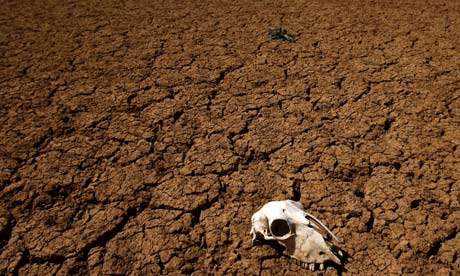
    Animal skull lies on dried-up reservoir

    Water shortage will cause greater ruin than peak oil. Photograph: Pedro Armestre/AFP/Getty Images

    Almost nine out of 10 climate scientists do not believe political efforts to restrict global warming to 2C will succeed, a Guardian poll reveals today. An average rise of 4-5C by the end of this century is more likely, they say, given soaring carbon emissions and political constraints.

    Such a change would disrupt food and water supplies, exterminate thousands of species of plants and animals and trigger massive sea level rises that would swamp the homes of hundreds of millions of people.

    The poll of those who follow global warming most closely exposes a widening gulf between political rhetoric and scientific opinions on climate change. While policymakers and campaigners focus on the 2C target, 86% of the experts told the survey they did not think it would be achieved. A continued focus on an unrealistic 2C rise, which the EU defines as dangerous, could even undermine essential efforts to adapt to inevitable higher temperature rises in the coming decades, they warned.

    The survey follows a scientific conference last month in Copenhagen, where a series of studies were presented that suggested global warming could strike harder and faster than realised.

    The Guardian contacted all 1,756 people who registered to attend the conference and asked for their opinions on the likely course of global warming. Of 261 experts who responded, 200 were researchers in climate science and related fields. The rest were drawn from industry or worked in areas such as economics and social and political science.

    The 261 respondents represented 26 countries and included dozens of senior figures, including laboratory directors, heads of university departments and authors of the 2007 report from the Intergovernmental Panel on Climate Change (IPCC).

    The poll asked the experts whether the 2C target could still be achieved, and whether they thought that it would be met: 60% of respondents argued that, in theory, it was still technically and economically possible to meet the target, which represents an average global warming of 2C since the industrial revolution. The world has already warmed by about 0.8C since then, and another 0.5C or so is inevitable over coming decades given past greenhouse gas emissions. But 39% said the 2C target was impossible.

    The poll comes as UN negotiations to agree a new global treaty to regulate carbon pollution gather pace in advance of a key meeting in Copenhagen in December. Officials will try to agree a successor to the Kyoto protocol, the first phase of which expires in 2012. The 2C target is unlikely to feature in a new treaty, but most of the carbon cuts proposed for rich countries are based on it. Bob Watson, chief scientist to Defra, told the Guardian last year that the world needed to focus on the 2C target, but should also prepare for a possible 4C rise.

    Asked what temperature rise was most likely, 84 of the 182 specialists (46%) who answered the question said it would reach 3-4C by the end of the century; 47 (26%) suggested a rise of 2-3C, while a handful said 6C or more. While 24 experts predicted a catastrophic rise of 4-5C, just 18 thought it would stay at 2C or under.

    Some of those surveyed who said the 2C target would be met confessed they did so more out of hope rather than belief. “As a mother of young children I choose to believe this, and work hard toward it,” one said.

    “This optimism is not primarily due to scientific facts, but to hope,” said another. Some said they thought geoengineering measures, such as seeding the ocean with iron to encourage plankton growth, would help meet the target.

    Many of the experts stressed that an inability to hit the 2C target did not mean that efforts to tackle global warming should be abandoned, but that the emphasis is now on damage limitation.

  • Sea ice spread linked to ozone layer


    Sea ice spread linked to ozone layer

    Article from:  The Australian

    SEA ice around Antarctica has been increasing at a rate of 100,000sq km a decade since the 1970s, according to a landmark study to be published today.

    The study by the British Antarctic Survey, published in the journal Geophysical Research Letters, says rather than melting as a result of global warming, Antarctica continues to expand.

    The fact that Antarctic ice is still growing does not in itself prove that global warming is not happening. But the BAS says increased ice formation can be explained by another environmental concern, the hole in the ozone layer, which is affecting local weather conditions.

    But the absence of an ice melt overall does put a further question mark over extreme claims that the world faces precipitous rises in sea levels because of the melting polar ice caps.

    Federal Environment Minister Peter Garrett has been under fire for suggesting sea levels could rise by 6m as a result of the melting of the Antarctic ice. Antarctica has 90 per cent of the Earth’s ice and extensive melting of its ice sheet would be required to raise sea levels substantially.

    The Weekend Australian reported on Saturday that the results of ice-core drilling and sea ice monitoring indicated there was no large-scale melting of ice over most of Antarctica. Drilling in the fast ice, a type of sea ice, off Australia’s Davis Station last year showed the ice was 1.9m thick, its densest in 10 years.

    The BAS, which discovered the ozone hole in the mid-1980s, has drawn on data from international agencies, including Australia’s three Antarctic bases.

    BAS project leader John Turner told The Australian yesterday that cooling had been recorded at the Australian bases and elsewhere in east Antarctica. He said satellite images indicated the ozone layer had strengthened surface winds around Antarctica, deepening storms in the South Pacific area of the Southern Ocean. This had resulted in a greater flow of cold air over the Ross Sea, leading to more ice production.

    While sea ice had been lost to the west of the Antarctic Peninsula, sea ice cover over the Ross Sea had increased.

    Dr Turner said the research results indicated why the extensive melting of ice in the Arctic was not occurring in Antarctica.

    “While there is increasing evidence that the loss of sea ice in the Arctic has occurred due to human activity, in the Antarctic, human influence through the ozone hole has had the reverse effect and resulted in more ice,” he said. As the ozone hole repaired itself as a result of measures in place to reduce chlorofluorocarbons in the stratosphere, the cooling in Antactica was expected to be reversed.

    “We expect ozone levels to recover by the end of the century, and by then there is likely to be around one-third less Antarctic sea ice,” Dr Turner said.

    He said that while the expansion of sea ice, the relatively thin ice in Antarctic coastal waters, had been established, debate continued about whether the main mass of the Antarctic ice sheet was growing or shrinking.