Category: Climate chaos

The atmosphere is to the earth as a layer of varnish is to a desktop globe. It is thin, fragile and essential for preserving the items on the surface.150 years of burning fossil fuel have overloaded the atmosphere to the point where the earth is ill. It now has a fever. Read the detailed article, Soothing Gaia’s Fever for an evocative account of that analogy. The items listed here detail progress on coordinating 6.5 billion people in the most critical project undertaken by humanity. 

  • Miliband’s coal decision is cvnical and meaningless


    Miliband’s coal decision is cynical and meaningless

    If coal plants go ahead on the condition that their emissions will one day be abated through carbon capture and storage technology, then emissions are a certainty

    It’s simple: there should be no new coal burning without 100% carbon capture and storage (CCS) to bury carbon dioxide emissions underground where they cannot influence the climate.

    This is a very different matter from Ed Miliband’s proposal in the House of Commons today that energy companies must “demonstrate CCS on a substantial proportion of any new coal-fired power station.” The figures he has just proposed (400MW of gross capacity) suggest that only around one-quarter to one-fifth of total emissions from a new plant will be captured.

    These partly abated coal plants, in other words, would still be much worse than unabated gas plants.

    Miliband went on to insist that “when the technology is proven [we will make a] commitment that CCS will be fitted on the entire plant.”

    So the big “if” about CCS has magically been turned into a “when”.

    If Miliband is sure that full-scale CCS is viable, two questions arise:

    1. Why has he just announced four demonstration projects to test whether it is viable or not?

    2. Why not go ahead with full CCS right now?

    Of course, there is no “when”. As Alastair Darling told the House of Commons in May 2007:

    “It is true to say that the technology to capture, transport and store the carbon exists, but it has not actually been joined up on a commercial basis yet … these things might never become available.”

    It might work. It might not. As anyone seeking to develop and commercialise a new technology knows, it is likely to be beset by a host of unforeseeable difficulties, which will almost certainly delay it and possibly derail it.

    As Miliband says:

    “I have had representations that from day one there should be 100% CCS on new coal, but I believe that this does not appreciate the need that still exists to demonstrate the technology before full-scale commercial deployment is possible.”

    So here’s the difficulty for the government. It will approve a new generation of coal-burning power stations, starting with Kingsnorth in Kent, on the basis that they will one day reduce their emissions by means of a technology that has not yet been demonstrated. What happens if the CCS demonstrations show that it doesn’t work on the scale Miliband envisages, or not, at least, when he predicts? The only means the government will then have of cutting emissions from the coal-burning plants it approves today is to shut them down, wholly or partially. Two factors mean that this is likely to be politically impossible:

    1. The government has to decide now what our future energy mix will be. All large-scale electricity generation – whether from fossil fuel, nuclear or renewables – takes years to plan, develop and bring onstream. If, say, the government decides that in 2020 one-fifth of our power will come from coal, and then discovers in 2020 that coal emissions cannot be abated by CCS, it will not be able to shut those power stations down without massive consequences for electricity supply. The choice will be a stark one: either it will have to abandon its carbon targets or it will have to subject the country to electricity rationing and rolling black-outs. It’s not hard to guess which way it would jump.

    2. Both Labour and the Conservatives have long colluded with the power generation industry. The Guardian’s new revelations about this relationship are just the latest in a long line. The power sector is a formidable industrial lobby group, which no government appears prepared to confront.

    Miliband can make extravagant promises today about retrofitting 100% CCS to all new coal-burning power stations by 2020 and preventing them from operating without it. But he probably won’t be in office then, and almost certainly won’t be in his current role. Perhaps, as a private citizen, he intends to march into the Kingsnorth power plant and demand that it shuts down, but he can expect to be bludgeoned by the police if he does, just like the rest of us.

    The government’s announcement, in other words, is cynical and meaningless. It cannot enforce the decision it has just made, and it knows that no one else will. If coal plants go ahead on the condition that their emissions will one day be abated through CCS, the emissions will be a certainty. The abatement will not.
    monbiot.com

  • Mangroves ‘protect coastal villages during cyclones’


    Mangroves ‘protect coastal villages during cyclones’

    Mangroves cut coastal deaths during cyclones — but their effectiveness during tsunamis is inconclusive, says a new study. From SciDev, part of the Guardian Environment Networ

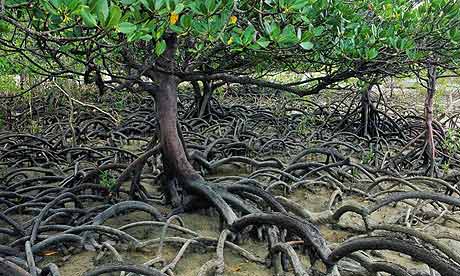
    Mangrove swamp

    Debate is growing on using mangrove forests as a protective shield against cyclones

    Mangrove forests, common along tropical coasts, can provide a protective shield against destructive cyclones and reduce deaths, a study has found.

    The finding follows a report published earlier this year (January) which said that mangroves were not effective against tsunamis (see Mangroves do not protect against tsunamis). It adds to a growing debate on using mangroves as bioshields in coastal areas.

    The new study, conducted by scientists at the University of Delhi, India, and Duke University in the United States, analysed the 1999 ‘super cyclone’ that ravaged Orissa state in eastern India, killing an estimated 10,000 people.

    The scientists found that coastal villages in Orissa with the widest mangrove belts suffered fewer deaths, compared to those with narrower or no mangroves.

    Their statistical models suggest that without mangroves, villages within ten kilometres of the coast would have suffered an average of 1.72 additional deaths.

    “Statistical evidence of this life-saving effect is robust” and remains “highly significant” even after taking into account other environmental and socioeconomic factors, the report says.

    The January study, however, found that ‘bioshields’ have negligible effects against tsunamis. Others have argued that promoting green coastal belts as a buffer against tsunamis is diverting valuable funds from effective protection measures such as developing early warning systems.

    Saudamini Das, an associate professor at the University of Delhi and a co-author of the new study points out that while the new study does not address whether mangroves protect tsunami-hit areas it does clear all doubts about their effects against cyclones.

    Das told SciDev.Net that there are key differences in the height and energy of the waves in tsunami and cyclone situations. Cyclones cause sea waters to rise and form a wall of water called a ‘storm surge’ up to eight metres high. The waves are driven by cyclone winds and their energy is concentrated near the water surface. “Mangroves can reduce the wind energy and [wave] velocity in this case,” she says.

    By contrast, tsunami wave heights can reach up to 20 metres and their effects on mangroves are not clear as there is no similar study covering a large sample size and taking into account other environmental and socioeconomic factors, she says.

    Das also says the maximum speed of tsunami waves mangroves can withstand is yet to be studied.

    • This article was shared by our content partner SciDev, part of the Guardian Environment Network

  • Budget 2009: Darling promises 34% emissions cuts with world’s first binding carbon budgets


    Budget 2009: Darling promises 34% emissions cuts with world’s first binding carbon budgets

    Environmentalists warn that emissions targets are out of date


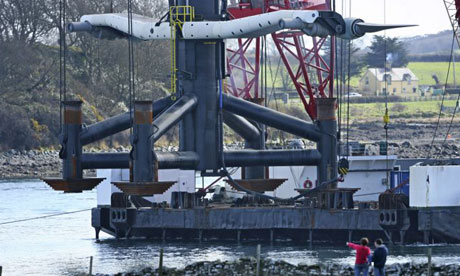
    SeaGen - the world's first and largest commercial scale tidal stream energy generator - was laid down in Strangford Lough, Northern Ireland

    There was widespread criticism that the rest of the budget did not include enough money for renewable energy such as tidal power. Photograph: Peter Muhy/Getty/AFP

    If they can actually do it, the government’s pledge to cut global warming emissions by one third in just over a decade should transform the way the UK economy works.

    However, critics warned that the cuts would still not be enough to avoid dangerous climate change, and warned that other spending pledges were not nearly enough to meet the target.

    Darling has now promised to cut greenhouse gases by 34% by 2020 through so-called carbon budgets, which fix binding limits on greenhouse gas emissions over five-year periods. The 34% target is in line with the advice of the government’s independent watchdog, the Committee on Climate Change. “This represents a step change in the UK ambition on climate change,” said the budget report.

    The budget report said the government “aims” to do this without purchasing controversial carbon credits from cuts made in other countries, but said these “offsets” could be a “fallback option”. It also said the target cut would be higher if there was “satisfactory” global agreement on cutting emissions, but stopped short of committing to the higher 42% cut recommended by the CCC in those circumstances.

    “These budgets give industry the certainty needed to develop and use low carbon technology – cutting emissions, creating new businesses and jobs,” said the chancellor.

    Nobody expected the government to reject the emissions targets put forward by its watchdog, which are designed to help reach a promised reduction of 80% by the middle of this century.

    However, the formal announcement makes the UK the first country in the world to set legally binding targets.

    Environmental campaigners and business groups commended the government on committing itself to firm targets. However, there were immediate warnings that not enough was being done.

    Friends of the Earth, the charity which led a mass public campaign for the Climate Change Act which created the targets, said the 34% cut was no longer enough.

    “Setting the first ever carbon budgets is a ground-breaking step – but the government has ignored the latest advice from leading climate scientists and set targets that are completely inadequate,” said Andy Atkins, the organisation’s executive director. “A 42% cut by 2020 is the minimum required if we are to play our part in avoiding dangerous climate change.”

    There was also widespread criticism that the rest of the budget did not include enough money for renewable energy like wind and tidal power, and energy efficiency for homes and other buildings. The budget also promised up to four “demonstration” projects for carbon capture and storage for coal and gas power plants, and £60m of new spending on research and development of the unproven technology, but critics said these partial capture schemes were not enough if the government goes ahead with plans for up to eight new coal plants.

    James Cameron, vice-chairman of Climate Change Capital, a low-carbon investment fund with more than US$1.5bn (£1bn) under management, said: “The idea of a carbon budget is to be applauded and must become a permanent feature of how we direct our economy. But the reality is that creating a low carbon economy requires more than high-level commitment. The scale of investment required is huge, and thus far the commitments to stimulate the economy and reduce emissions have been small gestures, albeit in the right direction. They have identified the correct areas to be targeting with strategic intervention but the orders of magnitude are much too small.”

    The budget report said a full strategy on how the targets will be met is due this summer, but that the “latest government modelling” showed it was on course to meet the 2020 and two interim targets.

    “The strategy will strengthen the long-term policy framework, taking into account recent consultations on heat and energy saving, renewable energy and zero carbon homes,” added the report.

  • Pollution scheme promotes driving

    Related story in The Land

    MOTORISTS will get a windfall of at least $150 million a year at the petrol pump under the “cent-for-cent” reduction of fuel taxes in the Government’s emissions trading scheme.

    But the annual petrol subsidy has angered green groups and industry, which say it will encourage motorists to drive more and increase emissions until at least 2025.

    In economic work done by the Australian Conservation Foundation, the environmental group found that by using price increases in diesel, which emits more carbon, as the baseline for cutting taxes on petrol, the Government will reduce the price of petrol more than it would normally cost without emissions trading.

    The ACF’s modelling shows that the subsidy to motorists using petrol will be $150 million a year based on a $20-a-tonne carbon price. That subsidy will increase as the price of carbon rises under a trading scheme.

    ACF economic adviser Simon O’Connor said yesterday the measure removed the price incentive for motorists to use their cars less and reduce emissions.

    A spokesman for Assistant Treasurer Chris Bowen said the additional funding would be paid for with cash raised from the sale carbon permits in the emissions trading scheme and would not add to the budget deficit.

    The Government has also committed to making cuts to fuel taxes permanent, meaning if the cost of carbon later falls — making fuel cheaper to refine — it will not increase the tax to original levels.

    The ACF found an ally for its complaints yesterday in petrol company Caltex, which called for the fuel tax cut to be scrapped.

    Caltex also wants the transport sector to be removed from emissions trading altogether and replaced with voluntary “complementary measures”.

    Caltex’s government relations manager, Frank Topham, told a Senate committee hearing on climate change in Sydney that, by Caltex’s calculation, the fuel tax reduction measures meant emissions from cars would rise in the first 15 years of a trading scheme, rather than fall.

    “The price of petrol goes down so emissions will go up for the next few years,” the manager of government affairs for Caltex, Frank Topham, told a Senate committee investigating the scheme.

    Mr Topham called for private motorists and small vehicle users to be permanently excluded from the scheme.

    Caltex estimates emissions will continue to rise until 2025.

    But Caltex wants a delay to the scheme, scheduled to begin in July 2010, until the end of the global economic crisis and 100 per cent free permits until an international agreement of carbon is reached.

  • Plagues follow drought, fire and flood

    From The Land

    AS IF drought wasn’t enough, farmers are now struggling with burgeoning plagues – everything from mice and locusts to rabbits and feral pigs.

    But at least a shortage of mouse bait experienced in several Central West areas last week is now over.

    “We’re back on deck with bait,” said Central West Livestock Health and Pest Authority senior ranger, Lisa Thomas, Dubbo.

    Central, western and north-western areas from Dubbo to the Queensland border are experiencing pest problems, some in near plague proportions.

    Ms Thomas said mice populations were high right across the Central West and western regions.

    “They’re all the way up to Coonamble and north, and Nyngan people are having problems as well.”

  • Damaged Barrier Reef coral makes ‘spectacular recovery’

    From the UK Guardian

    Sections of coral reef in Australia‘s Great Barrier Reef have made a “spectacular” recovery from a devastating bleaching event three years ago, marine scientists say.

    In 2006, high sea temperatures caused severe coral bleaching in the Keppell Islands, in the southern part of the reef — the largest coral reef system in the world. The damaged reefs were then covered by a single species of seaweed which threatened to suffocate the coral and cause further loss.

    A “lucky combination” of rare circumstances has meant the reef has been able to make a recovery. Abundant corals have reestablished themselves in a single year, say the researchers from the University of Queensland’s Centre for Marine Studies and the ARC Centre of Excellence for Coral Reef Studies (CoECRS).

    “Three factors were critical,” said Dr Guillermo Diaz-Pulido. “The first was exceptionally high regrowth of fragments of surviving coral tissue. The second was an unusual seasonal dieback in the seaweeds, and the third was the presence of a highly competitive coral species, which was able to outgrow the seaweed.”

    Coral bleaching occurs in higher sea temperatures when the coral lose the symbiotic algae they need to survive. The reefs then lose their colour and become more susceptible to death from starvation or disease.

    The findings are important as it is extremely rare to see reports of reefs that bounce back from mass coral bleaching or other human impacts in less than a decade or two, the scientists said. The study is published in the online journal PLoS one.

    “The exceptional aspect was that corals recovered by rapidly regrowing from surviving tissue,” said Dr Sophie Dove, also from CoECRS and The University of Queensland.

    “Recovery of corals is usually thought to depend on sexual reproduction and the settlement and growth of new corals arriving from other reefs. This study demonstrates that for fast-growing coral species asexual reproduction is a vital component of reef resilience.”

    Last year, a major global study found that coral reefs did have the ability to recover after major bleaching events, such as the one caused by the El Niño in 1998.

    David Obura, the chairman of the International Union for Conservation of Nature climate change and coral reefs working group involved with the report, said: “Ten years after the world’s biggest coral bleaching event, we know that reefs can recover – given the chance. Unfortunately, impacts on the scale of 1998 will reoccur in the near future, and there’s no time to lose if we want to give reefs and people a chance to suffer as little as possible.”

    Coral reefs are crucial to the livelihoods of millions of coastal dwellers around the world and contain a huge range of biodiversity. The UN’s Millennium Ecosystem Assessment says reefs are worth about $30bn annually to the global economy through tourism, fisheries and coastal protection.

    But the ecosystems are under threat worldwide from overfishing, coastal development and runoff from the land, and in some areas, tourism impacts. Natural disasters such as the earthquake that triggered the Indian Ocean tsunami in 2004 have also caused reef loss.

    Climate change poses the biggest threat to reefs however, as emissions of carbon dioxide make seawater increasingly acidic.

    Last year a study showed that one-fifth of the world’s coral reefs have died or been destroyed and the remainder are increasingly vulnerable to the effects of climate change.

    The Global Coral Reef Monitoring Network says many surviving reefs could be lost over the coming decades as CO2 emissions continue to increase.