Category: Climate chaos

The atmosphere is to the earth as a layer of varnish is to a desktop globe. It is thin, fragile and essential for preserving the items on the surface.150 years of burning fossil fuel have overloaded the atmosphere to the point where the earth is ill. It now has a fever. Read the detailed article, Soothing Gaia’s Fever for an evocative account of that analogy. The items listed here detail progress on coordinating 6.5 billion people in the most critical project undertaken by humanity. 

  • Climate change threatens Ganges, Niger and other mighty rivers

                                                                                    Neville Gillmore

    Climate change threatens Ganges, Niger and other mighty rivers

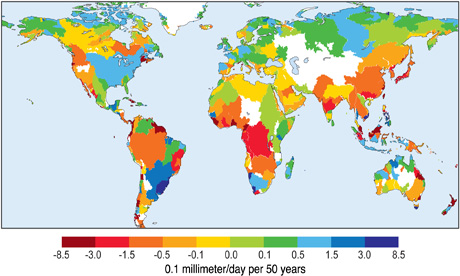
    water levels map

    This map shows the change in run-off inferred from streamflow records worldwide between 1948 and 2004, with bluish colors indicating more streamflow and reddish colors less. Graphic: Journal of Climate, modified by UCAR

    Some of the mightiest rivers on the planet, including the Ganges, the Niger, and the Yellow river in China, are drying up because of climate change, a study of global waterways warned yesterday.

    The study by the National Center for Atmospheric Research in Colorado found that global warming has had a far more damaging impact on rivers than had been realised and that, overwhelmingly, those rivers in highly populated areas were the most severely affected. That could threaten food and water supply to millions of people living in some of the world’s poorest regions, the study warned.

    “In the subtropics this [decrease] is devastating, but the continent affected most is Africa,” said NCAR’s Kevin Trenberth. “The prospects generally are for rainfalls, when they do occur, to be heavier and with greater risk of flooding and with longer dry spells in between, so water management becomes much more difficult.”

    The scientists examined recorded data and computer models of flow in 925 rivers, constituting about 73% of the world’s supply of running water, from 1948-2004. It found that climate change had had an impact on about a third of the major rivers. More than twice as many rivers experienced diminished flow as a result of climate change than those that saw a rise in water levels.

    In addition, those rivers that did see a rise were in sparsely populated, high latitude areas near the Arctic Ocean where there is rapid melting of ice and snow.

    The authors said their study brought new clarity to an understanding of the long-term effects of climate change on waterways. “I think our study settles the question regarding long-term trends in global streamflow,” said Aiguo Dai, the lead author of the report.

    The greatest danger was posed to those dependent on the Niger in West Africa, the Ganges in South Asia and the Yellow river in China. The Colorado river in the US was also experiencing a drop in water levels.

    Other big rivers in Asia, such as the Brahmaputra in India and the Yangtze in China, remained stable or registered an increase in flow. But the scientists said they too could begin shrinking because of the gradual disappearance of the Himalayan glaciers.

    The only rivers that could gain strength from climate change were those that flow north of the 50th parallel. “Global warming raises temperature and precipitation there and it may not be a bad thing,” said Dai. “However, these are sparsely populated regions.”

    The study found that climate change, which had disrupted rain patterns and evaporation, had a far greater and more damaging effect on the world’s rivers than other human-made factors such as dams, and diverting water for irrigation. “For many of world’s large rivers the effects of the human activities on yearly streamflow are likely small compared with that of climate variations during 1948-2004,” the study said.

    It also had a knock-on effect because the rivers empty into the world’s oceans. As the rivers shrink, oceans were growing saltier. During the lifespan of the study, fresh water discharge into the Pacific ocean fell by about 6% – or roughly the annual volume of the Misssissippi.

  • ACF urges Senators :fix CPRS, then pass it


    ACF urges Senators: fix CPRS, then pass it.         Neville Gillmore

    Date: 22-Apr-2009

    The climate change problem is too urgent and Australia has too much to lose for the Parliament not too fix the flaws in the Carbon Pollution Reduction Scheme (CPRS), the Australian Conservation Foundation told a Senate inquiry in Melbourne today.

    ACF executive director Don Henry told the Senate Select Committee on Climate Policy tens of thousands of lives, hundreds of thousands of jobs and some of Australia’s most beautiful places were at risk if Australia responded weakly to climate change.

    “This year’s heatwave and bushfires are a foretaste of a much worse future if we don’t act now,” Mr Henry said.

    “More than 50,000 jobs in the tourism and recreation sectors are dependent on a healthy and attractive Great Barrier Reef and thousands more jobs that depend on the ski fields, the Daintree Rainforest and Kakadu are similarly at risk.

    “A weak Australian and global response to climate change will condemn these Australian icons and many of the jobs that depend on them.  On the other hand, Australian leadership on climate change can generate more than half a million jobs and help achieve strong global action to avoid dangerous climate change.”

    Mr Henry said it was in Australia’s national interest that an agreement to substantially cut greenhouse pollution was reached at the global negotiations in Copenhagen in December.

    “We call on the Parliament to set strong Australian targets, not the existing weak targets, to cut emissions.  We call for the CPRS be fixed and passed this year.  In its current form it carries a high risk of entrenching Australia in a laggard position on climate change.” 

    Mr Henry said for the emissions trading scheme to be effective it must have a strong 2020 target to reduce emissions and strong measures to boost renewable energy and energy efficiency.

    “This Parliament has the unique chance to promote strong action on climate change at precisely the time it is needed. As a nation we have the opportunity to play a key role in averting the worst of climate change and promoting strong jobs growth in the clean economy of the future. I urge all Parliamentarians to grasp this historic opportunity now.”

    Find the full text of Don Henry’s opening statement here »

  • Farmers back climate denier

    NFF President David Crombie added: “We’ve heard ad nauseam from those scientists convinced that climate change will ruin us all and, seemingly, hell-bent on making grim doomsday predictions. But we’ve heard precious little from those experts for whom the jury is still out, or, in the case of Professor Plimer, say their research shows extreme climate change predictions are over-stated.

    “Now, before I’m carted to a stake for public torching, I’m not saying Professor Plimer is right, nor that his colleagues with differing views are wrong. Just that it’s about time we had a balanced, informed discussion and debate… free from vilification of those who dare to question conventional wisdom.

    “We know that not all scientists agree on climate change or the cause and effect theories that underpin it. In his book, Prof Plimer claims that every scientific argument ever used to show that humans change climate is wrong and cites over 2,300 scientific references in support of his claims.

    “It’s food for thought. That’s why Prof Plimer will be a key speaker at our upcoming National Congress in Brisbane this June – so Australian farmers, agribusiness leaders, government officials and other delegates can make up their own minds.

    “You would be hard pressed to find any organisation that has been more proactive on the need to mitigate the potential risks of climate change than the NFF. We’ve been on the front foot in doing so for all my three years as President.

    “But, as Prof Plimer says: “If Government decisions, taxation and emissions trading are to be based on science that is demonstrably wrong, then primary industry in Australia will be destroyed”, then we must consider all possibilities, alternate information and counter-views so we can make informed decisions and choices.

    “As farmers, we have no way of knowing who is right, wrong or kind-of-in-the-ballpark on the scientific research and the judgements therein, but no-one was ever hurt by being exposed to all the facts on any given topic. Rigour underpins getting the science right… Prof Plimer is part of the mix.”

    More information the NFF’s 2009 National Congress, including all speakers and topics, is available from the National Congress website at: http://congress.nff.org.au.


  • World’s poor polluters too

    The conversation around climate largely focuses on carbon dioxide, the invisible greenhouse gas building in the atmosphere mainly from the burning of fuels and forests. But there’s another emission from human activities that would be easier to curb in the short run – and that also contributes to enormous conventional pollution problems as well as the warming of the climate.

    From the New York Times

    It’s good old fashioned black carbon soot – a visible pollutant with measurable effects on human health both in poor places, where it comes from cooking or heating using coal, firewood or dung, and rich countries, where it is produced mainly through the combustion of diesel and similar fuels and from some industries.

    James E. Hansen of NASA first drew attention to soot as a climate influence in 2000. He and others have also proposed that soot, by darkening Arctic ice and snow, could be accelerating the boreal melt well beyond what would happen only under natural climate variability or the growing warming influence from greenhouse gases.

    Now a new study by V. Ramanathan of the University of California, San Diego, published online this week in Nature Geoscience, finds that soot may be more than twice as potent a warming influence as the Intergovernmental Panel on Climate Change estimated last year. The study, co-authored by Greg Carmichael of the University of Iowa, also proposes that regional emissions of dark carbon particulates in south Asia could be contributing to the melting of the ice locked in the Himalayas.

    One reason for black carbon’s potent warming effect, according to the paper, is that most of it is forming vast “brown clouds” around the tropics where the sun is also at its strongest.

    Dr. Ramanathan, like Dr. Hansen, has said that carbon dioxide remains the dominant concern because it can persist in the atmosphere for centuries once emitted. But cutting sooty pollution can have an immediate payoff, both in limiting climate risks and improving public health, the new study said.

    One way or the other, it’s pretty clear that cooking on dried dung and firewood, the norm for about 2 billion people, will be hard to sustain as populations in south Asia and Africa climb.

    The climate impact of these energy sources pales beside the direct impact on the lives of the people — mainly women and their children — who spend a significant portion of the day gathering the fuels or breathing the smoke. International development agencies estimate that more than 1.5 million people die young each year from avoidable respiratory ailments associated with cooking.

    cooking fire
    Soot from cooking fires is a health threat and warming the climate. Gita Devi cooked dinner on a small wood-fueled fire by the light of a small can of kerosene in the courtyard of her home in the village of Chakai Haat in the state of Bihar. (Ruth Fremson/The New York Times)

    Still, the climate benefits from shifting away from such energy options count, too, Dr. Hansen said in an email. “And we need every bit of help we can get,” he said.

    There’s more here on black carbon and climate, and how the issue roiled politics and environmental campaigns and science in 2000.


  • Carbon Dioxide is now pollution

    From the New York Times

    WASHINGTON — The Environmental Protection Agency on Friday formally declared carbon dioxide and five other heat-trapping gases to be pollutants that endanger public health and welfare, setting in motion a process that will lead to the regulation of the gases for the first time in the United States.

    The E.P.A. said the science supporting the proposed endangerment finding was “compelling and overwhelming.” The ruling initiates a 60-day comment period before any proposals for regulations governing emissions of heat-trapping gases are published.

    Although the finding had been expected, supporters and critics said its issuance was a significant moment in the debate on global warming. Many Republicans in Congress and industry spokesmen warned that regulation of carbon dioxide emissions would raise energy costs and kill jobs; Democrats and environmental advocates said the decision was long overdue and would bring long-term social and economic benefits.

    The E.P.A. administrator, Lisa P. Jackson, said: “This finding confirms that greenhouse gas pollution is a serious problem now and for future generations. Fortunately, it follows President Obama’s call for a low-carbon economy and strong leadership in Congress on clean energy and climate legislation.”

    The United States has come under fierce international criticism for trailing other industrialized nations in regulating emissions of carbon dioxide and other pollutants tied to global warming. With this move and steps by Congress toward a cap-and-trade system to curb heat-trapping gases, the American government can now point to progress as nations begin to write a new international treaty on climate change.

    The European Union already has a system of trading permits for industrial emissions of heat-trapping gases in which polluters can meet limits either by reducing emissions or buying credits from more efficient producers. Europe also has a system for regulating emissions of heat-trapping gases from vehicles.

    Japan and several other nations have programs limiting tailpipe pollution that are more stringent than the limits expected to be proposed by the E.P.A.

    The E.P.A. announcement did not contain specific targets for reductions of heat-trapping gases or new requirements for energy efficiency in vehicles, power plants or industry. Those will come after a period of comment and rule-making or in any legislation that emerges from Congress.

    Senator Christopher S. Bond, Republican of Missouri, said the agency’s regulation of heat-trapping gases would be expensive and cumbersome.

    “The Obama administration’s actions today,” Mr. Bond said, “will do more to endanger families, farmers and workers with new energy taxes and lost jobs than it does to protect the environment.”

    As the E.P.A. begins the process of regulating the climate-altering substances under the Clean Air Act, Congress is writing wide-ranging energy and climate legislation that would alter, combine with or override the actions taken by the agency. Mr. Obama and Ms. Jackson have said they much prefer that Congress address global warming rather than have the E.P.A. tackle it through administrative action that could be subject to lawsuits.

    When the agency announced its finding, Mr. Obama was en route from Mexico City to Trinidad and Tobago for a meeting of Western Hemisphere nations. The agency made its decision public in a news release and an 133-page explanation of the scientific and legal basis of its proposed finding.

    In 2007, the Supreme Court, in Massachusetts v. E.P.A., ordered the agency to determine whether heat-trapping gases harmed the environment and public health. The case was brought by states and environmental groups to force the E.P.A. to use the Clean Air Act to regulate heat-trapping gases in vehicle emissions.

    Agency scientists were virtually unanimous in determining that those gases caused such harm, but top Bush administration officials suppressed their work and took no action.

    In his first days in office, Mr. Obama promised to review the case and act quickly if the findings were justified. The announcement Friday was the fruit of that review.

    According to the E.P.A. announcement, the finding was based on rigorous scientific analysis of six gases — carbon dioxide, methane, nitrous oxide, hydrofluorocarbons, perfluorocarbons and sulfur hexafluoride — that have been widely studied by scientists. The agency said its studies showed that concentrations of the gases were at unprecedented levels as a result of human activity and that it was highly likely that those elevated levels were responsible for an increase in average temperatures and other climate changes.

    Among the ill effects of rising atmospheric concentrations of the gases, the agency found, were increased drought, more heavy downpours and flooding, more frequent and intense heat waves and wildfires, a steeper rise in sea levels and harm to water resources, agriculture, wildlife and ecosystems.

    Environmental advocates applauded the decision, which they had sought for years.

    Auto companies, utilities and others tied to polluting emissions had long dreaded this day but generally reacted with caution because the regulatory process had just begun and they hoped to address their concerns in the legislation before Congress.

    The Alliance of Automobile Manufacturers said its members were developing cars and trucks to meet the expected tougher emissions standards.


  • Climigration tops polar conference agenda

    From the UK Guardian

    In Alaska, climate change is creating an unforeseen humanitarian crisis. Arctic sea ice – which had protected communities from coastal erosion and flooding – is rapidly disappearing and signalling a radical transformation of this northern ecosystem. Scientific observations during the summer of 2007 documented a new record low.

    In 2006, the US government completed a $2.5m (£1.7m) seawall to protect the native village of Kivalina, located on an island in the Chukchi Sea. But on the day of the dedication ceremony, a storm surge partly destroyed the newly constructed sea barrier. One year later, the community was evacuated to protect inhabitants from a severe storm.

    The situation looks set to get worse. Winter temperatures along the northern Alaskan coast have increased an average of 3.5C (38.3F)since 1975. These warming temperatures are causing the arctic seas to freeze later in autumn and the permafrost – usually permanently frozen subsoil – to thaw. Along the northwestern Alaskan coast, permafrost is the glue that keeps the land intact and habitable.

    Approximately 200 indigenous villages that have inhabited the arctic for millennia are located along Alaska’s coasts and rivers. Dozens of these communities are now endangered because of accelerating erosion and flooding. Five indigenous communities, located along the Bering and Chukchi Seas, have concluded that relocation is the only durable solution to the climatic events that are threatening their lives.

    Government agencies now realise that erosion and flooding control can no longer protect these coastal communities. In 2006, a US government report found that relocation of three communities is required because a catastrophic climatic event could submerge them within 10-15 years. Despite these dire predictions, no community has yet been relocated because of the governance issues that must be addressed to facilitate relocation. The report recognised that no government agency has the authority to relocate communities, no governmental organisation exists that can address the strategic planning needs of relocation, and no funding is specifically designated for relocation.

    Since 2006, government officials have organised numerous meetings to address the policy and practical challenges of relocation. One village, Newtok, is in the relocation process. The Newtok Planning Group is the only interdisciplinary governmental workgroup in Alaska focused on relocation. The Newtok Traditional Council is leading the effort.

    Next week in Alaska, the Inuit Circumpolar Conference will host a gathering of indigenous peoples from all over the world. The goal is to develop recommendations for the UN Convention on Climate Change meeting in December 2009. One of the topics will be the creation of a human rights regime to protect those forced to relocate because of climate change. “Climigration” is the word that best describes this type of population displacement. Climigration requires a new and unique institutional response based in human rights doctrine. Communities, rather than individuals, will be forced to migrate. Permanent relocation will be mandated because there will be no ability to return home because home will be under water or sinking in thawing permafrost.

    Catastrophic random environmental events, such as hurricanes, do not cause climigration. However, these random environmental events, if on-going, may alter ecosystems permanently, cause extensive damage to public infrastructure, repeatedly place people in danger and require communities to relocate. Determining which communities are most likely to encounter displacement will require a complex assessment of a community’s ecosystem vulnerability to climate change, as well as the vulnerability of its social, economic and political structures. Permanent relocation must only occur when there are no other durable solutions.

    International human rights principles need to be specifically created for climigration to ensure that the social, economic and cultural human rights of individuals and the communities forced to migrate are protected. These principles will ensure that the affected community is a key leader and decision-maker in the relocation process. The principles will also affirm that families and tribes remain together. For indigenous communities, tribal relationships are essential to cultural identity.

    The Intergovernmental Panel on Climate Change (IPCC) predicts that 150 million people may be displaced by climate change by 2050. The United Nations University has developed an international research agenda on climate change and forced migration. The IPCC needs to convene an expert working group to fully develop the human rights framework that will guide nation-states in addressing climigration. The time to act is now.

    Robin Bronen is a human rights attorney and a National Science Foundation fellow. She lives in Anchorage, Alaska.