Category: Climate chaos

The atmosphere is to the earth as a layer of varnish is to a desktop globe. It is thin, fragile and essential for preserving the items on the surface.150 years of burning fossil fuel have overloaded the atmosphere to the point where the earth is ill. It now has a fever. Read the detailed article, Soothing Gaia’s Fever for an evocative account of that analogy. The items listed here detail progress on coordinating 6.5 billion people in the most critical project undertaken by humanity. 

  • World treaty leaves Australia behind

    “Australia cannot hope to transform into a renewable energy powerhouse while neither the Government nor the industry are interested in making it happen,” Australian Greens Deputy Leader and Climate Change Spokesperson, Senator Christine Milne, said.

    “Renewable energy technologies are already capable of replacing coal if governments and industry come together to make it happen.

    “But the Rudd Government refuses to do anything to challenge coal’s dominance, and the domestic renewable energy industry seems unable to effectively promote itself.

    “The establishment of IRENA shows that Australia’s renewable energy reticence is not shared by the rest of the world.

    “If the Rudd Government signs and ratifies the IRENA founding treaty, its hypocrisy will be on global show. If it fails to sign, it will only be the Australian people who will come face to face with the hypocrisy of the Government they so recently elected on a platform of climate action.”

    IRENA aims to drive “a rapid transition towards the widespread and sustainable use of renewable energy on a global scale” by providing technical and policy advice to industrialised and developing countries, as well as promoting renewable energy on the global stage.

    “The Australian renewable energy industry needs to take inspiration from the establishment of IRENA and start to speak up for itself instead of accepting scraps from the table,” Senator Milne concluded.

    All information about IRENA can be found at http://www.irena.org/

  • Warming gets cold shoulder from Rudd

    And when coal flows from two new export infrastructure projects announced in 2008, in the Hunter Valley of NSW and at Gladstone, Queensland, the addition to global emissions from burning that coal will be an amount each year greater than Australia’s total greenhouse gas emissions, cancelling out the planned reduction by 2020 many times over.

    How did it come to this, when there was optimism after its election that the Government would take a lead in climate policy in 2008, not jog on the spot at the rear of the field? Was a mistake made in taking the political pressure off in 2008 as the large climate groups switched from mobilising people power to advocating policy detail, assuming the Government was predisposed to listen? Did the Government decide to give real access only to those climate advocates who were prepared to support its “clean coal” policy, narrowing and conservatising the range of voices to which it listened? Was the Government always going to put the views of big business and the fossil fuel lobby first?

    It is not unreasonable to answer yes in each case.

    The climate action movement’s message is big and unsettling, so it is easier for government not to want to listen. Many of the policy players — business, unions, welfare groups — are sending mixed messages about supporting action as long as it does not hurt their constituencies in the short term, which quickly reduces to sectoral self-interest and political equivocation.

    It is also clear that the Government does not understand how big the scientific imperatives are. If it did, its failure to act in accord with the size and urgency of the problem could justifiably be characterised as a failure to carry out its duty of care.

    But the evidence points to another possibility. In a Rumsfeldian manner, it seemingly does not know it does not know; it is ignorant about the most recent climate science knowledge.

    Hans Joachim Schellnhuber, Europe’s leading climate scientist and adviser to the German Government and the EU, says that “we are on our way to a destabilisation of the world climate that has advanced much further than most people or their governments realise”. Schellnhuber says only concentrations of greenhouse gases close to the pre-industrial levels may be safe, around 280 to 320 parts per million, compared to the present level of close to 390 parts per million.

    One sign of this problem in Australia is the way the Prime Minister and Climate Minister have adopted a traditional Labor approach to climate: something for the environment lobby and something for business. But solving the climate crisis cannot be treated like a wage deal. It is not possible to negotiate with the laws of physics and chemistry, and believing that it can reflects only an ignorance of the task at hand.

    The planet cannot be traded off. There are absolute limits that should not be crossed, and doing something, but not enough, will still lead to disaster. This the Government appears not to understand at all.

    Serious climate-change impacts are already happening, both more rapidly and at lower global temperature increases than projected. We have passed the tipping point for complete loss of the Arctic’s sea-ice in summer.

    “The Arctic is often cited as the canary in the coalmine for climate warming, and now, as a sign of climate warming, the canary has died,” says Dr Jay Zwally, a NASA glaciologist.

    The Arctic sea-ice is the first domino and it is falling fast. Other dominoes, including catastrophic levels of carbon release from warming permafrost in Siberia, are likely to fall unless we stop emitting greenhouse gases and cool the planet to get the Arctic sea-ice back.

    When transformative national and global leadership on climate is now necessary, the many thousands of Australians who work diligently in their local climate action groups see a spectacular failure of political imagination in Canberra.

    And the conclusion to their four-day meeting in the national capital? It will be back to doorknocking the neighbourhood, talking in local churches and workplaces, engaging with local MPs and building an enormous grassroots movement that aims to make our politicians energetic advocates for transformative action on global warming, but a movement also capable of inflicting political pain on those who continue to taken them and the planet’s health for granted.

    David Spratt is co-author of Climate Code Red.

  • Melting glaciers start countdown to climate chaos

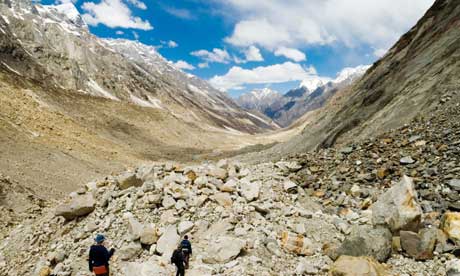
    Trekkers crossing Gangotri glacier in Indian Haimalayas

    Trekkers crossing Gangotri glacier in Indian Himalayas. Photograph: Alamy

    For centuries, writers, painters and photographers have been drawn to the wild and seemingly indestructible beauty of glaciers. More practically, they are a vital part of the planet’s system for collecting, storing and delivering the fresh water that billions of people depend on for washing, drinking, agriculture and power. Now these once indomitable monuments are disappearing. And as they retreat, glacial lakes will burst, debris and ice will fall in avalanches, rivers will flood and then dry up, and sea levels will rise even further, say the climate experts. Communities will be deprived of essential water, crops will be ruined and power stations which rely on river flows paralysed.

    As a result, people will have to change their lifestyles, their farming, even move their homes, says Achim Steiner, executive director of the United Nations Environment Programme (UNEP). He also fears the problem could exacerbate tensions over inadequate supplies between neighbouring states and countries, possibly spilling over into conflict.

    ‘We’re talking about a major transformation, from household livelihood to big industries,’ says Steiner. ‘While I’m always cautious about “water wars”, certainly the potential for water to become a trigger for more tension and, where there’s already conflict, to exacerbate conflict is another issue that’s not hypothetical.’

    The scale of the problem so alarms Lester Brown, a leading environmental thinker, that he fears huge populations dependent on glacier-fed rivers in Asia – 360 million on the Ganges in India and 388 million on the Yangtze in China alone – will not be able to feed themselves, with devastating effect on already rising global food prices.

    ‘These populations are larger than the populations of any other country in the world,’ said Brown. ‘We know from models there will be shifts in rainfall, crop yields reducing, but these are theoretical. Here there’s a degree of certainty we’ve not seen before in terms of an historically negative effect on food security.’

    Glaciers act like gigantic water towers: snow falls on the top in wet seasons, where it freezes and compacts over years, while melting water at the bottom is released gradually, keeping rivers flowing even in the hottest weather. ‘Glaciers are like a bank,’ says Professor Wilfried Haeberli, director of the World Glacier Monitoring Service. ‘You have income – mainly snow – and you have expenditure – mainly melting: the difference between snowfall and melting is the yearly balance.’

    Since at least 1980 the service has kept a constant record of this net gain or loss in mass balance of 30 ‘reference’ glaciers in nine mountain ranges around the world. It has also used travellers’ diaries, photographs, and the clues left on landscapes scarred by the moving mass of ice and debris to map historic growth and the gradual decline of glaciers since the mid-19th century.

    From 1850 to 1970, the team estimates net losses averaged about 30cm a year; between 1970 to 2000 they rose to 60-90cm a year; and since 2000 the average has been more than one metre a year. Last year the total net loss was the biggest ever, 1.3m, and only one glacier became larger. Worldwide, the vast majority of the planet’s 160,000 glaciers are receding, ‘at least’ as much as this, says Haeberli, probably more – a claim supported by evidence from around the world.

    In North America, Dr Bruce Molina of the US Geological Survey says that in Alaska ’99-plus per cent of glaciers are retreating or stagnating’.

    In the European Alps, a report last year by UNEP said glaciers declined, from a peak in the 1850s, by 35 per cent by 1970 and by 50 per cent by 2000, and lost 5-10 per cent in the mega-hot year of 2003 alone.

    UNEP has also reported declines in the last 50-150 years of 1.3 per cent in the Arctic islands to 50 per cent in the North Caucasus in Russia, 25-50 per cent in central Asia, a 2km retreat of the massive Gangotri glacier which feeds the Ganges, 49 to 61 per cent in New Zealand, and 80 per cent in the high mountains of southern Africa. There is also ‘considerable’ shrinking of medium and small glaciers in central Chile and Argentina accompanied by ‘drastic retreat’ of glaciers in Patagonia to the south.

    The only region where glaciers are advancing is Scandinavia, where climate change has increased precipitation to more than compensate for higher melting, and even there the growth has stagnated, says Haeberli.

    Based on the forecast increase in global temperatures this century, the UNEP report warned of ‘deglaciation of large parts of many mountain regions in the coming decades’. Perhaps most shockingly, it predicted two-thirds of China’s glaciers would disappear by 2050, and ‘almost all would be gone by 2100’.

    Ironically, the immediate local threat is that more meltwater will combine with rains to cause floods – a problem already suspected in parts of China, says Molina: ‘Some large floods have destroyed their infrastructure, taking out bridges, roads and villages. Another threat is that meltwater will collect in glacial lakes until they burst. In the Himalayas, UNEP says some lakes have grown 800 per cent since the 1970s.

    Longer term, though, the problem is less water, as even fast-melting glaciers are too small to keep rivers flowing during dry seasons. To make matters worse, freshwater supplies are also threatened by evaporation in warmer temperatures, pollution and growing demand from a rising and more affluent population. And – like glaciers – snow and thus snowmelt is also declining in the same areas.

    This would have an immediate effect on people who depend on rivers for washing and drinking, irrigating crops, powering hydroelectric stations, transport and – often – religious and cultural traditions. Further afield, drying rivers would no longer be able to recharge groundwater tables used by cities.

    The problem is perhaps most acute in Asia, where glaciers are an important source for nine major rivers which run through land occupied by 2.4 billion people. In Pakistan, for example, 80 per cent of agricultural land is irrigated by the Indus, which the WWF last year highlighted as one of the world’s 10 big at-risk rivers because retreating glaciers provide 70-80 per cent of its flow.

    On a global level, scientists warn that melting glaciers are contributing more than ever to rising sea levels: expansion of warmer water is estimated to cause two-thirds of the problem, but melting glaciers and icecaps are the second biggest contributor. A recent paper published by Science calculated acceleration of glacier melt could add 0.1-0.25m to sea-level rise by 2100.

    Globally there are also concerns that water and food shortages will force more people to flee: just last week the European Commission predicted climate change would be a ‘major driver’ for ‘millions’ of environmental migrants within a decade.

    Experts are calling on political leaders to step up attempts to cut greenhouse gas emissions to slow and eventually stop global warming. Before then, however, they say governments need to do much more to encourage water efficiency, change to less water-thirsty crops and build flood protection and storage where possible. ‘It’s not a reason to sit back and say “it’s all too late”,’ insists Steiner.

  • Jakarta in danger from Climate Chaos


    Of all cities in Southeast Asia, Jakarta is the most vulnerable to the impacts of climate change, a study reveals.

    The Singapore-based Economy and Environment Program for South east Asia (EEPSEA) ranked Central, North and West Jakarta at the top of a list of administrative regions prone to climate change, followed by Mondol Kiri province in Cambodia and East Jakarta.

    The report, prepared by economists Arief Anshory Yusuf and Herminia A. Francisco, reveals Jakarta is vulnerable to all types of climate-change related disasters except for tropical storms.

    “It is frequently exposed to regular flooding but most importantly, it is highly sensitive because it is among the most densely-populated regions in Southeast Asia,” said the report released Wednesday.

    Arief is an environmental economist at Padjadjaran University in Bandung.

    The EEPSEA assessed Jakarta’s history of exposure to five types of natural disaster —floods, landslides, drought, sea-level change and tropical storms — in the period from 1980 to 2000, along with those of 530 other areas in Southeast Asia.

    The results were drawn up by considering each area’s exposure to disasters and its ability to adapt to such threats, and comparing those findings with the vulnerability assessment framework of the United Nations’ Intergovernmental Panel on Climate Change.

    Other vulnerable areas in Indonesia include West Sumatra and South Sumatra, the study says.
    The study also reveals that all regions in the Philippines, Vietnam’s Mekong River Delta, Cambodia, North and East Laos and Bangkok are vulnerable.

    “The Philippines, unlike other countries in Southeast Asia, is not only exposed to tropical cyclones, but also many other climate-related hazards; especially floods, landslides and droughts,” it said.

    In Malaysia, the most vulnerable areas are the states of Kelantan and Sabah.

    Thailand and Malaysia are the most capable of adapting to the impacts of climate change, according to the report.

    “Overall, the areas with relatively high adaptive capacities are in Thailand, Malaysia and Vietnam whereas areas with relatively low adaptive capacities are mostly in Cambodia and Laos,” the EEPSEA said.

    The EEPSEA was established in 1993 to support research and training in environmental and economics studies. It is supported by the International Development Research Center, the Swedish International Development Cooperation Agency and the Canadian International Development Agency.

    A study by the State Ministry for the Environment revealed earlier that flooding, combined with a rise in the level of the sea could permanently inundate parts of Greater Jakarta, including Soekarno-Hatta International Airport.

    International activists have branded Indonesia the world’s third biggest polluter after the United States and China, mostly due to widespread forest fires.

    Developing nations, including Indonesia, have repeatedly called on rich nations to provide financial assistance to enable them to adapt to the impacts of climate change.

  • Inaugration a Green Tie Event

    By Marisa Belger @ MSNBC

    As Washington, D.C., rumbles with pre-inaugural preparations — confirming VIP guest lists, double-checking menus, stocking bars — several party planners find themselves adding another section to their checklists: eco-consciousness.

    History will be made next Tuesday as Barack Obama is sworn in as president, but the celebrations will be framed in another first as organic and local food, carbon offsets and energy-efficient lighting debut on the party planning priority list.

    If any presidential inauguration were to feature not one — but two — carbon-neutral galas, it would be Obama’s. The President-elect has made his hopes for environmental action clear, and when you think about it, there’s no better moment to kickstart the new green economy then at an inaugural fiesta.

    Green galas
    Hoping to set a clear eco-example, the planners behind these environmentally conscious events — The Green Inaugural Ball hosted by Al Gore and The Green Inaugural Party hosted by Event Emissary, a DC-based event planner — have transformed their conventional parties into paradigms of eco-entertaining.

    “We want to show people that you can do an event at the caliber of an inaugural ball and still have it be green,” says Jenna Mack, a co-producer of the Green Inaugural Party taking place January 17. “We have greened every aspect of the event.” She’s not kidding. Any leftover food (organic and local of course) from the event will be composted; the outdoor catering tents will be powered with a biodiesel generator; energy-efficient LEDs will make up the decorative lighting; VIPs will skip the plastic bottles, hydrating instead with water made from the air (check out ecoloblue.com to learn all about atmospheric water generation); and staff and talent (including headliner Wyclef Jean) will be shuttled in chauffeured electric cars — thanks to GEM, a division of Chrysler — among other highly considered eco details.

    Meanwhile, the Green Inaugural Ball (January 19) will be meeting equally high environmental standards — but with Al Gore as the face of the event, was there ever another option? “We’re really focused,” says Shelley Cohen, chair of the event’s greening committee. “We’re looking at everything holistically, understanding that everything makes an impact.” Lucky attendees will walk down Bentley Prince Street’s recycled green carpet; dine on food sourced — when possible — from vendors in the D.C. metropolitan area; wash their hands with biodegradable soap; and rest assured that 100 percent of the energy used to power the event is being offset through a partnership with carbon offset organization Native Energy.

    Transportation
    But green tie events are just the beginning of the eco-awareness that will be sweeping D.C. during inauguration week. Revelers — estimates predict that millions of people will descend on the city — are encouraged to leave their cars at home and seek out alternative and public methods of transportation (there will never be a better opportunity to see ball gowns on the Metro). Bike riders can utilize the Washington Area Bike Association’s two free bike valet stations at the primary inaugural event; friends of the segway (a two-wheeled, self-balancing electric vehicle) can rent the contraption through Segs in the City. Those who insist on four wheels can make a better choice by renting a hybrid vehicle from a local rental agent or looking for one of the Saturn hybrids that will be used as courtesy vehicles throughout the inauguration.   

    Accommodation
    Are you extraordinarily wealthy and interested in greening your accommodations while in D.C.? For a mere $40,000 you can experience the Fairmont Washington D.C.’s “Eco-Inaugural Package,” which includes four nights in a eco-sumptuous suite made from rapidly renewable materials like bamboo; a party gown designed by famed sustainable designer Linda Loudermilk; a series of organic spa treatments; an all-organic midnight supper; and a Lexus hybrid complete with driver for all of your transportation needs.

    Or you can do what I would do and crash on the couch in the house of your best D.C. buddy.

    Personal responsibility
    From green balls to green transportation, I can’t help but wonder if all of this inaugural eco-effort has rubbed off on other presidential affairs taking place next week — including the main event. “My understanding is that [Obama’s inaugural team] has brought in a consultant to help them with green measures,” says Mack. “It’s obviously something this administration cares about. I am confident that they are working to green the event.” And if the inauguration can go green, we can, too. “We are encouraging people to take personal responsibility,” says Cohen.” We’ve demonstrated that this is a very doable thing, that there is an infrastructure for it.”

  • Farmers attack failed carbon scheme

    To cap off what AFI executive director Mick Keogh calls the “all stick and no carrot” nature of the CPRS, nowhere in the design of the scheme is there any incentive for farmers to innovate with offsets like forestry or soil carbon sequestration.

    Nor are there imbedded incentives for research organisations to plunge money into emissions-reduction R&D, with no apparent means of making a return on the investment.

    The result, says the AFI report, headlined Emission Impossible, is that by 2016, the farm sector could be bleeding between 2.4pc and 7.8pc of its cash margins to the CPRS, with no ability to trade on its assumed ability to sequester carbon, other than through voluntary markets yet to be devised.

    Should agriculture be included under the CPRS in 2015, as is currently being discussed, outcomes could be even worse.

    Even if government recognises agriculture as “trade exposed” and provides 90pc of emissions permits at no cost, AFI’s modelling suggests that farm cash margins across the sector would drop between 3-24pc.

    If agriculture is brought under the CPRS umbrella with no upfront assistance, cash margins could in some sectors—notably medium-sized beef-sheep enterprises—shrink by more than 100pc.

    Looked at from all angles, the CPRS is currently a “dead end” for agriculture, Mr Keogh concluded.

    “It’s hard to see where to go from here,” he said.

    “One of the proposals put to government in the run-up to this was that it develop an offsets scheme for agriculture that’s not part of the emissions trading scheme, but enables farmers to act to reduce their emissions and gain some benefit.

    “That was rejected in the Green Paper and the White Paper (on CPRS design).”

    If introduced, agriculture may have developed technologies, like soil carbon sequestration or methane reduction, that allowed it to offset emissions trading costs and ultimately transition smoothly into the CPRS, Mr Keogh said.

    Without it, agriculture faces a raft of new costs outside its control.

    “The bit of the White Paper that I found particularly jarring was the statement that if agriculture didn’t become a covered sector, then a ‘cost-efficient emissions reduction requirement’ would be placed on the sector,” Mr Keogh added.

    “It seems to mean that whatever happens, agriculture will pay the equivalent of the CPRS price for carbon. The way things stand, that will just be a dead hand on the sector.”