Category: Climate chaos

The atmosphere is to the earth as a layer of varnish is to a desktop globe. It is thin, fragile and essential for preserving the items on the surface.150 years of burning fossil fuel have overloaded the atmosphere to the point where the earth is ill. It now has a fever. Read the detailed article, Soothing Gaia’s Fever for an evocative account of that analogy. The items listed here detail progress on coordinating 6.5 billion people in the most critical project undertaken by humanity. 

  • Extreme weather calls for action, UN climate chief says

    Extreme weather calls for action, UN climate chief says
    Reuters
    “We have had severe climate and weather events all over the world and everyone is beginning to understand that is exactly the future we are going to be looking about if they don’t do something about it,” she said. SEA LEVELS. Rajendra Pachauri, head of
    See all stories on this topic »
    PRC sets new rules for utilities during severe weather
    Bizjournals.com (blog)
    The New Mexico Public Regulation Commission will require the state’s regulated gas and electric utilities to follow stricter emergency response protocols during severe weather events. The new rules come after a PRC staff report on severe weather
    See all stories on this topic »


    This once a day Google Alert is brought to you by Google.

    Delete this alert.
    Create another alert.
    Manage your alerts.

  • Emma Ruby-Sachs – Avaaz.org

    Emma Ruby-Sachs – Avaaz.org
    9:25 AM (1 hour ago)

    to me

    Dear friends,

    A secret deal could allow China’s energy companies to take over an enormous toxic oil reserve with devastating consequences for the planet. A lawsuit is our big chance to stop it. Click to chip in and Avaaz will only process your donation if the deal is signed and we have enough money to fight a legal battle:

    Right now, the tar sands, a toxic oil reserve almost the size of Saudi Arabia’s but over 3 times as dangerous for climate change, sits landlocked in Northern Canada. People power has twice blocked new pipelines into this poison, but now we have a bigger challenge.

    A new trade deal, negotiated in secret with China, could allow China’s companies to take over the tar sands and sue the Canadian government if it hampers their exploitation with environmental or health laws. Canada’s right-wing Prime Minister is an oil-man with a history of climate-denial, and he’s using this tactic to bypass democracy, with potentially devastating consequences for the planet.

    Our big chance to stop this is that the deal may not be legal. It’s likely to be signed in the coming days or weeks and we need to be ready to hit back when that happens. If 20,000 of us pledge now to help hire outstanding lawyers and fund research and public campaigning, we can be sure to hit the ground running when the government acts — Avaaz will only process the pledge if we get enough to make this important case happen. Our climate is already under grave threat, and tar sands could push it over the edge. Pledge now to defend the planet:

    https://secure.avaaz.org/en/canada_fipa_pledge_formleft/?bhPqncb&v=19610

    Tar sands oil would harm all of us: The emissions from this dirty oil are up to 35% greater than regular crude oil, the process for getting it out of the ground alone emits three times the pollution, and the production of one gallon of oil poisons up to 35 gallons of fresh water. Not to mention that the exposure of another huge oil reserve would skyrocket the destruction of our planet.

    That’s why experts and campaigners all over joined the fight to stop pipelines from being built in the US and Canada that would unlock this toxic sludge from the ground. Now those hard-fought victories could be wiped out.

    We have already reached out to one of the top constitutional law firms in Canada and they are standing by to help us fight this dirty deal. But it’s going to take a powerful legal fund to stand up to the government’s deep pockets, campaign to win in the court of public opinion and make sure we keep dirty oil in the ground. Let’s all pledge our support now. Then, if the deal goes through, we’ll be able to get started right away defending our planet in Canada’s courts. Can you pledge now?

    https://secure.avaaz.org/en/canada_fipa_pledge_formleft/?bhPqncb&v=19610

    We’ve taken on the Canadian government before, and won — striking a blow against a Fox News-style television network and beating back attempts to stop Canadian Avaaz members from campaigning during federal elections. This is our chance to win a battle for the entire world’s survival against a trade deal that threatens our water, air and land.

    With hope and determination

    Emma, Ricken, Dalia, Morgan, Rewan, Ari, Grant and the rest of the Avaaz team

    MORE INFORMATION:

    Chinese FIPA now a lose-lose proposition (Vancouver Sun)
    http://www.vancouversun.com/life/OPINION+Chinese+FIPA+lose+lose+proposition/7545141/story.html

    What if the Canada-China investment treaty is unconstitutional? (The Globe and Mail)
    http://www.theglobeandmail.com/commentary/what-if-the-canada-china-investment-treaty-is-unconstitutional/article4629972/

    Even Canada doesn’t believe its own spin on tar sands (Guardian)
    http://www.guardian.co.uk/environment/damian-carrington-blog/2011/dec/20/oil-sands-tar-canada-uk-lobbying-emissions

    Canadian Government: Greenhouse Gas Emissions from Tar Sands May Double by 2020 (Think Progress)
    http://thinkprogress.org/climate/2011/08/08/291116/canadian-government-greenhouse-gas-emissions-from-tar-sands-will-double-by-2020/

    Background: Environmental Impacts of Tar Sands Development (Sierra Club)
    http://www.sierraclub.org/energy/factsheets/tarsands.asp


    Avaaz.org is a 17-million-person global campaign network
    that works to ensure that the views and values of the world’s people shape global decision-making. (“Avaaz” means “voice” or “song” in many languages.) Avaaz members live in every nation of the world; our team is spread across 19 countries on 6 continents and operates in 14 languages. Learn about some of Avaaz’s biggest campaigns here, or follow us on Facebook or Twitter.

    You are getting this message because you signed “Save our dying planet!” on 2011-12-08 using the email address nevilleg729@gmail.com.
    To ensure that Avaaz messages reach your inbox, please add avaaz@avaaz.org to your address book. To change your email address, language settings, or other personal information, https://secure.avaaz.org/act/index.php?r=profile&user=6be3e9aa63582c9b1397464fcc49baa9&lang=en, or simply go here to unsubscribe.

    To contact Avaaz, please do not reply to this email. Instead, write to us at www.avaaz.org/en/contact or call us at +1-888-922-8229 (US).

  • First evidence of ocean acidification affecting live marine creatures in the Southern Ocean

    First evidence of ocean acidification affecting live marine creatures in the Southern Ocean

    Posted: 26 Nov 2012 08:09 AM PST

    The shells of marine snails — known as pteropods — living in the seas around Antarctica are being dissolved by ocean acidification, according to a new study. These tiny animals are a valuable food source for fish and birds and play an important role in the oceanic carbon cycle.

  • China planning ‘huge fracking industry’

    China planning ‘huge fracking industry’

    Chinese plans to expand fracking for shale gas prompt fears over local water and international climate impacts

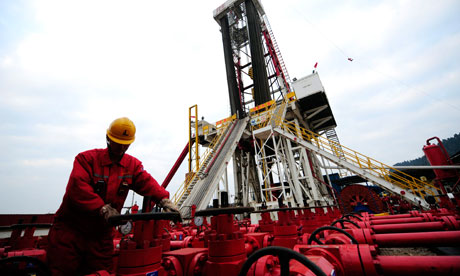
    Shale gas in China : natural gas appraisal well of Sinopec in Langzhong county, Sichuan

    A worker performs a routine check to the valves at a natural gas appraisal well of Sinopec in Langzhong county, Sichuan province, March 1, 2011. Photograph: Stringer /Reuters

    China is ratcheting up its fracking ambitions with virtually no regard for groundwater protection or other environmental safety measures, according to a new investigation by the independent publication Caixin. The report points to an 24 October white paper on energy development released by China’s top cabinet which “calls for ramping up the industry and pumping 6.5 billion cubic meters of natural gas from underground shale formations by 2015.”

    “The model for China’s anticipated success is the US shale gas sector,” the article states. “Geologists estimate the nation’s recoverable reserves at about 25 trillion cubic meters, on par with the United States.”

    Fracking has particular appeal in China because it provides an alternative to burning coal, which currently supplies about 70 percent of the nation’s consumed energy. Because natural gas can generate electricity at half the greenhouse gas emissions of coal, some see it as a way to reduce China’s carbon footprint.

    But fracking isn’t without environmental problems, as I and my colleagues at Mother Jones have reported before. And Caixin‘s review of government documents as well as interviews with industry sources, government officials, and environmental advocates reveal that fracking’s risks have not come under public scrutiny the way they have in the US, “much less addressed by the [Chinese] government or controlled via environmental laws.”

    If fracking takes off in China as planned, it will likely exacerbate the nation’s existing water crisis. “Most of the nation’s shale gas lies in areas plagued by water shortages,” the report says. With about 20 percent of the world’s population and only 6 percent of the world’s water resources, China is one of the least water-secure countries in the world. Its water shortages are made worse by pollution: According to the Ministry of Water Resources about 40 percent of China’s rivers were so polluted they were deemed unfit for drinking, while about 300 million rural residents lack access to safe drinking water each year.

    In order to reach the government’s annual shale gas production goal of 6.5 billion cubic meters by 2015, as many as 1,380 wells will need to be drilled across the country, requiring up to 13.8 million cubic meters of water, an industry source told Caixin. China’s industrial sector already consumes about 35 billion cubic meters of water a year. That amount of water would fill about 14 million Olympic-size swimming pools.

    There’s also serious risk of water contamination, as seen in the US fracking experience. Multiple studies in recent years including those by the EPA, Pennsylvania, and Duke University have concluded that shale gas drilling releases methane which can contaminate nearby water supplies. A 2009 ProPublica investigation found methane contamination from fracking was widespread in Colorado, Ohio, and Pennsylvania. But as Caixin reports, “there would be no legal reason to limit methane emissions at a shale gas well because China’s pollution standards do not cover methane.” One Ministry of Environmental Protection source told the publication that writing a new standard into law would take three years, “which helps explain why the State Council’s decision to fast-track the nation’s fledgling shale gas industry is making a lot of people nervous.”

    Groundwater in 57 percent of China’s 660 cities have already been significantly polluted, according to the Ministry of Environmental Protection.

    An unidentified source at China’s Ministry of Land Resources told Caixin that as shale gas development accelerates the government will likely introduce specific environmental policies to address fracking, such as groundwater protection. But these are not likely to be legally binding, an industry source told the publication.

    Perhaps a bigger concern is that China’s main energy and economic planning agencies, including the Ministry of Land Resources, seem to view fracking’s environmental risks as minimal or inflated:

    The MLR geological department source said, for example, that China’s shale gas is at least 3,000 meters and sometimes 4,000 meters underground—significantly deeper than aquifers, and separated from underground water by impermeable rock.

    Other industry sources argue that fracking fluids, which are mainly comprised of water and sand, break down naturally over a short time. And chemical additives make up less than 0.5 percent of what’s injected, they say.

    Similarly upbeat arguments against environmental fretting can be found in the government’s development plan for the period ending in 2015. It was jointly issued by four agencies including the National Development and Reform Commission and National Energy Bureau.

    Meanwhile, Caixin reported that one test fracking operation in Shaanxi Province—a major coal region in China’s dry North—recently “went awry, forcing local officials to temporarily cut a nearby city’s water supply.”

    Commercial fracking operations in China have not yet started, according to Caixin‘s report, but some Chinese companies have drilled test wells, and the government has begun selling chunks of designated fracking territory. In its latest round of auctioning shale-gas exploration blocks, for example, the Ministry of Land Resources awarded two blocks to Sinopec and Henan Coal Seam Gas Development and Utilization Co, in deals worth an estimated $128.5 million.

    Foreign companies including Royal Dutch Shell are also showing interest in China’s fracking plans. Shell announced earlier this month that it had shale gas agreements with three major Chinese oil companies. Caixin also reported in September that Shell was in talks with one company about a shale gas joint venture. ExxonMobil, BP, Chevron, and France-based Total are also working to form shale gas partnerships with Chinese oil and gas companies, according to an August National Geographic report.

  • UN: methane released from melting ice could push climate past tipping point

    UN: methane released from melting ice could push climate past tipping point

    Doha conference is warned that climate models do not yet take account of methane in thawing permafrost

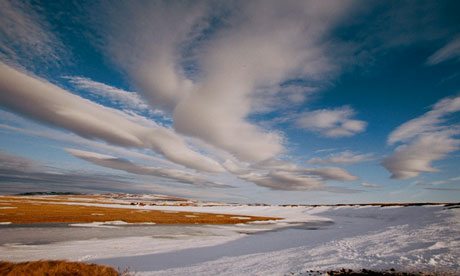
    Siberia

    Frozen ground in Siberia. Permafrost covers nearly a quarter of the northern hemisphere. Photograph: Francis Latreille/Corbis

    The United Nations sounded a stark warning on the threat to the climate from methane in the thawing permafrost as governments met for the second day of climate change negotiations in Doha, Qatar.

    Thawing permafrost releases methane, a powerful greenhouse gas, but this has not yet been included in models of the future climate. Permafrost covers nearly a quarter of the northern hemisphere at present and is estimated to contain 1,700 gigatonnes of carbon – twice the amount currently in the atmosphere. As it thaws, it could push global warming past one of the key “tipping points” that scientists believe could lead to runaway climate change.

    The UN Environment Programme (UNEP) called for the effect to be studied in detail by the Intergovernmental Panel on Climate Change (IPCC), the body of top climate scientists convened by the UN to provide governments with the most up-to-date and comprehensive knowledge on climate change. The next IPCC report will be published in several parts from next year.

    Achim Steiner, executive director of UNEP, said: “Permafrost is one of the keys to the planet’s future because it contains large stores of frozen organic matter that, if thawed and released into the atmosphere, would amplify current global warming and propel us to a warmer world. Its potential impact on the climate, ecosystems and infrastructure has been neglected for too long.”

    UNEP said warming permafrost could also “radically alter ecosystems and cause costly infrastructural damage due to increasingly unstable ground” and called for national monitoring systems to be put in place by countries with permafrost, including Russia, Canada, China and the US.

    Most of the current permafrost formed during or since the last ice age and extends to depths of more than 700 metres in parts of northern Siberia and Canada. Permafrost consists of an active layer of up to two metres in thickness, which thaws each summer and refreezes each winter, and the permanently frozen soil beneath. As temperatures in the Arctic are rising faster than elsewhere, this could increase the danger of permafrost melting. Warming permafrost could emit 43 to 135 gigatonnes of carbon dioxide equivalent by 2100 and 246 to 415 gigatonnes by 2200, according to the report, and emissions could start within the next few decades. Permafrost emissions could ultimately account for up to 39% of total emissions, according to the report.

    UNEP’s report came as governments argued over the future of the Kyoto protocol at the Doha climate talks. One of the main aims of the talks is an agreement to continue the protocol beyond the end of this year, when its current provisions and targets expire. But only the EU and a handful of other relatively small emitters, including Australia, Norway and Switzerland, have agreed.

    Japan was once a strong defender of the protocol, taking pride in the fact that it was negotiated there. But the country has now abandoned it, in part because of fears that its neighbour, China, has taken a competitive advantage because it is not obliged to reduce its emissions.

    Masahiko Horie, of the Japanese negotiating team, said: “Only developed countries are legally bound by the Kyoto protocol and their emissions are only 26% [of global emissions]. If we continue the same, only one quarter of the world is legally bound and three quarters of countries are not bound at all.”

    He said it was more important to Japan to formulate a new framework that would require action on emissions from developing as well as developed countries. At the talks, governments are expected to draw up a work plan that would set out how they will draw up such a new global agreement by 2015, coming into force in 2020.

    But many developing countries want developed countries to continue with Kyoto beyond 2012 as part of any deal. Andre Correa do Lago, head of the Brazilian delegation, said: “If rich countries which have the financial means, have technology, have a stable population, already have a large middle class, think they cannot reduce [emissions] and work to fight climate change, how can they ever think that developing countries can do it? That is why the Kyoto protocol has to be kept alive. If we take it out, we have what people call the Wild West. You are not going get the [emissions] reductions necessary.”

    The talks will continue until the end of next week.

  • Doha 2012: US claims ‘enormous’ efforts to cut carbon emissions Two weeks of talks aim at securing a treaty by 2015 to cut greenhouse emissions Share14 inShare.1 Email Fiona Harvey, environment correspondent The Guardian, Monday 26 November 201

    Doha 2012: US claims ‘enormous’ efforts to cut carbon emissions

    Two weeks of talks aim at securing a treaty by 2015 to cut greenhouse emissions

    Doha 2012 climate change summit

    Almost 200 governments are gathering in Doha in an attempt to reach an agreement on climate change. Photograph: EPA

    The US is claiming credit for “enormous” efforts on climate change – delivered in part by the carbon reductions from its investments in the controversial practice of “fracking” for shale gas.

    The claim came as nearly 200 governments gathered in Doha, Qatar, for two weeks of talks aimed at forging an agreement on the climate. Governments have until 2015 to draw up a binding treaty, the first since the 1997 Kyoto protocol, to cut greenhouse gas emissions and avoid dangerous global warming.

    Jonathan Pershing, a senior negotiator for the US, said: “Those who don’t know what the US is doing may not be informed of the scale and extent of the effort, but it’s enormous.”

    The United Nations’ top climate official, Christiana Figueres, called on countries to step up their efforts to reach an agreement. The Kyoto protocol took five years to draft, so the new deadline is tight, and scientific warnings have grown more stark in recent years.

    In the past few weeks alone, authorities including the World Bank and the International Energy Agency have warned that the world is heading for unprecedented warning – of between 4C and 6C – if current trends are not reversed.

    Levels of warming on that scale would result in droughts, floods, heatwaves and fiercer storms, as well as declining agricultural productivity, plant and animal extinctions, and widespread human migration, according to scientists.

    Figueres said it was still possible for the world to cut emissions in time to avoid such a fate, but that it would take urgent action. She said: “Expert analysis consistently says that we do have the possibility to keep on track and that to act now is safer and much less costly than to delay.

    “In the last three years, policy and action towards a sustainable, clean energy future has been growing faster than ever. But the door is closing fast because the pace and scale of action is simply not yet enough. So Doha must deliver its part in the longer-term solution.”

    The host of the conference, Abdullah bin Hamad al-Attiyah of Qatar‘s Administrative Control and Transparency Authority, said: “Climate change is a common challenge for humanity. We must work in earnest for a better future for present and for future generations. We have a precious opportunity over the coming days, and we must make full use of it.”

    But Qatar has drawn criticism because it has the highest emissions per capita in the world, owing to its oil and gas wealth, and high use of energy for air conditioning, desalination and other technologies. Attiyah responded: “We should not focus on the amount per capita but on the total per country.”

    The US has often been painted as the villain in the annual United Nations climate talks, since it signed the Kyoto protocol in 1997 but then failed to ratify it, and as under George Bush’s presidency climate sceptics were in the ascendancy. The Obama White House has taken a different view, but developing countries complain that the US has not taken on sufficient responsibility for cutting emissions and aiding the most vulnerable nations.

    Pershing defended the US’s record, saying that more effort was on its way. He said: “[Our efforts so far] doesn’t mean enough is being done. It’s clear the global community, and that includes us, has to do more if we are going to succeed at avoiding the damages projected in a warming world.”

    Greenhouse gas emissions from the US have fallen sharply in recent years, owing to the replacement of coal-fired power generation by gas in the US, following its widespread adoption of shale gas.

    By contrast, a new analysis by HSBC has found that China’s greenhouse gas emissions are unlikely to start falling before 2030, which could put the 2 degree target out of reach. China’s increasing role in emissions, compared with the decrease in the US, could redraw the battle lines of the talks.