Category: Climate chaos

The atmosphere is to the earth as a layer of varnish is to a desktop globe. It is thin, fragile and essential for preserving the items on the surface.150 years of burning fossil fuel have overloaded the atmosphere to the point where the earth is ill. It now has a fever. Read the detailed article, Soothing Gaia’s Fever for an evocative account of that analogy. The items listed here detail progress on coordinating 6.5 billion people in the most critical project undertaken by humanity. 

  • Methane leaking from coal seam gas field, testing shows

    Methane leaking from coal seam gas field, testing shows

    Date
    November 14, 2012 – 5:36PM
    • 74 reading now

    Vast amounts of methane appear to be leaking undetected from Australia’s biggest coal seam gas field, according to world-first research that undercuts claims by the gas industry.

    Testing inside the Tara gas field, near Condamine on Queensland’s Western Downs, found some greenhouse gas levels over three times higher than nearby districts, according to the study by researchers at Southern Cross University.

    The study has potential national consequences because last week’s energy white paper forecast a massive expansion of Australian coal seam gas drilling, and called for environmental objections to be removed to make large-scale gas extraction easier

    Methane, carbon dioxide and other gases appear to be leaking up through the soil and bubbling up through rivers at an astonishing rate, the researchers said.

    “The concentrations here are higher than any measured in gas fields anywhere else that I can think of, including in Russia,” said Damien Maher, a biochemist who helped conduct the tests. “The extent of these enriched concentrations is significant.”

    The study has potential national consequences because last week’s energy white paper forecast a massive expansion of Australian coal seam gas drilling, and called for environmental objections to be removed to make large-scale gas extraction easier. In NSW, the Planning Assessment Commission is currently considering a proposal by AGL to drill 66 new coal seam gas wells in western Sydney.

    The Australian Petroleum Production and Exploration Association, the leading industry, attacked the research, saying it was “premature and questionable”.

    The coal seam gas industry has previously maintained that gas leakage in Australia is “negligible”, and the default assumption has been that about 0.12 per cent of gas leaks out of wells during production. Uncontrolled leaks up through rock fissures and soil, of the type measured by the Southern Cross University team, were assumed to be nil, and are unaccounted for under the federal emissions trading scheme.

    The researchers drove back and forth on public roads through the gas fields at Tara, taking measurements every second via a cavity ring down spectrometer – the only instrument of its type in Australia. It enabled them to take thousands of real-time readings of several gases in the air, and accurately pinpoint them with a global positioning system.

    “Everything we’re finding shows that something major is happening and we need to look deeper into the problem,” said Isaac Santos, a senior lecturer in biochemistry at Southern Cross University, who worked on the study with Dr Maher.

    “I think what it shows is we have to go through all gas fields, and potential gas fields, and take measurements, so we have baseline data to work from.”

    Inside the gas field, methane was measured at up to 6.89 parts per million, compared to an average background level outside the gas field of about two parts per million.

    Carbon dioxide levels inside the gas field were measured at up 541 parts per million, compared to 423 parts per million outside.

    The team also took samples of airborne methane from major wetlands and high-density cattle operations near Casino in northern NSW, using the same equipment.

    “The concentrations are higher at Tara than at any of these other potential sources,” Dr Santos said.

    The federal government is currently reassessing its methodology for measuring greenhouse gas leakage from coal seam gas fields, and the researchers have sent a submission to the government asking it to take their work into account.

    “These results provide strong evidence for significant, but still unquantified, greenhouse gas emissions in the Tara region,” the submission says. “Our results demonstrate the need for baseline studies before the development of gas fields. We suspect that depressurisation (fracking, groundwater pumping) of the coal seams during gas extraction changes the soil structure (i.e., cracks, fissures) that enhance the release of greenhouse gases such as methane and carbon dioxide.”

    The findings were welcomed by opponents of large-scale coal seam gas drilling, including the Lock The Gate group which wants a moratorium on drilling until comprehensive tests are done.

    “This study has massive implications for accounting for Australia’s greenhouse gas emissions since methane is a very potent greenhouse gas,” said the group’s president, Drew Hutton. “It also means the CSG industry would need to pay much higher carbon tax than is currently predicted.”

    The Greens said a national, independent study was needed to accurately measure gas leaks.

    “The gas industry has been hiding behind its claim to be better for the climate than coal for years, and the government has just accepted those claims despite the Greens, farmers and scientists providing evidence that they are deceptive,” said the Greens leader, Senator Christine Milne.

    “It makes no sense to develop a new fossil fuel industry at the end of the fossil fuel age, particularly when it is compromising food growing land and contaminating aquifers.”

    The Tara gas field operation is owned by BG Group, a British multinational gas and oil company. It directed questions to the industry body APPEA.

    “Incomplete research from Southern Cross University academics this week lacks the basics of scientific rigour,” APPEA’s chief operating officer for the eastern region, Rck Wilkinson, said in a statement. “What is presented as research is in reality a funding submission.

    “The claim that large-scale fugitive gas emissions are a result of coal seam gas production, before they even do their research, seems to indicate a bias against coal seam gas,” Mr Wilkinson said.

    “This does them no credit and it diminishes the good work by many other scientists in an age where scientific endeavour has been wearied by community scepticism.”

    The researchers have submitted two papers on their findings, which have been seen by Fairfax, and the papers are currently undergoing a peer-review process prior to publication.

    Read more: http://www.smh.com.au/environment/methane-leaking-from-coal-seam-gas-field-testing-shows-20121114-29c9m.html#ixzz2CCGIio5K

  • Experts: sea levels rising faster than expected

    Experts: sea levels rising faster than expected
    IceNews
    American researchers have claimed that the rise of sea level may be happening at twice the rate previously thought. The news comes via a newly released study conducted by geologists from the University of Colorado in Boulder. The report says that sea
    See all stories on this topic »

    IceNews
    $1.24 billion needed to rescue Saigon from flooding
    VietNamNet Bridge
    VietNamNet Bridge – By 2070, there will be nearly 10,000 hectares, 257,000 people, 1,494 km of roads and many production facilities, industrial parks being flooded due to high tides and the sea level rise, according to a workshop assessing the risk of
    See all stories on this topic »

    VietNamNet Bridge
    UM Professor Finds Greenland Absorbs Large Amounts Of Melt
    The Roundup
    Scientists know that sea level currently rises about 3.2 mm per year, with about half of that rise comes from melting ice around the world. Researchers estimate that 20 to 40 percent of that new water comes from Greenland. Harper led a team of
    See all stories on this topic »
    Can US adapt to surging storms in time to avert coastal damage?
    Alaska Dispatch
    Along the US East Coast, where Sandy and last year’s hurricane Irene left chaos in their wakes, a perfect storm of rising sea levels and coastal development is brewing. Forty-two percent of the dry land up to one meter above sea level is already
    See all stories on this topic »
    The Moral of Sandy
    Project Syndicate
    Consider sealevel rise, which caused by far the most damage in New York. Models show that the world’s most ambitious climate policy, the EU’s “20-20-20” plan, will have a net cost of roughly $250 billion a year for the rest of the century, or about
    See all stories on this topic »

    Project Syndicate
    Tell Us: Is this Extreme Weather a Symptom of Climate Change?
    Patch.com
    A study funded by the Rhode Island Sea Grant, found that the sea level around the East Bay has increased eight inches since 1930. By 2100, the Rhode Island Coastal Resources Management Council said to expect three to five feet of sea level rise.
    See all stories on this topic »


    This once a day Google Alert is brought to you by Google.

    Delete this alert.
    Create another alert.
    Manage your alerts.

  • Climate change is here, even if election skipped it

    Climate change is here, even if election skipped it
    Milwaukee Journal Sentinel
    But climate scientists say the record warm weather of the past year, punctuated by extreme events such as superstorm Sandy in the Northeast, provides a glimpse of things to come and should push the issue higher on the list of national priorities
    See all stories on this topic »

  • Northwest Queensland Weather Radar at Mount Isa

    Northwest Queensland Weather Radar at Mount Isa
    Importantly, the radar will increase the ability of the Bureau and community to monitor severe weather events. The Mount Isa Radar will have Doppler capability
    www.bom.gov.au/weather…/mount_isa_radar_nov2012.shtml

  • Kyoto protocol: Australia signs up to second phase

    Kyoto protocol: Australia signs up to second phase

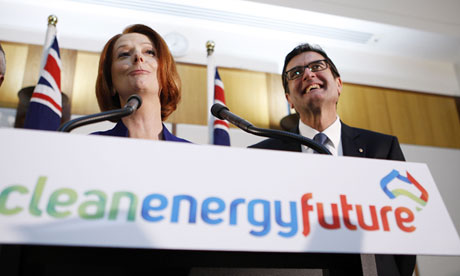
    Australia’s commitment to binding emission reductions up to 2020 gives fresh hopes for progress at Doha climate talks

    Australia ready to sign to Kyoto 2 :  Julia Gillard and the Minister for Climate Change Greg Combet

    Prime minister, Julia Gillard, and climate and and energy minister, Greg Combet. Australia has signed up to the second phase of the Kyoto protocol. Photograph: Stefan Postles/Getty Images

    Negotiations towards a new global treaty on climate change took a small step forward on Friday as the Australian government announced it would join up to a continuation of the Kyoto protocol beyond 2012.

    At the end of this month, governments will meet in Doha, Qatar, to discuss a new treaty that would be signed in 2015 and come into force from 2020. But the mood ahead of the UN conference is tense, as few countries are willing to make the concessions needed for a compromise deal.

    Greg Combet, Australia’s climate change and energy efficiency minister, said the country would “commit to limiting its greenhouse gas emissions from 2013 to 2020 with a Kyoto target consistent with the bipartisan target of reducing emissions to 5% below 2000 levels by 2020”.

    But he added that this did not rule out the option later of moving up Australia’s 2020 target range of 5-15%, or 25% below 2000 levels if Australia’s conditions relating to the extent of action committed elsewhere in the world are met.

    The current commitment period of the Kyoto protocol finishes at the end of this year, and developing countries are adamant there must be a continuation if they are to sign up to any 2015 deal.

    Also on Friday, New Zealand drew fire from environments and opposition politicians for ruling out a second phase of Kyoto. The country’s climate change minister, Tim Groser, said the country would be better served by working towards the new 2015 treaty.

    Australia’s move makes it one of only a handful of countries outside the European Union’s member states to agree to such a deal. It follows the country introducing a carbon tax in June that will lead to a system of carbon trading, similar to that in operation within the EU, intended to reduce greenhouse gas emissions.

    Australia finally ratified the 1997 Kyoto protocol in 2007, under the last Labor government, after a decade of refusal, despite signing up to the treaty originally. But subsequent leaders turned away from it again. Climate change is a highly divisive issue in Australian politics – the country is heavily dependent on coal, and is a big exporter. There are many vocal climate sceptics in the country with the ear of government, and a powerful mining lobby.

    “This is an extremely welcome announcement from Australia and for the first time expands international commitment beyond Europe,” Ed Davey, the UK’s energy and climate change minister, said. “Having Australia on board will really help to push the second Kyoto protocol period which is vital to maintaining agreed rules to cut global emissions as we make the transition to a new, global, legally binding deal.

    “Australia’s work to reduce emissions is bold and promising. I’ll be working hard with Combet and our global counterparts to make even more progress in Doha.”

    Another development that may make negotiations in Doha easier is the result of the US presidential elections. Although Barack Obama has been largely reticent on climate change, his opponent would have been much less likely to approach the negotiations favourably, given the extent of opposition to action on emissions within the US Republican party.

  • Months without power in wake of Sandy

    Months without power in wake of Sandy

    Date
    November 11, 2012

    Henry Goldman, Freeman Klopott

    text

    Ruined … members of the US Coast Guard help clear a house in the Midland Beach area. Photo: Reuters

    ABOUT 100,000 homes and businesses in New York City and Long Island were so damaged by hurricane Sandy that restoring power to some of them may take months, the Governor of New York, Andrew Cuomo, has said.

    About two-thirds are on Long Island’s south shore, with 36,000 clustered in Staten Island and the Rockaways where the most flooding occurred, Mr Cuomo said.

    ”You have some people who have buildings and have homes that you cannot turn on the power until that building or home is repaired or replaced,” he said. ”Those are going to be the most difficult situations.”

    Sandy slammed the East Coast with winds of almost 160km/h and a tidal surge more than four metres above normal.

    The October 29 storm displaced thousands of people, crippled mass transit, knocked out power to more than 8.5 million customers in 21 states and killed more than 100 in the US, including 42 in New York City.

    Mr Cuomo said on Friday that electricity has been restored to 96 per cent of the region, though that did not include the 100,000 power customers whose properties were so damaged it could be months before service was restored.

    About 434,140 homes and businesses, in New York and New Jersey, remained without power , according to the US Energy Department.

    New Jersey’s Republican Governor, Chris Christie, said about 240,000 homes and businesses in the state remained without electricity on Friday.

    Mr Cuomo, a Democrat, has been critical of the utilities, some of which have struggled to get the lights back on in less damaged homes for almost two weeks. Friday, he said he’ll be taking a hard look at what caused some utilities to perform worse than others, after the emergency is over.

    ”I want the utilities to work better and faster,” Cuomo said. ”You have people without power for a very long time. It’s gotten cold. It’s uncomfortable. Yes, we’re understanding, but we’re also impatient.”

    Bloomberg

    Read more: http://www.smh.com.au/world/months-without-power-in-wake-of-sandy-20121110-294v7.html#ixzz2BrddZ4DN