Category: Climate chaos

The atmosphere is to the earth as a layer of varnish is to a desktop globe. It is thin, fragile and essential for preserving the items on the surface.150 years of burning fossil fuel have overloaded the atmosphere to the point where the earth is ill. It now has a fever. Read the detailed article, Soothing Gaia’s Fever for an evocative account of that analogy. The items listed here detail progress on coordinating 6.5 billion people in the most critical project undertaken by humanity. 

  • Glaciers cracking in the presence of carbon dioxide

    Glaciers cracking in the presence of carbon dioxide

    Posted: 10 Oct 2012 04:17 PM PDT

    The well-documented presence of excessive levels of carbon dioxide in our atmosphere is causing global temperatures to rise and glaciers and ice caps to melt. New research has shown that carbon dioxide molecules may be also having a more direct impact on the ice that covers our planet.

  • Wind farms on the bog of Ireland could provide UK electricity

    Wind farms on the bog of Ireland could provide UK electricity

    Company behind the £5bn proposals hopes to build more than 700 turbines and transport power in cables beneath Irish Sea

    Wind farms on the bog of Ireland could provide UK electricity

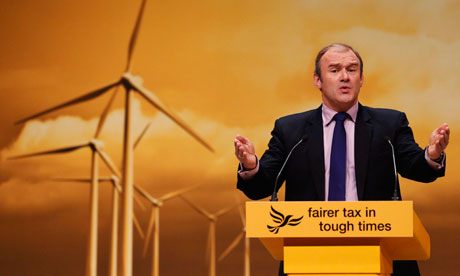
    Ed Davey, the secretary of state for energy and climate change, is considering the proposals. Photograph: Luke Macgregor/Reuters

    Hundreds of wind farms could be built on the great bog of Ireland to generate electricity exclusively for the UK’s national grid under plans being considered by ministers.

    Element Power, the company behind the £5 billion proposals, hopes to build more than 700 turbines and transport power through two dedicated undersea cables across the Irish sea.

    Company executives met Ed Davey, the cabinet minister in charge of climate change, and civil servants to discuss the plans this summer.

    The plans have been discussed among the coalition and appear in theory to appease both political parties. Liberal Democrats wish for an increase in green energy but have concerns over the high price of building wind farms offshore. Conservative ministers are worried about the backlash in some rural communities as wind turbines have become more common in Britain.

    To proceed, the Irish project would need access to the subsidies currently given to UK wind power, but the difficulty for ministers in setting a precedent – which could mean any foreign energy projects can get UK subsidies – means the project face major challenges.

    Mike O’Neill, the president of Element Power, said the project would solve a number of thorny problems for the British government. “Our experience is that it is easier to get planning permission in the Republic of Ireland, if you do it in a sensible and sensitive way,” he said.

    Britain’s electricity suppliers are obliged to provide an increasing percentage of their electricity from renewable sources, to help the UK meet its legally binding targets for cutting the carbon emissions that drive climate change.

    Costs for onshore wind power are currently estimated to be half that of offshore wind power. Element Power claims its project, entitled Greenwire, will provide electricity at two-thirds of the cost of building a big offshore wind farm, which will reduce the amount that needs to be charged to the UK consumer by £7 billion over 15 years.

    The company says its proposed investment would be €8 billion – two-thirds for the wind turbines and a third for the two big sub-sea cables that would take the electricity to the UK. It says the project could provide 3GW of electricity capacity and employ thousands of workers.

    O’Neill said the project could start generating power from 2018, if the subsidy obstacle could be overcome. Another hold-up were the delays in the government setting the actual level of the subsidy, so the project can proceed. O’Neill said energy company EDF was getting special treatment from the government over the price that will be guaranteed for nuclear power and that Greenwire should get the same.

    There are more than 1,100 turbines in operation in Ireland, mostly at 176 onshore windfarms with a further seven offshore. Element Power hopes to expand in Meath, Westmeath, Kildare, Laois and Offaly but says that its project will not prevent the Republic of Ireland meeting its own carbon target of a 40% cut by 2020.

    Coalition tensions over green issues have increased since September’s reshuffle. Owen Paterson, who has campaigned against wind farms in his own constituency, is believed to have clashed with Davey, the Lib Dem secretary of state for energy and climate change.

    Davey appeared to see off Conservative ministers’ attempts to slash the subsidies for onshore wind farms, instead sticking with a smaller cut previously agreed with the industry.

    The row began after more than 100 Conservative backbenchers wrote to the prime minister earlier this year demanding he “dramatically cut” the £400m in annual subsidies paid to onshore wind developers.

    The energy secretary said the new changes to subsidies for renewables, which also include reducing offshore wind payments and more than doubling support for tidal, stream and wave power, would boost clean electricity while curbing the cost to consumers.

  • Warm North Atlantic ocean causing UK’s wet summers, study shows

    Warm North Atlantic ocean causing UK’s wet summers, study shows

    Data points to link between warmer oceans and the change in weather, and the possibility of a rapid reversal to drier climate

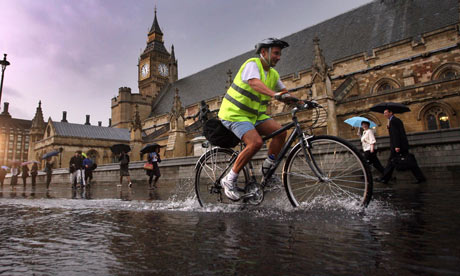
    Wet summer

    Wet summers are becoming common but they could rapidly switch back to dry pattern, study says. Photograph: Lewis Whyld/AP

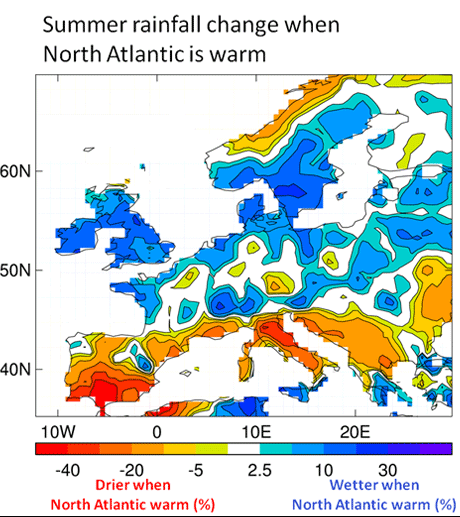
    The UK’s dismal recent summers can be blamed on a substantial warming of the North Atlantic ocean in the late 1990s, according to new scientific research. The shift has resulted in rain-soaked weather systems being driven into northern Europe, increasing summer rainfall by about a third.

    The pattern is likely to revert to drier summers and may do so suddenly, according to Professor Rowan Sutton, at the University of Reading, who led the work. “I can’t guarantee it but it is likely,” he said. “However we are not sure of the timing, which is what every one wants to know – but we are working on this now.” Sutton added that when the switch occurs, it could happen as rapidly as over two to three years.

    The summer of 2012 was the wettest in a century and follows a series of above average years for summer rainfall. Sutton’s team, who published their study in Nature Geoscience, examined over a century of data and found that the temperature of the North Atlantic remains above or below the long term average for decades at a time. The periods of warmer temperature, the latest of which started in the late 1990s, were found to correlate with wet summers in Northern Europe and hotter, drier summers in the Mediterranean. The team used existing detailed climate simulations to demonstrate a causal link between the warmer oceans and the change in the weather.

    Sutton said these shifts have been occurring for many hundreds of years, but that global warming was also having an impact. “It is not now purely natural or purely a manifestation of human-induced climate change,” he said. “There is lot of evidence to show that climate change is changing the timing and amplitude of the temperature changes.” For example, he said, the cooler period from the 1960s to the 1980s occurred when soot and other pollution from dirty power stations cooled the planet.

    The previous North Atlantic warm phase, which ran from the 1930s to the 1950s, also saw a run of wet summers in the UK, including severe flooding in August 1948, which closed the east coast mainline railway for three months, and the Lynmouth floods in August 1952 in which 34 people died.

    The warming of the North Atlantic has been one reason for the record low in Arctic sea ice this summer. It is possible that the shrinking of the sea ice is also contributing to poor summers in the UK, as the exposed ocean waters warm in the sun. However, Sutton said that this remains to be proven by scientific work that is now underway.

    Map - Europe rainfall Map: Europe rainfall

    The warm and cold swings in the North Atlantic affect temperatures, rain and winds across Europe, Africa and North and South America, and previous research indicates they are related to changes in ocean circulation. Other research at Reading University has suggested that it may in future be possible to predict the warming and cooling cycles some years ahead.

  • Climate sceptics more prominent in UK and US media

    Climate sceptics more prominent in UK and US media

    Posted: 04 Oct 2012 05:09 PM PDT

    Climate sceptics are being given a more prominent, and sometimes uncontested, voice in UK and US newspapers in contrast to other countries around the world, new research suggests.
    You are subscribed to email updates from ScienceDaily: Earth Science News
    To stop receiving these emails, you may unsubscribe now.
    Email delivery powered by Google
  • Weather-making high-pressure systems predicted to intensify

    Weather-making high-pressure systems predicted to intensify

    Posted: 05 Oct 2012 09:39 AM PDT

    High-pressure systems over oceans, which largely determine the tracks of tropical cyclones and hydrological extremes in much of the northern hemisphere, are likely to intensify this century, according to a new study.
    You are subscribed to email updates from ScienceDaily: Severe Weather News
    To stop receiving these emails, you may unsubscribe now.
    Email delivery powered by Google
  • Sea Level Rise Will Make Several Islands Uninhabitable Within A Decade

    Sea Level Rise Will Make Several Islands Uninhabitable Within A Decade
    Business Insider
    (Photo by Paula Bronstein/Getty Images). Sea level rise and extreme weather is going to get so bad, that some island nations may need to evacuate within a decade, Micheal Mann, a lead climate scientist, told the Guardian at the SXSW Eco conference.
    See all stories on this topic »
    Global warming: Sea level going up, up up …
    Summit County Citizens Voice
    Modeling sealevel rise is challenging because the ice sheets are slow components of the climate system, but the best available data suggests that unchecked emissions of greenhouse gases will result in a much greater rise in sea level — up to 6.8
    See all stories on this topic »
    Rising Sea Wiping Out Florida Keys Rabbits: Study
    Earthweek – A Diary of the Planet
    Almost imperceptible sea level rises have submerged about 48 percent of habitat for a Florida Keys rabbit. The disappearance of nearly half of a South Florida rabbit species’ habitat due to rising sea levels illustrates the mounting dangers of climate
    See all stories on this topic »