Category: Climate chaos

The atmosphere is to the earth as a layer of varnish is to a desktop globe. It is thin, fragile and essential for preserving the items on the surface.150 years of burning fossil fuel have overloaded the atmosphere to the point where the earth is ill. It now has a fever. Read the detailed article, Soothing Gaia’s Fever for an evocative account of that analogy. The items listed here detail progress on coordinating 6.5 billion people in the most critical project undertaken by humanity. 

  • Warming ocean could start big shift of Antarctic ice

    Google Alert – SEA LEVEL RISE

    Inbox
    x

    Google Alerts googlealerts-noreply@google.com
    7:36 PM (1 hour ago)

    to me
    News 3 new results for SEA LEVEL RISE
    New Hanover officials support sealevel rise research
    StarNewsOnline.com
    The New Hanover County Commissioners last week included as part of their legislative agenda a commitment to support future research into sealevel rise, a move officials said was meant to convey a desire to be included in the ongoing conversation
    See all stories on this topic »
    Another View: MD Harmon’s column did not reflect reality of rising sea level
    Press Herald
    But the U.S. Geological Survey and all other scientific organizations measuring and modeling sea levels have documented that the rate of sea level rise has about doubled in the past decade compared to the rate seen over the last century. This is not
    See all stories on this topic »
    Warming ocean could start big shift of Antarctic ice
    environmentalresearchweb
    Fast-flowing and narrow glaciers have the potential to trigger massive changes in the Antarctic ice sheet and contribute to rapid ice-sheet decay and sealevel rise, a new study has found. Research results published in the journal Proceedings of the
    See all stories on this topic »

    Web 1 new result for SEA LEVEL RISE
    Antarctic ice streams key to future sea level rise: New Zealand study
    20 (Xinhua) — Small changes in temperature in the Southern Ocean can affect the interior of the Antarctic ice sheet and contribute to global sea level rise,
    news.xinhuanet.com/english/sci/2012-09/…/c_131863204.htm


    Tip: Use quotes (“like this”) around a set of words in your query to match them exactly. Learn more.

    Delete this alert.
    Create another alert.
    Manage your alerts.

  • Hansen A New Age in Risk

    A New Age of Risk

    Inbox
    x

    James Hansen jimehansen@gmail.com via mail316.us2.mcsv.net
    8:54 AM (48 minutes ago)

    to me
    Email not displaying correctly? View it in your browser.
    A New Age of Risk
    Charts used in my talk (A New Age of Risk) on 22 September at the meeting “Mobilizing Science for Sustainable Development: The Sustainable Development Solutions Network” at Columbia University are available on my web site under Recent Presentations or via the direct link.

    Jim Hansen
    25 September 2012

  • Scientists predict major shifts in Pacific ecosystems by 2100

    Scientists predict major shifts in Pacific ecosystems by 2100

    Posted: 24 Sep 2012 07:27 AM PDT

    Scientific models suggest that major Pacific ecosystems will move hundreds of miles by 2100 as a result of climate change. The results of this research could help officials manage the potentially significant impacts — on sea creatures and humans — of marine habitat shifts.

  • Satellites trace sea level change

    Satellites trace sea level change
    BBC News
    A major reassessment of 18 years of satellite observations has provided a new, more detailed view of sealevel change around the world. Incorporating the data from a number of spacecraft, the study re-affirms that ocean waters globally are rising by
    See all stories on this topic »

    BBC News

    ENVIRONMENT: Scientists float solutions to rising seawater
    North County Times
    Pacific Rim communities should float ideas on how to protect their shorelines from sea level rise, an international climate conference cautioned. The meeting of the Association of Pacific Rim Universities Sustainability and Climate Change Program, held
    See all stories on this topic »

  • America’s miasma of misinformation on climate change

    America’s miasma of misinformation on climate change

    With serious reporting of global warming by US media virtually nonexistent, it’s no wonder Americans are paralysed in denial

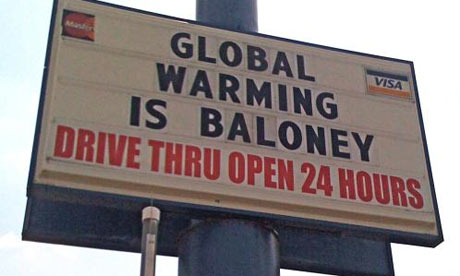
    Burger King Calls Global Warming 'Baloney' reports by the Memphis Flyer

    Sixty-one per cent of Americans consider themselves ‘cautious’, ‘disengaged’, ‘doubtful’ and ‘dismissive’ on climate change. Photograph: www.memphisflyer.com

    Since 1950, humans have manufactured more goods than have ever existed in history. Our consumption of those goods – a highly inefficient use of our natural capital – has wrought a long list of environmental consequences. Staggering deforestation, check. Increasing greenhouse gas emissions, check. Rising heat, sea level, and incidence of extreme weather events – check, check and check.

    To environmental experts, such evidence is the proverbial writing on the wall: we must transition to a low-carbon economy, stat, in order to avoid irrevocable damage. As President Obama affirmed, upon accepting his party’s nomination for president, no less:

    Climate change is not a hoax. More droughts and floods and wildfires are not a joke. They’re a threat to our children’s future.”

    The president’s choice of words seemed a pointed response to Republican Senator James Inhofe, author of The Greatest Hoax and, it’s worth noting, recipient of $1.3m in campaign contributions from the oil and gas lobby.

    Political maneuvering aside, why are Americans so disengaged from climate change – arguably, one of the most critical problems of our time?

    Denial ain’t just a river in Egypt; it’s also in places like North Carolina and perhaps even embedded into America’s cultural DNA. According to the latest study from the Yale Project on Climate Change Communication, the American public’s concern about global warming can be sorted into six categories, ranging from alarmed (13%) and concerned (26%), to cautious, disengaged, doubtful and dismissive (that’s the other 61% of us). Among the many explanations offered for the knowledge gap are clashing worldviews, varying education levels, demographics, and the media’s handling of the issue.

    Even as evidence for climate change mounts and the consequences of the phenomenon become more severe, the amount of climate coverage on broadcast networks has plummeted. According to a stunning analysis by Media Matters, the Sunday morning current affairs shows averaged about one hour each on climate change in 2009, compared to averaging 21 minutes apiece in 2010 and only 9 minutes per program in 2011. In 2011, Fox News Sunday covered climate change the most (just under an hour), “but much of the coverage promoted the ‘Climategate’ controversy and downplayed the threat of climate change,” reports Media Matters.

    At the other end of the spectrum, CBS had the least climate change coverage, devoting four minutes to the topic in three years. Altogether, in 2011, ABC, CBS, NBC and Fox spent twice as much time discussing Donald Trump’s “will he, won’t he” run for president rather than climate change. In fact, NBC’s Meet the Press devoted 23 minutes to Trump that year – but not a single minute to climate change.

    While there is virtually no mention of climate change in the local news, reporters have turned the weather into a national pastime. Perhaps this is because storms, hurricanes and tornadoes ignite a primal reaction, whereas climate change requires an intellectual one. There is also a perception of trust that grows from constant visibility on television – although we poke fun at the weatherman, we still hide in our closets during tornado warnings. On the other hand, we regard PhD-level climate scientists with suspicion, even though their work must hold up to rigorous peer review. The weather versus climate conflict illustrates what behavioral economists have said for years:

    “We base our decisions on emotion far more than reason.”

    Flawed climate risk perception may also explain why meteorologists have an advantage over climate scientists in making immediate weather more urgent than climate change. Although hard data do influence thinking, the psychology of risk perception is complicated. Often, our fears defy reason and statistics. For instance, blood-curdling events like shark attacks and plane crashes scare the living daylights out of us, when we have more reason to be afraid of climbing into our cars each morning: sharks claim about 12 lives per year, while car crash fatalities average around 93 per day. In the case of climate change, fear over problems that will affect us 50 years from now cannot compare with fear of challenges we face today. What people don’t understand is that climate change is, in fact, already affecting our economy.

    It’s understandable that our perception of risk may lead us to focus on surviving an immediate disaster more than preventing a future one. But it defies logic that so many would fall prey to “infotainers” such as Glenn Beck, who uses sustainable development as fodder for jokes. From McKinney, Texas to Trenton, New Jersey, sustainable development projects are being held up due to aggressive pushback and fear-mongering over Agenda 21, a voluntary initiative that some suspect to be diabolical attempt on the part of the UN to force a one-world government.

    Fortunately, most folks are not held back by reactionary ideology so much as basic lack of exposure to the problem. More than 1 billion people live in low-lying coastal areas, and most live in poverty. Already, at least 25 million climate refugees and counting are facing the consequences. For them, climate change is no longer an abstract concept to get their minds around; they are literally wading through it.

    Seeing is believing. If weak perception of risk is our blind spot, we needn’t let the media keep us in the dark. Instead, we can use media – pictures, videos and websites such as National Geographic – to confront the challenges, and so mobilize citizens and students toward solutions. Weather may fade, but pictures of post-drought west Texas, hurricane-ravaged New Orleans and submerging countries such as Tuvalu are a stark reminder that climate change carries not only an economic or environmental toll, but also a human one.

    Sure, we can always evacuate, but we cannot get around paying a price for avoiding climate change. And the price – like the sea level – keeps rising.

  • Expedition to study methane gas bubbling out of the Arctic seafloor

    News 6 new results for METHANE
    Expedition to study methane gas bubbling out of the Arctic seafloor
    Phys.Org
    The black rectangle on this map shows the general region where Paull and his collaborators have been studying methane releases in the Beaufort Sea. The smaller red rectangle indicates the edge of the continental shelf and continental slope where they
    See all stories on this topic »
    Methane boss to explain Somerset drilling plan
    This is Somerset
    The process of methane extraction has similarities to “fracking” in which gas is released by pumping high pressure water into rocks to create passages through which gas can pass. Frack Free Somerset, a coalition of concerned groups, has called a
    See all stories on this topic »
    Gas Outlets Are No New Phenomenon Off The Coast Of Spitsbergen
    RedOrbit
    Marine scientists from Kiel, together with colleagues from Bremen, Great Britain, Switzerland and Norway, spent four and a half weeks examining methane emanation from the sea bed off the coast of Spitsbergen with the German research vessel MARIA S.
    See all stories on this topic »
    When people explode during colonoscopies
    io9
    In the process, these bacteria generate a variety of gases, including carbon dioxide, oxygen, nitrogen, hydrogen and methane, to name a few. Some of these gasses are odorless. Others, (particularly ones containing sulfur), are not. Two of them
    See all stories on this topic »
    Infrastructure: Mission to transform lives
    Financial Times
    The big ticket projects in energy and transport that are also under way could be transformative, particularly if methane gas production combines with hydro and thermal power to quadruple electricity output from the current 110 MW and reduce costs. As
    See all stories on this topic »
    Methane Making An Appearance In Pa. Water Supplies
    North Country Public Radio
    Aug 28, 2012 (Morning Edition) — Water wells and streams in Leroy Township, Pa., have been bubbling up with methane gas in the past few months. The state’s Department of Environmental Protection blames nearby natural gas fracking operations. A local
    See all stories on this topic »


    Web 1 new result for METHANE
    Methane Power – Green Tech
    This was a very surprising story. A piggery is using the manure to produce power, nothing new, but the figures amazed.Turned a $15k/month electricity bill into.
    forums.whirlpool.net.au/archive/1982655


    Tip: Use quotes (“like this”) around a set of words in your query to match them exactly. Learn more.

    Delete this alert.
    Create another alert.
    Manage your alerts.

    Click here to Reply or Forward
    Why this ad?Ads –
    First Aid (Level 2) $90.00. 6.5 hrs 6, 770 George Street, Sydney 2000