Category: Climate chaos

The atmosphere is to the earth as a layer of varnish is to a desktop globe. It is thin, fragile and essential for preserving the items on the surface.150 years of burning fossil fuel have overloaded the atmosphere to the point where the earth is ill. It now has a fever. Read the detailed article, Soothing Gaia’s Fever for an evocative account of that analogy. The items listed here detail progress on coordinating 6.5 billion people in the most critical project undertaken by humanity. 

  • Extreme temperatures may raise risk of premature cardiovascular death

    Extreme temperatures may raise risk of premature cardiovascular death

    Posted: 18 Sep 2012 03:48 PM PDT

    Extreme temperatures during heat waves and cold spells may increase the risk of premature cardiovascular disease (CVD) death, according to new research.

  • Erosion management changes rushed: Greens ABC Online

    The Very Real Threat of Sealevel Rise to the United States
    Huffington Post (blog)
    Until the very end of the Republican Convention in Tampa, the issue of climate change was a no-show. Even the Democrats have not made as much of this issue as many in the scientific community would like. But the issue did come up when Governor
    See all stories on this topic »
    Erosion management changes rushed: Greens
    ABC Online
    “What this will do is pit landowner against landowner, right up and down our coasts. “We’ll have people fortifying their front lawns against incoming sea level rise, against incoming coastal inundation. “What we need for coastal erosion and sea level
    See all stories on this topic »


    Blogs 1 new result for SEA LEVEL RISE
    Scientists converge in La Jolla to discuss rising sea levels | La Jolla
    By Pat Sherman
    This report is the first in a two-part series chronicling an international workshop on sealevel rise, held at UC San Diego last week.
    La Jolla Light


    Tip: Use a minus sign (-) in front of terms in your query that you want to exclude. Learn more.

    Delete this alert.
    Create another alert.
    Manage your alerts.

  • Australian ‘mega mine’ plan threatens global emissions target

    Australian ‘mega mine’ plan threatens global emissions target

    ‘Unprecedented’ increase in the scale of Australian mining would nullify an internationally agreed goal, Greenpeace warns

    Damian blog : coal in Australia BHP Billiton Announces Record Financial Results

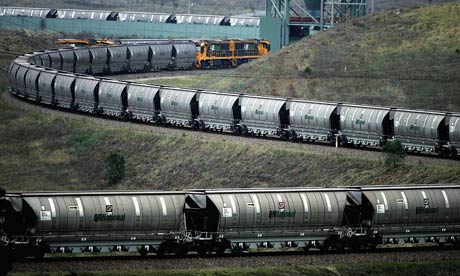
    A coal train awaits loading. Photograph: Ian Waldie/Getty Images

    Plans to open up a new Australian “coal export rush” would turn a single Queensland region into the seventh largest contributor of carbon dioxide emissions on the planet, undermining international efforts to keep global warming below 2C, a new report has warned.

    Nine proposed “mega mines” in the Galilee Basin would, at full capacity, result in 705m tonnes of CO2 released into the atmosphere, according to a Greenpeace Australia analysis. This level of emissions would surpass those of all but six nations in the world. By comparison, the UK emitted 549.3 million tonnes of CO2 from all sources in 2011.

    Greenpeace said that the nine mines’ production capacity of 330m tonnes of coal a year for export would represent an “unprecedented” increase in the scale of coal mining in Australia. The mines’ maximum output, primarily aimed at servicing the burgeoning Chinese and Indian markets, would nearly double Australia’s total 2010/11 coal production of 352m tonnes and eclipse its export total of 283m tonnes.

    The Greenpeace report states that the mines will only be able to launch and operate at capacity if global appetite for coal continues to grow strongly. This scenario would in effect nullify an internationally agreed goal to keep the increase in average global temperatures below 2C from pre-industrial levels.

    Greenpeace warns that a growth in coal-fired emissions represented by the nine Queensland mines would be in line with the International Energy Agency’s model of a “catastrophic” 6C rise in temperatures.

    “At a time when the science could not be clearer on the need to reduce global carbon emissions, and when governments worldwide are shifting to a low-carbon economy, exploiting the Galilee Basin is a reckless proposition,” the report states. “It is imperative that the Galilee Basin coal reserves remain in the ground.”

    The Alpha coal mine, a joint venture between Indian conglomerate GVK and Gina Rinehart’s Hancock Coal, last month became the first major Galilee Basin project to be given state and federal government approval, despite protests from environmentalists and farmers.

    The mine, which will bring an estimated AU$1bn (£642m) into the Queensland economy, will have the capacity to create 64.7m tonnes of CO2 – the equivalent of Israel’s entire 2009 emissions from fuel combustion.

    The other eight mines are yet to be given the green light by ministers. Adani, another Indian mining firm, hopes to build a new town for 12,000 people to service its big Carmichael mine, which would produce up to 60m tones of coal a year.

    Greenpeace’s report argues that the expansion in Queensland coal mining will damage the nearby Great Barrier Reef through coral bleaching from increased temperatures, but also in the shorter term due to the development of new ports and shipping lanes in order to transport the coal overseas.

    In June, a UN report expressed “extreme concern” over the level of development along the Great Barrier Reef coast, calling for all building to cease until an assessment of the ecosystem’s health was carried out.

    The Greenpeace Australia campaigner Georgina Woods, author of the new coal report, said: “Australia has just pretended up until now that coal exports aren’t part of the problem but it’s time that we started talking about it if we want to keep treasures like the Great Barrier Reef.”

    “These proposed mines need to be taken off the table and development along the Great Barrier Reef coast needs to be ruled out. The topic of coal exports is a very immature conversation in Australia but we need to start that conversation.”

    Australia is itself a heavy user of coal, as well as a leading exporter. Although the country has committed to cutting its own carbon emissions by 5% on 2000 levels by 2020 and introduced carbon pricing in July, the federal government has been accused of botching its attempts to move the country away from fossil fuels. This month, the government abandoned plans to pay five of Australia’s dirtiest coal-fired power generators to close down, despite already handing them $1bn in taxpayer money to cushion the impact of carbon pricing.

  • taking action against coal in Australia, 350 org

    Aaron Packard – 350.org organizers@350.org
    10:21 AM (33 minutes ago)

    to me

    Ready to see 350.org Australia dive deeper into the fight to move beyond coal?

    Join us as we get started:

    1. Sign the Coal Terminal Action Group Petition

    2. Send us your ideas

    Sign on Now

    Dear friends,

    There’s something we simply can’t wait any longer to email you about. At one stage or another, I’m sure you’ve thought about it already, and perhaps you’ve even wondered why 350.org isn’t more actively doing something about the situation.

    What’s “it…?” Coal.

    If there’s one particular burden that Australia bears when dealing with climate change, it’s coal. For any of you who read Bill McKibben’s recent article in Rolling Stone magazine know, there’s a very finite amount of carbon that can be put in the atmosphere if we’re going to have any chance of limiting global warming to 2 degrees C, let alone return back to 350 ppm. Australian coal alone holds 182.1 gigatonnes of potential CO2 emissions — carbon that needs to remain in the ground. And, with proposals for massive new coal ports and countless mine expansions around Australia, the coal industry plans to ensure every last bit we have burns.

    This isn’t likely to be news to you. Australian coal has loomed large for the climate change movement domestically and internationally. So what’s been holding us back? Well, simply that we wanted to be able to communicate about the issue with the strongest plan possible at the most timely moment possible. That combined with the fact that 350.org as a global campaigning organization has very limited resources to put towards any one particular country, and we’re truthfully not sure what resources we can bring to the coal struggle in Australia.

    Yet we write to you now, not because we’ve resolved these questions — we don’t have a detailed plan in place, nor do we have resources secured for scaling up a campaign. We write to you now because we simply couldn’t go another week receiving more news from you — friends, partners and organisers — about the latest coal mining, coal export proposals and infrastructure build up or failed government policy meant to reduce domestic coal use. Put simply, we needed to let you know that we’re stepping up to find ways to reduce the climate and health impacts of coal, promoting clean energy solutions and working with individuals and organisations interested in helping.

    For starters, if you agree that there’s no time to waste in taking action against coal in Australia, here are two things we ask you do:

    1) Sign this petition letter that our friends at the Coal Terminal Action Group have organised to stop a fourth coal terminal in Newcastle (which would double the volume of coal exports through Newcastle). Their representatives need to hear from as many people as possible!

    2) Let us know your ideas for how to move Australia beyond coal(including exports), and how 350.org can play a role in educating the public and working for alternatives to polluting coal. Email us at australia@350.org.

    350.org Australia and other organisations are already working on reducing our dependence on coal. Over the next few months, we will be asking for your support — both political and financial — and your participation to bring new capacity and strategies to address this urgent issue.

    Thanks to everyone ready to take on this enormous challenge. We look forward to working on this issue together.

    Onwards,

    Aaron Packard, Blair Palese, and the 350.org team


    350.org is building a global movement to solve the climate crisis. Connect with us on Facebook and Twitter, and sign up for email alerts. You can help power our work by getting involved locally, sharing your story, and donating here.

    To stop receiving emails from 350.org, click here.

  • When it rains, it pours: Intensification of extreme tropical rainfall with global warming modeled


    When it rains, it pours: Intensification of extreme tropical rainfall with global warming modeled

    Posted: 17 Sep 2012 09:42 AM PDT

    Global warming is expected to intensify extreme precipitation, but the rate at which it does so in the tropics has remained unclear. Now a new study has given an estimate based on model simulations and observations.
    You are subscribed to email updates from ScienceDaily: Severe Weather News
    To stop receiving these emails, you may unsubscribe now.
    Email delivery powered by Google
    Google Inc., 20 West Kinzie, Chicago IL USA 60610


    When it rains, it pours: Intensification of extreme tropical rainfall with global warming modeled

    Posted: 17 Sep 2012 09:42 AM PDT

    Global warming is expected to intensify extreme precipitation, but the rate at which it does so in the tropics has remained unclear. Now a new study has given an estimate based on model simulations and observations.
    You are subscribed to email updates from ScienceDaily: Severe Weather News
    To stop receiving these emails, you may unsubscribe now.
    Email delivery powered by Google
    Google Inc., 20 West Kinzie, Chicago IL USA 60610

    Posted: 17 Sep 2012 09:42 AM PDT

    Global warming is expected to intensify extreme precipitation, but the rate at which it does so in the tropics has remained unclear. Now a new study has given an estimate based on model simulations and observations.
    You are subscribed to email updates from ScienceDaily: Severe Weather News
    To stop receiving these emails, you may unsubscribe now.
    Email delivery powered by Google
    Google Inc., 20 West Kinzie, Chicago IL USA 60610
  • 36% Of ‘Major’ Hotels At Risk From Sea Rise

    36% Of ‘Major’ Hotels At Risk From Sea Rise
    Bahamas Tribune
    More than one-third of “major” Bahamian hotels will be impacted by just a one metre sea level rise, with a regional study calling for “serious and urgent” action to address the likely climate change impacts on this nation. The study, published earlier
    See all stories on this topic »
    El Salvador in battle against tide of climate change
    The Independent
    A tiny rise in the sea level has, according to local people, seen about 1,000ft of the mangroves on which they depend vanish beneath the ocean since 2005. Another 1,500ft remains between the Pacific and their village, La Tirana. No one, it seems, knows
    See all stories on this topic »
    Future for coast?
    Auckland stuff.co.nz
    Sea levels are rising about 1.5mm higher each year and look likely to continue for the next few decades. But the speed of the rise will also gradually increase and by next century the Government is advising planners to look at 1cm increases a year
    See all stories on this topic »

    Auckland stuff.co.nz
    Construction of vast coastal reserve underway in Essex
    Wildlife Extra
    The RSPB’s Wallasea Island Wild Coast Project will create (148 hectares) of mudflats, acres (192 ha) of saltmarsh, acres (76 ha) of shallow saline lagoons and a second area of saltmarsh in anticipation of sea level rise. About eight miles of coastal
    See all stories on this topic »

    Wildlife Extra


    Tip: Use quotes (“like this”) around a set of words in your query to match them exactly. Learn more.

    Delete this alert.
    Create another alert.
    Manage your alerts.