Category: Climate chaos

The atmosphere is to the earth as a layer of varnish is to a desktop globe. It is thin, fragile and essential for preserving the items on the surface.150 years of burning fossil fuel have overloaded the atmosphere to the point where the earth is ill. It now has a fever. Read the detailed article, Soothing Gaia’s Fever for an evocative account of that analogy. The items listed here detail progress on coordinating 6.5 billion people in the most critical project undertaken by humanity. 

  • Hansen still argues 5m 21st C sea level rise possible

    With all the bilge that the NSW Govt. and Councils are spruiking, this
    is the more likely scenario. They are not listening. Sandbagging will not
    block this rise out. They are living in a fools paradise.
    I am glad that in Leura we are about 1000 metres above sea level.

    Would they bother to read Hansen’s report moreover understand it?

    Hansen still argues 5m 21st C sea level rise possible
    by Stuart Staniford

    This is interesting – here is the latest paper from James Hansen and coauthor Miki Sato Paleoclimate Implications for Human-Made Climate Change. If you are up to reading climate science papers it’s highly recommended (I’m a little slow in getting to it – the press release was Dec 8th 2011 but I just got to reading it yesterday and today).
    A little background is in order – one of the serious scientific debates in the climate science community over the last decade has been the implications of the unexpectedly large acceleration of glacier discharge in Greenland and Antarctica and in particular a discovery by Zwally et al in 2002 that surface melt water can get down the base of a glacier and lubricate its motion. Prior to the early 2000s it was assumed that ice sheets would decay mainly by melting on the surface and climate models all assumed that they would decay only very slowly in a warmer world – it was a surprise to realize that the most important breakdown mode was actually basal lubrication and sliding down into the ocean.
    Hansen in particular became the leading spokesman for the view that the ice sheets on Greenland and parts of Antarctica would prove quite unstable under Anthropocene conditions and might break down in a rapid non-linear manner and cause very large levels of twenty-first century sea level rise. See for example this essay from 2005 in which he says:

    Consider the situation during past ice sheet disintegrations. In melt-water pulse 1A, about 14,000 years ago, sea level rose about 20 m in approximately 400 years (Kienast et al., 2003). That is an average of 1 m of sea level rise every 20 years. The nature of glacier disintegration required for delivery of that much water from the ice sheets to the ocean would be spectacular (5 cm of sea level, the mean annual change, is about 15,000 cubic kilometers of water). “Explosively” would be an apt description, if future ice sheet disintegration were to occur at a substantial fraction of the melt-water pulse 1A rate.
    Are we on a slippery slope now? Can human-made global warming cause ice sheet melting measured in meters of sea level rise, not centimeters, and can this occur in centuries, not millennia? Can the very inertia of the ice sheets, which protects us from rapid sea level change now, become our bete noire as portions of the ice sheet begin to accelerate, making it practically impossible to avoid disaster for coastal regions?

    This kind of nigh-apocalyptic rhetoric from a very senior and respected climate scientist provoked a flurry of papers in response seeking to analyze the situation. Most of these suggested various reasons why 21st century sea level rise, while likely worse than previously projected (for example in the 3rd IPCC report in 2001), would not be as bad as the worst fears of Hansen. Hansen and Sato’s own description of this new literature seems fair to me:

    Rahmstorf (2007) made an important contribution to the sea level discussion by pointing
    out that even a linear relation between global temperature and the rate of sea level rise, calibrated with 20th century data, implies a 21st sea level rise of about a meter, given expected global warming for BAU greenhouse gas emissions. Vermeer and Rahmstorf (2009) extended Rahmstorf’s semi-empirical approach by adding a rapid response term, projecting sea level rise by 2100 of 0.75-1.9 m for the full range of IPCC climate scenarios. Grinsted et al. (2010) fit a 4-parameter linear response equation to temperature and sea level data for the past 2000 years, projecting a sea level rise of 0.9-1.3 m by 2100 for a middle IPCC scenario (A1B). These projections are typically a factor of 3-4 larger than the IPCC (2007) estimates, and thus they altered perceptions about the potential magnitude of human-caused sea level change.
    Alley (2010) reviewed projections of sea level rise by 2100, showing several clustered around 1 m and one outlier at 5 m, all of these approximated as linear in his graph. The 5 m estimate is what Hansen (2007) suggested was possible under IPCC’s BAU climate forcing. Such a graph is comforting – not only does the 5-meter sea level rise disagree with all other projections, but its half-meter sea level rise this decade is clearly preposterous.
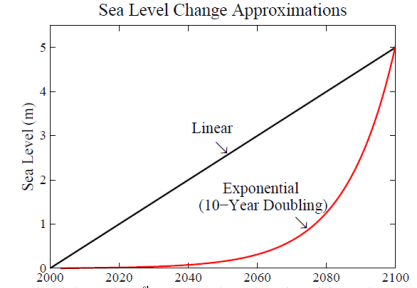
    However, the fundamental issue is linearity versus non-linearity. Hansen (2005, 2007) argues that amplifying feedbacks make ice sheet disintegration necessarily highly non-linear, and that IPCC’s BAU forcing is so huge that it is difficult to see how ice shelves would survive. As warming increases, the number of ice streams contributing to mass loss will increase, contributing to a nonlinear response that should be approximated better by an exponential than by a linear fit. Hansen (2007) suggested that a 10-year doubling time was plausible, and pointed out that such a doubling time, from a 1 mm per year ice sheet contribution to sea level in the decade 2005-2015, would lead to a cumulative 5 m sea level rise by 2095.
    Nonlinear ice sheet disintegration can be slowed by negative feedbacks. Pfeffer et al.
    (2008) argue that kinematic constraints make sea level rise of more than 2 m this century
    physically untenable, and they contend that such a magnitude could occur only if all variables quickly accelerate to extremely high limits. They conclude that more plausible but still accelerated conditions could lead to sea level rise of 80 cm by 2100

    I had been following this debate and reading the papers in question and had been somewhat reassured that 21st century sea level rise would be not too problematic for civilization at large (though it clearly would be very painful for coastal property owners and jurisdictions).
    (Before we go on it’s worth emphasizing the important aside – hardly any climate scientists doubt that huge quantities of the Greenland and Antarctic ice sheets would eventually melt and cause tens of meters of sea level rise as a result of human climate modifications – the debate is solely about how much of the consequences of our actions we will experience in the 21st century).
    However, Hansen is not reassured by these new papers and is doubling down:

    The kinematic constraint may have relevance to the Greenland ice sheet, although the assumptions of Pfeffer at al. (2008) are questionable even for Greenland. They assume that ice streams this century will disgorge ice no faster than the fastest rate observed in recent decades. That assumption is dubious, given the huge climate change that will occur under BAU scenarios, which have a positive (warming) climate forcing that is increasing at a rate dwarfing any known natural forcing. BAU scenarios lead to CO2 levels higher than any since 32 My ago, when Antarctica glaciated. By mid-century most of Greenland would be experiencing summer melting in a longer melt season. Also some Greenland ice stream outlets are in valleys with bedrock below sea level. As the terminus of an ice stream retreats inland, glacier sidewalls can collapse, creating a wider pathway for disgorging ice.
    The main flaw with the kinematic constraint concept is the geology of Antarctica, where large portions of the ice sheet are buttressed by ice shelves that are unlikely to survive BAU climate scenarios. West Antarctica’s Pine Island Glacier (PIG) illustrates nonlinear processes already coming into play. The floating ice shelf at PIG’s terminus has been thinning in the past two decades as the ocean around Antarctica warms (Shepherd et al., 2004; Jenkins et al., 2010). Thus the grounding line of the glacier has moved inland by 30 km into deeper water, allowing potentially unstable ice sheet retreat. PIG’s rate of mass loss has accelerated almost continuously for the past decade (Wingham et al., 2009) and may account for about half of the mass loss of the West Antarctic ice sheet, which is of the order of 100 km^3 per year (Sasgen et al., 2010).
    PIG and neighboring glaciers in the Amundsen Sea sector of West Antarctica, which are also accelerating, contain enough ice to contribute 1-2 m to sea level. Most of the West Antarctic ice sheet, with at least 5 m of sea level, and about a third of the East Antarctic ice sheet, with another 15-20 m of sea level, are grounded below sea level. This more vulnerable ice may have been the source of the 25 ± 10 m sea level rise of the Pliocene (Dowsett et al., 1990, 1994). If human-made global warming reaches Pliocene levels this century, as expected under BAU scenarios, these greater volumes of ice will surely begin to contribute to sea level change. Indeed, satellite gravity and radar interferometry data reveal that the Totten Glacier of East Antarctica, which fronts a large ice mass grounded below sea level, is already beginning to lose mass (Rignot et al., 2008).

    However, probably their main point is that the data we have on the Antarctic/Greenland meltdown is relatively short and is consistent with the idea that it’s doubling with a relatively short (decade or less) timescale and if you extrapolate that out over the 21st century you get to very large values of sea level rise (a point I made in a blog post back in 2006). This leads them to include this figure (which I take to be a conceptual sketch rather than an exact forecast):

    The picture that emerges is a relatively slow manageable sea level rise in the first part of the century followed by increasingly catastrophic levels of change in the latter part of the century as the rapid breakdown of the ice sheets overwhelms everything else.
    I take Hansen’s opinions very seriously. It’s certainly true that there isn’t enough data to rule out this scenario yet (though another decade of data should help a lot). Obviously at this point he hasn’t succeeded in persuading most of his colleagues, but neither have they persuaded him. Only more data is likely to resolve the situation.

    Original article available here

  • 4 days to stop a corporate Death Star

    4 days to stop a corporate Death Star

    Inbox
    x

    Iain Keith – Avaaz.org
    12:45 PM (33 minutes ago)

    to me

    Dear friends,

    We have four days to stop a top-secret global corporate power grab that attacks everything from a free Internet to environmental protections. This agreement is being negotiated right now by bureaucrats backed by corporate lobbyists. Click below to crash their secret meeting with our global call to kill the TPP deal:

    Details are leaking of a top-secret, global corporate power grab of breathtaking scope — attacking everything from a free Internet to health and environmental regulations, and we have just 4 days to stop it.

    Big business has a new plan to fatten their pockets: a giant global pact, with an international tribunal to enforce it, that is kept top secret for years (even from our lawmakers!) and then brought down like a Death Star on our democracies. Big Tobacco, Big Oil, Big Pharma, Walmart and almost 600 other corporate lobbyists are all in on the draft — including limits on smoking laws, affordable medicines and free speech on the Net.

    The latest round of negotiations ends in just 4 days — but outcries in each of our countries could shake the confidence of negotiators and scuttle the talks forever. Let’s get to a million against the global corporate takeover. Sign below and forward widely. Avaaz will project our petition counter on the walls of the conference so negotiators can see the opposition to their plan exploding in real time:

    http://www.avaaz.org/en/stop_the_corporate_death_star/?bhPqncb&v=17866

    The deal, called the Trans-Pacific Partnership (TPP), is written to protect investors from government regulation, even if that regulation is passed in the public interest. Leaked versions suggest the TPP would undermine protections for air and water safety and reintroduce measures from the US Internet freedom attack as well as steamrolling efforts to produce generic affordable medicines. Worse still, lawmakers who fail to conform to the TPP’s rules face sanctions in an international tribunal — a place where corporations can sue us for deals previous governments signed in secret!

    Negotiators say this is just a trade agreement, written to facilitate investment and profit for all. But the leaked draft imposes so many limits on citizen protections, it’s clear this “trade” agreement is skewed to put corporate profit above people’s needs — that’s not surprising since it’s been drafted in secret with almost 600 corporate lobbyists.

    But there is hope: Australia is bucking against the international tribunal system, and New Zealand is objecting to the takeover of its medicine-pricing protections that keep drugs affordable. Massive public opposition, casting doubt over each country’s ability to sell TPP at home, could derail the talks for good. Sign the petition now, and forward widely — the delegates and lobbyists are watching the wave of opposition grow in real time:

    http://www.avaaz.org/en/stop_the_corporate_death_star/?bhPqncb&v=17866

    US candidate for Senate, Elizabeth Warren in a recent speech said: “Corporations are not people. People have hearts, they have kids, they get jobs, they get sick, they cry, they dance. They live, they love, and they die. And that matters, because we don’t run this country for corporations, we run it for people.” Let’s reach one million to stop the corporate takeover of our governments.

    With hope,

    Iain, Pedro, Laura, Ari, Emma, Lisa, Luca, Ricken and the whole Avaaz team

    PS – Avaaz has launched Community Petitions, an exciting new platform where it’s quick and easy to create a campaign on any issue you care strongly about. Start your own by clicking here: http://www.avaaz.org/en/petition/start_a_petition/?do.ps.tpp

    MORE INFORMATION

    The Nation: “NAFTA on Steroids”
    http://www.thenation.com/article/168627/nafta-steroids

    The Guardian: “The Pacific free trade deal that’s anything but free”
    http://www.guardian.co.uk/commentisfree/2012/aug/27/pacific-free-trade-deal

    Huffington Post: “Leak Cracks Open Trans-Pacific Partnership Scandal”
    http://www.huffingtonpost.com/ian-fletcher/leak-cracks-open-transpac_b_1594675.html

    Reuters: “Lawmakers press for open Trans-Pacific trade talks”
    http://www.reuters.com/article/2012/06/27/us-usa-congress-trade-idUSBRE85Q1MK20120627

    TechDirt: “Hollywood Gets To Party With TPP Negotiators; Public Interest Groups Get Thrown Out Of Hotel”
    http://www.techdirt.com/articles/20120131/23161417605/hollywood-gets-to-party-with-tpp-negotiators-public-interest-groups-get-thrown-out-hotel.shtml

    Electronic Frontier Foundation: “Background and analysis of the Trans-Pacific Partnership Agreement”
    https://www.eff.org/issues/tpp

    ——————————

    ——

    Support the Avaaz Community!
    We’re entirely funded by donations and receive no money from governments or corporations. Our dedicated team ensures even the smallest contributions go a long way.


    Avaaz.org is a 15-million-person global campaign network
    that works to ensure that the views and values of the world’s people shape global decision-making. (“Avaaz” means “voice” or “song” in many languages.) Avaaz members live in every nation of the world; our team is spread across 19 countries on 6 continents and operates in 14 languages. Learn about some of Avaaz’s biggest campaigns here, or follow us on Facebook or Twitter.

    You are getting this message because you signed “Save our dying planet!” on 2011-12-08 using the email address nevilleg729@gmail.com.
    To ensure that Avaaz messages reach your inbox, please add avaaz@avaaz.org to your address book. To change your email address, language settings, or other personal information, https://secure.avaaz.org/act/index.php?r=profile&user=6be3e9aa63582c9b1397464fcc49baa9&lang=en, or simply go here to unsubscribe.

  • State Government ditches UN’s climate science

    State Government ditches UN’s climate science
    ABC Online
    “I think you’ll find local councils in coastal areas up and down the state scratching their heads and saying ‘what do we now do in terms of development applications that come in in areas that are affected or could be affected by sea level rises in the
    See all stories on this topic »
    An Ounce of Prevention in New York City

  • ‘Managed retreat’ to sandbag city? Sydney Morning Herald

    ‘Managed retreat’ to sandbag city?
    Sydney Morning Herald
    NEW state government sea level rise guidelines will make it easier for people to fortify their homes against the effects of climate change, but local councils said the policy would lead to ”ad hoc” walls of sandbags that will not hold back the sea
    See all stories on this topic »

    Sydney Morning Herald
    SEA LEVEL’S RISE FOCUS OF SUMMIT
    U-T San Diego
    LA JOLLA — Climate researchers, social scientists and policy experts from across the Pacific Rim convened at UC San Diego last week to get ahead of seas projected to rise so dramatically that they could create some of the most visible effects of
    See all stories on this topic »
    Drilling to lakes under Antarctic may give clues to sea rise
    Bangladesh News 24 hours
    OSLO, Sept 10 (bdnews24.com/Reuters) – A British plan to drill into a sunless lake deep under Antarctica’s ice in December could show the risks of quicker sea level rise caused by climate change, scientists said on Friday. Sediments on the bed of Lake
    See all stories on this topic »
    New York Is Lagging as Seas and Risks Rise, Critics Warn
    New York Times
    Many decisions also require federal assistance, like updated flood maps from the Federal Emergency Management Agency that incorporate sea level rise, and agreement from dozens of public agencies and private partners that own transportation, energy,
    See all stories on this topic »

    New York Times
    ENVIRONMENT: Scientists weigh effects of climate change
    North County Times
    The workshop, held by the Association of Pacific Rim Universities Sustainability and Climate Change Program, offered a primer on projections of sea level rise, and thoughts on what coastal cities can do to contain the damage, with suggestions ranging
    See all stories on this topic »
    Policy sandbags Warringah Council
    The Manly Daily
    “We will be assisting councils by providing information on future sea level rise relevant to their local area and by giving councils access to expert advice,” Mr Hartcher said. The reforms would also make it easier for coastal landowners to install
    See all stories on this topic »

    The Manly Daily
    Sea Otters May Be Fighting Climate Change By Keeping Sea Urchins In Check
    Huffington Post
    http://slr.s3.amazonaws.com/factsheets/New_York.pdf” target=”_hplink”>Climate Central explains, “the NY metro area hosts the nation’s highest-density populations vulnerable to sea level rise.” They argue, “the funnel shape of New York
    See all stories on this topic »
    Obama doesn’t believe in climate science. He believes in climate fantasy.
    Washington Examiner
    But many on the environmental Left were pretty upset at Romney’s comment, seeing it as a mockery of climate change, or even of rising sea levels. Alex Pareene of Slate wrote, sarcastically, “Isn’t climate change hilarious?” and called Mitt’s joke
    See all stories on this topic »
  • Global carbon trading system has ‘essentially collapsed’

    Global carbon trading system has ‘essentially collapsed’

    The UN clean development mechanism, designed to give poor countries access to green technologies, is in dire need of rescue

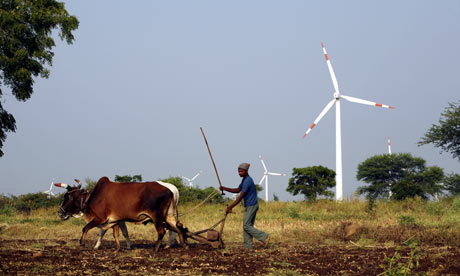
    BP  India wind energy investment, Suzlon Energy windfarm in Dhule

    The clean development mechanism is in dire need of rescue, according to a UN panel. Photograph: Corbis

    The world’s only global system of carbon trading, designed to give poor countries access to new green technologies, has “essentially collapsed”, jeopardising future flows of finance to the developing world.

    Billions of dollars have been raised in the past seven years through the United Nations‘ system to set up greenhouse gas-cutting projects, such as windfarms and solar panels, in poor nations. But the failure of governments to provide firm guarantees to continue with the system beyond this year has raised serious concerns over whether it can survive.

    A panel convened by the UN reported on Monday at a meeting in Bangkok that the system, known as the clean development mechanism (CDM), was in dire need of rescue. The panel warned that allowing the CDM to collapse would make it harder in future to raise finance to help developing countries cut carbon.

    Joan MacNaughton, a former top UK civil servant and vice chair of the high level panel, told the Guardian: “The carbon market is profoundly weak, and the CDM has essentially collapsed. It’s extremely worrying that governments are not taking this seriously.”

    The panel said that governments needed to reassure investors, who have poured tens of billions into the market, by pledging a continuation of the system, and propping up the market by toughening their targets on cutting emissions, and perhaps buying carbon credits themselves.

    Governments have a last chance to restore confidence in the system when they meet in Qatar this December to discuss climate change. But few participants hold out any hope that they will agree to toughen their 2020 emissions targets, which are scarcely even on the agenda. Instead, governments are focusing on drawing up a new climate change treaty by the end of 2015, which would stipulate emissions cuts for the period after 2020.

    Under the CDM, developers of projects to cut carbon emissions in developing countries receive a UN-issued carbon credit for every tonne of carbon dioxide the project avoids. This applies to a wide range of activities, from building new windfarms and solar panels, and distributing more efficient cook stoves and lights, to the installation of technology on factories to prevent the release of certain industrial gases.

    The system was set up under the 1997 Kyoto protocol, after years of debate, but no credits could be issued until that treaty finally came into force in 2005. Since then, just over 1bn CDM credits have been issued.

    These carbon credits can in theory be bought by the governments which are obliged by the Kyoto protocol to cut their emissions, to count against their targets. In practice, however, with the US refusing to ratify Kyoto and big emerging economies such as China, India and Mexico carrying no emissions-cutting obligations under the treaty, Europe is the only market of any size. The EU has its own cap-and-trade emissions scheme, under which heavy industries are awarded a quota of carbon they can emit, which they can top up by buying the UN credits.

    But the recession and Eurozone crisis have whipped the rug from under this market. As industrial activity has declined, and the after effects of too-generous carbon quotas early on work themselves through, few EU companies now need to top up their carbon quotas. To make matters worse, the current phase of the Kyoto protocol ends this year, and of the world’s major economies only the EU has pledged to continue it.

    All of this has combined to bring about a collapse in the price of UN credits, from highs topping $20 (£12.50) before the financial crisis to less than $3 each today. At such rates, many potential projects are not commercially viable. Financiers and project developers have abandoned the market in droves.

    MacNaughton warned that critics of the market, who argue it does not do enough to cut emissions, could end up regretting its demise, because the years of work it took to set up the market could not easily be replicated. “This is a stable framework, with functioning mechanisms and standards and legal [procedures], and all the things you need for a market. People are assuming this will all still be there in a few years when they want it again, but I don’t think it will [unless they act],” she said. Even if countries decided on reform, no new system could start functioning before 2020, so the CDM could “play a bridging role”.

    Mitchell Feierstein, chief executive of Glacier Environmental Funds, said the CDM had long been overshadowed by bigger opportunities for green investors. “Carbon markets will exist [in future] but certainly not as they exist today,” he said. “Investment capital will continue flowing into the innovative technologies which increase energy efficiency while reducing global dependence on fossil fuels. Private capital is now more easily deployed in other investment opportunities without the bureaucratic hassles of the current CDM.”

    But the CDM still has its optimists. Flora Yu, of the carbon specialist IdeaCarbon, said the market was likely to continue, as some countries – including Australia, China and South Korea – have been developing their own cap-and-trade carbon markets, which they will want to link to a global system. “There is still a potential opportunity for the CDM, to further develop the amount of money and resources that have already been invested in it. We think it is not going to go away.”

  • Caribbean coral reefs face collapse

    Caribbean coral reefs face collapse

    Caribbean coral reefs are in danger of disappearing, depriving the world of one of its most beautiful and productive ecosystems

    coral reef

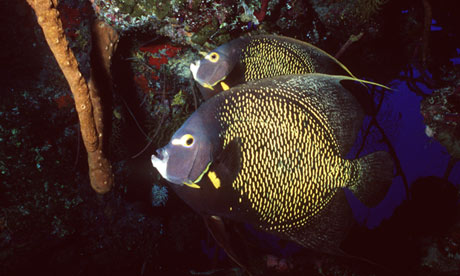
    A pair of French angelfish enjoy the coral reef in the Caribbean Sea. Photograph: Marcus Mays for the Guardian

    Caribbean coral reefs – which make up one of the world’s most colourful, vivid and productive ecosystems – are on the verge of collapse, with less than 10% of the reef area showing live coral cover.

    With so little growth left, the reefs are in danger of utter devastation unless urgent action is taken, conservationists warned. They said the drastic loss was the result of severe environmental problems, including over-exploitation, pollution from agricultural run-off and other sources, and climate change.

    The decline of the reefs has been rapid: in the 1970s, more than 50% showed live coral cover, compared with 8% in the newly completed survey. The scientists who carried it out warned there was no sign of the rate of coral death slowing.

    Coral reefs are a particularly valuable part of the marine ecosystem because they act as nurseries for younger fish, providing food sources and protection from predators until the fish have grown large enough to fend better for themselves. They are also a source of revenue from tourism and leisure.

    Carl Gustaf Lundin, director of the global marine and polar programme at the International Union for Conservation of Nature (IUCN), which published the research, said: “The major causes of coral decline are well known and include overfishing, pollution, disease and bleaching caused by rising temperatures resulting from the burning of fossil fuels. Looking forward, there is an urgent need to immediately and drastically reduce all human impacts [in the area] if coral reefs and the vitally important fisheries that depend on them are to survive in the decades to come.”

    Warnings over the poor state of the world’s coral reefs have become more frequent in the past decades as pollution, increasing pressure on fish stocks, and the effects of global warming on the marine environment – in the form of higher sea temperatures and slightly elevated levels of acidity in the ocean – have taken their toll.

    Last year, scientists estimated that 75% of the Caribbean’s coral reefs were in danger, along with 95% of those in south-east Asia. That research, from the World Resources Institute, predicted that by 2050 virtually all of the world’s coral reefs would be in danger.

    This decline is likely to have severe impacts on coastal villages, particularly in developing countries, where many people depend on the reefs for fishing and tourism. Globally, about 275 million people live within 19 miles of a reef.

    IUCN, which is holding its quadrennial World Conservation Congress on Jeju island in South Korea this week, said swift action was vital. The organisation called for catch quotas to limit fishing, more marine-protected areas where fishing would be banned, and measures that would halt the run-off of fertilisers from farmland around the coast. To save reefs around the world, moves to stave off global warming would also be needed, the group said.

    On a few of the more remote Caribbean reefs, the situation is less dire. In the Netherlands Antilles, Cayman Islands and a few other places, the die-off has been slower, with up to 30% coverage of live coral still remaining. The scientists noted that these reefs were in areas less exposed to human impact from fishing and pollution, as well as to natural disasters such as hurricanes.

    The report – compiled by 36 scientists from 18 countries – was the work of the IUCN-coordinated Global Coral Reef Monitoring Network.