Category: Climate chaos

The atmosphere is to the earth as a layer of varnish is to a desktop globe. It is thin, fragile and essential for preserving the items on the surface.150 years of burning fossil fuel have overloaded the atmosphere to the point where the earth is ill. It now has a fever. Read the detailed article, Soothing Gaia’s Fever for an evocative account of that analogy. The items listed here detail progress on coordinating 6.5 billion people in the most critical project undertaken by humanity. 

  • Westerly storms warm Norway

    Westerly storms warm Norway

    Posted: 06 Sep 2012 04:40 AM PDT

    New research indicates that storms from the west are the main reason that Norwegians can enjoy temperatures 5-10°C warmer than other places so far north. Climate researchers are casting more and more doubt on the Gulf Stream’s role as the primary cause of Norway’s relatively high temperatures.

    North America’s Rocky Mountains affect Norway’s climate

    Posted: 06 Sep 2012 04:40 AM PDT

    Both the Gulf Stream and the Norwegian Sea have a major impact on Norway’s climate. However, it turns out that weather conditions are also influenced by geographical elements from much farther away. North America’s Rocky Mountains, for instance, play a major role in weather in Norway.
    You are subscribed to email updates from ScienceDaily: Severe Weather News
    To stop receiving these emails, you may unsubscribe now.
    Email delivery powered by Google
    Google Inc., 20 West Kinzie, Chicago IL USA 60610
  • MONBIOT Declaring War on the Environment

    Monbiot.com


    Declaring War on the Environment

    Posted: 06 Sep 2012 01:31 AM PDT

    With the appointment of an anti-green as Environment Secretary, the pretence is over.


    By George Monbiot, published on the Guardian’s website

    So that’s it then. The final shred of credibility of “the greenest government ever” has been doused in petrol and ignited with a casual flick of a gold-plated lighter. The appointment of Owen Paterson as Environment Secretary, is a declaration of war on the environment, and another sign that the right of the party – fiercely opposed to anything that prevents business from doing as it wishes – has won.

    Alongside the signs that the government is preparing to renege on its pledge not to build a third runway at Heathrow, this appointment reinforces the impression that Cameron’s professed environmentalism is – and always was – phoney.

    Paterson is steeped in the mythologies of the anti-environment movement. A letter about wind farms he sent to his district council is riddled with schoolboy howlers of the kind that are endlessly repeated by climate change deniers. For example, he expresses the belief that if the capacity factor of a wind turbine is 30%, this means that “the wind blows sufficiently to generate useful electricity, typically, only 30 percent of the time”.

    Perhaps such mistakes are unsurprising: much of the letter was cut and pasted verbatim, without acknowledgement or circumspection, from a document published by an anti-wind farm group called Country Guardian. As Environment Secretary, Paterson will have to weigh up conflicting claims, and make decisions based on the best available evidence. Though Paterson will not have responsibility for energy policy, this cutting and pasting should give you a sense of what we’re up against.

    In May, when Owen Paterson was Northern Ireland secretary, Conservative Home reported that he set out a three-point plan for economic growth in a Cabinet meeting.

    – “Exemption of all micro businesses from red tape, following the model Ronald Reagan pursued in the early 1980s;
    – Ending of all energy subsidies and then fast-tracked exploitation of shale gas;
    – Urgent review of airport policy to ensure Britain gets its full share of global trade.”

    Perhaps it was sentiments like this that secured his new job. His predecessor at Environment, Caroline Spelman, though blighted by some terrible junior ministers (the worst of whom remains in post), and though wildly illogical on certain issues (such as the badger cull), at least appeared to understand that we are in the midst of an environmental crisis, and that action needs to be taken. This could be why she was said to have no voice within the Cabinet.

    The reshuffle pushes the coalition further towards the politics of the Tea Party Republicans: in denial about about the underlying problems, opposed to democratic constraints on business, prepared to treat the planet as a dustbin. Paterson’s appointment appears to exemplify the shift.

    www.monbiot.com

    You are subscribed to email updates from George Monbiot
    To stop receiving these emails, you may unsubscribe now.
    Email delivery powered by Google
    Google Inc., 20 West Kinzie, Chicago IL USA 60610
  • Sea Level Rise in Florida Is No Laughing Matter

    Sea Level Rise in Florida Is No Laughing Matter
    Clean Energy News (blog)
    Local sea level rise has increased so much since the Key West Airport was built, that during the “Super Moon” super high tide in May 2012 it was flooded with seawater. Sea planes would have been more appropriate than jet planes during that day
    See all stories on this topic »
    New Model Accurately Predicts Coastline Erosion Caused by SeaLevel Rise
    AZoCleantech
    A research team comprising Rosh Ranasinghe and his colleagues from TU Delft, UNESCO-IHE and Deltares has developed a new model that is capable of producing highly accurate prognoses of coastline erosion caused by sealevel rise within few minutes.
    See all stories on this topic »

    AZoCleantech
    Coastline erosion due to rising sea levels greater than thought
    Zee News
    Coastline erosion due to rising sea levels greater than thought Washington: The effects of coastline erosion as a result of rising sealevel rise in the vicinity of inlets, such as river estuaries, have until now been dramatically underestimated
    See all stories on this topic »
  • Canada ‘playing with numbers’ on carbon target claims

    Canada ‘playing with numbers’ on carbon target claims

    Stephen Harper’s government accused of using accounting tricks to take credit for emission declines

    Canada - Energy - Tar Sands

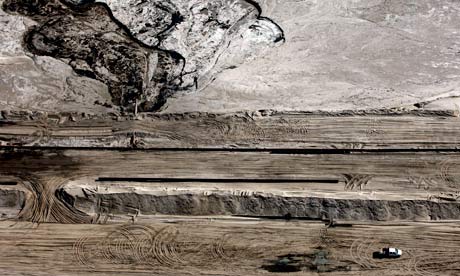
    A tar sands excavation site in Alberta, Canada. Emissions from Canada’s huge tar sands operations will represent 51% of the entire oil/gas sector in 2012. Photograph: Orjan F. Ellingvag/ Dagens Naringsliv/Corbis

    Canada‘s claims of progress on meeting its carbon targets do not add up, according to an independent analysis published on Wednesday.

    In August, the government said it was halfway to its 2020 emissions goal of a 17% cut on 2005 levels, but the analysis – the first to date – says Canada’s cuts amount to one-third at best.

    “They’re [Canada] just playing with numbers to pretend they’ve actually done something to reduce their emissions,” said Marion Vieweg, a policy analyst working with the Climate Action Tracker (CAT), an independent science-based assessment that tracks the emission commitments and actions of countries.

    The Canadian government is taking credit for the emissions declines caused by the 2009 recession and the energy trend away from coal to gas, Vieweg told the Guardian from Bangkok at the close of the latest UN climate summit.

    “There is no information in their reports about their policies that are actually driving emission reductions.”

    “The [Stephen] Harper government has been working hard to reduce emissions,” said the environment minister, Peter Kent, last month, announcing the government’s statistics. Only a year ago the Harper government said it was 25% cent of the way to its 2020 target.

    A big part of the difference is a change in the UN rules this year that allows Canada to claim emissions credits for its vast forests because they absorb CO2. But on the other side of the ledger, Canada is one of biggest logging nations and its forests have experienced massive fires and insect outbreaks that have killed hundreds of millions of trees in recent years. Those emissions are missing in Canada’s new numbers and the Harper government assumes there will be few fires or insect problems over the next eight years to 2020, says Vieweg.

    Meanwhile emissions from Canada’s huge tar sands operations will represent 51% of the entire oil/gas sector in 2012, an increase from a share of only 20% in 2005.

    Canada has been using current data and measuring it against old projections. And it has begun using a methodology previously only used by developing countries, the CAT report found.

    “Canada is using accounting tricks to make it look like they are taking action when it’s not,” she said.

    This week Kent is expected to announce tougher regulations for new coal plants. A year ago draft regulations capped emissions from new coal plants at 375 tonnes of carbon dioxide per gigawatt hour of electricity generated. Media reports suggest the actual standard will be relaxed to about 420 tonnes.

  • Growing Growing Gone! Dick Smith with Richard Heinberg

    From: George Carrard <george_carrard@yahoo.com.au>
    Date: Thu, Sep 6, 2012 at 12:10 PM
    Subject:
    To: George Carrard <george_carrard@yahoo.com.au>

    Please would you publicise the following event on your lists.  Or possibly attend?
    Thanks
    George Carrard
    ~~~~~~~~~
    Growing Growing Gone!  Dick Smith with Richard Heinberg
    It may be possible to mitigate the disastrous effect of global warming on our descendents if we learn to live without economic growth.  Dick Smith will introduce one of the best brains to help us do this: Richard Heinberg, author of “The End of Growth”.
    Keywords: population, economy, global warming
    Tuesday September 18, 6.30pm, Guthrie Theatre University of Technology Sydney, 702-730 Harris St (between Broadway and ABC Ultimo Centre) Ultimo
    Entry by donation $10/$5 suggested
    More information: Sustainable Population Australia www.population.org.au/ (02) 95793020

    George Carrard
    22 Lansdowne Pde
    OATLEY 2223
    Ph 02 9579 3020
    or, if no answer, try 0412704426

    “Anyone who believes exponential growth can go on forever in a finite world is either a madman or an economist.” – attributed to economist Kenneth Bouldin

  • On thin ice: Time-frame to save the Arctic is melting away

    On thin ice: Time-frame to save the Arctic is melting away

    Posted: 05 Sep 2012 01:27 AM PDT

    By David Spratt, first published by ReNew Economy on 5 September 2012

    Something extraordinary is happening when graphs of melting Arctic sea-ice have their vertical axis redrawn because the data are falling off the chart.
    But that’s what has occurred in the last 10 days, since the extent of floating Arctic sea-ice broke the satellite-era minimum record on 24 August. On that date it was 4.2 million square kilometres, according to data from the Japan Aerospace Exploration Agency.
    Since then, an additional half a million square kilometres of sea-ice has melted. The extent on 4 September was just half of the average minimum extent of the 1980s. At the current rate of loss, with one to three weeks left in the northern melt season, the minimum may well shrink below 3.5 million square kilometres. This is an astounding story.
    Whilst there was modest media coverage of the record being broken, the unprecedented further melting has barely rated a mention – despite the profound consequences for both the climate and policy-making. Two weeks ago on these pages I wondered whether policy makers really want to know.
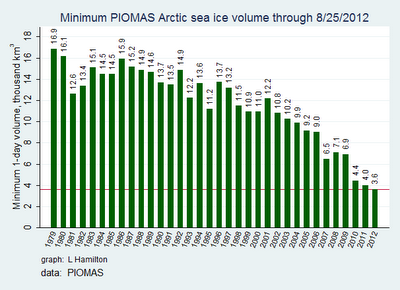
    And it’s not just the extent of the ice. It’s now much thinner: new figures of modelled data from PIOMAS show the volume on 25 August was around 3,600 cubic kilometres. This is just one-quarter of the volume twenty years ago. This fits with datafrom the first purpose-built satellite launched to study the thickness of the Earth’s polar caps showing that the rate of Arctic summer sea ice loss is 50 per cent higher than predicted.

    Arctic sea-ice volume 1979–25 August 2012. Data: PIOMAS. Graph: L. Hamilton

    As the ice becomes thinner and vulnerable to break-up from more severe Arctic storms, there are predictions of a summer Arctic Ocean free of sea-ice as early as 2015-16. A week ago ReNew Economy reported on the “big call”of the Cambridge Professor and Arctic expert Peter Wadhams who predicts Arctic summer sea ice “all gone by 2015”, except perhaps for a small multi-year remnant.
    Other Arctic specialists are now saying we will see an ice-free Arctic in summer within a decade or so. Some, relying on global generalised climate models which have a poor record for modelling and projecting Arctic sea-ice loss, are sticking to a 2030-2040 projection, but lament that “We just don’t know exactly why this (sea-ice loss) is moving so fast”.
    With three-quarters of sea-ice by volume gone in the past 20 years and the rate of loss accelerating, Wadhams’s prediction seems well founded. And because the consequences are so great, sensible risk management suggests that this scenario should be taken very seriously and its implications be well understood:

    • Regional and global warming: A 2011 studyfound that if the Arctic were ice-free for one month a year plus associated ice-extent decreases in other months then, without taking cloud changes into account, the global impact would be about 0.2 degrees Celsius [ºC] of warming. If there were no ice at all during the months of sunlight, the impact would close to 0.5ºC of global warming.
    • With Greenland passing its previous record melton 8 August 2012 – with more than a month of the melt season left – it seems to be an extraordinary year, but the record suggests this may be the new norm as the Arctic warms at two-to-four timesthe global average, and increasing areas of exposed sea are absorbing vast amounts of energy that would previously have been reflected by ice. Greenland ice mass loss is accelerating, with big implications for sea-level rises.
    • Extremes: There is evidence connecting sea-ice loss to the more severe and extreme weather patterns in Europe and north America, consistent with research from the US National Oceanic and Atmospheric Administration.
    • Carbon stores: Melting of Arctic permafrost has dramatic consequences, as explained in an interview with Bloomberg on 16 August by NASA’s top climate scientist, James Hansen. A paperpublished last week in Nature shows that an ancient and large permafrost carbon pool is releasing greenhouse gases along the 7000-km coast of northernmost Siberian Arctic.

    The 2007 IPPC report suggested that by 2100 Arctic sea-ice would likely exist in summer, though at a much reduced extent. Because many of the Arctic’s climate system tipping points are significantly related to the loss of sea-ice, the implication was that the world had some reasonable time to eliminate greenhouse emissions, and still be on time to “save the Arctic”.The 2007 IPCC-framed goal of reducing emissions 25 to 40 per cent by 2020 and 80 per cent by 2050 would “do the job” for the Arctic.
    But the physical world didn’t agree. By 2006, scientist Richard Alley had observedthat the Arctic was already melting “100 years ahead of schedule”. But the Arctic is not melting 100 years ahead of schedule: the climate system appears to be more sensitive to perturbations than anticipated, with observations showing many climate change impacts happening more quickly and at lower temperatures that projected, of which the Arctic is a prime example.
    Politically, we are 100 years behind where we need to be on emissions reductions.
    Yet the policy discourse about climate impacts and political action is still in the 2007 IPCC frame.
    Our scientists, and Australia’s Climate Commission, must lead by presenting today’s climate observations as the necessary basis for resetting the political and policy frame. Their role is crucial.
    In a forthright assessment in the current issue of Nature Climate Change, leading British researchers Kevin Anderson and Alice Bows describe A new paradigm for climate change, saying that:

    How climate change science is conducted, communicated and translated into policy must be radically transformed if ‘dangerous’ climate change is to be averted.

    They demonstrate that climate science has become intertwined with politics “to the extent that providing impartial scientific analysis is increasingly challenging and challenged” and point to “the scale of the discontinuity between the science (physical and social) underpinning climate change and the economic hegemony”. The challenge to their colleagues is unambiguous:

    Civil society needs scientists to do science free of the constraints of failed economics. It also needs us to guard against playing politics while actively engaging with the processes of developing policy; this is a nuanced but nonetheless crucial distinction. Ultimately, decisions on how to respond to climate change are the product of many constituencies contributing to the debate. Science is important among these and needs to be communicated clearly, honestly and without fear.

    RELATED POSTS

    You are subscribed to email updates from Climate Code Red
    To stop receiving these emails, you may unsubscribe now.
    Email delivery powered by Google
    Google Inc., 20 West Kinzie, Chicago IL USA 60610