Category: Climate chaos

The atmosphere is to the earth as a layer of varnish is to a desktop globe. It is thin, fragile and essential for preserving the items on the surface.150 years of burning fossil fuel have overloaded the atmosphere to the point where the earth is ill. It now has a fever. Read the detailed article, Soothing Gaia’s Fever for an evocative account of that analogy. The items listed here detail progress on coordinating 6.5 billion people in the most critical project undertaken by humanity. 

  • Methane from Arctic permafrost is the most feared tipping point

    Methane from Arctic permafrost is the most feared tipping point

    These reports on thawing Siberian permafrost are signs that the tipping point may have been reached. This is when through feedback there is no stopping runaway global heating. They are chilling because methane is more than twenty times more powerful in global warming than carbon dioxide. Also, over hundreds of millions of years spikes in global temperature have always been associated with spikes in methane release.

    Methane turns into CO2. There is twice as much carbon held in permafrost than in the atmosphere. The Arctic region is experiencing twice the global average of climate warming. Add these figures up, and ask why we are doing so little.

    Carbon release in Siberia.

    Less carbon being absorbed in Arctic.

    Arctic warming feedback loops.

    Abrupt permafrost thawing.


  • Hundreds battle fires threatening coastal Spain

    More severe weather events/ severe flooding in England , heat and wildfires in the US. Our turn will come next summer.


    Hundreds battle fires threatening coastal Spain

    Updated 18 minutes ago

    A huge bushfire is threatening the wealthy Spanish resort of Marbella.

    Unusually dry weather has contributed to a series of fires in the country after a prolonged heatwave left much of Spain’s countryside tinder-dry.

    At least one person has died in the fires at Spain’s popular upmarket holiday destination, Costa del Sol.

    Around 800 people – firefighters and emergency military personnel, backed by 31 planes and helicopters – battled the blaze, which was fanned by warm, dry winds in southern Spain, officials said.

    Flames licked the tree tops, lighting up the sky in the early hours as a 12 kilometre line of fire glowed across the Sierra Negra mountains by the Costa del Sol resort.

    The inferno, which reportedly forced up to 5,000 people from their homes, also left a couple with major burns, and sent a mother and her two children scurrying into a cave to escape the danger.

    A British man’s corpse was found in a small rural home near Ojen, not far from Marbella, despite an evacuation order the previous night, a spokesman for the Andalusia regional government said.

    The 78-year-old man’s burnt corpse was found near the remains of the house, which had been consumed by flames.

    A search of the ruins found no other victims.

    Another five people were taken to hospital, among them a Spanish couple in their 50s, who sustained second and third-degree burns over about two-thirds of their bodies, the government spokesman said.

    “They are in a serious state with mechanical ventilation,” he said.

    The flames reached their chalet in the district of Rosario in the foothills of the mountains overlooking long white beaches along the Mediterranean coast, Spanish media said.

    A 40-year-old mother and her two children, one aged three and the other 11, took refuge from the inferno in a cave, and were treated for bruises and given oxygen in hospital, officials said.

    High fire risk


    The inferno broke out on Thursday afternoon (local time) and rapidly gained strength into the night.

    “The whole mountainside was burning,” one evacuated resident, Catherina, told Spanish news agency Europa Press.

    “At dusk you could see the full glare of the fire and the sky was entirely covered in red,” a resident from near Marbella said.

    Early Friday morning, the wind died down and a brief sprinkling of rain fed hopes for relief.

    Ojen’s 3,000 residents were all evacuated as a thick cloud of smoke billowed in the cinder-clogged air. Surrounding trees were blackened by the fire.

    However, residents in other parts of the scorched region were allowed to return home.

    In the late afternoon, firefighters were focussing on hotspots near Ojen and trying to prevent the fire spreading into new areas after it jumped a highway, officials said.

    Spain’s major Mediterranean motorway was briefly cut off, but reopened in the afternoon.

    Marbella’s beaches and vibrant night life attract about 1.5 million foreign tourists a year, mostly Britons but also Nordic visitors and Germans, French, Italians, Dutch and Belgians.

    Spain is at particularly high risk of fires this summer after suffering its driest winter in 70 years, and blazes have broken out in various parts of the country in recent days.

    Flames destroyed more than 153,000 hectares of land between January 1 and August 26, three times the amount during the same time last year and the highest amount in a decade, according to agriculture ministry figures.

    There have been major wildfires in northern Catalonia, near the Pyrenees, and on La Gomera, in the Canary Islands.

    ABC/AFP

    Topics:fires, disasters-and-accidents, spain

    First posted 1 hour 58 minutes ago

  • Carbon release from collapsing coastal permafrost in Arctic Siberia

    Carbon release from collapsing coastal permafrost in Arctic Siberia

    Posted: 30 Aug 2012 07:53 AM PDT

    A new study shows that an ancient and large carbon pool held in a less-studied form of permafrost (“Yedoma”) is thaw-released along the approximately 7000-kilometer desolate coast of northernmost Siberian Arctic.

  • Heavy rain causes chaos as summer confirmed as wettest in 100 years

    Heavy rain causes chaos as summer confirmed as wettest in 100 years

    Train derailed and people forced from homes by latest instances of bad weather in extraordinarily damp year

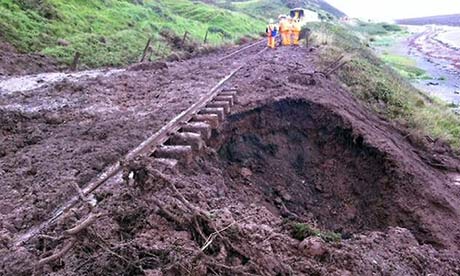
    Cumbria train derailment

    A commuter train on its way to Sellafield nuclear plant was derailed when it hit a landslide caused by torrential rainfall. Photograph: Network Rail/PA

    Forecasters have confirmed what many suspected: summer 2012 in England and Wales has been the biggest washout for a century. The Met Office said it had been the one of the dullest on record, one of the coolest, and the soggiest since 1912.

    As if to illustrate the point, Cumbria was hit by heavy rain and flash flooding on Thursday, , forcing people to leave their homes and causing a train carrying about 100 passengers to derail.

    A landslide is thought to have caused the derailment of the two-carriage train, which was travelling towards Sellafield nuclear plant. No injuries were reported.

    While the month is not quite over, Met Office figures up to 29 August make grim reading. Not only has this summer experienced just 399 hours of sunshine, it has also been cool, with a mean temperature of 14C (57F), some 0.4C below the long term average.

    The Met Office does not expect summer rainfall (currently at 366.8mm) to exceed the 384.4mm seen in the summer of 1912, and Scotland has escaped relatively lightly with 357mm.

    This will come as cold comfort to millions of Britons who have endured the damp weather. It is shaping up to be the fourth wettest summer since records began in 1727.

    Torrential rain on Wednesday night forced people in Cumbria from their homes and about 20 elderly men and women were moved to an emergency shelter at Egremont market hall after a power cut.

    Egremont and the Calder valley were the worst affected parts of west Cumbria, with 15mm of rain recorded in just 15 minutes at Calder Hall, and a total of 52mm recorded between 10pm and 4am on Thursday.

    Passengers on the derailed train were on their way to work at Sellafield when it ran into the landslip at 6.45am. Despite the large amount of mud and debris on the tracks, the train stayed upright.

    Alan Isles was on board. He described how fellow travellers screamed out as the train hit the landslide, sending debris flying over the carriages.

    Isles, from Workington, said: “As we were coming round a corner, there was no deceleration at all and we suddenly felt a large impact. A lot of people screamed out as the train derailed and many were disorientated. We were worried about rolling over, but luckily we didn’t. The staff were great and took control straight away.”

    A second train sent to the scene to transport the stranded passengers to Sellafield also encountered a landslide and had to return to Nethertown. Passengers were escorted to the nearest road for their onward journey.

    Network Rail said the derailment, about a mile south of St Bees station, happened in a remote area with no easy road access. Engineers spent the day removing rubble and carrying out repairs. There will be an investigation by the Rail Accident Investigation Branch.

    Following the severe weather, Cumbria fire service said it received more than 100 calls for help, mainly involving requests for sandbags. A spokesman said: “Some people have had to be evacuated and many have made their own way out of their flooded houses.”

    Cumbria police said drains were unable to cope after the river Ehen and several becks in the Egremont area burst their banks.

    Emma Jane Taylor said floodwater began entering her St Bees home shortly before midnight on Wednesday. “We’ve had heavy rain here before, but it’s never been this bad. I alerted some neighbours, but within 30 minutes it was through my front door and coming up through my floorboards. At the moment you can paddle across my floor.”

    Earlier this week the rear of a four-storey house in Egremont collapsed into the river Ehen after heavy rain.

    Forecasters say Friday will bring largely dry and fine weather for England and Wales, turning cloudier in the north and west later.

  • CLIMATE CODE RED Extensive melt over the Greenland Ice Sheet.

    Climate News

    Posted: 11 Aug 2012 08:13 PM PDT

    Week ending 12 August 2012

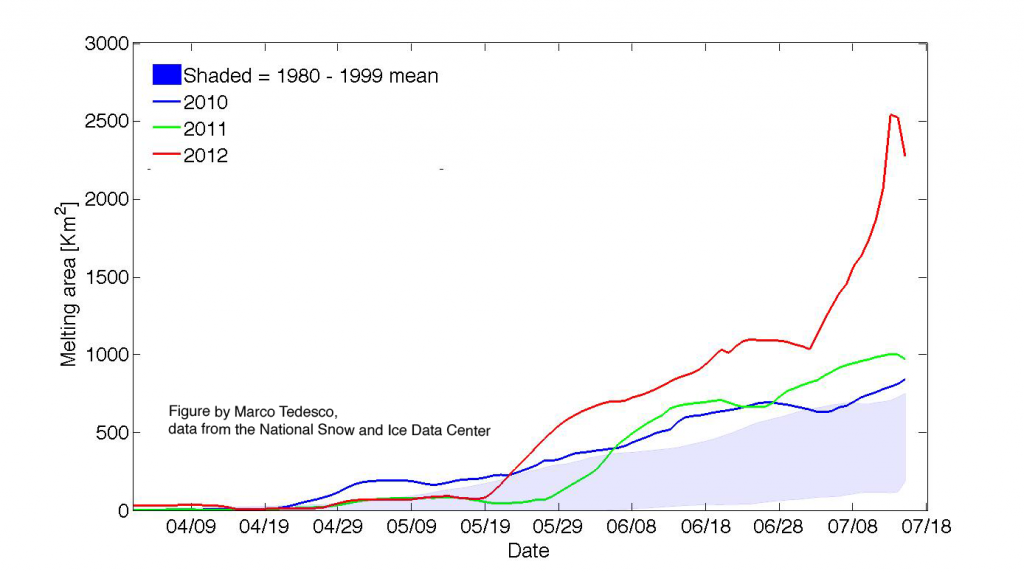
    Extensive melt over the Greenland Ice Sheet. This figure shows the daily, cumulative area of the Greenland ice sheet showing surface melt for 2012, 2011, 2010 and for the 1980 to 1999 mean. While melt was unusually extensive through May and June of 2012, the melt area increased rapidly in early July in response to an unusually warm weather event. Source: http://nsidc.org/arcticseaicenews/2010/08/a-most-interesting-arctic-summer/figure6-2/
  • Greenpeace head urges climate consensus

    Greenpeace head urges climate consensus

    Daniel Fogarty, AAPAugust 12, 2012, 2:40 pm


    Australia faces serious trouble from climate change unless our politicians can reach consensus on the issue and lead the global fight to reduce emissions, the new CEO of Greenpeace says.

    David Ritter has urged Opposition Leader Tony Abbott to rethink his promise to repeal the carbon tax if he becomes prime minister, and says Australia must follow its tradition of punching above its weight when it comes to finding solutions to climate change.

    Tackling climate change must also involve Australia exerting diplomatic pressure on other nations, he says.

    Perth-born Mr Ritter has returned to Australia after five years working for Greenpeace in the UK, to take up the position as CEO of Greenpeace Australia Pacific.

    The former commercial lawyer first developed a passion for native title issues before turning his focus to the environment.

    In London, he worked for Greenpeace on global campaigns on oceans, rainforests and climate change.

    There the tone of debate on climate change is “very, very different”, with a push for action from all major political parties, he says.

    As leader of the opposition, now British Prime Minister David Cameron once launched a policy from the Greenpeace warehouse.

    Mr Ritter is urging Mr Abbott to follow the UK Conservatives’ bipartisan approach and not repeal the carbon tax.

    “Obviously I hope whoever leads the Liberal Party, whether it is Abbott or anyone else, if they do succeed in becoming prime minster I obviously hope they don’t repeal the carbon tax,” he told AAP.

    “I know that statements have been made to that effect, but you would like to hope that a different view would be taken in government.”

    Instead, Mr Ritter hopes Australia can be a leader in the global response to climate change.

    “I’d like to see an Australia which takes an ambitious view on climate change, not only in terms of targets but in terms of things that people feel much more tangibly,” he said.

    “I would like to see an Australia that took on foreign policy initiatives that were about saying `Look, if climate change is not halted, is not tackled effectively, Australia is in really serious trouble.’

    As Greenpeace CEO, Mr Ritter hopes to continue to do as he did in the UK and work with big companies on environmental issues.

    During his time in London he built working relationships with retail giants Marks and Spencer and Sainsbury’s.

    “You can’t expect people to act outside of their role,” he said.

    “People who work within companies will always have to put the company first. But there’s an awful lot of room to look for solutions and to look for where we can make progress.

    “I see the role of Greenpeace as tapping into the extraordinary energy, emotion and willingness and goodwill that exists among people to really get moving and change things.”