Category: Climate chaos

The atmosphere is to the earth as a layer of varnish is to a desktop globe. It is thin, fragile and essential for preserving the items on the surface.150 years of burning fossil fuel have overloaded the atmosphere to the point where the earth is ill. It now has a fever. Read the detailed article, Soothing Gaia’s Fever for an evocative account of that analogy. The items listed here detail progress on coordinating 6.5 billion people in the most critical project undertaken by humanity. 

  • The John James Newsletter  251

    View Email Online                          Subscribe to NewsletterImage29 September 2018

    Its a long weekend  – a special read just for you

    Mike Pence went to kiss his wife, Karen, and she turned away from him. “You got what you wanted, Mike,” she said. “Now leave me alone.” She wouldn’t so much as say hello to Trump. Trump himself just stared at the TV without saying anything. His campaign hadn’t even bothered to prepare an acceptance speech. It was not hard to see why Trump hadn’t seen the point in preparing to take over the federal government: why study for a test you will never need to take?

    They were about to take control of the portfolio of existential risks managed by the US government. Only they weren’t. On the morning after the election the hundreds of people who had prepared to brief the incoming Trump administration sat waiting. A day became a week and a week became a month … and no one showed up. The parking spots that had been set aside for Trump’s people remained empty, and the briefing books were never opened. You could walk into almost any department of the US government and hear people asking the same question: where were these people who were meant to be running the place?

    3543.jpg?width=300&quality=85&auto=forma

    ‘This guy doesn’t know anything, and he doesn’t give a ……’
    The inside story of Trump’s shambolic transition team

    Chris Christie noticed a piece in the New York Times – that’s how it all started. The New Jersey governor had dropped out of the presidential race in February 2016 and thrown what support he had behind Donald Trump. In late April, he saw the article. It described meetings between representatives of the remaining candidates still in the race – Trump, John Kasich, Ted Cruz, Hillary Clinton and Bernie Sanders – and the Obama White House. Anyone who still had any kind of shot at becoming president of the United States apparently needed to start preparing to run the federal government. The guy Trump sent to the meeting was, in Christie’s estimation, comically underqualified. Christie called up Trump’s campaign manager, Corey Lewandowski, to ask why this critical job had not been handed to someone who actually knew something about government. “We don’t have anyone,” said Lewandowski.

    Christie volunteered himself for the job: head of the Donald Trump presidential transition team. “It’s the next best thing to being president,” he told friends. “You get to plan the presidency.” He went to see Trump about it. Trump said he didn’t want a presidential transition team. Why did anyone need to plan anything before he actually became president? It’s legally required, said Christie. Trump asked where the money was going to come from to pay for the transition team. Christie explained that Trump could either pay for it himself or take it out of campaign funds. Trump didn’t want to pay for it himself. He didn’t want to take it out of campaign funds, either, but he agreed, grudgingly, that Christie should go ahead and raise a separate fund to pay for his transition team. “But not too much!” he said.

    And so Christie set out to prepare for the unlikely event that Donald Trump would one day be elected president of the United States. Not everyone in Trump’s campaign was happy to see him on the job. In June, Christie received a call from Trump adviser Paul Manafort. “The kid is paranoid about you,” Manafort said. The kid was Jared Kushner, Trump’s son-in-law. Back in 2005, when he was US attorney for New Jersey, Christie had prosecuted and jailed Kushner’s father, Charles, for tax fraud. Christie’s investigation revealed, in the bargain, that Charles Kushner had hired a prostitute to seduce his brother-in-law, whom he suspected of cooperating with Christie, videotaped the sexual encounter and sent the tape to his sister. The Kushners apparently took their grudges seriously, and Christie sensed that Jared still harboured one against him. On the other hand, Trump, whom Christie considered almost a friend, could not have cared less.

    Christie viewed Kushner as one of those people who thinks that, because he is rich, he must also be smart. Still, he had a certain cunning about him. And Christie soon found himself reporting everything he did to prepare for a Trump administration to an “executive committee”. The committee consisted of Kushner, Ivanka Trump, Donald Trump Jr, Eric Trump, Manafort, Steve Mnuchin and Jeff Sessions. “I’m kind of like the church elder who double-counts the collection plate every Sunday for the pastor,” said Sessions, who appeared uncomfortable with the entire situation. The elder’s job became more complicated in July 2016, when Trump was formally named the Republican nominee. The transition team now moved into an office in downtown Washington DC, and went looking for people to occupy the top 500 jobs in the federal government. They needed to fill all the cabinet positions, of course, but also a whole bunch of others that no one in the Trump campaign even knew existed. It is not obvious how you find the next secretary of state, much less the next secretary of transportation – never mind who should sit on the board of trustees of the Barry Goldwater Scholarship and Excellence in Education Foundation.

    By August, 130 people were showing up every day, and hundreds more working part-time, at Trump transition headquarters, on the corner of 17th Street and Pennsylvania Avenue. The transition team made lists of likely candidates for all 500 jobs, plus other lists of informed people to roll into the various federal agencies the day after the election, to be briefed on whatever the federal agencies were doing. They gathered the names for these lists by travelling the country and talking to people: Republicans who had served in government, Trump’s closest advisers, recent occupants of the jobs that needed filling. Then they set about investigating any candidates for glaring flaws and embarrassing secrets and conflicts of interest. At the end of each week, Christie handed over binders, with lists of names of people who might do the jobs well, to Kushner, Donald Jr and the others. “They probed everything,” says a senior Trump transition official. “‘Who is this person?’ ‘Where did this person come from?’ They only ever rejected one person: Manafort’s secretary.”

    3305.jpg?width=300&quality=85&auto=forma
    In transition … Donald Trump and Chris Christie on 20 November 2016. Photograph: Carolyn Kaster/AP

    The first time Trump paid attention to any of this was when he read about it in the newspaper. The story revealed that Trump’s very own transition team had raised several million dollars to pay the staff. The moment he saw it, Trump called Steve Bannon, the chief executive of his campaign, from his office on the 26th floor of Trump Tower, and told him to come immediately to his residence, many floors above. Bannon stepped off the elevator to find Christie seated on a sofa, being hollered at. Trump was apoplectic, yelling: You’re stealing my money! You’re stealing my fucking money! What the fuck is this?

    Seeing Bannon, Trump turned on him and screamed: Why are you letting him steal my fucking money? Bannon and Christie together set out to explain to Trump federal law. Months before the election, the law said, the nominees of the two major parties were expected to prepare to take control of the government. The government supplied them with office space in downtown DC, along with computers and rubbish bins and so on, but the campaigns paid their people. To which Trump replied: Fuck the law. I don’t give a fuck about the law. I want my fucking money. Bannon and Christie tried to explain that Trump couldn’t have both his money and a transition.

    Shut it down, said Trump. Shut down the transition.

    Here Christie and Bannon parted ways. Neither thought it was a good idea to shut down the transition, but each had his own misgivings. Christie thought that Trump had little chance of running the government without a formal transition. Bannon wasn’t so sure if Trump would ever get his mind around running the federal government; he just thought it would look bad if Trump didn’t at least seem to prepare. Seeing that Trump wasn’t listening to Christie, he said: “What do you think Morning Joe will say if you shut down your transition?” What Morning Joe would say – or at least what Bannon thought it would say – was that Trump was closing his presidential transition office because he didn’t think he had any chance of being president.

    Trump stopped hollering. For the first time he seemed to have listened.

    “That makes sense,” he said.

    With that, Christie went back to preparing for a Trump administration. He tried to stay out of the news, but that proved difficult. From time to time, Trump would see something in the paper about Christie’s fundraising and become upset all over again. The money that people donated to his campaign Trump considered, effectively, his own. He thought the planning and forethought pointless. At one point he turned to Christie and said: “Chris, you and I are so smart that we can leave the victory party two hours early and do the transition ourselves.”

    At that moment in American history, if you could somehow organise the entire population into a single line, all 350 million people, ordered not by height or weight or age but by each citizen’s interest in the federal government, and Donald Trump loitered somewhere near one end of it, Max Stier would occupy the other.

    By the autumn of 2016, Stier might have been the American with the greatest understanding of how the US government worked. Oddly, for an American of his age and status, he had romanticised public service since he was a child. He had gone through Yale in the mid-80s and Stanford law school in the early 90s without ever being tempted by money or anything else. He thought the US government was the single most important and interesting institution in the history of the planet and could not imagine doing anything but working to improve it. A few years out of law school he had met a financier named Sam Heyman, who was as disturbed as Stier was by how uninterested talented young people were in government work. Stier persuaded Heyman to set aside $25m for him so that he might create an organisation to address the problem.

    Stier soon realised that to attract talented young people to government service, he would need to turn the government into a place that talented young people wanted to work. He would need to fix the US government. Partnership for Public Service, as Stier called his organisation, was not nearly as dull as its name. It trained civil servants to be business managers; it brokered new relationships across the federal government; it surveyed the federal workforce to identify specific management failures and success; and it lobbied Congress to fix deep structural problems. It was Stier who had persuaded Congress to pass the laws that made it so annoyingly difficult for Trump to avoid preparing to be president.

    Anyway, from the point of view of a smart, talented person trying to decide whether to work for the US government, the single most glaring defect was the absence of an upside. The jobs were not well-paid compared with their equivalents in the private sector. And the only time government employees were recognised was if they screwed up – in which case they often became the wrong kind of famous. In 2002, Stier created an annual black tie, Oscars-like awards ceremony to celebrate people who had done extraordinary things in government.

    Every year the Sammies – as Stier called them, in honour of his original patron – attracted a few more celebrities and a bit more media attention. And every year, the list of achievements was mind-blowing. A guy in the energy department (Frazer Lockhart) organised the first successful cleanup of a nuclear weapons factory, in Rocky Flats, Colorado, and had brought it in 60 years early and $30bn under budget. A woman at the Federal Trade Commission (Eileen Harrington) had built the Do Not Call Registry, which spared the entire country from trillions of irritating sales pitches. A National Institutes of Health researcher (Steven Rosenberg) had pioneered immunotherapy, which had successfully treated previously incurable cancers. There were hundreds of fantastically important success stories in the US government. They just never got told.

    Stier knew an astonishing number of them. He had detected a pattern: a surprising number of the people responsible for them were first-generation Americans who had come from places without well-functioning governments. People who had lived without government were more likely to find meaning in it. On the other hand, people who had never experienced a collapsed state were slow to appreciate a state that had not yet collapsed.

    That was maybe Stier’s biggest challenge: explaining the value of this enterprise at the centre of a democratic society to people who either took it for granted or imagined it as a pernicious force in their lives over which they had no control. He would explain that the federal government provided services that the private sector could not or would not: medical care for veterans, air traffic control, national highways, food safety guidelines. He would explain that the federal government was an engine of opportunity: millions of American children, for instance, would have found it even harder than they did to make the most of their lives without the basic nutrition supplied by the federal government. When all else failed, he would explain the many places the US government stood between Americans and the things that might kill them. “The basic role of government is to keep us safe,” he would say.

    The US government employed 2 million people, 70% of them one way or another in national security. It managed a portfolio of risks that no private person or corporation was able to manage. Some of the risks were easy to imagine: a financial crisis, a hurricane, a terrorist attack. Most were not: the risk, say, that some prescription drug proves to be both so addictive and so accessible that each year it kills more Americans than were killed in action by the peak of the Vietnam war. Many of the risks that fell into the government’s lap felt so remote as to be unreal: that a cyberattack left half the country without electricity, or that some airborne virus wiped out millions, or that economic inequality reached the point where it triggered a violent revolution. Maybe the least visible risks were of things not happening that, with better government, might have happened. A cure for cancer, for instance.

    Enter the presidential transition. A bad transition took this entire portfolio of catastrophic risks – the biggest portfolio of such risks ever managed by a single institution in the history of the world – and made all the bad things more likely to happen and the good things less likely to happen. Even before Stier created an organisation to fix the federal government, the haphazard nature of presidential transitions drove him nuts. “We have a legacy government that hasn’t kept up with the world we live in, largely because of disruptions from bad transitions,” he said. “People don’t understand that a bungled transition becomes a bungled presidency.” The new people taking over the job of running the government were at best only partially informed, and often deeply suspicious, of whatever happened to be going on before they arrived. By the time they fully grasped the problems they were dealing with, it was time to go. “It’s Groundhog Day,” said Stier. “The new people come in and think that the previous administration and the civil service are lazy or stupid. Then they actually get to know the place they are managing. And when they leave they say: ‘This was a really hard job, and those are the best people I’ve ever worked with.’ This happens over and over and over.”

    Most of the big problems inside the US government were of the practical management sort and had nothing to do with political ideology. A mundane but important example was how hard it was for any government agency to hire new people. Some agencies couldn’t hire anyone without 60 different people signing off on him. The George W Bush administration had begun to attack that particular mundane problem. The Obama administration, instead of running with the work done during the Bush years, had simply started all over again.

    5040.jpg?width=300&quality=85&auto=forma
    Steve Bannon and Jared Kushner on 11 January 2017. Photograph: Evan Vucci/AP

    Stier’s Partnership for Public Service had helped to push through three separate laws related to the transition. In 2010, Congress gave free office space and other resources to the nominees of the two major political parties immediately after the summer conventions. “The reason campaigns didn’t prepare is that they thought it would cost them politically: no one wanted to be seen measuring the drapes,” said Stier. “The idea was to give the nominees of the major political parties cover to do what they should do.” In 2011-2012, to enable the president to put people in jobs more quickly, Congress reduced the number of presidential appointments that required Senate confirmation from about 1,400 to roughly 1,200 – still more than 1,000 too many, in Stier’s view, but a start. Finally, in 2015, Congress required the sitting president to prepare in various ways to hand the government over to his or her successor. The person who had already taken the test was now required by law to help the person who may not have studied for it.

    As the 2016 presidential election approached, Stier was about as hopeful as he had ever been that the US government would be handed from one leader to another with minimum stupidity. His partnership had worked with both the Clinton and the Trump campaigns. “Their work was good,” said Stier. He was disappointed with Obama in some ways. Obama had been slow to engage with the federal workforce. He had appointed some poor managers to run some agencies. The fiasco of the rollout of HealthCare.gov was not an accident but a byproduct of bad management. But Obama’s preparations to hand over the government had been superb: the Obama administration had created what amounted to the best course ever on the inner workings of the most powerful institution on earth. What could go wrong?

    Chris Christie was sitting on a sofa beside Trump when Pennsylvania was finally called. It was 1.35am, but that wasn’t the only reason the feeling in the room was odd. Mike Pence went to kiss his wife, Karen, and she turned away from him. “You got what you wanted, Mike,” she said. “Now leave me alone.” She wouldn’t so much as say hello to Trump. Trump himself just stared at the TV without saying anything, like a man with a pair of twos whose bluff has been called. His campaign hadn’t even bothered to prepare an acceptance speech. It was not hard to see why Trump hadn’t seen the point in preparing to take over the federal government: why study for a test you will never need to take? Why take the risk of discovering you might, at your very best, be a C student? This was the real part of becoming president of the US. And, Christie thought, it scared the crap out of the president-elect.

    Not long after the people on TV announced that Trump had won Pennsylvania, Jared Kushner grabbed Christie anxiously and said: “We have to have a transition meeting tomorrow morning!” Even before that meeting, Christie had made sure that Trump knew the protocol for his discussions with foreign leaders. The transition team had prepared a document to let him know how these were meant to go. The first few calls were easy – the very first was always with the prime minister of Great Britain – but two dozen calls in you were talking to some kleptocrat and tiptoeing around sensitive security issues. Before any of the calls could be made, however, the president of Egypt called in to the switchboard at Trump Tower and somehow got the operator to put him straight through to Trump. “Trump was like … I love the Bangles! You know that song Walk Like an Egyptian?” recalled one of his advisers on the scene.

    That had been the first hint Christie had of trouble. He had asked Kushner what that was about, and Kushner had simply said, Trump ran a very unconventional campaign, and he’s not going to follow any of the protocols. The next hint that the transition might not go as planned came from Pence – now, incredibly, the vice-president-elect. Christie met with Pence the day after the election, to discuss the previous lists of people who had been vetted for jobs. The meeting began with a prayer, followed by Pence’s first, ominous question: “Why isn’t Puzder on the list for labour?” Andrew Puzder, the head of CKE Restaurants, the holding company for the fast-food chains Hardee’s and Carl’s Jr, wanted to be the secretary of labour. Christie explained that Puzder’s ex-wife had accused him of abuse (although she later retracted the allegation) and his fast-food restaurant employees had complained of mistreatment. Even if he was somehow the ideal candidate to become the next secretary of labour, he wouldn’t survive his Senate confirmation hearings. (Trump ignored the advice and nominated Puzder. In the controversy that followed, Puzder not only failed to be confirmed, but also stepped down from his job.)

    After meeting with Pence, Christie was scheduled to brief the Trump children, Kushner and the other members of Trump’s inner circle. He was surprised to find, suddenly included in this group, retired army lieutenant general Michael Flynn. Flynn was a jobseeker the transition team had found reasons to be extremely wary of. Now he wanted to be named Trump’s national security adviser, which was maybe the most important job in the entire national security apparatus. The national security team inside the Trump transition – staffed with senior former military and intelligence officials – had thought that was an especially bad idea. Flynn’s name was not on the list. But here he was, in the meeting to decide who would do what in the Trump administration, and Ivanka was asking him which job he would like to have.

    Before Christie could intercede, Bannon grabbed him and asked to see him privately. Christie followed Bannon to his office impatiently. Hey, this is going to have to be quick, said Christie.

    It’s really quick, said Bannon. You’re out.

    Why? asked Christie, stunned.

    We’re making a change.

    “Okay, what are we changing?

    You.

    Why?

    It’s really not important.

    The method of his execution was unsurprising: Trump always avoided firing people himself. The man who played Mr You’re Fired on TV avoided personal confrontation in real life. The surprise was that it was being done now, just when the work of the transition team was most critical. Only when Christie threatened to go down and tell reporters that Bannon had fired him did Bannon concede, “It was Jared.”

    In the days after the election, the people in the building on 17th and Pennsylvania were meant to move to another building in downtown DC, a kind of White House-in-waiting. They soon discovered that the lists that they had created of people to staff the Trump administration were not the lists that mattered. There was now this other list, of people allowed into the new building, and most of their names weren’t on it. “People would show up to the new building and say: ‘Let me in,’ and the secret service would say: ‘Sorry, you’re not on the list,’” said a civil servant who worked in the new building.

    It wasn’t just Christie who had been fired. It was the entire transition team – although no one ever told them so directly. As Nancy Cook reported in Politico, Bannon visited the transition headquarters a few days after he had given Christie the news, and made a show of tossing the work the people there had done for Trump into the bin. Trump was going to handle the transition more or less by himself. Not even Bannon thought this was a good idea. “I was fucking nervous as shit,” Bannon later told friends. “I go, ‘Holy fuck, this guy [Trump] doesn’t know anything. And he doesn’t give a shit.’”

    They were about to take control of the portfolio of existential risks managed by the US government. Only they weren’t. On the morning after the election the hundreds of people who had prepared to brief the incoming Trump administration sat waiting. A day became a week and a week became a month … and no one showed up. The parking spots that had been set aside for Trump’s people remained empty, and the briefing books were never opened. You could walk into almost any department of the US government and hear people asking the same question: where were these people who were meant to be running the place?

    The department of agriculture was an excellent case study. The place had an annual budget of $164bn and was charged with so many missions critical to the society that the people who worked there played a drinking game called Does the Department of Agriculture Do It? Someone would name a function of government, say, making sure that geese don’t gather at US airports, and fly into jet engines. Someone else would have to guess whether the agriculture department did it. (In this case, it did.) Guess wrong and you had to drink. Among other things, the department essentially maintained rural America, and also ensured that the American poor and the elderly did not starve. Much of its work was complicated and technical – and yet for the months between the election and the inauguration, Trump people never turned up to learn about it. Only on inauguration day did they flood into the building, but the people who showed up had no idea why they were there or what they were meant to do. Trump sent, among others, a long-haul truck driver, a telephone company clerk, a gas company meter reader, a country club cabana attendant, a Republican National Committee intern and the owner of a scented candle company. One of the CVs listed the new appointee’s only skill as “a pleasant demeanor”.

    All these people had two things in common. They were Trump loyalists. And they knew nothing whatsoever about the job they suddenly found themselves in. A new American experiment was underway.

    https://www.theguardian.com/news/2018/sep/27/this-guy-doesnt-know-anything-the-inside-story-of-trumps-shambolic-transition-team

    This is an edited extract from The Fifth Risk by Michael Lewis, published by Penguin on 2 October.

    To unsubscribe from any future messages, please click the unsubscribe link below.

  • The John James Newsletter  261

    The John James Newsletter  261

    View Email Online                          Send to Friends                          Subscribe to Newsletter

    When does a consistent pattern of inevitable disasters point to a deep-seated crisis that is not only environmental but profoundly social?   
    Murray Bookchin

    Throughout my career, I have been impressed with the importance of integrity – whether it was growing up as a Boy Scout, working in one of my first jobs as a university janitor, or being a leader in a Fortune 500 company 
    Rex Tillerson


    The story of Exon, and their program of denial
    Bill McKibben
    Extract, lightly edited

    The fossil-fuel industry’s contribution to the code of denial has been by far the most damaging. Alex Steffen, an environmental writer, coined the term “predatory delay” to describe “the blocking or slowing of needed change, in order to make money off unsustainable, unjust systems in the meantime.” The behavior of the oil companies, which have pulled off perhaps the most consequential deception in mankind’s history, is a prime example.

    As journalists at InsideClimate News and the Los Angeles Times have revealed, Exxon, the world’s largest oil company, understood that its product was contributing to climate change a decade before James Hansen testified to Congress. In July, 1977, James F. Black, one of Exxon’s senior scientists, addressed many of the company’s top leaders in New York, explaining the earliest research on the greenhouse effect. “There is general scientific agreement that the most likely manner in which mankind is influencing the global climate is through carbon-dioxide release from the burning of fossil fuels,” he said, according to a written version of the speech which was later recorded, and which was obtained by InsideClimate News. In 1978, speaking to the company’s executives, Black estimated that a doubling of the carbon-dioxide concentration in the atmosphere would increase average global temperatures by between two and three degrees Celsius, and as much as ten degrees Celsius at the poles.

    Exxon spent millions of dollars researching the problem. It outfitted an oil tanker, the Esso Atlantic, with CO2 detectors to measure how fast the oceans could absorb excess carbon, and hired mathematicians to build sophisticated climate models. By 1982, they had concluded that even the company’s earlier estimates were probably too low. In a private corporate primer, they wrote that heading off global warming and “potentially catastrophic events” would “require major reductions in fossil fuel combustion.”

    An investigation by the LA Times revealed that Exxon executives took these warnings seriously. Ken Croasdale, a senior researcher for the company’s Canadian subsidiary, led a team that investigated the positive and negative effects of warming on Exxon’s Arctic operations. In 1991, he found that greenhouse gases were rising due to the burning of fossil fuels. “Nobody disputes this fact,” he said. The following year, he wrote that “global warming can only help lower exploration and development costs” in the Beaufort Sea. Drilling season in the Arctic, he correctly predicted, would increase from two months to as many as five months. At the same time, he said, the rise in the sea level could threaten onshore infrastructure and create bigger waves that would damage offshore drilling structures. Thawing permafrost could make the earth buckle and slide under buildings and pipelines. As a result of these findings, Exxon and other major oil companies began laying plans to move into the Arctic, and started to build their new drilling platforms with higher decks, to compensate for the anticipated rises in sea level.

    The implications of the exposés were startling. Not only did Exxon and other companies know that scientists like Hansen were right; they used his NASA climate models to figure out how low their drilling costs in the Arctic would eventually fall. Had Exxon and its peers passed on what they knew to the public, geological history would look very different today. The problem of climate change would not be solved, but the crisis would, most likely, now be receding. In 1989, an international ban on chlorine-containing man-made chemicals that had been eroding the earth’s ozone layer went into effect. Last month, researchers reported that the ozone layer was on track to fully heal by 2060. But that was a relatively easy fight, because the chemicals in question were not central to the world’s economy, and the manufacturers had readily available substitutes to sell. In the case of global warming, the culprit is fossil fuel, the most lucrative commodity on earth, and the companies responsible took a different tack.

    A document uncovered by the LA Times showed that, a month after Hansen’s testimony, in 1988, an unnamed Exxon “public affairs manager” issued an internal memo recommending that the company “emphasize the uncertainty” in the scientific data about climate change. Within a few years, Exxon, Chevron, Shell, Amoco, and others had joined the Global Climate Coalition, “to coordinate business participation in the international policy debate” on global warming. The GCC coördinated with the National Coal Association and the American Petroleum Institute on a campaign, via letters and telephone calls, to prevent a tax on fossil fuels, and produced a video in which the agency insisted that more carbon dioxide would “end world hunger” by promoting plant growth. With such efforts, it gunned up opposition to the Kyoto Protocol, the first global initiative to address climate change.

    In October, 1997, two months before Kyoto, Lee Raymond, Exxon’s president and CEO, who had overseen the science department that in the nineteen-eighties produced the findings about climate change, gave a speech in Beijing to the World Petroleum Congress, in which he maintained that the earth was actually cooling. The idea that cutting fossil-fuel emissions could have an effect on the climate, he said, defied common sense. “It is highly unlikely that the temperature in the middle of the next century will be affected whether policies are enacted now, or twenty years from now,” he went on. Exxon’s own scientists had already shown each of these premises to be wrong.

    On a December morning in 1997 at the Kyoto Convention Center, after a long night of negotiation, the developed nations reached a tentative accord on climate change. Exhausted delegates lay slumped on couches in the corridor, or on the floor in their suits, but most of them were grinning. Imperfect and limited though the agreement was, it seemed that momentum had gathered behind fighting climate change. But as I watched the delegates cheering and clapping, an American lobbyist, who had been coördinating much of the opposition to the accord, turned to me and said, “I can’t wait to get back to Washington, where we’ve got this under control. I hope this visit from your king has brightened your outlook on things.”

    He was right. On January 29, 2001, nine days after George W. Bush was inaugurated, Lee Raymond visited his old friend Vice-President Dick Cheney, who had just stepped down as the CEO of the oil-drilling giant Halliburton. Cheney helped persuade Bush to abandon his campaign promise to treat carbon dioxide as a pollutant. Within the year, Frank Luntz, a Republican consultant for Bush, had produced an internal memo that made a doctrine of the strategy that “Voters believe that there is no consensus about global warming within the scientific community. Should the public come to believe that the scientific issues are settled, their views about global warming will change accordingly. Therefore, you need to continue to make the lack of scientific certainty a primary issue in the debate.”

    The strategy of muddling the public’s impression of climate science has proved highly effective. In 2017, polls found that almost ninety per cent of Americans did not know that there was a scientific consensus on global warming. Raymond retired in 2006, after the company posted the biggest corporate profits in history, and his final annual salary was four hundred million dollars. His successor, Rex Tillerson, signed a five-hundred-billion-dollar deal to explore for oil in the rapidly thawing Russian Arctic, and in 2012 was awarded the Russian Order of Friendship. In 2016, Tillerson, at his last shareholder meeting before he briefly joined the Trump Administration as Secretary of State, said, “The world is going to have to continue using fossil fuels, whether they like it or not.”

    It’s by no means clear whether Exxon’s deception and obfuscation are illegal. The company has long maintained that it “has tracked the scientific consensus on climate change, and its research on the issue has been published in publicly available peer-reviewed journals.” The First Amendment preserves one’s right to lie, although, in October, New York State Attorney General Barbara D. Underwood filed suit against Exxon for lying to investors, which is a crime. What is certain is that the industry’s campaign cost us the efforts of the human generation that might have made the crucial difference in the climate fight.

    Exxon’s behaviour is shocking, but not entirely surprising. Philip Morris lied about the effects of cigarette smoking before the government stood up to Big Tobacco. The mystery that historians will have to unravel is what went so wrong in our governance and our culture that we have done nothing to stand up to the fossil-fuel industry.

    There are undoubtedly myriad intellectual, psychological, and political sources for our inaction, but I cannot help thinking that the influence of Ayn Rand, the Russian émigré novelist, may have played a role. Rand’s disquisitions on the “virtue of selfishness” and unbridled capitalism are admired by many American politicians and economists—Paul Ryan, Tillerson, Mike Pompeo, Andrew Puzder, and Donald Trump, among them. Trump, who has called “The Fountainhead” his favorite book, said that the novel “relates to business and beauty and life and inner emotions. That book relates to . . . everything.” Long after Rand’s death, in 1982, the libertarian gospel of the novel continues to sway our politics: Government is bad. Solidarity is a trap. Taxes are theft. The Koch brothers, whose enormous fortune derives in large part from the mining and refining of oil and gas, have peddled a similar message, broadening the efforts that Exxon-funded groups like the Global Climate Coalition spearheaded in the late nineteen-eighties.

    Fossil-fuel companies and electric utilities, often led by Koch-linked groups, have put up fierce resistance to change. In Kansas, Koch allies helped turn mandated targets for renewable energy into voluntary commitments. In Wisconsin, Scott Walker’s administration prohibited state land officials from talking about climate change. In North Carolina, the state legislature, in conjunction with real-estate interests, effectively banned policymakers from using scientific estimates of sea-level rise in the coastal-planning process. Earlier this year, Americans for Prosperity, the most important Koch front group, waged a campaign against new bus routes and light-rail service in Tennessee, invoking human liberty. “If someone has the freedom to go where they want, do what they want, they’re not going to choose public transit,” a spokeswoman for the group explained. In Florida, an anti-renewable-subsidy ballot measure invoked the “Rights of Electricity Consumers Regarding Solar Energy Choice.”

    Such efforts help explain why, in 2017, the growth of American residential solar installations came to a halt even before March, 2018, when President Trump imposed a thirty-per-cent tariff on solar panels, and why the number of solar jobs fell in the US for the first time since the industry’s great expansion began, a decade earlier. In February, at the Department of Energy, Rick Perry—who once skipped his own arraignment on two felony charges, which were eventually dismissed, in order to attend a Koch brothers event—issued a new projection in which he announced that the US would go on emitting carbon at current levels through 2050; this means that our nation would use up all the planet’s remaining carbon budget if we plan on meeting the 1.5-degree target. Skepticism about the scientific consensus, Perry told the media in 2017, is a sign of a “wise, intellectually engaged person.”

    Of all the environmental reversals made by the Trump Administration, the most devastating was its decision, last year, to withdraw from the Paris accords, making the US, the largest single historical source of carbon, the only nation not engaged in international efforts to control it. As the Washington Post reported, the withdrawal was the result of a collaborative venture. Among the anti-government ideologues and fossil-fuel lobbyists responsible was Myron Ebell, who was at Trump’s side in the Rose Garden during the withdrawal announcement, and who, at Frontiers of Freedom, had helped run a “complex influence campaign” in support of the tobacco industry. Ebell is a director of the Competitive Enterprise Institute, which was founded in 1984 to advance “the principles of limited government, free enterprise, and individual liberty,” and which funds the Cooler Heads Coalition, “an informal and ad-hoc group focused on dispelling the myths of global warming,” of which Ebell is the chairman. Also instrumental were the Heartland Institute and the Koch brothers’ Americans for Prosperity. After Trump’s election, these groups sent a letter reminding him of his campaign pledge to pull America out. The CEI ran a TV spot: “Mr. President, don’t listen to the swamp. Keep your promise.” And, despite the objections of most of his advisers, he did. The coalition had used its power to slow us down precisely at the moment when we needed to speed up. As a result, the particular politics of one country for one half-century will have changed the geological history of the earth.

    We are on a path to self-destruction, and yet there is nothing inevitable about our fate. Solar panels and wind turbines are now among the least expensive ways to produce energy. Storage batteries are cheaper and more efficient than ever. We could move quickly if we chose to, but we’d need to opt for solidarity and coördination on a global scale. The chances of that look slim. In Russia, the second-largest petrostate after the US, Vladimir Putin believes that “climate change could be tied to some global cycles on Earth or even of planetary significance.” Saudi Arabia, the third-largest petrostate, tried to water down the recent IPCC report. Jair Bolsonaro, the newly elected President of Brazil, has vowed to institute policies that would dramatically accelerate the deforestation of the Amazon, the world’s largest rain forest. Importantly, a carbon tax would, at this late stage, have little impact on the outcome.
    To unsubscribe from any future messages, please click the unsubscribe link below.

  • The John James Newsletter  260

    The John James Newsletter  260

    View Email Online                          Send to Friends                          Subscribe to Newsletter

    The $4bn takeover of the Sydney Morning Herald will shrink the major sources of Australian news from five to four – Channel Nine, Rupert Murdoch’s News Corp, Kerry Stokes’ Seven West Media and the ABC
          Lenore Taylor

    Every step toward the goal of justice requires sacrifice, suffering, and struggle; the tireless exertions and passionate concern of dedicated individuals
    Martin Luther King, Jr.

    Facts are stern things
    John Curtin

    The hypocrisy, arrogance, and hubris of a family that has sought to turn the Presidency into another Trump franchise. You can’t do that in that position unless you think that you are bulletproof, and you don’t really give a damn what people think
    John Cassidy

    The growth-bug, if it becomes an addiction, is itself a disease. Out of control, it is a cancer, which can destroy the organism.
    Eric Zuesse

    Imagine two 18-year-olds, one in China, one in the US. Who has a better chance at upward mobility? Not too long ago, the answer might have been the teenager in the US But China has risen so quickly that, today, a young person’s chances of improving their living situation vastly exceeds those in the U.S. Here’s why, by the numbers:
    800 million: The number of people in China that have been lifted out of poverty since 1990. That’s two and a half times the US population.
    500 percent: The average per capita income growth in China between 1980 and 2014.
    $12,000: China’s economic output per capita. A decade ago, it was $3,500.
    1/4: The share of the world’s middle class that was in China in 2016.
    29: China’s score on the Gini coefficient, a worldwide measure of inequality, where a lower score represents a more equal economy. The U.S. scores 37.
    Despite that progress, 40 percent of China’s population still lives on less than $5.50 a day.

    NY Times

    Either Brexit agreement will leave the UK economically weakened, with no say in EU rules  must follow and years of uncertainty for business, or a no-deal Brexit I know as minister of transport will inflict untold damage on our nation. To present the nation with a choice between two deeply unattractive outcomes, vassalage and chaos, is a failure of British statecraft on a scale unseen since the Suez crisis
    Jo Johnson

    It takes a lot less money to defend a homeland, than to prepare to attack another country – or to police an empire that stretches across the entire planet
    John Rachel

    I can’t run no more
    With that lawless crowd
    While the killers in high places
    Say their prayers out loud
    But they’ve summoned up
    A thundercloud
    And they’re going to hear from me.  

    Leonard Cohen

    Extinction Rebellion Shuts Down London Bridges to Save Mother Earth
    The day of revolt leads to mass arrests in the UK as protestors argue too many still don’t “recognise the seriousness of our existential crisis” and almost nobody is doing enough to end humanity’s reckless assault on planet’s living systems. Mass arrests on Saturday as thousands of people and members of the ‘Extinction Rebellion’ movement—for “the first time in living memory”—shut down the five main bridges of central London in the name of saving the planet, and those who live upon it, from destructive over-consumption, runaway greenhouse gas emissions, and the ongoing failure of global leaders to address the intensifying threats.

    People are risking their liberty in defence of the living world in large numbers. It is only when we are prepared to take action that people begin to recognise the seriousness of our existential crisis.
          George Monbiot

    The ‘social contract’ has been broken … [and] it is therefore not only our right, but our moral duty to bypass the government’s inaction and flagrant dereliction of duty, and to rebel to defend life itself
          Gail Bradbrook, Extinction Rebellion organizer

    We have tried marching, and lobbying, and signing petitions. Nothing has brought about the change that is needed.
          Tiana Jacout

    2098066.jpgThe laws of physics, not to mention social and economic forces, tell us that infinite growth is not possible on a finite planet. Please read this article so you can disabuse yourself of any notion that industrial-scope capitalism dependent on endless growth can persist ….. whether with or without renewable energy. Please distribute this article.
    The Limits of Renewable Energy and the Case for Degrowth
    Between 1990 and 2015, the share of fossil fuels in the global energy mix (including nuclear energy in this particular calculation based on data from the BP Statistical Review) declined from 88% to 86% — a marginal decrease of 1% per decade. And more recently, in spite of the significant growth of renewables, in actual quantities, the share of petroleum and gas increased twice as much as renewable electricity 2011 – 2016.
    What accounts for the gap between what people perceive as a rapid transition to renewable energy and the reality of quite meagre progress? Part of the explanation lies with the use of relative data expressed as percentages: it’s easy to report big percentage increases when you’re talking about small numbers. Then there’s also the problem of media hype: boasting about achievements while remaining mum about failures. There is a real selection bias for success stories. Another typical media strategy is to publish forecasts of objectives to be achieved at some point in the distant future, which recede from memory as the day of reckoning approaches — no one is likely to recall dated, overly optimistic predictions.
    The public discourse on renewables is intended to be reassuring, to bolster confidence in the State and industry, and in the belief that the market system will take us to where we need to go. It shores up the status quo.Our smart devices will become the new and  massive surveillance network
    In Britain there’s one surveillance camera for every 11 people, illustrating the rapid rise of the surveillance state in industrialised Western democracies. Elsewhere, security services and local law enforcement authorities are   warming to the idea of using more devices to surveil the general population. With facial recognition technology growing so compact and efficient they’ll soon be cataloging the face and identity of everyone who passes a police officer or checkpoint on the street. Smart devices in our homes will begin to pry into our personal lives; invasive technology is only going to get more advanced, necessitating that it will become easier to establish a surveillance network just about anywhere. Even our homes won’t be safe sooner rather than later; Amazon recently filed for a patent to detect user illnesses by analysing the emotional state of a voice, illustrating the awesome and infiltrative potential these smart devices have. The digital technology of your phone is already sufficient to record and send every conversation (even if switched off) to an unknown “Listener”. The Stasi has arrived in a new form!The fire in Paradise: From natural disaster to social catastrophe
    The victims in Paradise were older and poorer than the rest of California. The median age was 50, and the median household income $20,000 a year less than for the state as a whole. As far as the government response has been concerned, their lives and continued survival are a matter of indifference. Aside from a handful of shelters—where a norovirus outbreak sent at least 25 survivors to the hospital—and a pittance in FEMA supplies, those fleeing Paradise have had to rely on friends, family and charity. The Camp Fire joins the long list of disasters over the past few years, including Hurricanes Michael (60 dead), Florence (53 dead) and Maria (3,057 dead) in the US. It comes four months after the Attica wildfires in Greece, which killed 99. In each case, natural events have been compounded by crumbling infrastructure and inadequate emergency planning to create social catastrophes.

    The abnormal has become the new normal
    The wildfire ravaging California is now the deadliest in state history. This isn’t the new normal, it’s the new abnormal, and we need to talk about causes and remedies.

    2059769.jpegHow Extreme Weather Is Shrinking the Planet
    With wildfires, heat waves, and rising sea levels, large tracts of the earth are at risk of becoming uninhabitable. But the fossil-fuel industry continues its assault on the facts.  California is ablaze. A big fire near Los Angeles forced the evacuation of Malibu, and an even larger fire, in the Sierra Nevada foothills, has become the most destructive in California’s history.
    After a summer of unprecedented high temperatures and a fall “rainy season” with less than half the usual precipitation, the northern firestorm turned a city called Paradise into an inferno within an hour, razing more than ten thousand buildings and killing at least sixty-three people; more than six hundred others are missing. The authorities brought in cadaver dogs, a lab to match evacuees’ DNA with swabs taken from the dead, and anthropologists from California State University at Chico to advise on how to identify bodies from charred bone fragments.
    A period of contraction is setting in as we lose habitable parts of the earth.
    Hurricane Michael, the strongest hurricane ever to hit the Florida Panhandle, inflicted thirty billion dollars’ worth of material damage and killed forty-five people.
    The effort to evacuate the blazing California towns along narrow roads was so chaotic that many people died in their cars. But most of the pullback will be slower, starting along the world’s coastlines.
    Each year, another twenty-four thousand people abandon Vietnam’s sublimely fertile Mekong Delta as crop fields are polluted with salt.
    As sea ice melts along the Alaskan coast, there is nothing to protect towns, cities, and native villages from the waves.
    In Mexico Beach, Florida, which was all but eradicated by Hurricane Michael, a resident told the Post, “The older people can’t rebuild; it’s too late in their lives. Who is going to be left? Who is going to care?”
    In Jakarta, a city with a population of ten million,  a rising Java Sea had flooded the streets., and in the first days of 2018, a nor’easter flooded downtown Boston; dumpsters and cars floated through the financial district.
    In Louisiana, government officials were finalizing a plan to relocate thousands of people threatened by the rising Gulf. “Not everybody is going to live where they are now and continue their way of life, and that is a terrible, and emotional, reality to face”. Lithium and the Battle for Afghanistan’s Mineral Riches
    More American Troops to Afghanistan, To Keep the Chinese Out? Unknown to the broader public, Afghanistan has significant oil, natural gas and strategic raw material resources, not to mention opium, a multibillion dollar industry which feeds America’s illegal heroin market. These mineral reserves include huge veins of iron, copper, cobalt, gold and lithium, which is a strategic raw material used in the production of high tech batteries for laptops, cell phones and electric cars. The implication of Trump’s resolve is to plunder and steal Afghanistan’s mineral riches that could become the “Saudi Arabia of lithium.” This resource has been known to both Russia and China since the 1970s.The reality of environmental protection
    We are at a stage where we humans have wiped out 85% of wildlife and are facing the specter of extinction. It is true that my tiger jinx was broken in Ranthambore and in three days I saw twelve tigers. It is true that when I watch Blue Planet or Planet Earth, with Sir David Attenborough commenting on the glory of nature and the profusion of wildlife, I am carried away with the sheer beauty of what I see. But it is good to remember that the reality is far from this. Very far. Yes, I saw twelve tigers in Ranthambore, but tigers are so seriously endangered as to be close to becoming extinct in the wild in India. Our population pressure, total ignorance and apathy towards forests and wildlife, greed to make money at any costs and a political class that is innocent of any ethics, responsibility or knowledge, means that forests and wildlife continue to get short shrift. Every mining concession, highway or railway line tends to get precedence over the forest that it will either seriously endanger or completely destroy. It is no secret that tiger reserves which get a higher level of protection from reserve forests, were systematically de-tigered so that the status of the forest could be officially downgraded to reserve forest, in order to start mining for marble.

    2098068.jpgUS Could Lose in War with China or Russia
    A  bipartisan congressional panel highlights a new era of “Great Power competition” with Moscow and Beijing. The panel, run by a dozen former top Democratic and Republican officials, found that just as the US military faced budget cuts and diminishing military advantages, authoritarian nations like China and Russia are pursuing buildups aimed “at neutralising US strengths.. America’s military superiority – the hard-power backbone of its global influence and national security – has eroded to a dangerous degree.”Cities Will Soon Face Six Climate Disasters at Once
    Before century’s end the frightening new normal could be cities and states facing multiple extreme climate events all at once.  New York, Sydney, and Rio de Janeiro could soon face up to five catastrophic weather events in a single year—including wildfires, hurricanes, storm surges, and droughts. Florida has experienced more than 100 wildfires, drought, and the severely destructive Hurricane Michael in the past year—but with most news reports and climate researchers focusing on one disastrous weather event at a time, the current reality has been obscured. “A focus on one or few hazards may mask the impacts of other hazards, resulting in incomplete assessments of the consequences of climate change on humanity,” writes Camilo MoraHow did Trump react to the news that the Russian hypersonic nuclear missile Avangard was ready?
    He announced that his country would withdraw from the INF Treaty. So, instead of making a plan to catch up and quickly developing hypersonic missiles, he intends to reassemble the US medium range nuclear missile arsenal.  Valentin Vasilescu observes that the US is no longer manufacturing motors for this type of missile and is using Russian motors for its Atlas V rockets. Conclusion: Trump has given Moscow yet another advantage.

    US vice president beats war drums in Asia:
    Pence issued an ultimatum to China: either accept a subservient, semi-colonial status, or confront the full force of US diplomatic, economic and ultimately military weight. Washington is insisting that Beijing abandon plans to develop hi-tech industries to compete with US companies, further open up to American corporate exploitation, bow to the “international rules-based system” determined by the US, and halt any efforts to counter increasingly aggressive anti-Chinese propaganda.

    These 4,000-year-old termite mounds are visible from space
    Some 200 million conical termite mounds rise from the ground in northeastern Brazil, each about 2 to 4 meters high and about 9 meters wide, visible on Google Earth. Researchers dated the soil from 11 of these mounds and found that the piles are up to about 4,000 years old, making them almost as ancient as the pyramids of Giza. The mounds are still inhabited by the termite species, Syntermes dirus, that first made them. The mounds themselves lack any definite internal architecture, but there are extensive networks of underground tunnels that the termites use to safely access fallen leaves on the forest floor.

    2098065.jpgPoverty in Britain: a social calamity
    He visited Newcastle where he found people struggling to negotiate the benefits system and going hungry. He called it a ‘social calamity and an economic disaster’. The UK government has inflicted “great misery” on its people with “punitive, mean-spirited, and often callous” austerity policies. He found people struggling to cope within a benefits system designed to force people into work with built-in delays to payments. Many have been referred to food banks with some still going hungry.Shithole Countries: Made in the USA
    The primary concern is the preservation of the new feudal mythology that they have created: that the world is a dangerous place, that they are the protectors, that the danger is omnipresent, eternal, and omnidirectional, comes from without, and comes from within. The mythology is constructed and presented through all media; journals, films, television, radio, music, advertising, books, the internet in all its variety. All available information systems are used to create and maintain scenarios and dramas to convince the people that they, the protectors, are the good and all others are the bad. We are bombarded with this message incessantly. In following much of American political leaders’ rhetoric or media coverage of the conflict, one is struck by the deliberate disregard of empirical facts, and the contempt for established legal constructs and precedents.icon.pngWhich planet is the media living on?
    While extreme weather events are being reported almost daily on news bulletins, only rarely is it conveyed that these events constitute the manifestation of advanced global warming and a fundamental shift in the state of the atmosphere. Rarely do major ABC TV forums, such as The Drum, The Insiders, Q and A, Four-Corners, the 7.30 Report, Breakfast, Matter of Fact and other programs include climate scientists to discuss the trends and consequences of climate disruption, mitigation and adaptation. In a recent interview with the ex-PM on the ABC Q&A program, the climate has hardly been mentioned, yet on the 12th August 2010 he said “Now our response to climate change must be guided by science. The science tells us that we have already exceeded the safe upper limit for atmospheric carbon dioxide. We are as humans conducting a massive science experiment with this planet. It’s the only planet we’ve got”.icon.png“Keep Tathra Cool, Climate Action Now”
    Frustrated by inaction and squabbling on climate change 12 years after they first took a stand, the Tathra community has again come out en-mass to lead the discussion and advocate for the future. With Dr Matthew Nott, the founder of Clean Energy for Eternity directing the traffic, hundreds of people turned out on Lawrence Park on 30 September to create a human sign that spoke not just to the atmosphere above that could see it best but more so our political leaders. “It’s 2006 since we did our first human sign on Tathra Beach, today was bigger, bolder, and more beautiful. Today’s sign is born out of frustration, we did our sign in 2006 because we were frustrated by the lack of government action and now it’s even worse. Our country now has no strategy for reducing emissions – that’s outrageous.”

    2098067.jpgTo unsubscribe from any future messages, please click the unsubscribe link below.

  • The John James Newsletter  258

    The John James Newsletter  258

    Why don’t the Americans get it? The terrorists are already in their midst, already in their homes: the mad gun-wielding members of the NRA.
    John James

    The drive towards personal excellence fuelled by the system of private enterprise has an embedded need for exponential growth and seems incapable of protecting key resources such as air quality, fertile soil and clean water
    Bruce Pascoe

    When plunder becomes a way of life for a group of men in a society, over the course of time they create for themselves a legal system that authorises it and a moral code that glorifies it
    Frédéric Bastiat

    British Columbia’s southern resident killer whale population is down to only 76 animals because human fishers have displaced the orcas from their favoured food, Chinook salmon, as we simultaneously displace the salmon from their spawning streams through hydro dams, pollution and urbanization.
    William Rees

    It is always easier to fight for one’s principles than to live up to them
    Alfred Adler

    The biggest crime scene on the planet is on the planet
    Gavin Schmidt

    The bellicose actions of the Trump Administration against trade with Iran is forcing major countries into cooperation that ultimately could spell the demise of the dollar hegemony, a hegemony that has allowed a debt-bloated US Government to finance global tyranny
    Willian Engdahl

    The EU resents and fears the consequences of the Trump administration’s reckless and provocative offensive against Iran. They resent it because Washington’s scuttling of the nuclear deal has pulled the rug from European capital’s plans to capture a leading position in Iran’s domestic market and exploit Iranian offers of massive oil and natural gas concessions. They fear it, because the US confrontation with Iran threatens to ignite a war that would invariably set the entire Mideast ablaze, triggering a new refugee crisis, a massive spike in oil prices and, last but not least, a re-partition of the region when the European powers lack the military means to independently determine the outcome.
    Keith Jones

    The US is now an Oligarchy
    Economic elites and organised business interests have substantial independent impacts on US government policy, while average citizens and mass-based interest groups have little or no independent influence. “When the preferences of economic elites are catered for, the preferences of the average American have only a minuscule, near-zero, statistically non-significant impact upon public policy. Though Americans do enjoy many features central to democratic governance, such as regular elections, freedom of speech and association, and a widespread (if still contested) franchise, policymaking is dominated by powerful business organisations and a small number of affluent Americans. Therefore, America’s claims to being a democratic society are seriously threatened.”      Read more

    Trump’s $2.1 trillion deal with the devil has failed
    Ominous signs are already evident in sectors most sensitive to higher borrowing costs. The Freddie Mac rate for a 30-year fixed mortgage has risen 100 basis points to 4.83% over the last year. Home sales have dropped by 21%. Average house prices have slipped 3.5%. This is remarkable given that the fiscal pedal is pushed to floor. The federal budget deficit is nearing 5% of GDP, at a time when full employment should restore balance.      Read details

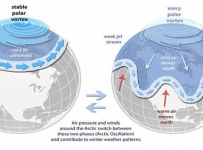
    Global warming is eroding the polar vortex that once insulated the frozen north.
    The north pole gets no sunlight until March, but an influx of warm air has pushed temperatures in Siberia 35C above averages. Greenland has already experienced 61 hours above freezing in 2018 – more than three times as in any previous year. “This is an anomaly among anomalies. It is far enough outside the historical range that suggests there are further surprises in store as we continue to poke the angry beast that is our climate,” said Michael Mann. “The Arctic has always been regarded as a bellwether because of the vicious circle that amplify human-caused warming in that particular region. And it is sending out a clear warning.” This is a displacement of what ought to be happening farther north. Some recent temperatures have been warmer than London and Zurich, which are thousands of miles to the south.      Read more

    Summer weather is getting ‘stuck’ due to Arctic warming
    Rising Arctic temperatures mean we face a future of ‘extreme extremes’ where sunny days become heatwaves and rain becomes floods, leading to “very extreme extremes”, which occur when abnormally high temperatures linger for an unusually prolonged period, turning sunny days into heat waves, tinder-dry conditions into wildfires, and rains into floods.      Read more

    Comma tips.  See here

    2085934.pngEfforts to Fight Climate Change Had a Tough Election Day
    On Election Day, the House went to the Democrats, the Senate to the Republicans, and only two of seven climate-related measures on ballots across the country went in the planet’s favour. In Washington State, oil companies—led by BP America—spent more than thirty million dollars to defeat Initiative 1631, which would have established the country’s first-ever carbon fee. The proceeds that the state collected from its worst carbon polluters would have been put back into clean-energy infrastructure and other investments to adapt to the effects of climate change. Nevertheless the Democrats say “We will look to restore the environmental protections that have been gutted over the last two years.”      Read thisEarth Endangered by New Strain of Fact-Resistant Humans
    A virulent strain of humans who are virtually immune to any form of verifiable knowledge, are leaving scientists at a loss as to how to combat them. “These humans appear to have all the faculties necessary to receive and process information, and yet, somehow, they have developed defences that, for all intents and purposes, have rendered those faculties totally inactive. More worryingly, as facts have multiplied, their defences against those facts have only grown more powerful. Our research shows it’s possible that they will become more receptive to facts once they are in an environment without food, water, or oxygen.”      Humerous or true?China’s ‘extraordinary’ ambitions: the futuristic city being built on reclaimed land
    Colombo Port City is a project local politicians hope will spearhead the city’s bid to become a new Singapore-like economic hub in the Indian Ocean. China’s role in the project has also raised concerns in India, which is suspicious of Beijing’s intentions in the region. The project has strategic “implications, for by increasing Chinese leverage over Sri Lanka through debt-trap diplomacy, it promises to give China a strategic foothold in the Sri Lankan capital. Chinese projects can quickly acquire a strategic dimension.”      Read moreEurope and America clash over Washington’s economic war on Iran
    Washington’s imposition of sweeping new sanctions on Iran—aimed at strangling its economy and precipitating “regime change” in Tehran—is roiling world politics. The US is embargoing all Iranian energy exports and freezing Iran out of the US-dominated world financial system to cripple the remainder of its trade and deny it access to machinery, spare parts and even basic foodstuffs and medicine. American imperialism is once again acting as a law unto itself. The sanctions are illegal under international law. It is tantamount to a declaration of war.    Read more

    2085933.jpgPutin to Trump: Thanks for Helping Make Russia Great Again!
    I am writing to thank you, Donald the Great, for helping me make Russia great again. What you have done by unilaterally withdrawing from Iran nuclear deal and by re-imposing and adding more sanctions on Iran on November 5 was a blessing for us and I love it! And here is why. The resource-rich Iran still needs to feed and take care of its more than 80 million people. And I am there for them, right up the road on the Caspian Sea, that technically and for all practical purpose makes us neighbors. BTW & FYI, at my behest, we just signed a major agreement divvying it up with Iran and three other littoral states. Donald, I cannot thank you enough for pushing Iran deeper into my lap, which in the near future will become entirely a “client state” of Russia. Pretty soon I will be their largest supplier, trading partner, freight forwarder, middleman, salesman, banker, capital projects builder, and agent, all combined! But wait a minute: I have to be careful of your trade menace, the sneaky Xi Jinping who is my menace too! He undoubtedly will try to compete with me, as he dreams to corner Iran’s market by bartering for their discounted oil and selling them all sort of Chinese goods and services, as well as pushing for his new global initiative of building more “belts and roads”!      Read moreOcean shock
    Reuters reveals the climate crisis beneath the waves. Driven by warming waters, marine life is on the move — and life on land is forever changed. Fish and other sea life are fleeing for their lives, seeking the even temperatures they need to breed and thrive.      Read here

    El Nino alert with 70pc chance of hot and dry conditions
    The Met has just upped the chance of an El Nino this year, meaning there is now three times the normal risk of the climate being hotter and dryer this year. It had been a slow boil.”This is absolutely not the outlook many people hoped to hear.”      Read more

    David Attenborough has betrayed the living world he loves
    It is not proselytising or alarmist to tell us the raw truth about what is happening to the world, however much it might discomfit us. For many years, wildlife film-making has presented a pristine living world. It has created an impression of security and abundance, even in places afflicted by cascading ecological collapse. The cameras reassure us that there are vast tracts of wilderness in which wildlife continues to thrive. They cultivate complacency, not action. You cannot do such a thing passively. Wildlife film-makers I know tell me that the effort to portray what looks like an untouched ecosystem becomes harder every year. They have to choose their camera angles ever more carefully to exclude the evidence of destruction, travel further to find the Edens they depict. They know – and many feel deeply uncomfortable about it – that they are telling a false story, creating a fairytale world that persuades us all is well, in the midst of an existential crisis.      Read the whole argumentWorld Bank ends its support for coal worldwide
    The World Bank has abandoned the last coal project on its books, with its president publicly dumping the Kosovo e Re plant on Wednesday. “We are required by our by-laws to go with the lowest cost option and renewables have now come below the cost of coal. So without question, we are not going to [support the plant].     Read more

    Spain to close most coalmines in €250m transition deal
    By the end of the year after government and unions struck a deal that will mean €250m will be invested in mining regions over the next decade. Unions hailed the mining deal – which covers Spain’s privately owned pits – as a model agreement. It mixes early retirement schemes for miners over 48, with environmental restoration work in pit communities and re-skilling schemes for cutting-edge green industries.      Read more

    A Day in Pompeii – Full-length animation
    Fascinating.          Watch this

    2085935.pngThe psychosocial dimension of power: An emotional analysis of the Davos elite’s discourse on globalization
    The central feature of the Davos elite culture of globalisation that emerged from this analysis is the lack of democracy in the decision-making processes, both at relational and organisational level. To change this entails recovering the sense of public good, conceived as pertaining to the collectivity, in contrast to the private good, referring to an exclusive possession, that deprives someone of something.      Read moreArctic Methane Catastrophe
    55 million years ago it took less than 200 years for global temperature to rise about 10C. There was a critical level of C02, beyond which rapid and unstoppable temperature rise occurred.    Video worth warching

    2085998.pngChina’s ‘extraordinary’ ambitions: the futuristic city being built on reclaimed land
    C
    olombo Port City, a project local politicians hope will spearhead the city’s bid to become a new Singapore-like economic hub in the Indian Ocean. China’s role in the project has also raised concerns in India, which is suspicious of Beijing’s intentions in the region. The project has strategic “implications, for by increasing Chinese leverage over Sri Lanka through debt-trap diplomacy, it promises to give China a strategic foothold in the Sri Lankan capital. Chinese projects can quickly acquire a strategic dimension.”     Read more

    $2.7 billion deal opening Madagascar to Chinese fishing
    Life on the coast of Madagascar is increasingly precarious. In recent decades, the overexploitation of marine life has made it difficult for hundreds of thousands of small-scale fishers to make a living. Two months ago, a little-known private Malagasy association signed a 10-year, $2.7 billion fishing deal — the largest in the country’s history — with a group of Chinese companies that plans to send 330 fishing vessels to Madagascar. The country’s fisheries minister said he learned about it in the newspaper. Local fishers are already struggling with foreign competition for Madagascar’s dwindling marine stocks. No draft of the deal has been made public and the association that signed it did not conduct an environmental impact assessment or any public consultation.      Not pleasant reading

    A Theory of Human Thinking
    “By connecting all these previous discoveries, we came to the assumption that the brain stores a mental map, regardless of whether we are thinking about a real space or the space between dimensions of our thoughts. Our train of thought can be considered a path though the spaces of our thoughts, along different mental dimensions. These processes are especially useful for making inferences about new objects or situations, even if we have never experienced them,” the neuroscientist continues. Using existing maps of cognitive spaces humans can anticipate how similar something new is to something they already know by putting it in relation to existing dimensions. If they’ve already experienced tigers, lions, or panthers, but have never seen a leopard, we would place the leopard in a similar position as the other big cats in our cognitive space. Based on our knowledge about the concept ‘big cat’, already stored in a mental map, we can adequately react to the encounter with the leopard. We can generalise to novel situations, which we constantly face, and infer how we should behave.”    This is my experience, too

    “The abuse of buying and selling votes crept in and money began to play an important part in determining elections. Later on, this process of corruption spread to the law courts. And then to the army, and finally the Republic was subjected to the rule of emperors”     
    Plutarch

    The past two years Trump has abandoned or threatened the Trans-Pacific Partnership, the Paris Climate Accord, the JCPOA with Iran, the North Atlantic Treaty Organisation, the International Criminal Court, the Postal Union Treaty, and the Intermediate-range Nuclear Forces Treaty. The liberal world order is under threat from its principal architect, the UDS.
    Matthew Shannon

    The cut in corporate tax rates from 35% to 21% has fed stock buybacks by US companies. Why would they invest into an ageing boom, in the midst of a global trade war? The mechanical consequence of a US consumption boom and a soaring dollar is to suck in imports, painting the current account deficit in Gothic colours.
          Ambrose Evans-Pritchard

    Climate change is impacting the Caribbean, with millions facing increasing food insecurity and decreasing freshwater availability as droughts become more likely across the region
    Blaine Friedlander

    Russia & China Invest in Infrastructure; US Spends on Military
    China’s “Belt and Road Initiative” is famous as an extension of their domestic infrastructure investments, but Russia is also investing heavily in infrastructure. Both countries need to do it in order to improve the future for their respective populations, and both Governments have avoided the Western development model of going heavily into debt in order to pay for creating and maintaining infrastructure. Both are, in fact, exceptionally low-debt Governments. China has a public debt/GDP of 17.7%, and Russia’s is 8.0%. For comparison, America’s is 93.6%. (Others are: Germany 85.8%, Spain 91.2%, Italy 122.6%, Greece 147.1%, India 54.2%, Pakistan 47.0%, and Brazil 55.0%.) The US isn’t going into public debt in order to finance building or maintenance of infrastructure, but instead to finance expansions of its military, which is already (and by far) the world’s largest (in terms of its costs, but not of its numbers of troops). A nation that spends over a trillion dollars a year on ‘national defence’ can’t have much left over to spend on things that ‘can wait’ — such as repairing its bridges, roads, etc. — and so those repairs do wait, while even more money, than before, becomes devoted to purchases of new weaponry.   Read more

    Russia, India & Iran want to create alternative trade route to Suez Canal
    The new shipment passage, North-South Transport Corridor, to connect the Indian Ocean with the Persian Gulf through Iran to Russia and Europe. The 7,200-kilometers long corridor will combine sea and rail routes.Currently, Indian logistics companies have to route shipments through China, Europe or Iran to get an access to Central Asian markets – long, time-consuming and inevitably expensive: with the Iranian route seen as the most viable.     Read the details

    2085990.pngApocalyptic Climate Reporting Completely Misses the Point
    Reporting on the IPCC, and climate change more broadly, is unbalanced. It’s fixated on the predictions of climate science and the opinions of climate scientists, with cursory gestures to the social, economic, and political causes of the problem. Yet analysis of these causes is as important to climate scholarship as modelling ice-sheet dynamics and sea-level rise. Reductionist climate reporting misses this. Many references to policy are framed in terms of carbon pricing. This endorses the prevailing contempt in establishment circles for people’s capacity to govern themselves beyond the restrictions of market rule. Meanwhile, the IPCC report is overflowing with analyses showing that we can avoid runaway climate change, improve most people’s lives, and prioritise equality through a broad set of interventions.      Read morePopulation: The Multiplier of Everything Else
    Conservative demographic projections show the world’s population growing by 2.5 billion people over the next four decades – a 40% increase. Many people are simply not aware of the scale and speed at which world population is expected to continue growing – by about 80 million annually. This is like adding a new Egypt every year. The total population is approaching 7 billion, seven times what it was in 1800. The cost in human suffering from unplanned and excessive childbearing is staggering: 500,000 women and girls die worldwide every year from pregnancy and childbirth. Most of the women who die are in their teens and early twenties, forced by their societies into bearing children too young and far too frequently. The lives of billions are being rendered increasingly desperate by being denied access to family-planning. The surge is not the result of rising birth rates, which have dropped since 1970, but primarily from declining death rates —the result of widespread vaccination, etc.      Read moreBlack-starting the grid after a power outage
    Large blackouts can be quite devastating and it isn’t easy to restart the electric grid again. This is typically done by designated black start units of natural gas, coal, hydro, or nuclear power plants that can restart themselves using their own power with no help from the rest of the electrical grid.         Read more“It is easier to imagine the end of the world than the end of capitalism.”         Blog source

    2085936.pngTo unsubscribe from any future messages, please click the unsubscribe link below.

  • The John James Newsletter  253

    View Email Online                          Subscribe to NewsletterForward this message to a friend so they can use the Subscribe to Newsletter link at the top of the message to receive future emailsImageThe recent IPCC report says we could, but will we?
    It tells us we can limit planetary destruction if we act now, but we know from the world’s response to that report that we won’t act, not now and probably not ever. Since the Paris agreement, the mining of fossil fuels has increased, and we are still constructing coal powered plants, and planning more oil extraction. No country has instituted a carbon tax, no country has passed mandatory energy efficiency measures, no country has reduced car emissions or the production of cement, or plastics, or weapons of war. There has been not one agricultural reform to reduce methane emissions. Not one country has started to do anything commensurate with the risk, not one!
    And we know the weather is being destabilised, the world is getting too hot for life, cereal production is threatened and the permafrost is melting and releasing more methane – something this report, like its predecessors, does not mention.
    And what of population growth around the tropics that further stretch the earth’s capacity for food, goods, energy, homes and water.
    The IPCC state that a condition for success is that we withdraw much of the carbon we have put into the air. Not only do we not have the technology, but every calculation shows there would be little net gain as the environmental cost would be too high.
    What the report does not say is that it would be better to reduce our wealth and comfort to safeguard our future; better to end all fossil fuel use right now; better to shut down all operating coal plants and cancel any under construction; better to impose a stiff carbon tax; better to end the use of plastics; better to develop a recycling economy at all levels; better to stop fighting.
    This latest report offers hope that something could be still be done in spite of history. The report warns our leaders, but is it likely they will lead? Do you reckon??? Read it here.
    As long as our current political and economic system remains we cannot avoid paying the extreme penalty for what we have inflicted on our planet, our only home.
    John James

    The scariest thing about the IPCC Report is that it’s the watered down, consensus version. The latest science is much, much, much more terrifying
    Jamie Henn

    The IPCC understates a key risk: that self-reinforcing feedback loops could push the climate system into chaos before we have time to tame our energy system, and the other sources of climate pollution
    Mario Molina

    Capitalism cannot save nature because it sees nature only as another collection of commodities, the long-term persistence of which comes second to immediate profit concerns
    Jeffrey Hollander

    Politics is the not-so-gentle art of getting votes from the poor and campaign funds from the rich, by promising to protect each from the other
    Oscar Ameringer

    You have no idea of how much the people must be misled if the support of the masses is required
    Mien Kampf

    From 1952 to 1985, the western edge of the Vavilov ice cap, 1,820 square kilometres in area and between 300 metres and 600 metres in thickness, shifted at about 12 metres a year. By 2011 it had stepped up the pace to 75 metres a year. By 2015, the ice front had broken into tongues that moved at more than 1,000 metres a year. And within a year the leading edge had started racing into the Kara Sea at 5,000 metres a year. By the way, it is also thinning at the rate of a third of a metre a day,
    Michael Willis

    Nations have lost control of their own economies: it doesn’t matter what people want as there is no way to vote against the global interests of Goldman Sachs or ExxonMobil. This is the core of today’s political crises. The global result is movements of resistance, of which Trump is just a part.
    Chris Hedges

    The problem with carbon capture is that it is energy-intensive and expensive. The process uses chemicals to absorb carbon dioxide from exhaust gas. Then they have to be separated so that they can be reused and the carbon dioxide can be buried. All of this consumes energy. Power plants equipped with carbon capture systems generally use up to 30 percent of the electricity they generate just to power the capture, release, and storage of carbon dioxide.
    Prachi Patel   

    Our climate’s natural variability is now on steroids
    Joelle Gergis

    At this point both 1.5 and 2C climate goals goals are starting to look wildly out of reach
    New York Times

    Today, 2 degrees is aspirational and 1.5 degrees is ridiculously aspirational. We need to face the fact that we might not stop at either, and start thinking seriously about what a 2.5 degree or 3 degree world might look like
    Gary Yohe

    Planet has only until 2030 to stem catastrophic climate change
    The IPCC report warns that the planet will reach the crucial threshold of 1.5 C by 2030, precipitating the risk of extreme drought, wildfires, floods and food shortages for hundreds of millions of people. The date falls well within the lifetime of most people alive today. It is based on current levels of greenhouse gas emissions. The window on keeping global warming below 1.5 C is closing rapidly and the current emissions pledges made by signatories to the Paris Agreement do not add up to us achieving that goalTo limit global warming to 1.5 degree C is “possible within the laws of chemistry and physics.” But doing so would require unprecedented changes.    Read more

    Lets ponder those changes. Reduce coal and gas production and (and!) use by 10% each year, so phased out by 2030. Compensation? Share market losses? Massive equipment junked? Enforcement? Silence the barons? If we haven’t begun this process so far, what makes you believe its going to be any different from here?     The report is our obituary, premature but timely.

    Sketch shows that even were we to stop now there would still be overshoot. This, like all studies, does not take methane into account, nor the almost 1C increase that would occur as the pollution falls out of the atmosphere, our blanket of filth that has been keeping the temperature lower.
    2054844.jpgWhat’s Not in the Latest Terrifying IPCC Report?
    “The scariest thing about the report is that it’s the watered down, consensus version. The latest science is much, much, much more terrifying” because it does not cover the threat from methane and the threatened tipping points when self-reinforcing feedback loops push the climate system into chaos before we have time to tame our capitalist energy system. The world has less than twelve years to drastically alter course to avoid the worst impacts of human-caused global warming and that nothing less than keeping all fossil fuels in the ground is the solution to avoid future calamities. Experts responding to the report have a potentially unwelcome message for your already over-burdened hearts and minds: It’s very likely much worse than you’re being told.    Read moreVast costs of Arctic change
    The costs of a melting Arctic will be huge, because the region is pivotal to the functioning of Earth systems of oceans and climate. The release of methane from thawing permafrost beneath the East Siberian Sea, off northern Russia, would cost $60 trillion in the absence of mitigating action — a figure comparable to the size of the world economy in 2012. A 50-gigatonne reservoir of methane, stored in the form of hydrates, exists on the East Siberian Arctic Shelf. It is likely to be emitted as the seabed warms, either steadily over 50 years – or suddenly. The total cost of Arctic change will be much higher, mostly borne by developing countries, which will face extreme weather, poorer  health and lower agricultural production.     Read moreReactions of the Least Developed Countries to the IPCC Report    Read more‘There’s nowhere to hide’: companies warned on climate risks
    When it comes to corporate Australia and climate change, 2018 is shaping up as a perfect storm. Investors and lawyers are all circling, ramping up their scrutiny on how companies are planning for climate change, how they are trying to tackle it, and what information they are releasing about the risks it poses to their operations. More than 200 institutional investors with $26 trillion in assets under management said they would step up pressure on the world’s biggest corporate greenhouse gas emitters to combat climate change.    Read moreFinal warning
    These projections underestimate what is happening in the atmosphere-ocean-land system since, due to amplifying feedbacks from desiccating land, warming oceans, melting ice, methane release and fires, no temperature limit can be specified for global warming. The Paris agreement, which focuses on limits to emissions, hardly acknowledges the essential need to down-draw atmospheric carbon which has already reached >450 ppm CO2 including methane. The report takes little account of the non-linear to abrupt behaviour of atmospheric conditions, no of aerosol blanketing. Together these mean global temperatures are tracking closer 2 degrees. The “Paris target” of 1.5oC is meaningless since: (1) no mechanism is known to arrest amplifying feedbacks rom rising above this limit, and (2) no plans for draw-down of atmospheric CO2 appear to be at hand, the $trillions required for such endeavor being spent on the military and wars.    Read more

    Climate Change Kills More People Than Terrorism
    Twenty governments commissioned a study of the human and economic costs of climate change. It linked 400,000 deaths worldwide to climate change each year, projecting deaths to increase to over 600,000 per year by 2030. When scientists attribute deaths to climate change, they don’t just mean succumbing to a heat wave. Heat waves devastate food security, nutrition, and water safety, increase malaria and dengue and floods contaminate drinking water with bacteria and pollution.  MAP of the most vulnerable countries.   Read this

    2054845.pngDutch Court orders Government to Move Faster on Emission Cuts
    The government of the Netherlands, said the court, “has done too little to prevent the dangers of climate change and is doing too little to catch up.” Dennis van Berkel, the legal counsel for Urgenda, added that the move “has consequences for all governments. They should look at this closely and realise that they are not acting in the interests of their own people. By delaying [climate] actions and not increasing them to the highest possible level—they are violating the rights of their people.”      Read moreHow to protect your private data when you travel to the United States
    First, use a cloud-based service such as Dropbox, Google Drive, OneDrive or Box.com to backup all of your data. Use another service like Boxcryptor, Cryptomator or Sookasa to protect your data such that neither the storage provider nor government agencies can read it. Next, cross the border with no or clean devices. If a border agent asks you to unlock your device, simply do so and hand it over. There should be nothing for them to find. You can access your data from the cloud at your destination. However, border agents do not need your device to access your online accounts. What happens if they simply demand your login credentials? Protecting your cloud data requires a more sophisticated strategy.     Read moreBaulking at the Chinese – wisdom at last
    Pakistan, following in the footsteps of Malaysia and Myanmar, is the latest country to baulk at the infrastructure focus of Beijing’s Belt and Road-related investments. They require it shifts to agriculture, job creation and foreign investment. Various Asian and African countries worry that Belt and Road-related investments in infrastructure risk trapping them in debt and forcing them to surrender control of critical national infrastructure, and in some cases media assets. Malaysia has suspended or cancelled $26 billion in Chinese-funded projects while Myanmar is negotiating a significant scaling back of a Chinese-funded port project on the Bay of Bengal in a bid to avoid shouldering an unsustainable debt.      Read more
    India alarmed at Saudi oil refinery project in strategic Gawadar port.  Read hereStephen Hawking’s final scientific paper
    Black Hole Entropy and Soft Hair was completed in the days before the physicist’s death in March. It may have been the last scientific exchange Hawking had. “It was very difficult for Stephen to communicate and I was put on a loudspeaker to explain where we had got to. When I explained it, he simply produced an enormous smile. I told him we’d got somewhere. He knew the final result.”     Read moreCerrado towns terrorized to provide toilet paper for the world
    Global consumers who buy brand name toilet paper and tissues may unwittingly be fuelling land conflicts, environmental crimes and the loss of native vegetation in Brazil. Residents of Forquilha, a traditional community in Maranhão state, allege that an agricultural entrepreneur used armed gunmen to try and force them out in 2014. The businessman took land claimed by the community and converted it to eucalyptus plantations, intending to sell the trees to Suzano, Brazil’s biggest pulp provider. Kimberly-Clark confirmed that it sources a significant amount of eucalyptus in Brazil from Suzano and Fibria, with pulp used to make “tissue and towel products like Scott, Cottonelle, Kleenex and Andrex.”      Read moreLonger and more frequent marine heatwaves over the past century
    We identify significant increases in marine heatwaves over the past century. From 1925 to 2016, global average marine heatwave frequency increased by 34%, resulting in a 54% increase in annual marine heatwave days globally. These trends can largely be explained by increases in mean ocean temperatures, suggesting that we can expect further increases in marine heatwave days under continued global warming.     Read this

    What Does Runaway Warming Look Like?
    The forcing caused by the rapid rise in the levels of greenhouse gases is far out of line with current temperatures. A 10°C higher temperature is more in line with these levels, as illustrated by the image below. Carbon dioxide levels have been above 400 ppm for years. Methane levels above 1900 ppb were recorded in September 2018. Such high levels are more in line with a 10°C higher temperature based on 420,000 years of ice core data from Vostok, Antarctica, research station.     Read moreUS Women Earned More PhDs Than Men Last Year    Read more
    2054848.jpg
    A mature response to the inevitable – at last!
    Governor Baker Signs Legislation Directing $2.4 Billion to Climate Change Adaptation, Environmental Protection, and Community Investments.    Read moreThe power of a hug
    Being hugged leads to release of the hormone oxytocin, setting off a range of downstream outcomes that could explain the benefits of hugging. Oxytocin is involved in a complex range of social processes, but has been implicated romantic bonding and trust. The benefits of hugs and affectionate touch more generally rest within the cardiovascular system. One study found lower systolic blood pressure in the husbands of couples asked to increase the frequency of affectionate touch with one another. Other research documents lowered blood pressure and heart rate among women who receive frequent hugs. We hug to convey that we care, that we’re grateful for a benefit received, that we share in an achievement.     Read moreWhy the American empire has lost control
    The dollar as the world’s reserve currency is running on fumes. The moment that’s over, American financial supremacy is instantly finished. It will be very similar to the aftermath of the Suez disaster—something like that is a characteristic of late empire. And the fragility of an empire means that when collapse comes it’s almost instantaneous. You look back at the rapid fall of the old Soviet Union. A failing empire is like a house of cards that just comes down—it’s not a slow descent. We know from history what happens. It’s not a mystery.     Read more

    ‘There’s no plan B’: Chris Hedges on the collapse of America
    We’re on the cusp of disintegration and I’m also clear that this has been a long process in which this is the culmination of a political, economic, and cultural deterioration.     Read moreGot a political problem? Commission a report
    Reports are the tried and true method to look like your doing something – without burning any political capital. In Australia we have had eight or more reports on climate change and energy policy. Let’s survey the field, charred as it is with the remains of ashed reviews and inquiries.
    1. In 2006 we had the Switkowski report into nuclear power.
    2. The Garnaut climate change review was released in 2008,
    3. then updated in 2011, after the release of eight interim papers. It recommended, of course, a carbon tax, an idea that now seems laughably utopian.
    4. The Finkel report in 2017 was supposed to form the basis for a credible, coming-together policy on energy and emissions reductions. Its chief recommendation – the creation of a clean energy target – was ignored.
    5. In the last year the Climate Change Authority has done three reviews – into the Emissions Reductions Fund, The National Wind Farm Commissioner and the National Greenhouse and Energy Reporting legislation.
    Yet climate policy in this country remains constipated. It is a boom time for reports, if not for their recommendations.     Read moreFacebook deletes alternative health pages as the war on free news escalates
    False health information can be disastrous, but “alternative” doesn’t always mean illegitimate. Can Facebook tell the difference? Facebook has deleted dozens of pages dedicated to fringe or holistic medicine in an apparent crackdown on pseudoscience. The Global Freedom Movement, an alternative media site, reported that the social platform purged over 80 accounts and that “no reason was provided. No responses to inquiries have been forthcoming.” This includes rather large accounts focused on health, natural remedies, and organic living, such as Just Natural Medicine (1 million followers), Natural Cures Not Medicine (2.3 million followers), and People’s Awakening (3.6 million followers). Small accounts with under 15,000 followers were also hit. Jake Passi spent six years building his Collectively Conscious page, which covered alternative health, spirituality, science, and “information that isn’t covered on mainstream media networks” and laments that his Facebook community was suddenly erased without warning. It had 915,000 followers.     Read moreThe Pentagon’s Insect Army
    Swarms of insects, transporting genetically modified infectious viruses, attack the agricultural crops of a country and destroy its food production – this is not a science-fiction scenario, but a plan that is actually being prepared by DARPA, the Pentagon’s Defence Advanced Research Projects Agency. This scenario of an attack on agricultural cultures in Russia, China and other countries, led by the Pentagon with swarms of insects transporting the virus, is not a science-fiction fable. DARPA’s programme is not the only one to use insects as a weapon of war. The US Office of Naval Research has asked for research from Washington University in St Louis in order to transform locusts into biological drones.     Read more

    2054843.jpgFarmers’ climate denial begins to wane as reality bites
    Australia has been described as the “front line of the battle for climate change adaptation”, and our farmers are the ones who have to lead the charge. Farmers will have to cope, among other pressures, with longer droughts, more erratic rainfall, higher temperatures, and changes to the timing of seasons. Yet, puzzlingly enough to many commentators, climate denial has been widespread among farmers and in the ranks of the National Party, which purports to represent their interests. There are signs we may be on the brink of a wholesale shift in farmers’ attitudes towards climate change. For a farmer, accepting the science means facing up to the prospect of a harsher, more uncertain future.      Read moreSalmon Farmers Are Scanning Fish Faces to Fight Killer Lice
    New technology will use facial recognition to build individual medical records for millions of fish to prevent the spread of epidemics like sea lice that infect hundreds of millions of farmed fish and cost the global industry $1 billion each year. “We can build a medical record for each individual fish, like a revolution.” Also a facial-recognition system to monitor cows so farmers can adjust feeding regimens to enhance milk production. Scanners will allow them to track food and water intake and even detect when females are having fertile days.    Read moreHow can politicians lie about climate change after signing off on the truth?
    “Approval” means that the material has been subjected to detailed line by line discussion and agreement. “By endorsing the IPCC reports, governments acknowledge the authority of their scientific content.” So, both the US and the Australian governments – which means Republicans and Coalition members, for they are the government – know, but still promulgate denial. They lie for political reasons and for gain. PIC.    Read more

    2054847.jpgTo unsubscribe from any future messages, please click the unsubscribe link below.

  • Warming poles drive wild weather

    Warming poles drive wild weather

    The “Beast from the East” that froze Europe last week is actually closer to the Game of Thrones Winter crossing The Wall. The Wall is a jet-stream driven by the temperature difference between the poles and continental Eurasia and North America. As the Arctic warms dramatically that differential disappears and the arctic airmass leaks south. The Vortex that froze northern USA in 2014 in a way that shocked the public at the time, has returned intermittently since and has now hit Northern Europe as well.
    This is the atmospheric equivalent of the Gulf Stream that controls the weather in the North Atlantic, carrying warm tropical water up the East Coast of America to the West Coast of England. It is the Gulf Stream that keeps Eastern USA, England and Ireland comparitavely warm. The Ice Ages of pre-history occurred when the gulf stream was turned off.
    Following a discussion about the impact of the gulf stream on ocean currents in live science discussions about whether global warming could cause an ice age fuelled hilarity among client skeptics. The notion was at the heart of the 2004 movie, The Day After Tomorrow. It took five years of more considered discussion for this simplistic notion that the planet will fix itself by simply flipping its major settings to engender a more nuanced discussion. Looking back over more than a decade of reporting on the politics of climate change what appears more important than our oversimplification of science in an attempt to get simple and clear explanations is the tendency to see these solutions as saving humanity. Rather than confronting the very real difficulties of the small changes in front of us, we immediately look to the more distant future in an attempt to find grand solutions.
    How Climate Change Interacts With the Polar Vortex
    The entire region of the Arctic above the 80 degree North Latitude line has been 8.64 degrees Celsius warmer than normal for all of 2018 thus far. This is an extraordinary departure for a region that plays a critical role in how the Earth’s climate system functions. When the Jet Stream winds slow, they tend to meander — forming large ridges and deep troughs. The elongated ridges and troughs eventually break like waves — pushing against the circulation of the Polar Vortex.
    Scientists alarmed by ‘crazy’ temperature rises
    Record warmth in the Arctic is unprecedented. The north pole gets no sunlight until March, but an influx of warm air has pushed temperatures in Siberia up by as much as 35C above historical averages this month. Greenland has already experienced 61 hours above freezing in 2018 – more than three times as many hours as in any previous year. The question now is whether this signals a weakening or collapse of the polar vortex, the circle of strong winds that keep the Arctic cold by deflecting other air masses. The vortex depends on the temperature difference between the Arctic and mid-latitudes, but that gap is shrinking because the pole is warming faster than anywhere on Earth. While average temperatures have increased by about 1C, the warming at the pole – closer to 3C – is melting the ice mass.
    New study sharpens focus on Antarctic ice loss 
    Accelerating ice losses from the West Antarctic Ice Sheet and reveal surprisingly steady rates of flow from its much larger neighbor to the east.
     
    Stronger storms mean new ‘category six’ scale may be needed
    Traditional scale used goes only to five but strength and intensity of storms is increasing, stimulating creating a category six to reflect the increasing severity of tropical cyclones in the wake of warming sea temperatures and climate change.Scientifically, six would be a better description of the strength of 320km/h storms, and it would also better communicate the well-established finding now that climate change is making the strongest storms even stronger,
    Climate change will push European cities towards breaking point
    Uurgent need to adapt urban areas to cope with floods, droughts and heatwaves. The research highlights the urgent need to design and adapt our cities to cope with these future conditions.They found the British Isles have some of the worst overall flood projections, with the high scenario predicting half of UK cities could see at least a 50% increase on peak river flows.
    There is a super-hot sport over the North Pole. It has forced the normal frozen Arctic air to the south, creating this crisis.  We should call this the Dragon from the north, not the Beast from the East. The media has not discussed the connection. This is the only so-far-ultimate consequence of warming the planet and the oceans.  
    the Unusually Warm Arctic Might Scare Your Pants Off
    Cities in Europe, meanwhile, are getting hit with unusually cold temperatures and snowfall. That’s days after the U.S. East Coast had record highs.
    Siberian blast to SMASH Britain with ‘coldest winter snap
    Watch the video of icy weather moving into England
    A Large Area of Open Water Forms North of Greenland During February
    Warm winds blowing at up to gale force intensity from the south have assaulted the ice with high waves and above-freezing temperatures for about four days now. The ice edge north of Svalbard is being rapidly beaten back. Perhaps more disturbing, is the fact that the ice pack to the north of Greenland has also now withdrawn — opening up a huge polynya.
    Onset Of Climate Tipping Points
    The global effect of Arctic melting will create almost as much global warming as already produced by the total rise in atmospheric CO2. Once a temperature threshold is breached, abrupt events follow due to amplifying feedbacks, even within a few years, examples being  (1) freeze events which followed temperature peaks during past interglacial peaks due to influx of cold ice-melt water into the north Atlantic Ocean; (2) the Dansgaard–Oeschger warming events during the last glacial period; (3) the Younger dryas stadial freeze and the Laurentian stadial freeze. In some instances it only took a temperature rise of about 1-2 degrees Celsius to trigger extensive ice melt, with a flow of cold melt water into the oceans that triggered abrupt transitions that could occur over a few decades and even few years.