Category: Climate chaos

The atmosphere is to the earth as a layer of varnish is to a desktop globe. It is thin, fragile and essential for preserving the items on the surface.150 years of burning fossil fuel have overloaded the atmosphere to the point where the earth is ill. It now has a fever. Read the detailed article, Soothing Gaia’s Fever for an evocative account of that analogy. The items listed here detail progress on coordinating 6.5 billion people in the most critical project undertaken by humanity. 

  • The economic cost of increased temperatures: Warming episodes hurt poor countries and limit long-term growth

    ScienceDaily: Severe Weather News


    The economic cost of increased temperatures: Warming episodes hurt poor countries and limit long-term growth

    Posted: 07 Aug 2012 08:33 AM PDT

    Even temporary rises in local temperatures significantly damage long-term economic growth in the world’s developing nations, according to a new study.
    You are subscribed to email updates fromScienceDaily: Severe Weather News
    To stop receiving these emails, you may unsubscribe now.
    Email
  • Manila suffers severe flollowing torrential rainfall and flooding

    CLIMATE CHANGE???

    Manila suffers severe flollowing torrential rainfall and flooding

    Monsoon rains in capital of Philippines worse than Typhoon Ketsana, which devastated region in 2009

    MDG : Floods in Philippines : residents evacuating from floods in Marikina City Metro Manila

    Residents being evacuated from their homes in Marikina City, east of Manila, which has been hit by flooding. Photograph: Matthew Gonzalez-Noda/Christian Aid

    Within the past 24 hours, torrential rains have caused massive flooding in Manila, bringing the sprawling capital of the Philippines to a standstill. Dr Mahar Lagmay, executive director of Project Noah, the country’s diasaster mitigation system, said rainfall in Metro Manila (the City of Manila and its surrounding areas) has surpassed the levels of Typhoon Ketsana, which devastated Manila in 2009 and resulted in hundreds of deaths.


    Tens of thousands of people have been evacuated and 15 deaths have been reported so far. CNN claimed 500mm of rain have fallen in Manila over the past 48 hours, while according to an AFP report, a landslide buried four houses in a Manila slum area.

    Schools, financial markets and government offices were closed on Tuesday as flooding on major roadways made travel impossible. Schools in affected areas will remain closed on Wednesday. Non-stop monsoon rains have left hundreds stranded on roads and the government has issued landslide warnings in provinces outside the capital. Roads have turned into rivers, and on some streets people could be seen floating on whatever they could find.

    Jean Navarez of the state weather service said: “If we put it in a percentage, at least 50% of Metro Manila is flooded.” Benito Ramos, executive director of the national disaster risk reduction and management council said the continued floods were due to the fact that soil remains saturated after several days of continuous rain. He added that “the sea and the flood waters looked like one single body of water”.

    Massive evacuation and relief efforts have been underway throughout Metro Manila and nearby provinces. According to Red Cross volunteer Benjo Ramos, whose team has rescued more than 92 people so far, water levels have reached nine to 15 feet in some areas. “Some are stranded on the second floor, some are losing their second floors [and] calling for help from the roofs of houses,” he said. “We are taking them from houses to shelters, and feeding them – all our teams are out.”

    A local emergency response team led by Melvin Villaruz, a councillor for Pasig City, has already evacuated 300 families of “informal settlers” living along the Pasig river, a 27km waterway that winds through Metro Manila. These disadvantaged communities are living there illegally but have nowhere else to go. “It’s very bad,” he said. “Beside the river it’s flooded area. Half the Pasig [river] is almost near the neck.”

    He added: “We take them to schools or gyms for safety. We also rescued 10 children who were living under a bridge on the river. We warned them what will happen if the river rises in a few hours.”

    Flooded roads make it difficult to reach these areas. On the way to the river, Villaruz’s team rescued a family of eight (a grandmother, five children and two adults) who could not leave their homes because the water had reached shoulder level.

    John Javellana, a photojournalist who has covered every major typhoon in the country in the past four years, is surprised at how victims are responding to the flood. He says they are more prepared, even though there was no official typhoon warning sent out by the weather service (the local news reported only an upgraded rainfall alert and a warning of flooding in low-lying parts and areas located near river channels ).

    “It was a relief to see,” said Javellana. “Although not ideal yet, people co-operated more with rescue workers. During Typhoon Ondoy [Ketsana], many people were hesitant to leave until the last minute because they were afraid of losing belongings. Now if it’s only a forecast for heavy rains and the government says go, they do.”

    Ramos also noticed a difference in today’s rescue efforts. “Everyone pitched in – military, local government, police, NGOs … This time, everything was more organised and obviously people had learned from past disasters.”

    Evacuation centres were also very organised, with relief goods making it on time, said Ramos. “It’s by the book – we are prepared this time. But there is a lot more work to be done, more families to be saved; it’s not over yet.”

  • Here comes the sun: chilling verdict on a climate going to extremes James Hansen August 07, 2012

    Here comes the sun: chilling verdict on a climate going to extremes

    James Hansen August 07, 2012

    James Hansen dinkus

    When I testified before the US Senate in the hot summer of 1988, I warned of the kind of future that climate change would bring to us and our planet. I painted a grim picture of the consequences of steadily increasing temperatures, driven by mankind’s use of fossil fuels. But I have a confession to make: I was too optimistic.

    My projections about increasing global temperature have been proved true. But I failed to fully explore how quickly that average rise would drive an increase in extreme weather.

    In a new analysis of the past six decades of global temperatures, my colleagues and I have revealed a stunning increase in the frequency of extremely hot summers, with deeply troubling ramifications for not only our future but also for our present.

    This is not a climate model or a prediction but actual observations of weather events and temperatures that have happened. Our analysis shows it is no longer enough to say global warming will increase the likelihood of extreme weather and to repeat the caveat that no individual weather event can be directly linked to climate change. To the contrary, our analysis shows that, for the extreme hot weather of the recent past, there is virtually no explanation other than climate change.

    The deadly European heatwave of 2003, the fiery Russian heatwave of 2010 and catastrophic droughts in Texas and Oklahoma last year can each be attributed to climate change. And once the data is gathered in a few weeks’ time, it’s likely that the same will be true for the extremely hot summer the US is suffering.

    The odds that natural variability created these extremes are minuscule, vanishingly small. To count on those odds would be like quitting your job and playing the lottery every morning to pay the bills.

    More below

    Years ago, I introduced the concept of ”climate dice” to help distinguish the long-term trend of climate change from the natural variability of day-to-day weather. Some summers are hot, some cool. Some winters brutal, some mild. That’s natural variability.

    But as the climate warms, natural variability is altered, too. In a normal climate without global warming, two sides of the dice would represent cooler-than-normal weather, two sides would be normal weather, and two sides would be warmer-than-normal weather. Rolling the dice season after season, you would get an equal variation of weather over time.

    But loading the dice with a warming climate changes the odds. You end up with only one side cooler than normal, one side average, and four sides warmer than normal.

    Our new peer-reviewed study, published by the National Academy of Sciences, makes clear that while average global temperature has been steadily rising due to a warming climate, the extremes are actually becoming much more frequent and more intense worldwide.

    When we plotted the world’s changing temperatures on a bell curve, the extremes of unusually cool and, even more, the extremes of unusually hot are being altered so they are becoming both more common and more severe.

    The change is so dramatic, one face of the dice must represent extreme weather to illustrate the greater frequency of extremely hot events.

    More below

    Such events used to be exceedingly rare. Extremely hot temperatures covered about 0.1 per cent to 0.2 per cent of the globe in the base period of our study, from 1951 to 1980. In the past three decades, while the average temperature has slowly risen, the extremes have soared and now cover about 10 per cent of the globe.

    This is the world we have changed, and we have to live in it – the world that caused the 2003 heatwave in Europe that killed more than 50,000 people and the 2011 drought in Texas that caused more than $5 billion in damage. Such events, our data shows, will become even more frequent and more severe.

    There is still time to act and avoid a worsening climate but we are wasting precious time. We can solve the challenge of climate change with a gradually rising fee on carbon collected from fossil-fuel companies, with 100 per cent of the money rebated to all legal residents on a per capita basis. This would stimulate innovations and create a robust clean-energy economy with millions of new jobs. It is a simple, honest and effective solution.

    The future is now. And it is hot.

    James Hansen directs the NASA Goddard Institute for Space Studies. This article was first published in The Washington Post.

    Follow the National Times on Twitter


  • Scientists monitoring NZ volcano after eruption

    Scientists monitoring NZ volcano after eruption

    Updated August 07, 2012 15:41:25

    Scientists in New Zealand are monitoring Mount Tongariro carefully after the volcano erupted last night for the first time in 115 years.

    Police and conservation rangers have been checking huts on the mountain, and have confirmed that no hikers have been trapped by the eruption.

    Police say there are no reports of death or injury.

    People near the volcano in the central North Island have reported hearing loud explosions and seeing flames, bright flashes, and red-hot rocks flying from the mountain’s north side.

    Ash has fallen as far away as Napier, 100km to the south-east, with up to five centimetres of ash reported in some areas.

    Meteorologists said the ash cloud is being blown eastwards towards the Pacific Ocean.

    Truck driver Bryn Rodda was driving near the mountain when it erupted and has told Radio New Zealand it was a spectacular sight.

    “I could see this big cloud, it looked like a fist basically, at an angle a across the sky, and at about the wrist section of the fist, there was a sudden, orange ball of flash,” he said.

    “And there were a few startled comments over the CB from various odd truckies that I could hear, along the lines of, what the hell was that?”

    Flights to various regional centres have been cancelled and residents in the area are being urged to stay indoors with windows closed.

    GNS New Zealand volcanologist Michael Rosenberg has told Radio Australia’s Pacific Beat the eruptions have stopped for the moment.

    “The initial ash eruption probably lasted a couple of hours, at the moment things are fairly quiet,” he said.

    “What that means we’ll just have to wait and see.”

    Map: Mount Tongariro volcano erupts


    Scientists say the eruption – the mountain’s first since 1897 – may be the start of more volcanic activity.

    The spew of rocks, fine particles and steam from the snow-capped, 1,978m peak, was caused by a pressure buildup of volcanic gases, volcanologists said

    Mr Rosenberg says despite recent rumblings from Mt Tongariro, the eruption has come as a surprise.

    “Over the last three or four weeks we’ve been recording very small volcanic earthquakes underneath the mountain, but in the last week or so there’ve been far fewer of those earthquakes, and much much smaller,” he said.

    “And from that very low level, suddenly we’re into an eruption – so it’s certainly unexpected.”

    New Zealand’s Civil Defence has warned that volcanic activity could pose a threat to Waikato, Hawke’s Bay, Gisborne, Manawatu-Whanganui, Bay of Plenty and Taranaki.

    The ministry’s David Coetzee told Radio Australia they don’t know if or when it will erupt again.

    “You know we just don’t know,” he said.

    “We may have a similar occurrence without warning and if people are there they could be in harm’s way. So we advise that they reconsider over the next few days if they intended to go there.”

    The Desert Road section of State Highway 1, north-east of the mountain, and State Highway 46, to the north, have also been closed.

    Air New Zealand has cancelled flights to and from airports east of the volcano, including Gisborne, Rotorua and Taupu.

    “We will not fly through ash and are constantly taking guidance from the CAA (Civil Aviation Authority) and the MetService to ensure we can continue to carry passengers where safe routes and altitudes are available,” the airline said in a statement.

    Flights from Auckland to Wellington have not been affected, as they fly at a higher altitude than the ash.


    Topics:volcanic-eruption, new-zealand, pacific

    First posted August 07, 2012 06:20:45

  • Govt votes down Greens’ move to investigate risk posed by rising sea levels

    Govt votes down Greens’ move to investigate risk posed by rising sea levels

    29 Mar 2007Christine Milne

    COMMITTEESEnvironment, Communications, Information Technology and the Arts Committee
    Reference
    Speech
    Senator MILNE (Tasmania) (10.44 a.m.)-I move:

    (1) That the Senate notes that:
    (a) the 4th assessment report of the Working Group I of the Intergovernmental Panel on Climate Change (IPCC), published in February 2007, indicates that sea levels will rise by between 0.18 metres to 0.59 metres by the end of the century and that these projections do not include the full effects of changes in ice sheet flow because a basis in published literature is lacking;
    (b) the next IPCC report on impacts, adaptation and vulnerability, to be released in April 2007, is expected to conclude that there is a medium confidence, that is a 50 per cent chance, that the Greenland and Antarctic ice sheets would be committed to partial deglaciation for a global average temperature increase greater than 1 to 2 C, causing a sea level rise of 4 to 6 metres over centuries to millennia;
    (c) recent scientific research, published too late for inclusion in the IPCC reports, suggest that sea levels are rising more quickly than previously thought and many scientists, including Dr James Hansen, head of Atmospheric Research for the National Aeuronautics and Space Administration, warn that a warming of 2 to 3 C could melt the ice sheets of West Antarctica and parts of Greenland resulting in a sea level rise of 5 metres within a century;
    (d) the assessment of the impact of even a moderate sea level rise in Australia remains inadequate for adaptation planning;
    (e) assessing the vulnerability of low coastal and estuarine regions requires not only mapping height above sea level but must take into account factors such as coastal morphology, susceptibility to long-shore erosion, near shore bathymetry and storm surge frequency;
    (f) delaying analysis of the risk of sea level rise exacerbates the likelihood that such information may affect property values and investment through disclosure of increased hazards and possible reduced or more expensive insurance cover; and
    (g) an early response to the threat of a rise in sea level may include avoiding investment in long-lived infrastructure in high risk areas.
    (2) That the following matter be referred to the Environment, Communications, Information Technology and the Arts Committee for inquiry and report by 20 September 2007:

    An assessment of the risks associated with projected rises in sea levels around Australia, including an appraisal of:
    (a) ecological, social and economic impacts;
    (b) adaptation and mitigation strategies;
    (c) knowledge gaps and research needs; and
    (d) options to communicate risks and vulnerabilities to the Australian community.

    Yesterday in Australia we heard from Sir Nicholas Stern, one of the world’s most eminent speakers on the economic impacts of climate change, pointing out that whatever it costs to take action now will be nothing compared with what it will cost if we do not take action. I am asking the Senate to agree to a motion to look at the assessment of the risks associated with sea level rise in Australia, including an appraisal of recent science relating to sea level rise projections, the ecological, social and economic impacts of the full range of projections, adaptation and mitigation strategies, knowledge gaps and research needs, and options to communicate risks and vulnerabilities to the Australian community.

    This is an urgent matter; it is an urgent matter because the science is telling us that we can expect not only the current amount of global warming that is locked in because of the levels of CO concentrations in the atmosphere but that we will see accelerating global warming as the concentrations of CO rise. We have to make deep cuts. But, regardless of the deep cuts that we make in the next 10 or 15 years, the sea level rise is going to continue. We have had the Intergovernmental Panel on Climate Change fourth assessment report published in February telling us that the sea level will rise by between 0.18 metres and 0.59 metres by the end of the century. More concerning than that is recent evidence from scientists such as Dr Barrie Pittock, formerly of CSIRO. He says that we have an increase in the outflow of the glaciers from Greenland and parts of Antarctica-increasing to such an extent that the latest papers are suggesting a rise by 2100 of between 50 centimetres and 1½ metres. That is the range that the latest science is demonstrating by 2100. If you take into account the rule of thumb that for every metre in sea level rise the coast will retreat and go inland by 100 metres-so for every metre you can expect that impact of 100 metres-and you consider how many people live in the coastal zone around Australia, we have to be concerned.

    Only a couple of weeks ago in Cairns we had a meeting of the Planning Institute of Australia. They talked about the impacts of sea level rise, and we also had the insurance industry there. Both the Planning Institute of Australia and the Insurance Council of Australia are saying that we are reaching a situation where some people will no longer be able to get insurance because of where they are in relation to the coast. Furthermore, they are saying that, in the future, local government in particular will be sued because they have given planning approval for development in coastal zones where it was already known there would be sea level rise. So we have a situation where people are moving to the coast and local government is not taking adequate note of the likely impacts of sea level rise.

    Looking at their website today, I was alarmed to see that the Greenhouse Office has not published anything since 2004 on updated impact assessment of sea level rise around Australia. No doubt I am going to hear from the government that they have a Greenhouse Office and that that is the answer to climate change-that you set up the office. It is what the office actually does that is of concern to me.

    At that recent Planning Institute conference in Queensland they said that in the Northern Territory nearly 900 coastal buildings, mainly in Darwin, are at risk. Along the Tasmanian coastline more than 17,000 addresses are considered vulnerable-as are more than 60,000 in South Australia, mostly around Adelaide, and over 80,000 along the Victorian coast, mainly around Melbourne. In Western Australia 94,000 buildings have been identified as vulnerable around Perth. But the biggest concern is along the eastern seaboard where more than 200,000 buildings are considered vulnerable on the New South Wales coast, including Sydney. Queensland faces the largest risk with almost 250,000 buildings under threat stretching from the Gold Coast to the Sunshine Coast. So this is not something 50 or 100 years hence-although, as I am saying, we are likely to see increasing rates of sea level rise; these are buildings that have been identified as vulnerable right now because of sea level rise. Add to that the issue of storm surge and you will see that we are facing major disaster around Australia, and we need to spend money right now dealing with it.

    In the UK the Thames Barrier in the mouth of the Thames River has been there for a long time to try and stop storm surge influencing the city of London to the extent that it did previously as a result of that coastal flooding and storm surge. At a recent meeting of the conference of the parties to the United Nations Framework Convention on Climate Change, there was a discussion about what we know as the Low Countries-and that includes, of course, the Netherlands-considering putting out a tender for a new coastline. It is a concept that is very difficult to even imagine in terms of the costs of actually considering that you might have to build a new coastline. Already in the Netherlands they are actively moving people from areas that are clearly going to be vulnerable to flooding. They face not only the risk of sea level rise but also, with heavier rainfall events, they are going to have flooding coming down the rivers-the two will meet and there will be massive flooding. Certainly Europe is focused on this because of the density of population in what we know as those Low Countries.

    In Australia we also have issues with areas like Kakadu and our national parks, coastal wetlands, protected areas and so on. We are going to see sea level rise have a considerable impact as a result of saltwater incursion into our wetlands. I was appalled when I heard earlier this year the federal Minister for the Environment and Water Resources, the Hon. Malcolm Turnbull, saying:

    There’s a lot of very exaggerated claims and you have to bear in mind that most of our coastal population lives on the east coast of Australia and because of the geology or the typography-

    I presume he meant topography-

    of the east coast, you know, much of that is adequately elevated to deal with a one-metre sea rise.

    That demonstrates the complete ignorance of the government about what a one-metre sea level rise would mean for coastal Australia. It would be absolutely devastating to infrastructure and to millions of people. But consider for a moment what it would mean for our Pacific neighbours. We already recognise that a large number of people will be dislocated and will have to move from the islands where they live. Not only will their lives and their culture be disrupted but they will need somewhere to go-and Australia, of course, is resisting even the definition of an ‘environmental refugee’ in the refugee convention, let alone agreeing to have future arrangements and treaties whereby Australia would take some of those people, even though Tuvalu and the New Zealand government have had an understanding that New Zealand will absorb a number of people from Tuvalu because of sea level rise and saltwater incursion into fresh water supplies.

    Returning to Australia, a recent report by the Risk Frontiers Natural Hazards Research Centre at Macquarie University talked about the wider Sydney region, including the central and south coasts. It said that there are almost 13,000 dwellings below two metres above mean sea level and over 140,000 dwellings below six metres above mean sea level. It noted that, during spring tides, sea level is almost a metre above mean sea level in Sydney. Another study found that, for a given sea level rise of 20 centimetres by 2050, coastal erosion of up to 22 metres is projected for the Collaroy-Narrabeen beach, rising to 110 metres given a one-in-50-year storm surge, with associated economic losses of $230 million.

    Also, an interesting rumour has been handed down from generation to generation of public servants in New South Wales that, as long ago as under the Wran government, the planning department there did an assessment on sea level rise impacts on Sydney and coastal New South Wales. When those planning people delivered that to the Wran government, they were told to bury it-and it has been buried ever since-because of the devastating impact it would have had on coastal property prices at that particular time. No doubt that is why people do not want to have this kind of assessment into the future impacts of sea level rise and storms and storm surge on coastal Australia associated with global warming, because not only will it have a significant impact on future infrastructure planning-and it is absolutely appropriate that it should have-but also it will place a lot of councils and state governments in all sorts of quandaries about what they will do about protecting existing infrastructure.

    Of course, that has to be done in conjunction with the insurance industry, which will be moving rapidly to take away people’s insurance cover. I am glad that the Insurance Council of Australia has come out with a plan that says we have to deal with this matter as soon as possible. In Tasmania, I pointed out that Lauderdale, which is not far from Hobart, is probably one of Tasmania’s most vulnerable communities to sea level rise. That was identified in a coastal vulnerability analysis done for the state government. The population of Lauderdale are already suffering a rise in the watertable as the sea level rises and they are vulnerable to overwash. However, the insurance institute representative in Tasmania said that it was not a problem as far as the insurance industry was concerned. I think that was a serious misleading of the local population about the likely impacts on people in that area being able to continue to maintain insurance cover.

    However, all this goes to the point that, in Australia, we need a proper assessment, as has been done in the UK and in countries like the Netherlands. In the UK, they have gone along its southern coast and have identified communities that will be saved by infrastructure-new groynes, seawalls, new port facilities and so on. They have identified other coastal areas for what they call ‘managed retreat’. That has not even come onto the agenda in Australia. However, huge conflict is being caused on the southern coast of the UK, with the government there announcing that they will start identifying communities to be saved and others for managed retreat. Unfortunately, one of the main considerations for many of those communities is the extent to which they are well-known tourist locations. So a place like Lyme Regis, where TheFrench Lieutenant’s Woman was filmed and which is a major tourist attraction, has been identified as a town that has to be saved, with millions of pounds being spent on groynes and seawalls. However, other communities nearby, which local people would say are more reflective of the culture of southern England and so on, have been identified for managed retreat.

    That is how seriously the UK government is taking the figures on sea level rise. The Netherlands government is considering such measures and I have mentioned the Thames Barrier. It will require vast amounts of money in adapting to existing projections of sea level rise, not to mention that sea level rise will become unmanageable unless we act soon to mitigate further concentrations of CO that will make the matter worse. So we have to adapt to what we know is coming and reduce greenhouse gases to make sure that the situation does not get worse.

    That is why I am calling for the Senate to support an inquiry into this issue of sea level rise. It is not complicated. We know what the situation with global warming is. We know the projections for sea level rise. We need to look at Australia’s coastal vulnerability to sea level rise, because we need to consider infrastructure into the future. I hope that the Senate will support this reference. I referred a matter last year to the rural and regional affairs committee relating to Australia’s future oil supplies and that was an extremely successful Senate inquiry. I take these Senate inquiries seriously. If this reference gets up, I will be at all the hearings and I will work hard in this context so that we get a collaborative approach and, hopefully, a majority report-because I think it makes an important contribution and raises awareness of the issues in local communities.

    I urge the government, the opposition and the Democrats to support this reference. It has been circulated to members of the committee. As I said, it is not a complex idea that we would move to look at the science on sea level rise projections, the likely impacts for the full range of projections and scenarios, the adaptation of mitigation strategies, the knowledge gaps and the research that we need to undertake, and our options to communicate those risks and vulnerabilities to the Australian community.

    I recommend this reference to the Senate. I will be interested to hear the response of my colleagues and hope that we can get this up and make a serious contribution to stopping what will be major disasters if we just pretend it is not going to happen.

    Question negatived.

  • Updating the Climate Science (HANSEN)

    Updating the Climate Science

    What Path is the Real World Following?

    Makiko Sato & James Hansen

    Columbia University
    web page maintained by Makiko Sato (mhs119@columbia.edu)


    Our aim is to help people understand global climate change — and how the factors that drive climate are changing.

    We start with climate diagnostics — people are usually most interested in climate change itself. But cause-and-effect analysis requires also data on climate forcings (which drive climate change) and feedbacks (which amplify or diminish climate change).

    We update graphs of “Storms of My Grandchildren.” Yet the greatest insight about processes discussed in “Storms” is often provided by other quantities, for example, the rate of ice sheet disintegration. We include some data from other scientists or their web sites, as indicated.

    Continual updating of data curves, whether global temperature, the Greenland ice sheet mass, the sun’s brightness, Keeling’s carbon dioxide record, or other more obscure quantities, is a most interesting aspect of science. Sometimes data curves follow an expected path, sometimes not, but we usually learn something. As Richard Feynman said, there is a pleasure of finding things out.

    That pleasure is now mixed with concern. Humans are altering the measured curves. But whether climate change will be moderate — something humans and most species can adjust to — or whether climate change accelerates and spins out of control, with devastating consequences for future generations — that depends.

    Future climate depends on how climate forcings change — human-made greenhouse gases, especially carbon dioxide, and forcings that are not yet well measured, especially aerosols. The speed and degree of climate change also will depend upon how fast amplifying feedbacks, such as Arctic sea ice, the large ice sheets, and methane hydrates come into play.

    Construction of this web site is just beginning. But already there are interesting new data.

    “Storms of My Grandchildren” by James Hansen

    Critical Climate Diagnostics and Feedbacks


    Climate Forcings


    Recent Publications

    Target CO2 (2008)

    Global Temperature Change (2010)

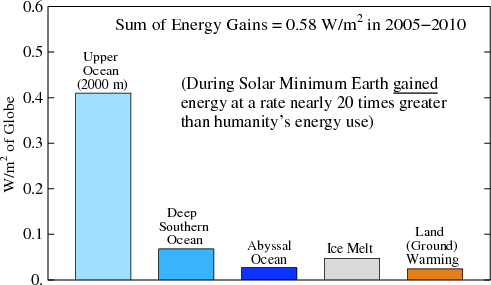
    Earth’s Energy Imbalance (2011)

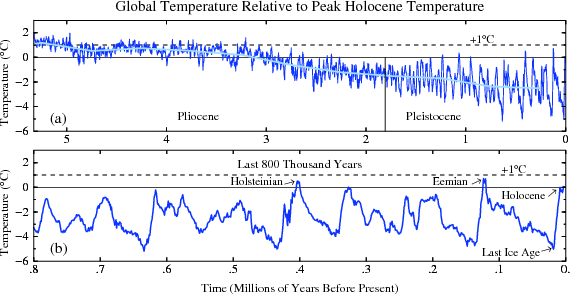
    Paleoclimate Implications (2012)

    Perceptions and Dice (2012)

    • “Perception of Climate Change” will be published in PNAS Plus online in the week of August 6.
    • Figures Only (last modified 2012/07/31)

    Case for Young People (2012?)

    • “Scientific Case for Avoiding Dangerous Climate Change to Protect Young People and Nature” submitted to Proc Nat Acad Sci USA in February 2012, and posted on arXiv on 2012/03/23.
    • Figures Only (last modified 2012/02/03)

    Climate Sensitivity (2012?)

    • “Climate Sensitivity Estimated from Earth’s Climate History” submitted to Phil. Trans. R. Soc. A in May, 2012.
    • Figures Only (last modified 2012/05/08)