|
|
7:03 AM (3 hours ago)
 |
|
||
|
|
||||
|
The atmosphere is to the earth as a layer of varnish is to a desktop globe. It is thin, fragile and essential for preserving the items on the surface.150 years of burning fossil fuel have overloaded the atmosphere to the point where the earth is ill. It now has a fever. Read the detailed article, Soothing Gaia’s Fever for an evocative account of that analogy. The items listed here detail progress on coordinating 6.5 billion people in the most critical project undertaken by humanity.Â
|
|
7:03 AM (3 hours ago)
|
|
||
|
|
||||
|
Text Size
Kathryn Hansen
Goddard Space Flight Center, Greenbelt, Md.
301-286-1046
kathryn.h.hansen@nasa.gov
Nicole Ruediger
University of Maryland, Baltimore County
410-455-5791
nruedige@umbc.edu
RELEASE : 12-262
Dust Dominates Foreign Aerosol Imports to North America
WASHINGTON — NASA and university scientists have made the first measurement-based estimate of the amount and composition of tiny airborne particles that arrive in the air over North America each year. With a 3-D view of the atmosphere now possible from satellites, the scientists calculated that dust, not pollution, is the main ingredient of these imports.
According to a new analysis of NASA satellite data, 64 million tons of dust, pollution and other particles that have potential climate and human health effects survive a trans-ocean journey to arrive over North America each year. This is nearly as much as the estimated 69 million tons of aerosols produced domestically from natural processes, transportation and industrial sources. The results were published Aug. 2 in the journal Science.
“This first-of-a-kind assessment is a crucial step toward better understanding how these tiny but abundant materials move around the planet and impact climate change and air quality,” says Hongbin Yu, lead author and an atmospheric scientist at the University of Maryland, College Park, and NASA’s Goddard Space Flight Center in Greenbelt, Md.
Observing these microscopic airborne particles and quantifying their global impact on warming or cooling Earth remains one of the most difficult challenges of climate science. Dust and pollution particles rise into the atmosphere and can travel for days across numerous national boundaries before settling to Earth.
Data from several research satellites with advanced observing technology developed and launched by NASA enabled the scientists to distinguish particle types and determine their heights in the atmosphere. They combined that information with wind speed data to estimate the amount of pollution and dust arriving over North America. The scientists used data from instruments on NASA’s Terra satellite and the Cloud-Aerosol Lidar and Infrared Pathfinder Satellite Observations (CALIPSO) satellite, a joint effort between NASA and the French space agency, Centre National d’Etudes Spatiales.
Yu and colleagues estimated that dust crossing the Pacific Ocean accounts for 88 percent, or 56 million tons, of the total particle import to North America every year. Dust movement is particularly active in spring, when the rise of cyclones and strong mid-latitude westerlies boost particle transport across the Pacific. Global aerosol transport models revealed Asia was a primary source of the dust reaching North America. Sixty percent to 70 percent comes from Asia and the remaining 30 percent to 40 percent comes from Africa and the Middle East.
Dust particles are fine pieces of minerals that primarily come from dry, desert-like regions. Winds lift these lightweight particles high into the atmosphere where they meet even faster-moving winds capable of transporting them around the planet. Pollution particles, in contrast, come from combustion sources such as wildfires or agricultural fires and fossil fuel burning for power and industry. These particles are emitted close to the ground, making them of prime interest to air quality researchers and managers. High-altitude dust particles are less a concern for human health, but their impact on climate can be significant.
One such impact on climate is a cooling effect, brought about by dust and some pollution particles that reflect sunlight back to space. The team calculated that the imported particles account for one third of the reduction in solar radiation, or solar dimming, over North America. “Globally this can mask some of the warming we expect from greenhouse gases,” says Lorraine Remer, an atmospheric scientist at University of Maryland, Baltimore County, and co-author on the study.
Climate change brought about by greenhouse gases could influence the relevance of dust in the future, according to Remer. “Desertification and reclamation, the land use modifications that change the exposure of dusty soils to wind erosion, are going to have a big impact on particle distribution and climate around the planet,” she says.
The study poses new questions about the magnitude of the particles’ indirect effects on local weather and climate. Dust and pollution could alter wind circulation, foster cloud growth and affect rainfall patterns. Soot and dust particles that land on snow, most likely in the western United States, could speed the melt of the snowpack and affect water supplies.
To see a video and images related to this study, visit:
http://www.nasa.gov/topics/earth/features/dust-imports.html
– end –
text-only version of this release
NASA press releases and other information are available automatically by sending a blank e-mail message to hqnews-subscribe@mediaservices.nasa.gov. To unsubscribe from this mailing list, send a blank e-mail message to hqnews-unsubscribe@mediaservices.nasa.gov.
Back to NASA Newsroom | Back to NASA Homepage
| FEATURED ON CHANNEL 7 NEWS THIS AFTERNOON/GRAPHIC PICTURES OF DAMAGE FROM SURGING TIDES THREATENING DWELLINGS. |
| www.griffith.edu.au/conference/ics2007/pdf/ICS102.pdf |
IPCC scientists tell Senate committee drought, wildfires and hurricanes are becoming normal because of climate change

Drought, wildfires, hurricanes and heatwaves are becoming normal in America because of climate change, Congress was told on Wednesday in the first hearing on climate science in more than two years.
In a predictably contentious hearing, the Senate’s environment and public works committee heard from a lead scientist for the UN’s climate body, the IPCC, on the growing evidence linking extreme weather and climate change.
“It is critical to understand that the link between climate change and the kinds of extremes that lead to disaster is clear,” Christopher Field, a lead author of the IPCC report and director of global ecology at the Carnegie Institute for Science, said in testimony.
“There is no doubt that climate has changed,” he went on. “There is also no doubt that a changing climate changes the risks of extremes, including extremes that can lead to disaster.”
He later told the committee that those climate-related disasters would have profound effects on industry and agriculture.
Field was the first IPCC scientist to appear before the committee since February 2009. It was a time when there was real optimism about prospects for action on climate change under the new Obama Administration.
By Wednesday, however, it was universally acknowledged there was no prospect of moving climate change legislation through Congress. There was also little chance the scientists’ presentations would persuade the most prominent Republican climate contrarian, Senator Jim Inhofe, who told the committee: “The global warming movement has completely collapsed.”
Senator Barbara Boxer, the California Democrat who chairs the committee, also noted she had deliberately avoid calling any administration officials or government scientists.
The Republican’s campaign against Obama’s green agenda, with their attacks on the Environmental Protection Agency and his clean energy loans, would make their presence a political distraction, she indicated.
But Boxer told reporters before the hearing she had faced growing pressure from the public to air the issue of climate change. The Republican-controlled House has turned down 15 requests from Democrats for a similar hearing.
Field, in his testimony, warned that the devastating extremes of the last year could soon become routine.
“The US experienced 14 billion-dollar disasters in 2011, a record that surpasses the previous maximum of 9,” he said. “The 2011 disasters included a blizzard, tornadoes, floods, severe weather, a hurricane, a tropical storm, drought and heatwaves, and wildfires. In 2012, we have already experienced horrifying wildfires, a powerful windstorm that hit Washington DC, heat waves in much of the country, and a massive drought.”
He went on to make a point of warning Texans that the future of farming and ranching could be put in jeopardy because of climate change.
The committee also heard from James McCarthy, a Harvard oceanographer and IPCC author, who warned that sea-level rise was occurring about three times faster than scientists believed even a decade ago.
The hearing quickly veered off course from reviewing the latest climate science to the intractable politics surrounding climate change in America.
In one of the liveliest exchanges, Bernie Sanders of Vermont continued his effort to take down Inhofe for his statements that climate change is a hoax and a conspiracy.
Sanders asked the scientists on the panel for their opinions on some of Inhofe’s more notorious assertions – that climate change is a hoax, that the planet is actually in a state of cooling, and that such environmental concerns were a conspiracy by the UN, Al Gore, and Hollywood.
The scientists did not support Inhofe’s claims.
Melting of icy surface opens up possibility of extracting rare earth metals and gemstones, but many fear it could destroy the Arctic

Europe is looking to open a new frontier in the ever more urgent quest for new natural resources – the pristine icy wastes of Greenland.
Oil and gas have been the focus of exploitation so far – but the EU sees just as much potential in a massive opening up of mining operations across the world’s biggest island, according to Antonio Tajani, the European commission’s vice-president and one of the most powerful politicians in the union. He called the move “raw material diplomacy”.
Latest satellite data reveal that 97% of the surface of the Greenland ice sheet underwent surface melting over four exceptionally warm days in July, indicating natural resources will become more available for extraction in the coming decades.
The potential gold rush is being welcomed by some in Greenland, but has raised fears of environmental damage, pollution and despoliation across the Arctic that could destroy one of the world’s last wildernesses.
Tajani said: “Greenland is hugely important in terms of natural resources, it has vast opportunities. We are currently working very hard with the prime minister of Greenland on this – we are working on our own agreement with Greenland on raw materials.”
He said: “This is raw material diplomacy. We have allies working on this worldwide.”
Greenland’s government is keen to exploit the island’s natural wealth in order to alleviate some of the serious poverty and social problems that blight the indigenous population.
Henrik Stendal, of the Greenland government’s mineral extraction department, told the Guardian: “The government would like to have another source of income – currently there is just fishing, and a little from tourism, so this is a big opportunity for us. These explorations can be done sensitively, we believe.”
Only one company is currently operating a productive mine in Greenland, producing gold. But at least five are in the advanced stages of setting up new mines, and more than 120 sites are being explored. Greenland is thought to contain vast mineral wealth, including rare earth metals, gemstones and iron ore.
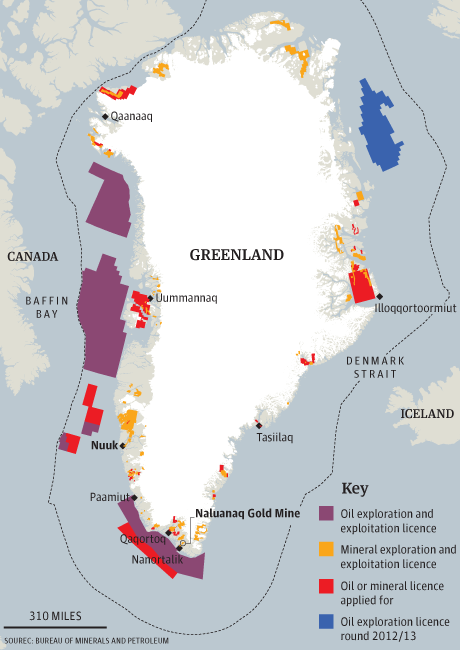
As competition from developing world pushes up price of energy, metals, minerals and other raw materials, finding new sources of supply is at a premium – putting densely populated Europe at a disadvantage, with little opportunity to expand its oil and gas supplies or mining operations.
But Greenland – with strong historical ties to the EU through Denmark, though the island now has home rule – represents a vast and largely untapped resource. Drilling for oil in Greenland’s waters is now at the exploratory stage, having been impractical until recent advances in deep sea drilling. Mining has also been all but impossible across most of the country, which is covered in a 150m thick sheet of ice except for a few coastal strips, but melting ice and new techniques are likely to bring more of the region’s potential mineral resources within reach in the coming years.
But Europe may face competition. China is already ahead; one of the most advanced metals mining projects in Greenland is nominally owned by London Mining, a UK company, but most of the finance and direction comes from China. Other countries are also eyeing the prize – although Greenland’s historical ties are mainly with Europe, it is geographically close to the US and Canada.
Tajani’s aggressive push into the Arctic puts him on a potential collision course with Greenpeace, the global environmental pressure group. Greenpeace recently opened up a new campaign focusing on the threats to the Arctic – one of the last places on earth where the industrial revolution and exploitation of natural resources have yet to penetrate. As part of the campaign they closed 74 UK Shell petrol stations in protest at the company’s moves to drill for oil in the Arctic.
Jon Burgwald, an Arctic expert at Greenpeace, said that mining operations can bring pollution and destruction: “There could be some very harsh environmental consequences.”
Mikkel Myrup, chair of the Greenlandic environmental campaigning group Akavaq, said that dealing with waste and “tailings” from the mines would be a key concern, as well as handling the toxic chemicals that are used in some forms of mining. “Mining does not have the same risks as oil drilling, but mining can be very hazardous to the environment. It’s a real worry, and we don’t think that the Greenlandic government has the capabilities to regulate this in the way that’s needed – they can’t stand up to these multinational companies. The public haven’t been given the full picture,” he said from his office in Nuuk, Greenland’s only town of any size, with 15,000 inhabitants.
Burgwald also warned of the potential social consequences. “What happens when you have [scores of] Chinese workers living next to a small town of indigenous people?”
Greenpeace has already succeeded in delaying attempts by Cairn Energy to establish oil and gas drilling operations in the Arctic seas. Activists have more such protests in their sights. Burgwald said that if there was damage or prospective damage from mines in Greenland, they too would attract similar actions. “We would certainly oppose it if it wasn’t being done right.”
He did not rule out mining in Greenland altogether, if done in a sustainable manner, but said that current plans were unclear and Greenland’s government would need substantial help in order to set up the right standards that would avoid the dangerous consequences. There was little sign of such help being forthcoming yet, he said.
Melting of icy surface opens up possibility of extracting rare earth metals and gemstones, but many fear it could destroy the Arctic
Europe is looking to open a new frontier in the ever more urgent quest for new natural resources – the pristine icy wastes of Greenland.
Oil and gas have been the focus of exploitation so far – but the EU sees just as much potential in a massive opening up of mining operations across the world’s biggest island, according to Antonio Tajani, the European commission’s vice-president and one of the most powerful politicians in the union. He called the move “raw material diplomacy”.
Latest satellite data reveal that 97% of the surface of the Greenland ice sheet underwent surface melting over four exceptionally warm days in July, indicating natural resources will become more available for extraction in the coming decades.
The potential gold rush is being welcomed by some in Greenland, but has raised fears of environmental damage, pollution and despoliation across the Arctic that could destroy one of the world’s last wildernesses.
Tajani said: “Greenland is hugely important in terms of natural resources, it has vast opportunities. We are currently working very hard with the prime minister of Greenland on this – we are working on our own agreement with Greenland on raw materials.”
He said: “This is raw material diplomacy. We have allies working on this worldwide.”
Greenland’s government is keen to exploit the island’s natural wealth in order to alleviate some of the serious poverty and social problems that blight the indigenous population.
Henrik Stendal, of the Greenland government’s mineral extraction department, told the Guardian: “The government would like to have another source of income – currently there is just fishing, and a little from tourism, so this is a big opportunity for us. These explorations can be done sensitively, we believe.”
Only one company is currently operating a productive mine in Greenland, producing gold. But at least five are in the advanced stages of setting up new mines, and more than 120 sites are being explored. Greenland is thought to contain vast mineral wealth, including rare earth metals, gemstones and iron ore.
As competition from developing world pushes up price of energy, metals, minerals and other raw materials, finding new sources of supply is at a premium – putting densely populated Europe at a disadvantage, with little opportunity to expand its oil and gas supplies or mining operations.
But Greenland – with strong historical ties to the EU through Denmark, though the island now has home rule – represents a vast and largely untapped resource. Drilling for oil in Greenland’s waters is now at the exploratory stage, having been impractical until recent advances in deep sea drilling. Mining has also been all but impossible across most of the country, which is covered in a 150m thick sheet of ice except for a few coastal strips, but melting ice and new techniques are likely to bring more of the region’s potential mineral resources within reach in the coming years.
But Europe may face competition. China is already ahead; one of the most advanced metals mining projects in Greenland is nominally owned by London Mining, a UK company, but most of the finance and direction comes from China. Other countries are also eyeing the prize – although Greenland’s historical ties are mainly with Europe, it is geographically close to the US and Canada.
Tajani’s aggressive push into the Arctic puts him on a potential collision course with Greenpeace, the global environmental pressure group. Greenpeace recently opened up a new campaign focusing on the threats to the Arctic – one of the last places on earth where the industrial revolution and exploitation of natural resources have yet to penetrate. As part of the campaign they closed 74 UK Shell petrol stations in protest at the company’s moves to drill for oil in the Arctic.
Jon Burgwald, an Arctic expert at Greenpeace, said that mining operations can bring pollution and destruction: “There could be some very harsh environmental consequences.”
Mikkel Myrup, chair of the Greenlandic environmental campaigning group Akavaq, said that dealing with waste and “tailings” from the mines would be a key concern, as well as handling the toxic chemicals that are used in some forms of mining. “Mining does not have the same risks as oil drilling, but mining can be very hazardous to the environment. It’s a real worry, and we don’t think that the Greenlandic government has the capabilities to regulate this in the way that’s needed – they can’t stand up to these multinational companies. The public haven’t been given the full picture,” he said from his office in Nuuk, Greenland’s only town of any size, with 15,000 inhabitants.
Burgwald also warned of the potential social consequences. “What happens when you have [scores of] Chinese workers living next to a small town of indigenous people?”
Greenpeace has already succeeded in delaying attempts by Cairn Energy to establish oil and gas drilling operations in the Arctic seas. Activists have more such protests in their sights. Burgwald said that if there was damage or prospective damage from mines in Greenland, they too would attract similar actions. “We would certainly oppose it if it wasn’t being done right.”
He did not rule out mining in Greenland altogether, if done in a sustainable manner, but said that current plans were unclear and Greenland’s government would need substantial help in order to set up the right standards that would avoid the dangerous consequences. There was little sign of such help being forthcoming yet, he said.




 Email
Email