Category: Climate chaos

The atmosphere is to the earth as a layer of varnish is to a desktop globe. It is thin, fragile and essential for preserving the items on the surface.150 years of burning fossil fuel have overloaded the atmosphere to the point where the earth is ill. It now has a fever. Read the detailed article, Soothing Gaia’s Fever for an evocative account of that analogy. The items listed here detail progress on coordinating 6.5 billion people in the most critical project undertaken by humanity. 

  • Environmental concerns increasing infectious disease in amphibians, other animals

    ScienceDaily: Earth Science News


    Environmental concerns increasing infectious disease in amphibians, other animals

    Posted: 18 Jul 2012 11:36 AM PDT

    Climate change, habitat destruction, pollution and invasive species are all involved in the global crisis of amphibian declines and extinctions, researchers suggest in a new analysis, but increasingly these forces are causing actual mortality in the form of infectious disease.

    X-rays illuminate the origin of volcanic hotspots

    Posted: 18 Jul 2012 10:17 AM PDT

    Scientists have recreated the conditions at Earth’s core-mantle boundary 2,900 km beneath the surface. Using X-rays at the European Synchrotron Radiation Facility, they probed tiny rock samples at extreme temperature and pressure showing for the first time that partially molten rock under these conditions is buoyant and should segregate towards the surface. This observation is strong evidence for the theory that volcanic hotspots like the Hawaiian Islands originate from mantle plumes generated at the core-mantle boundary.
    You are subscribed to email updates from ScienceDaily: Earth Science News
    To stop receiving these emails, you may unsubscribe now.
    Email delivery powered by Google
    Google Inc., 20 West Kinzie, Chicago IL USA 60610
  • Dumping iron at sea can bury carbon for centuries, study shows

    Dumping iron at sea can bury carbon for centuries, study shows

    Iron fertilisation creates algae blooms that later die off and sink, taking the absorbed carbon deep towards the ocean floor

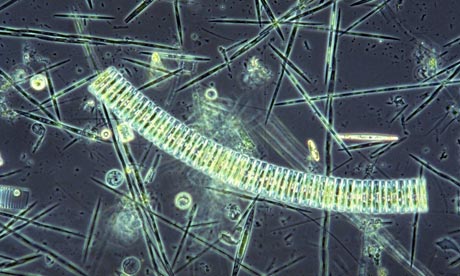
    Damian on Plankton  fertilisation with iron on the research vessel 'Polarstern' of the AWI

    A magnified view of the plankton three weeks after its fertilisation with iron. Photograph: Philipp Assmy/Awi/EPA

    Dumping iron into the sea can bury carbon dioxide for centuries, potentially helping reduce the impact of climate change, according to a major new study. The work shows for the first time that much of the algae that blooms when iron filings are added dies and falls into the deep ocean.

    Geoengineering – technologies aimed at alleviating global warming – are controversial, with critics warning of unintended environmental side effects or encouraging complacency in global deals to cut carbon emissions. But Prof Victor Smetacek, at the Alfred Wegener Institute for Polar and Marine Research in Germany, who led the new research, said: “The time has come to differentiate: some geoengineering techniques are more dangerous than others. Doing nothing is probably the worst option.”

    Dave Reay, senior lecturer in carbon management at the University of Edinburgh, said: “This represents a whole new ball game in terms of iron fertilisation as a geoengineering technique. Maybe deliberate enhancement of carbon storage in the oceans has more legs than we thought but, as the scientists themselves acknowledge, it’s still far too early to run with it.”

    A 2009 report from the Royal Society, the UK’s science academy, concluded that while cutting emissions is the first priority, careful research into geoengineering was required in case drastic measures – such as trying to block sunlight by pumping sulphate into the atmosphere – were one day needed.

    Prof John Shepherd, chair of the report, said on Wednesday: “It is important that we continue to research these technologies but governance of this research is vital to protect the oceans, wider environment and public interests.”

    Smetacek’s team added seven tonnes of iron sulphate to the ocean near Antarctica, where iron levels are extremely low. The addition of the missing nutrient prompted a massive bloom of phytoplankton to begin growing within a week. As the phytoplankton, mostly species of diatom, began to die after three weeks, they sank towards the ocean floor, taking the carbon they had incorporated with them.

    The scientists chose the experiment location carefully, within a 60km-wide self-enclosed eddy in the ocean that acted as a giant “test tube”. This meant that it was possible to compare what happened within the eddy with control points outside the eddy. After a month of monitoring nutrient and plankton levels from the surface to the depths the team concluded at least half of the bloom had fallen to depths below 1,000m and that a “substantial portion was likely to have reached the sea floor” at 3,800m.

    The scientists conclude in the journal Nature that the carbon is therefore likely to be kept out of the atmosphere for many centuries or longer.

    A dozen other experiments have shown that iron can prompt phytoplankton blooms, but this is the first study to show that the carbon the plants take up is deeply buried. Other researchers recognise the significance of this but warn of other issues that might prevent the iron fertilisation of the ocean as being a useful geoengineering technique.

    “The ocean’s capacity for carbon sequestration in low-iron regions is just a fraction of anthropogenic CO2 emissions, and such sequestration is not permanent — it lasts only for decades to centuries,” said Ken Buesseler, at the Woods Hole Oceanographic Institution in the US.

    Smetacek said ocean iron fertilisation could bury at most 1 gigatonne of CO2 per year compared to annual emissions of 8-9Gt, of which 4Gt accumulates in the atmosphere. But sequestering some CO2 could make the difference between crossing a climate “tipping” point, where feedback effects lead to runaway global warming, he said: “I don’t see what will stop Arctic sea ice from decreasing.”

    Michael Steinke, director of marine biology at the University of Essex, said: “Will this open up the gates to large-scale geoengineering using ocean fertilisation? Likely not, since the logistics of finding the right spot for such experiments are difficult and costly.”

    Smetacek responded that ocean iron fertilisation is much cheaper than other possible geoengineering techniques. He acknowledged more experiments were needed over longer periods to examine, for example, how many of the diatoms were eaten by krill, and then by whales, meaning they did not fall to the ocean floor.

    On the ethics of geoengineering, Smetacek, who is a vegetarian, told the Guardian: “We could reduce emissions significantly and increase the scope for sequestration on land [by freeing grazing land for forestry] if we managed to convert the global population to vegetarianism. Would that be geoengineering?”
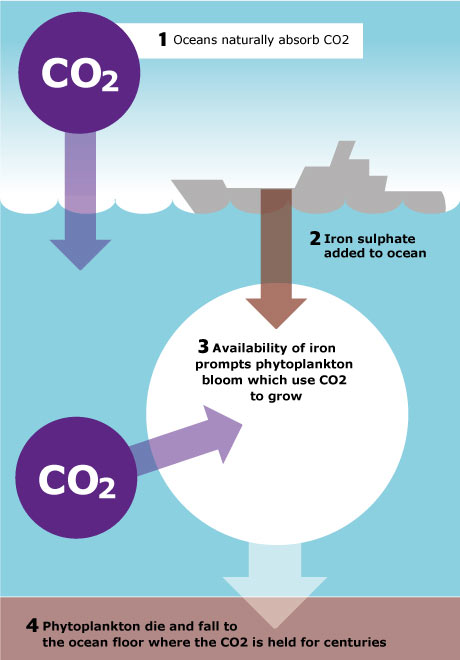
    Iron filings and carbon burial Iron filings and carbon burial Illustration: guardian.co.uk

  • Wildfire Map & Satellite Images | Wildfire Disaster Interactive Map View a continuously updated map of US wildfire locations, perimeters, fire potential areas, burn areas, precipitation, and social media.

    Wildfire Map & Satellite Images | Wildfire Disaster Interactive Map

    View a continuously updated map of US wildfire locations, perimeters, fire potential areas, burn areas, precipitation, and social media.

    www.esri.com/services/disaster-response/wildlandfire/latest-news-map.html
  • Focusing Science on the Damage of Fossil Fuel (NY TIMES)

    Alert Name: CLIMATE CHANGE NEWS
    July 16, 2012 Compiled: 12:52 AM

    By CHANDRAN NAIR (NYT)

    We’re masters at finding more fossil fuel. We should be masters at mitigating its damage.

    About This E-mail

    You received this e-mail because you signed up for NYTimes.com’s My Alerts tool. As a member of the TRUSTe privacy program, we are committed to protecting your privacy.

  • Wave of tornados cut swathe across Poland

    Wave of tornados cut swathe across Poland

    ABCUpdated July 16, 2012, 8:48 am


    A freak wave of tornadoes in Poland has left at least one person dead and another 10 injured.

    Local media said a national park was badly hit by one tornado that was between 800 and 1,000 metres wide.

    One resident described the moment a tornado struck his property, felling trees and bringing down power lines.

    “I was sleeping at the front of my house when a buzzing sound woke me up. I didn’t know what was happening. I looked out and saw a huge number of branches,” he said.

    “Then there was a terrifying rumble. It all lasted for four or five minutes. When it all ended I looked around and saw that my yard was covered in fallen trees that had been growing nearby.”

  • Japan floods force massive evacuation

    Japan floods force massive evacuation

    Island of Kyushu soaked by downpour for 3 days

    Posted: Jul 14, 2012 1:10 PM ET

    Last Updated: Jul 14, 2012 6:48 PM ET

    At least 20 have died in collapsed buildings or mudslides due to torrential rains in the  Fukuoka prefecture of southwestern Japane.At least 20 have died in collapsed buildings or mudslides due to torrential rains in the Fukuoka prefecture of southwestern Japane. (Kyodo/Reuters)
    Facebook
    28
    Twitter
    7
    Share
    35
    Email

    Heavy rains in Japan have triggered the evacuation of a southwestern region, affecting a quarter of a million people.

    At least 22 people have died in the deluge, which began three days ago, according to Japanese broadcaster NHK.

    Japan’s meterological agency is warning of torrential rains this weekend due to a warm mass from the south. In fact, more than 800 millimeters has fallen on a section of Kumamoto Prefecture since Wednesday.

    Evaucation orders have been issued for more than 250,000 people in the Japanese island of Kyushu, as rains pounded the region Saturday.

    Hiroaki Aoki, an official from Fukuoka prefecture, told AFP news agency there have been more than 181 landslides in Fukuoka prefecture, where shelters have been set up in schools and public buildings.

    Most of the fatalities so far have occurred around the city of Aso on the island, where 19 people have died in house collapses and landslides.

    The Japan Meteorological Agency said the city has been soaked with more than 75 centimetres of rain fall in 72 hours.

    Fukuoka prefecture, Japan  Google MapFukuoka prefecture, Japan Google Map