Category: Climate chaos

The atmosphere is to the earth as a layer of varnish is to a desktop globe. It is thin, fragile and essential for preserving the items on the surface.150 years of burning fossil fuel have overloaded the atmosphere to the point where the earth is ill. It now has a fever. Read the detailed article, Soothing Gaia’s Fever for an evocative account of that analogy. The items listed here detail progress on coordinating 6.5 billion people in the most critical project undertaken by humanity. 

  • Scientists warn US east coast over accelerated sea level rise

    Scientists warn US east coast over accelerated sea level rise

    Study says sea level is rising far faster than elsewhere, which could increase incidence of New York flooding

    Damian on sea levels rising on North East Cost of US : Hurricane Irene Crosses North Carolina Coast

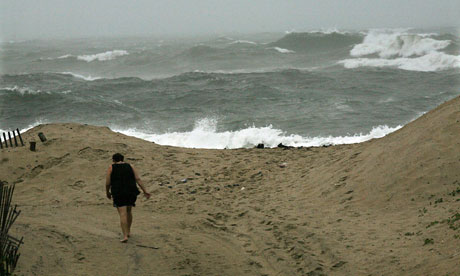
    A stormy Atlantic ocean hits the coast of Buxton, North Carolina. Photographer: Ted Richardson/Bloomberg via Getty Images

    Sea level rise is accelerating three to four times faster along the densely populated east coast of the US than other US coasts, scientists have discovered. The zone, dubbed a “hotspot” by the researchers, means the ocean from Boston to New York to North Carolina is set to experience a rise up a third greater than that seen globally.

    Asbury Sallenger, at the US geological survey at St Petersburg, Florida, who led the new study, said: “That makes storm surges that much higher and the reach of the waves that crash onto the coast that much higher. In terms of people and communities preparing for these things, there are extreme regional variations and we need to keep that in mind. We can’t view sea level rise as uniform, like filling up a bath tub. Some places will rise quicker than others and the whole urban corridor of north-east US is one of these places.”

    The hotspot had been predicted by computer modelling, but Sallenger said: “Our paper is the first to focus on using real data to show [the acceleration] is happening now and that we can detect it now.”

    The rapid acceleration, not seen before on the Pacific of Gulf coasts of the US, may be the result of the slowing of the vast currents flowing in the Altantic, said Sallenger. These currents are driven by cold dense water sinking in the Arctic, but the warming of the oceans and the flood of less dense freshwater into the Arctic from Greenland’s melting glaciers means the water sinks less quickly. That means a “slope” from the fastest-moving water in the mid-Atlantic down to the US east coast relaxes, pushing up sea level on the coast.

    “Coastal communities have less time to adapt if sea levels rise faster,” said Stefan Rahmstorf, at the Potsdam Institute Germany, who published a separate study in the same journal, Nature Climate Change, on Sunday. Rahmstorf’s team showed that even relatively mild climate change, limited to 2C, would cause global sea level to rise between 1.5 and 4 metres by the year 2300. If nations acted to cutting carbon emissions so the temperature rise was only 1.5C, the sea level rise would be halved, the researchers found.

    The impacts of the rising seas are potentially devastating, said the scientists. “As an example, 1 metre of sea level rise could raise the frequency of severe flooding for New York City from once per century to once every three years,” said Rahmstorf, adding that low lying countries like Bangladesh are likely to be severely affected. His colleague Michiel Schaeffer, at Wageningen University in the Netherlands, said: “Sea level rise is a hard to quantify, yet a critical risk of climate change. Due to the long time it takes for the world’s ice and water masses to react to global warming, our emissions today determine sea levels for centuries to come.”

    Sallenger’s work on the hotspot off the US east coast showed that the extreme acceleration in sea level rise could add 20-30% to the rise seen globally. “If this turns out to be a metre by 2100, it would add 20 to 30cm.” In May, North Carolina legislators drew ridicule from experts by proposing a law that would require estimates of sea level rise to be based solely on historical data and to rule out any acceleration in future rises.

    Rahmstorf said: “Sallenger’s paper shows that, far from being spared accelerating sea level rise, [the coast here] has been over the past decades a hotspot of accelerating sea level rise.” But he added that the cause of the hotspot was not fully understood, meaning it was uncertain whether the acceleration would continue.

    Sallenger said: “We came up with a very clear correlation between the acceleration of sea level rise and rising temperature in the hotspot area. That suggests to me that as long as temperature continues to rise the hotspot will continue to grow.”

  • Northern England flooded: Hundreds of US homes burn in wildfires

    MEANWHILE HUNDREDS OF HOMES HAVE BEEN DESTROYED BY WILDFIRES IN THE US.

    Northern England flooded

    Updated: 08:09, Sunday June 24, 2012

    About 140 flood warnings and alerts have been issued in northern England, parts of which have been hit by as much rain in one day as is normal in a month.

    In some areas, more than a month’s worth of rain fell in just 24 hours.

    The deluges battered revellers at the Isle of Wight Festival and brought havoc to Cumbria which buckled under the worst of the wet weather on Saturday.

    Up to 100mm of rain hit the region overnight, while southwest Scotland, Northern Ireland and Lancashire also experienced unusually heavy rainfall.

    The UK’s Environment Agency has issued around 140 flood warnings and alerts in northern regions which are also subject to severe weather warnings.

  • RIO ENDS WITH WARNING ON CORPORATE POWER

    Rio summit ends with warning on corporate power

    Environmental activists, one portraying Brazilian President Dilma Rousseff holding a banner symbolizing Those activists who had demanded action on fossil fuel subsidies will be disappointed

    Related Stories

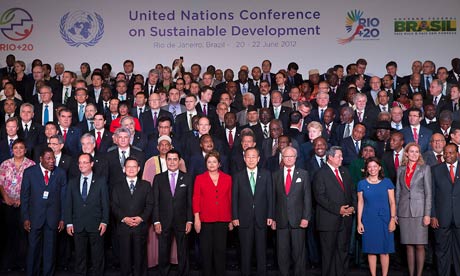
    The UN sustainable development summit in Brazil has ended with world leaders adopting a political declaration hammered out a few days previously.

    Environment and development charities say the Rio+20 agreement is too weak to tackle social and environmental crises.

    Gro Harlem Brundtland, author of a major UN sustainable development report 25 years ago, said corporate power was one reason for lack of progress.

    Nations will spend three years drawing up sustainable development goals.

    They will also work towards better protection for marine life on the high seas.

    But moves to eliminate subsidies on fossil fuels – recommended in a number of authoritative reports as likely to boost economies and curb CO2 emissions – came to naught.

    Plans to enshrine the right of poor people to have clean water, adequate food and modern forms of energy also foundered or were seriously weakened during the six days of preparatory talks.

    And many governments were bitter that text enshrining women’s reproductive rights was removed from the declaration over opposition from the Vatican backed by Russia and nations from the Middle East and Latin America.

    ‘No leadership’

    The UN had billed the summit as a “once in a generation chance” to turn the global economy onto a sustainable track.

    “It absolutely did not do that,” said Barbara Stocking, chief executive of Oxfam GB.

    People gathering water at a man-made water hole, in South Sudan's Upper Nile state The rights of poor people to have access to clean water were not enshrined as hoped

    “We had the leaders of the world here, but they really did not take decisions that will take us forward,” she told the BBC.

    “It was a real lack of action that is very worrying, because we know how difficult the situation is in much of the world in terms of environment and poverty, and they did not show the leadership we needed them to bring.”

    The president of the most impoverished country in the western hemisphere, Haiti’s President Michel Martelly, said the summit could have delivered more.

    “I feel like these poor countries, these countries that are always being hit by catastrophe – things have not changed much,” he told the BBC.

    “So on this summit I will say that much more effort needs to be done so we can correctly and precisely come out with resolutions that will have an impact on the lives of people being affected.”

    Cash concern

    Developing countries had argued that they needed financial assistance in order to meet the costs of switching onto a green development path.

    But with the US in an election year and the EU deep in eurozone mire, any mention of specific sums was blocked.

    As a consequence, developing countries refused to let the declaration endorse green economics as the definitive sustainable development path.

    Prof Jeffrey Sachs, the Columbia University economist and special adviser to UN Secretary-General Ban Ki-moon, said support was needed.

    “Those of us who look at this day in, day out know that many poor countries need that kind of help,” he said.

    A man rides his bicycle past the cooling tower and chimneys from a coal-burning power station in Beijing Developing countries had said they needed financial help to adopt greener forms of development

    “And it does not do any good to cite large ambitious promises many years out, and then behind the scenes to say ‘we’re not going to talk about how they’re going to be fulfilled.”

    But Lisa Jackson, Administrator of the US Environmental Protection Agency (EPA) and deputy head of the US delegation here, said the US was fully behind the “green economy” – and that the summit could help deliver the vision.

    “The negotiated document, which is really the first time we have a multilateral document that talks about the green economy that has broad-based support – that is a big push,” she said.

    “But probably more important are the connections that are being made between businesses large and small, civil society, academia and of course governments at the national and sub-national level – all those things are pushing the green economy forwards.”

    Norwegian would

    Start Quote

    People who have economic power influence political decision-makers – that’s a fact”

    Gro Harlem Brundtland Fromer head of World Commission on Environment

    The need to put the world on a sustainable track, and the perils of not doing so, were outlined most influentially in a 1987 commission chaired by Gro Harlem Brundtland, then Prime Minister of Norway.

    Speaking to BBC News in Rio, she reflected on the lack of real progress since then.

    “Obviously when you look back 25 years now, less than one would have expected has happened – that’s clear – but you can’t think you can turn the world round in 25 years,” she said.

    She said there were “complex reasons” why governments had been unable to take the vision further – including the power of corporations.

    “I think [the allegation] is justified – it’s not the whole truth but it certainly is a big part of it,” she said.

    “In our political system, corporations, businesses and people who have economic power influence political decision-makers – that’s a fact, and so it’s part of the analysis.”

    The next key date on the sustainable development journey is 2015.

    The sustainable development goals should be decided and declared by then; also, the UN climate convention will have what some, with trepidation, are calling its “next Copenhagen” – the summit that should in theory usher in a new global agreement with some legal force to tackle global warming.

    Follow Richard on Twitter

    More on This Story

    Related Stories

    The BBC is not responsible for the content of external Internet sites

  • Rio+20 draft text is 283 paragraphs of fluff (MONBIOT)

    Rio+20 draft text is 283 paragraphs of fluff (MONBIOT)

    World leaders have spent 20 years bracing themselves to express ‘deep concern’ about the world’s environmental crises, but not to do anything about them

    Rio+20 : People protest against the current economic system

    If ‘sustainability’ means anything, it is surely the opposite of ‘sustained growth’. Photograph: Ueslei Marcelino/Reuters

    In 1992, world leaders signed up to something called “sustainability”. Few of them were clear about what it meant; I suspect that many of them had no idea. Perhaps as a result, it did not take long for this concept to mutate into something subtly different: “sustainable development“. Then it made a short jump to another term: “sustainable growth”. And now, in the 2012 Rio+20 text that world leaders are about to adopt, it has subtly mutated once more: into “sustained growth”.

    This term crops up 16 times in the document, where it is used interchangeably with sustainability and sustainable development. But if sustainability means anything, it is surely the opposite of sustained growth. Sustained growth on a finite planet is the essence of unsustainability.

    As political economist Robert Skidelsky, who comes at this issue from a different angle, observes in the Guardian today:

    “Aristotle knew of insatiability only as a personal vice; he had no inkling of the collective, politically orchestrated insatiability that we call economic growth. The civilization of “always more” would have struck him as moral and political madness. And, beyond a certain point, it is also economic madness. This is not just or mainly because we will soon enough run up against the natural limits to growth. It is because we cannot go on for much longer economising on labour faster than we can find new uses for it.”

    Several of the more outrageous deletions proposed by the United States – such as any mention of rights or equity or of common but differentiated responsibilities – have been rebuffed. In other respects the Obama government’s purge has succeeded, striking out such concepts as “unsustainable consumption and production patterns” and the proposed decoupling of economic growth from the use of natural resources.

    At least the states due to sign this document haven’t ripped up the declarations from the last Earth summit, 20 years ago. But in terms of progress since then, that’s as far as it goes. Reaffirming the Rio 1992 commitments is perhaps the most radical principle in the entire declaration.

    As a result, the draft document, which seems set to become the final document, takes us precisely nowhere: 190 governments have spent 20 years bracing themselves to “acknowledge”, “recognise” and express “deep concern” about the world’s environmental crises, but not to do anything about them.

    This paragraph from the declaration sums up the problem for me:

    “We recognise that the planet Earth and its ecosystems are our home and that Mother Earth is a common expression in a number of countries and regions and we note that some countries recognise the rights of nature in the context of the promotion of sustainable development. We are convinced that in order to achieve a just balance among the economic, social and environment needs of present and future generations, it is necessary to promote harmony with nature.”

    It sounds lovely, doesn’t it? It could be illustrated with rainbows and psychedelic unicorns and stuck on the door of your toilet. But without any proposed means of implementation, it might just as well be deployed for a different function in the same room.

    The declaration is remarkable for its absence of figures, dates and targets. It is as stuffed with meaningless platitudes as an advertisement for payday loans, but without the necessary menace. There is nothing to work with here, no programme, no sense of urgency or call for concrete action beyond the inadequate measures already agreed in previous flaccid declarations. Its tone and contents would be better suited to a retirement homily than a response to a complex of escalating global crises.

    The draft and probably final declaration is 283 paragraphs of fluff. It suggests that the 190 governments due to approve it have, in effect, given up on multilateralism, given up on the world and given up on us. So what do we do now? That is the topic I intend to address in my column next week.

    monbiot.com

  • Rio+20 politicians deliver ‘new definition of hypocrisy’ claim NGOs

    Rio+20 politicians deliver ‘new definition of hypocrisy’ claim NGOs

    Greenpeace, WWF and Oxfam criticise world leaders for shirking responsibilities and say civil society must act in their place

    Rio+20

    Heads of state at Rio+20 have been criticised for showing a lack of courage on sustainable development. Photograph: Buda Mendes/STF/LatinContent/Getty Images

    World leaders at the Rio+20 Earth summit in Brazil delivered a “new definition of hypocrisy” for standing in the way of progress and failing so far to challenge the text of the draft outcome document, NGO leaders said on Thursday.

    Daniel Mittler, political director of Greenpeace, said: “The epic failure of Rio+20 was a reminder [that] short-term corporate profit rules over the interests of people.” He said the outcome of the conference was “nothing short of disastrous”, as governments came offering no money or commitments to action.

    “They say they can’t put money on the table because of the economic crisis, but they spend money on greedy banks and on saving those who caused the crisis. They spend $1 trillion a year on subsidies for fossil fuels and then tell us they don’t have any money to give to sustainable development.”

    Lasse Gustavsson, executive director for conservation at WWF, said two years of “sophisticated UN diplomacy has given us nothing more than more poverty, more conflict and more environmental destruction”. He said WWF had participated in numerous preparatory committee meetings in the runup to Rio, but there was very little to show from its efforts.

    Sharan Burrow, general secretary at the International Trade Union Confederation, who flew to Rio on Wednesday after attending the G20 meeting in Mexico, criticised leaders for their lack of courage in not challenging the document text, written by a team of negotiators, and for doing nothing to adopt a new model of development.

    She told the meeting that people should show politicians how they felt by not voting for them if they did not take decisive action. “The world we want will not be delivered by world leaders, who lack courage to come here and sit at the table to negotiate,” said Burrow. “They take no responsibility. The reality is we are living beyond our planetary means.”

    A recent poll of 175 million members of the trade union movement around the world found that the majority were disillusioned and had no hope that the next generation would fare better, she said. Leaders, she said, needed to seriously invest in green job creation.

    But although politicians have failed to impress at Rio, the NGOs agreed the conference provided an opportunity to mobilise people to act.

    Gustavsson said the 3,000 side events had shown the commitment and “strong leadership” of civil society groups, city mayors and the private sector. “Sustainable development will have to happen without the blessing of world leaders. Governments will need to play catch-up,” he said.

    Barbara Stocking, chief executive of Oxfam GB, said it was time to “pick up and move on. Civil society has to take action. They must do what they do.” She added that a meeting in Rome on Friday among four European leaders could put in motion a financial transaction tax (FTT), which could generate millions that could support efforts to alleviate poverty.

    The tax is opposed by the UK prime minister David Cameron, but has found support, at least in theory, among other European leaders. Friday’s talk will primarily be about the Eurozone crisis, but the FTT will also be under discussion. “The key thing will be to get an agreement and get this under way,” Stocking said. The money made on the tax should be spent on climate change adaption and development, she added.

    Peter Lehner, executive director of the National Resources Defence Council, said his organisation had launched a website, cloud of commitments, that would track the promises made by countries and the private sector at Rio

    He said it was “critical that we don’t equate Rio with a document. It’s not what it should be about. We don’t save the world with a document.” He added that Rio+20 could be a catalyst for action: “People are armed for real action. The document could do a lot more but the important thing is to see Rio as a catalyst for people around the world. Now it’s our turn to take the energy of people and convert that into action.”

  • Rio+20 protesters perform ‘ritual rip-up’ of negotiated text

    Rio+20 protesters perform ‘ritual rip-up’ of negotiated text

    Anger rises at Rio Earth summit, as raucous demo focuses on Future We Want text that ‘moves us forward by inches’

    Activist protest at the conference center against the weakness of the UN Rio+20 agreement

    Activists protest at the Rio+20 conference centre against the weakness of the agreement. Photograph: Alex Farrow

    Protest erupted in the Rio+20 conference centre on Thursday as civil rights groups carried out a “ritual rip-up” of a negotiating text that they condemn as a betrayal of future generations.

    Climate campaigner and founder of 350.org Bill McKibben joined youth delegates, indigenous groups and environmental NGOs in the raucous demonstration, which included speeches and songs in the walkway outside the plenary pavilion.

    “We were promised leaps and bounds but this agreement barely moves us forward by inches,” shouted Cam Fenton, a Canadian in the Major Group of Children and Youth, as protesters ripped up a giant mock text that they called “The Future We Bought”.

    “World leaders have delivered something that fails to move the world forward from the first Rio summit, showing up with empty promises at Rio+20,” said Miariana Calderon, a young woman from California. “This text is a polluters’ plan, and unless people start listening to the people, history will remember it as a failure for the people and the planet.”

    A short distance away, the Earth summit was underway, but negotiations on the outcome text – the Future We Want – were finished before the arrival on Wednesday of more than 150 world leaders and ministers.

    Despite widespread disappointment at the weak content, the visiting leaders – Chinese premier Wen Jiabao, US secretary of state Hillary Clinton, UK deputy prime minister Nick Clegg and other national representatives – have largely been given a ceremonial role in the talks.

    Eleven-year-old Ta’Kaiya Blaney of the Sliammon nation, an indigenous group from British Columbia, sang to the gathering and appealed for action. “What are we going to leave for future generations. There’ll be no environment left without change. It needs to come not tomorrow, but today.”

    “This kind of action is important. If change is to come it won’t be inside the conference halls, it will be made here outside. These meetings just ratify weakness of what we have done,” said McKibben. “The script doesn’t seem to advance anything. The real news today is that sea ice in the Arctic is at a record low for the date and that every state in the United States, except for North Dakota, has temperatures above 90 degrees.”

    Security were said to have declared the protest “an unsanctioned action”, which meant that participants risked losing their venue passes. “What use is this anyway,” said one speaker.

    The police presence was much higher outside the conference venue than in previous days. Ranks of riot police lined up outside the main entrance, armed troops patrolled in dinghies on the nearby lake and navy frigates cruised alongside the ocean highway that delegates take from hotels to the RioCentro conference venue.