Category: Climate chaos

The atmosphere is to the earth as a layer of varnish is to a desktop globe. It is thin, fragile and essential for preserving the items on the surface.150 years of burning fossil fuel have overloaded the atmosphere to the point where the earth is ill. It now has a fever. Read the detailed article, Soothing Gaia’s Fever for an evocative account of that analogy. The items listed here detail progress on coordinating 6.5 billion people in the most critical project undertaken by humanity. 

  • Rio+20 summit must move world beyond ‘grow now, clean up later’

    Rio+20 summit must move world beyond ‘grow now, clean up later’

    The Earth summit has to ensure sustainability is at the heart of growth models – the swelling global population depends on it

    Fossil fuel at rio+20 Hedegaard on Rio

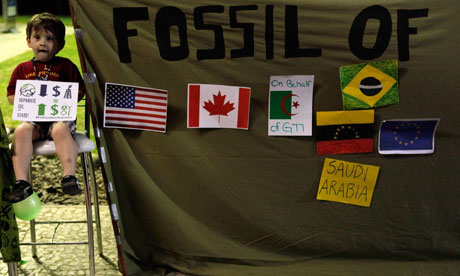
    A son of an environmentalist holds a sign at the entrance of the Rio+20 Earth summit. Photograph: Nacho Doce/Reuters

    Growth in itself is neither our enemy nor our problem. But what kind of economic growth do we need? And do we want growth at any cost?

    A child born today is one of seven billion people on Earth, and during its lifetime will see the world’s population grow by another 3 billion.

    At the same time, more people enter the global middle class. That is good news. But more people and a bigger middle class will inevitably put further strain on the planet’s capacity to meet our needs. By the time the child born today turns 18 in 2030, the world, will need at least 50% more food, 45% more energy and 30% more water, according to the UN. How are we going to cope with that?

    These numbers show that, as world leaders join the Rio+20 summit tomorrow, continuing with business as usual is clearly not an option. It would be wrong to believe it is the cheap option. It is not. On the contrary, it would be very costly in economic, environmental and human terms.

    For instance the Inter-American Development Bank (IDB) reported earlier this month that damage from climate change could cost Latin American and Caribbean countries $100bn per year by 2050. Not a small figure. This is one example of why we need a more sustainable growth model that captures the value of a country’s natural wealth, of a clean environment, of social cohesion.

    The traditional way of measuring economic growth based on GDP alone is not sufficient. GDP is nothing more than a measure of production. It takes no account of human wellbeing or natural wealth.

    For example, GDP gives no value to a forest until it is chopped down and turned into timber. Likewise, natural disasters that kill people and destroy infrastructure and cultural heritage are positive for GDP because the reconstruction works that follow boost economic activity.

    Putting a price on environmental pollution is also crucial to building a sustainable model for global growth. The cost of production cannot be the only factor determining the price of a product. The true cost of its environmental impact also needs to be factored into the price if people are to have an incentive to buy the least harmful and resource-intensive products available.

    That is why the Global Sustainability Panel report recommends that, by 2020, all governments establish price signals that value sustainability. This would help guide the consumption and investment decisions of households, businesses and the public sector in a more sustainable direction.

    The “grow now, clean up later” mantra is no longer viable. Polluters must be made to pay now instead of sending an unpayable bill to future generations. But we must do this in a smart way. Putting a price on carbon emissions is one of the ways to raise additional money for investments in sustainable development, especially in developing countries.

    The EU is already moving in this direction. We have a price on carbon, binding targets for reducing carbon emissions and increasing renewable energy, and an array of energy efficiency measures. And we are looking at smarter ways to use the tax system so that in future we tax less what people earn and more what they burn in terms of fossil fuels.

    But developed countries cannot tackle environmental challenges alone. The reality is that today emerging economies account for the biggest growth, not least in energy consumption and emissions. We are at a point where all countries have to act, in line with their respective capabilities and responsibilities.

    As for state subsidies for fossil fuels, they have no place in today’s world. They must be phased out as the G20 has pledged. In 2011, fossil-fuel worldwide received about six times more government subsidies than were given to the renewable energy industry, according the International Energy Agency (IEA).

    With the current economic and climate crisis, how smart is it that governments worldwide spend $400bn a year of taxpayers’ money subsidising dirty fuels that exacerbate climate change and air pollution? We would do better to spend this money on improving energy efficiency and promoting clean and affordable energy for all.

    Last year, global greenhouse gas emissions reached their highest ever level. This underlines once again the need for urgent action on a truly global scale.

    We must use the Rio+20 summit to kick off the global transition to a sustainable growth model for the 21st century. Inclusive, greener growth needs to be at the heart of the global economic agenda from now on if a growing world population is to enjoy prosperity, without exhausting the planet’s finite resources for future generations.

    Rio cannot afford not to have concrete results. Rio must get it right.

    • Connie Hedegaard is the EU Commissioner for Climate Action

  • Furious Greenpeace moves to ‘war footing’ at Rio+20

    Furious Greenpeace moves to ‘war footing’ at Rio+20

    Pace quickens at Rio summit, as NGO director responds to weakened oceans proposals with promise of civil disobedience

    Kumi Naidoo, executive director of Greenpeace

    Kumi Naidoo, executive director of Greenpeace, cited the battle against apartheid and slavery in an impassioned response to the Rio draft text. Photograph: Paul O’Driscoll

    The head of Greenpeace International said the NGO is moving to a “war footing” after negotiators at the Rio+20 sustainable development conference watered down proposals to protect the world’s oceans.

    Kumi Naidoo, Greenpeace International’s executive director, said there were so many fudges in the draft agreement that Greenpeace now had no other option but to change its strategy and start planning waves of civil disobedience.

    “We have to ask ourselves what history teaches us in terms of how change happens when humanity has faced a big challenge, such as civil rights, apartheid or slavery,” he told the Guardian.

    “It is only when decent men and women said enough is enough and no more and were prepared to put their lives on the line and go to prison if necessary, and that is where we are. We have to intensify civil disobedience.

    “I keep thinking of what Mandela said decades ago, which is, this struggle is one that I am prepared to live for and if needs be to die for and that is what the leadership challenge is for us.”

    When asked if he was prepared to die for the cause, he responded: “Yes. I feel a very deep sense of that.”

    South-African Naidoo, who was an anti-apartheid activist from the age of 15 and fled to England to escape a 15-year prison sentence, also warned that Greenpeace is willing to break an injunction served by Shell on every one of its country offices not to interfere with its oil development in the Arctic.

    “We have been warned there will be severe penalties but I now serve notice on Shell that we are at the point where, if needs be, we will break the injunctions and pay the price of that.”

    While there is still a small chance that the heads of state who start arriving in Rio today and tomorrow may beef up the negotiating text, Naidoo said this was more like wishful thinking.

    “If we do not get an outcome of substance then I think what we will see is a further acceleration towards disaster and for those of us who are concerned, my main message is that we have to put this struggle on a war footing,” he said. “As a Greenpeace person, I do not like to use the word war but I use it quite advisedly. To be brutally honest, Greenpeace and other organisations are winning some of the battles but we are losing the war.”

    Naidoo said the negotiations were failing because of national parochialism, with delegates making calls back to their capitals every time there was any suggestion of a change in text.

    He contrasted this with the Peoples’ Summit at Rio, where there was a common approach to the need to deal with the major social, environmental and economic challenges.

    Naidoo said the final straw for him was hearing at 2am this morning that the text on the oceans had been blocked by Russia, America, Canada and Venezuela.

    “What kept Greenpeace in the process was that it looked like we could get a decent deal on the oceans but we have now got a really watered-down text that has very little teeth,” said Naidoo.

    “The irony is that the Venezuelan delegate shouted at 2am that they were not going to negotiate with Greenpeace because we had warned that we will publicly say that it is Venezuela and the US working together to block this. That, of course, would play out so badly for the political leadership to be put in the same camp as the US.”

    It is not just the oceans where the text has been changed, said Naidoo, pointing out that the negotiating document was now riddled with fudges and proposals that would not hold countries to account.

    “The approach that has been taken is to go for the lowest common denominator,” he said. “The trick here is to look very carefully at the UN-ese language being used. If they use the word voluntary, it means it is not going to happen. They use phrases like seek to, and there was a line in the text this morning supporting the right of workers to education. What does that mean in terms of ambition?”

    He pointed out that the eradication of fossil fuel subsidies is now out of the text, and plans to beef up the role of the UN environment agency UNEP are also at risk.

    Naidoo also warned that political leaders would seek to put a gloss on the lack of ambition in the final text: “I think what will happen, which is completely meaningless, is there will be a political leaders’ declaration, which will be about two to three pages, which will sound as though they have moved things forward but in reality there will be no specifics, no action plans, unless of course the heads of state come with a different sense of urgency.

  • Thousands flee as typhoon heads for Tokyo

    This may cause further damage to Fukushima Nuclear Plants.

    Thousands flee as typhoon heads for Tokyo

    Posted June 20, 2012 09:45:53

    Loading…

    Map DataMap data ©2012 Google, Tele AtlasTerms of Use
    Map Data
    Map data ©2012 Google, Tele Atlas
    Map data ©2012 Google, Tele Atlas
    Map
    Map
    Satellite

    Map: Japan

    A powerful typhoon has forced the evacuation of thousands of people in Japan, and the cancellation of hundreds of flights.

    Typhoon Guchol is expected to soak Tokyo with up to 300 millimetres of rain.

    With winds of up to 180 kilometres per hour, it was lashing its way across Japan’s main island of Honshu overnight.

    More than 10,000 people in the tsunami-hit city of Ishinomaki were advised to evacuate, with the typhoon and a high tide forecast to inundate parts of the coastal community.

    More than 400 flights have been cancelled and some bullet train services disrupted.

    With many centres soaked by hundreds of millimetres of rain, there are also fears of landslides in some areas.

    Topics:storm-disaster, storm-event, japan

  • Rare earth stockpile radiation levels questioned

    Rare earth stockpile radiation levels questioned

    ABCJune 20, 2012, 9:37 am
    The rare earth is mined in Australia and exported.

    ABC © Enlarge photo

    An MP is calling on the State Government to make radiation monitoring results public after revelations the Lynas Corporation has been stockpiling rare earth concentrate in Bibra Lake.

    The Member for Fremantle, Adele Carles, says the Government is yet to confirm whether monitoring is being conducted.

    The Environment Minister Bill Marmion has confirmed the containers have been held at Lynas’ holding yard since March.

    They are not due to be shipped from Fremantle Port until the second half of the year but Mr Marmion says radioactive levels were low.

    Ms Carles says the Government is basically saying the material is perfectly safe.

    “I say to them, well, if it’s so safe, then release to us the radiation monitoring so that we can see that for ourselves,” she said.

    Ms Carles says monitoring is required under a Radiation Management Plan.

    “That requires that if this material is stored anywhere for more than 24 hours, there must be radiation monitoring,” she said.

    “I’ve asked to get copies of this monitoring and the Minister has basically denied that information.”

    ABCJune 20, 2012, 9:37 am
    The rare earth is mined in Australia and exported.

    ABC © Enlarge photo

    An MP is calling on the State Government to make radiation monitoring results public after revelations the Lynas Corporation has been stockpiling rare earth concentrate in Bibra Lake.

    The Member for Fremantle, Adele Carles, says the Government is yet to confirm whether monitoring is being conducted.

    The Environment Minister Bill Marmion has confirmed the containers have been held at Lynas’ holding yard since March.

    They are not due to be shipped from Fremantle Port until the second half of the year but Mr Marmion says radioactive levels were low.

    Ms Carles says the Government is basically saying the material is perfectly safe.

    “I say to them, well, if it’s so safe, then release to us the radiation monitoring so that we can see that for ourselves,” she said.

    Ms Carles says monitoring is required under a Radiation Management Plan.

    “That requires that if this material is stored anywhere for more than 24 hours, there must be radiation monitoring,” she said.

    “I’ve asked to get copies of this monitoring and the Minister has basically denied that information.”

  • Earthquake rocks Victoria

    Earthquake rocks Victoria

    14

    A MAGNITUDE 5.5 earthquake has rocked the south-east coast of Australia.

    Seismologists recorded the massive murmur – almost 10km deep – at 8.53pm.

    The mammoth quake spread itself statewide, reaching as far as 10km across south-west of Moe, 18km west of Morwell, 30km off Traralgon and 78km south-west of Sale.

    The tremor, which last about 20 seconds, has been felt from Kilmore, Gippsland, Mitcham, Coburg, Kensington, St Albans, Mornington Peninsula, Drouin, Rowville and inner-Melbourne.

    The tremors have been felt by millions of people.

    It is not yet known if the tremor has caused any damage.

    A spokeswoman for Geoscience Australia said its recordings showed it was a magnitude 5.5 earthquake, which was more accurate than international seismologist estimates.

    The epicentre has been identified 16km south-west of Moe, at the Latrobe Valley in Victoria’s east.

    “Our preliminary information is that it’s a 5.5,” she said.

    “We haven’t had any reports of local damage yet.”

    People who have experienced damage from the quake are urged to contact the SES.

    Bureau of Meteorology forecaster Richard Carlyon said details of the earthquake were not yet known as the website for Geoscience Australia – which monitors, analyses and reports on earthquakes within Australia and internationally, was in meltdown.

    “We’ve had reports of the tremor from Broadford all the way up to Myrtleford in north-east Victoria,” he said.


  • Ban Ki-moon: the momentum for change at Rio+20 is irreversible

    Ban Ki-moon: the momentum for change at Rio+20 is irreversible

    There may be disagreement between nations going into the Rio Earth summit, but much has been achieved already

    MDG : Rio+20 : flags of participating countries

    Some of the flags of participating countries in this week’s Rio+2- Earth summit. Photograph: Antonio Lacerda/EPA

    This week, world leaders gather for a momentous occasion – the United Nations Conference on Sustainable Development in Rio de Janeiro. Will it be a success? In my opinion, yes. To be sure, the negotiations have been lengthy. Even now there is more disagreement than agreement on the details of the so-called “outcome document” that will emerge. Yet that will not be the defining measure. Far more important is what the Rio conference has already accomplished. And that is to build a global movement for change.

    Rio+20 is a milestone on a long road. The famous 1992 Earth summit put sustainable development on the global agenda. Today, we have come to a broader and more nuanced understanding of this age-old imperative: how to better balance the development needs of a growing world population – so all may enjoy the fruits of prosperity and robust economic growth – with the necessity of conserving our planet’s most precious resources: land, air and water.

    At Rio, more than 100 heads of state and government will join an estimated 25,000 participants to map our way ahead. For too long we have sought to burn and consume our way to prosperity. That model is dead. At Rio, we must begin to create a new one – a model for a 21st century economy that rejects the myth that there must be a zero-sum trade-off between growth and the environment. Increasingly, we understand that, with smart public policies, governments can grow their economies, alleviate poverty, create decent jobs and accelerate social progress in a way that respects the earth’s finite natural resources.

    In this larger sense, I believe that momentum for change is already irreversible. The evidence is all around, hiding in plain sight in countries large and small, rich and poor. Barbados, Cambodia, Indonesia, the Republic of Korea and South Africa, among many others, are already adopting “green growth” strategies that use limited natural resources more efficiently, create jobs and promote low-carbon development. Armenia, Azerbaijan, Egypt, Kenya, Jordan, Malaysia, Mexico, Nepal, Senegal and Ukraine are applying new green-growth technologies in a variety of industries, from agriculture to tourism. China has committed to supply 16% of its energy needs from renewable sources by 2020 and plans to invest more than $450bn in waste recycling and clean technologies under its current five-year plan.

    In Brazil, waste management and recycling employs more than 500,000 people, most of whom live on society’s margins. Under its new National Rural Employment Guarantee Act, India has begun paying people to better manage natural resources, such as forests and fresh water. Wherever you look, national and local authorities are adopting principles and practices that, taken together, could help move us from a prospect of environmental ruin and growing social inequality toward a new era of inclusive and balanced sustainable growth.

    Governments and nation-states are not alone in driving this transformation. At Rio, more than 1,000 corporate leaders from all continents will deliver a common message: business as usual no longer works. Many are members of the United Nations Global Compact – volunteers in a growing private-sector movement that understands that 21st century corporate responsibility means corporate sustainability. Thus Nike has initiated a new programme called Mata no Peito – a Portuguese colloquialism for “taking on a challenge” by helping protect Brazilian forest ecosystems. Unilever has pledged to source all its raw materials from sustainable sources by 2020. Kenya’s mobile network provider Safaricom has integrated gender equality into its internal policies to create a mother-friendly environment.

    Meanwhile, Microsoft has announced it will soon go carbon-neutral. China’s Broad Group produces non-electric air conditioning units that are 200% more energy efficient; it is now diversifying into other energy-saving products and sustainable buildings. ToughStuff from Mauritius seeks to bring affordable and reliable solar energy to 33 million people in Africa by 2016, and the Abu Dhabi Future Energy Company is working to provide rural electrification in Afghanistan and the South Pacific island nation of Tonga.

    Energy will be a major focus at Rio. I call it the “golden thread” that connects the dots to a sustainable future – the key driver for development, social inclusion and environmental protection, including climate change. That is why, in 2011, I established a new initiative called Sustainable Energy for All. Our aim: to ensure universal access to modern energy services for the one in five people worldwide who lack them; to reduce energy waste by doubling energy efficiency; and to double the share of renewables in the global energy mix. In Rio, leaders from government, business and civil society will announce a galaxy of actions to advance these goals, from promoting cleaner, more efficient cook-stoves to helping governments scale up their geothermal and other renewable energy potential.

    Sustainable Energy for All is the partnership model of the future. The principle is simple but powerful: the United Nations uses its unrivalled convening power to bring all relevant actors to the table so they can work in common cause for the common good. At heart, this is what Rio+20 is all about.

    Yes, the negotiations themselves are very important. Agreements that can be committed to paper today will shape the debates of tomorrow. But Rio+20 goes beyond that. It is the expression of a dynamic global movement for change – and a big step forward toward the future we want.