The atmosphere is to the earth as a layer of varnish is to a desktop globe. It is thin, fragile and essential for preserving the items on the surface.150 years of burning fossil fuel have overloaded the atmosphere to the point where the earth is ill. It now has a fever. Read the detailed article, Soothing Gaia’s Fever for an evocative account of that analogy. The items listed here detail progress on coordinating 6.5 billion people in the most critical project undertaken by humanity.Â
NASA has selected an ocean wind study proposal led by the University of Michigan from among 19 submitted to the agency’s Announcement of Opportunity for small spaceflight investigations of the Earth system.
This e-mail update was generated automatically based on your subscriptions. Some updates may belong to more than one category, resulting in duplicate notices.
Click this link to sign up instantly to receive Science & Tech updates as well as the award winning newsletter from our partners at USA.gov or click this link to see all available options from USA.gov.
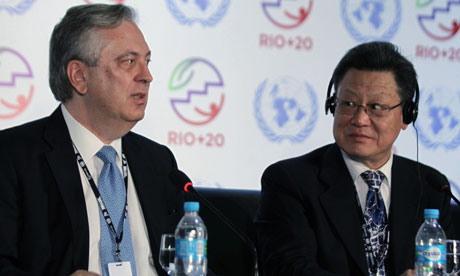
Sha Zukang, and Rio+20 Brazilian ambassador, Luiz Figueiredo Machado, attend a press conference in Rio de Janeiro, Brazil. Photograph: Antonio Lacerda/EPA
Brazilian negotiators have been accused of using strong-arm tactics at Rio+20 to secure a deal before heads of state start arriving for the Earth Summit later this week.
The ghost of the Copenhagen talks — which ended with disappointment and recriminations — is driving the attempt to force through an agreement, despite risks it could backfire spectacularly, said a senior source at the negotiations.
Brazil‘s spokesman said on Monday he was optimistic a compromise text could be approved by Tuesday evening.
But frustrated delegates are now considering blocking the proposed text because of its lack of ambition and the “aggressive” tactics employed by the host nation.
“They are doing this more because of how they will look in the eyes of the heads of state and their desire to show a successful conference in the sense that it did not break down or that there was no outcome,” said the source. “If they carry on with these tactics the risk is that some delegations will feel they may need to block this because it is not ambitious enough.”
Luiz Alberto Figueiredo, the Brazilian foreign ministry spokesman said on Tuesday that consensus was close on proposals to strengthen Unep, manage the world’s oceans and establish sustainable development goals.
This appeared to mark progress after weeks of procedural wrangling and divisions between rich and developing nations, but the host’s tactics are now being questioned.
“They are speaking with two tongues; on the political level they say they want ambition and on the civil servants level they are being extremely aggressive in closing down the conversation,” said the source. “For the Brazilians, it is more important that the process is seen to be efficient rather than effective. The reality is that the Brazilians are around during the negotiations, then they go back to their room and they say they have taken all the comments and thoughts into account and then just produce their own text.”
The hosts denied bullying tactics. “The Brazilian role in the consultations has been praised by the UN and by virtually all countries. The developed countries also seem to be satisfied,” said a senior official.
Other delegates were more sympathetic to Brazil’s efforts to reach a compromise, saying the host had done its best to incorporate a wide range of views. But there was widespread frustration at the weakness of the compromise document and its lopsided emphasis on the economy above than the environment.
“We want there to be more ambition so that it actually leads to sustainable development. At the moment, there is a risk that instead of the future we want, we will go back to the past we had,” said an EU official.
Several member states are concerned that a weak outcome is becoming inevitable. Little is expected from the US, which is preoccupied with a presidential election and strong domestic hostility to action on climate and other environmental issue. The G77 is divided on several major issues.
Europe, South Korea and Japan have told the Brazilian government they would like to see more concrete goals, timelines and measures to achieve a “green economy”, and argued that the current draft is inadequate to counter the risks posed by degrading ecosystems and diminishing resources that could be approaching a tipping point. Other nations, including New Zealand, are also pushing for more ambition on issue like the removal of fossil fuel subsidies.
Civil society has criticised the watered-down document.
“What we are seeing in Rio are incredibly weak negotiations which do not produce the results required to lift people out of poverty and stop environmental degradation. Rio+20 is creating a black hole of low ambition and little substance,” says Kit Vaughan, CARE’s Climate Change Advocacy Coordinator.
Lasse Gustavson, head of WWF’s delegation, said: “While we think some of the new text is a good base for the future, such as the language on oceans, we see a lopsided victory of weak words over action words ,with the weak words winning out at 514 to 10.”
This scheme was always a no-brainer. Getting rid of the use of fossil fuels is the ony answer.
Coal hard light of day for dud scheme
June 17, 2012
The Rudd government committed $400 million to set up the Global Carbon Capture and Storage Institute. Three years on, there is precious little to show for the money.
Kevin Rudd’s decision to spend hundreds of millions of dollars on technology to capture and store carbon has failed to deliver.
They’ve conferenced in empire-style Parisian ballrooms and dined in Kyoto on food cooked by a genuine Iron Chef. But deeply disgruntled former staffers believe Australia’s $300 million Global Carbon Capture and Storage Institute has not achieved very much.
In 2008 the then prime minister Kevin Rudd decided a fledgling technology called carbon capture and storage was the key to two of his government’s big aims: joining a successful international fight to reduce global warming and continuing to be the world’s largest exporter of coal.
In his grandiloquent style, he promised $400 million to a new not-for-profit company, the Global Carbon Capture and Storage Institute, which would get CCS up and running at home and also “lead the world”.
High society … the Global Carbon Capture and Storage Institute put Kevin Rudd on stage with Barack Obama. Photo: Reuters
The funding was pared back over time, but industry and government sources and former staff of the institute are frustrated that much of the $300 million spent on the institute has been “squandered”.
Even the man appointed to haul it away from government hand-outs and into the world of commercial reality – Brad Page, the former head of the peak electricity industry body – concedes the original $100 million a year “seed funding” given to the institute was more that it knew how to spend.
“It’s actually impossible to spend that amount of money responsibly,” he tells The Sun-Herald.
But his predecessors tried, in lavish ways that raised the ire of senior bureaucrats and ministers. Since 2009, more than $235 million has been delivered to the institute, $122 million of it already spent and another $113 million in its bank account, beyond the reach of Treasury’s razor, information provided at a Senate estimates hearing reveals.
Treasury managed to claw back more than $80 million of the promised $400 million before it was handed over. Only about $80 million remains to be paid over the next five years.
The institute has 78 staff, including nine permanent employees overseas – two in Washington, three in Tokyo and four in Paris. Former senior employees say its first chief executive, the British businessman Nick Otter, was paid well over $500,000 a year – more than the Prime Minister.
Page insists he has “no idea” what his predecessor was paid and his own salary is “nothing like that”. The institute’s five board members are paid from a budget of $400,000 a year and are entitled to first-class air travel.
The first members’ meeting was in Canberra, where the institute is based, in early 2009. But its second, in November 2009, attended by more than 15 Australia-based staff, was in the luxurious ballroom of the InterContinental Hotel in Paris, opposite the Paris Opera and decorated in similar ornate style.
Both industry sources and former staff concede the jaw-dropping opulence sent “all the wrong messages” to the 180 members who attended.
“The spending was very difficult to justify,” said one former employee.
And it did not end in Paris. In 2010 when they met in Kyoto, they enjoyed a dinner cooked by a celebrity Iron Chef ( the institute says his services were thrown in for no extra charge by the hotel).
Documents released under freedom of information show a staggering $54,257,000 was spent on “operational expenses” in the first two years.
The spending began before the institute even existed. Rudd – who decided at a G8 meeting in Japan in 2008 that the success of CCS was vital to Australia’s interest – set it up on advice from Boston Consulting, rather than the public service, at a cost of $1.5 million. By September 2008, he summoned business leaders to Canberra for a 30-minute presentation unveiling his plan.
Many were nonplussed, unsure about its aims or how it would be different from the CO2 co-operative research centre set up under the Howard government ( with almost $50 million in federal funds), Dick Wells’s National Low Emissions Coal Council ($400 million in federal funding) or another international body set up by the US, the Carbon Sequestration Leadership Forum.
”I still have no real idea how it will work or what it will do,” one chief executive said at the time.
But the public service was already doling out $65 million to future institute “partners”, including $21 million to the Asian Development Bank, almost $20 million to the International Energy Agency, $10 million to the Clinton Foundation headed by the former US president, and a grant to a body called the Climate Group to “advance” CCS. The Sun-Herald understands there is deep concern about what Australia is achieving from these contracts.
The institute was soon seeking global members and now boasts more than 300, including foreign governments, corporations, industry organisations and research bodies. There was no reason not to sign up. There is no joining fee.
In July 2009, the grand idea was paraded on the international stage, its reannouncement the key initiative at the G8 summit in L’Aquila, Italy. It was a heady moment for the Australian prime minister, who shared the podium with the US President, Barack Obama, the leaders of the developed world listening behind him.
At the time, Australia’s $400 million was termed “seed funding” with hundreds of millions from other governments also anticipated. But it took years for the US government to come good with $1 million and the European Union has only this year contributed €3 million ($3.8 million) for the institute to take over work it had previously contracted elsewhere.
Its advisory panel included the world’s best and brightest, among them former World Bank boss James Wolfensohn and influential climate economist Sir Nicholas Stern. Wolfensohn has since left.
Despite all its money, it took the institute some time to clarify exactly what it would do to meet its ambitious brief. At its inception, a spokesman for Rudd said the institute would not “actually fund demonstration projects overseas” but would “provide expertise … and research”.
However, in its first report to the Minister for Resources, Martin Ferguson, revealed under freedom-of-information laws, the institute said it was planning to “make approximately $50 million per annum available to support a substantial portfolio of CCS projects around the world”.
And in a letter to Ferguson in February 2010, institute chairman Russell Higgins wrote proudly that the initial offer to support international projects received an “extremely encouraging” response. The institute had received requests from overseas projects asking for a total of $500 million of Australia’s money. So far, the institute has spent $37 million on projects, mostly overseas. Several have failed. Only about $6 million has been spent on projects in Australia.
A total of $8 million was spent on a single CCS plant proposed by the energy company Tenaska, in Texas. In a recent report, Tenaska conceded it was still unable to bridge a “financing gap” required before the project could proceed because the US government had not provided any assistance. Internationally, the only CCS projects working on power plants are where the injected carbon dioxide serves an additional revenue-raising purpose – helping to recover more oil deposits from underground.
“They thought they could purchase an acceleration of projects overseas, but it was clear from the start that even though we had a lot of money, doing that would cost a lot more money than we had,” the former employee says.
Peter Cook, the former head of the research centre CO2CRC and a professorial fellow at the University of Melbourne, says Australia should have used its money to make sure at least one domestic carbon capture and storage project was built to prove to investors that the technology worked at commercial scale.
“Some of the other countries must think we are wonderfully generous, but I believe we could be getting a lot more bang for our buck,” he said.
Page says the institute’s function is now “knowledge sharing” – to make sure each new project around the world does not repeat the mistakes of the last. He says the money was initially paid to overseas projects to begin building up the institute’s publicly available “knowledge bank”, but from now on it will commission specific research and will no longer fund projects on the ground.
As the government funding runs out, Page’s job over the next two years “is to develop a strategy for the future … where our services are attractive enough to be paid for by our customers.” It will almost inevitably involve fewer staff and pared back operations.
But the main knowledge being “shared” is that, like all low-emission technologies, CCS is more expensive than coal, and therefore (unless it can make a revenue stream through enhanced oil recovery) it requires upfront capital assistance from governments, and ongoing subsidies while a carbon price remains low.
The institute itself came to this conclusion after its first global “audit”, released in October 2009 and Page concedes this remains the reason for slow progress on CCS around the world.
The United Nations Environment Program issued a report showing that the world has made significant progress on only four of the 90 most important environmental objectives agreed on through the U.N. process. Gains have come in eliminating ozone-depleting substances, phasing out lead in gasoline, increasing access to water supplies and encouraging research into marine pollutants. In most other categories — including protecting plant and animal species, curbing marine pollution and conserving water supplies — humanity is falling short.
“If current trends continue, if current patterns of production and consumption of natural resources prevail and cannot be reversed and ‘decoupled,’ then governments will preside over unprecedented levels of damage and degradation,” UNEP Executive Director Achim Steiner said in a statement.
The journal Nature published a series of articles Wednesday on the precarious state of the planet, including a study that warns that the world could be approaching a tipping point at which human activities cause a “planetary-scale critical transition” to a different environment.
An active region on the sun, numbered AR 1504, rotated into view over the left side of the sun on June 10, 2012. The region fired off two M-class flares and two coronal mass ejections (CMEs) on June 13 and June 14, 2012.
An active region on the sun, numbered AR 1504, rotated into view over the left side of the sun on June 10, 2012. The region fired off two M-class flares and two coronal mass ejections (CMEs) on June 13 and June 14, 2012.
With a little over two weeks to go until the start date for the carbon price, the Federal Government has released an updated list of the entities likely to pay the tax.
The Clean Energy Regulator says 294 entities have now been identified as liable to pay the carbon price when it comes into effect on July 1.
But it is well short of the figure of the 500 first nominated by the Federal Government.
Its list includes a total of 34 local councils which have landfill sites or produce natural gas.
Climate Change Minister Greg Combet says it is a figure which will continue to change.
“As some businesses may even be able to apply technology to reduce their greenhouse gas emissions so that they come off the list, they get underneath the threshold. Others might expand production and so end up above the threshold and come onto the list,” he said.
There has been particular attention recently on the effect the carbon price will have on local councils.
But Parliamentary Secretary for Climate Change, Mark Dreyfus, says councils will not have to pay liabilities for another 12 months.
“What we’re expecting for those 32 councils who are covered under the carbon price mechanism is that there will be some rate rises in the range of around 13 cents per household per week up to around 40 cents per household per week,” he said.
“That’s amply covered by the $10.10 per household per week assistance that’s coming from the Federal Government.”
And he says the Australian Competition and Consumer Commission (ACCC) will be on watch for people misrepresenting the impact of the tax and pushing up prices unnecessarily.
But Opposition climate spokesman Greg Hunt says if councils pay more they will pass on the cost.
“Whether you are in Bendigo, Rockingham, Darwin, Gold Coast, Geelong, Lake Macquarie, Launceston, across the country there are residents who will be hit with either higher rates of fewer services and inevitably they will also pay more money to go to the tip,” he said.





 Email
Email