Category: Climate chaos

The atmosphere is to the earth as a layer of varnish is to a desktop globe. It is thin, fragile and essential for preserving the items on the surface.150 years of burning fossil fuel have overloaded the atmosphere to the point where the earth is ill. It now has a fever. Read the detailed article, Soothing Gaia’s Fever for an evocative account of that analogy. The items listed here detail progress on coordinating 6.5 billion people in the most critical project undertaken by humanity. 

  • Guatemala’s volcano spews lava

    Guatemala’s volcano spews lava
    Sky News Australia
    Guatemala’s volcano spews lava Updated: 14:58, Monday May 21, 2012 Magma is spewing from the Volcan de Fuego in Guatemala, sending a cloud of ash and steam up to 5000 metres above its crater. Eruptions on Sunday at the peak, whose Spanish name means
    See all stories on this topic »

  • Heartland Institute facing uncertain future as staff depart and cash dries up

    Heartland Institute facing uncertain future as staff depart and cash dries up

    Free-market thinktank’s conference opens in Chicago with president admitting defections are hurting group’s finances

    • Leo blog : The Heartland Institute conference billboard in Chicago

      The billboard ads comparing climate change believers to the Unabomber Ted Kaczunski. Photograph: The Heartland Institute

      The first Heartland Institute conference on climate change in 2008 had all the trappings of a major scientific conclave – minus large numbers of real scientists. Hundreds of climate change contrarians, with a few academics among them, descended into the banquet rooms of a lavish Times Square hotel for what was purported to be a reasoned debate about climate change.

      But as the latest Heartland climate conference opens in a Chicago hotel on Monday, the thinktank’s claims to reasoned debate lie in shreds and its financial future remains uncertain.

      Heartland’s claims to “stay above the fray” of the climate wars was exploded by a billboard campaign earlier this month comparing climate change believers to the Unabomer Ted Kaczynski, and a document sting last February that revealed a plan to spread doubt among kindergarteners on the existence of climate change.

      Along with the damage to its reputation, Heartland’s financial future is also threatened by an exodus of corporate donors as well as key members of staff.

      In a fiery blogpost on the Heartland website, the organisation’s president Joseph Bast admitted Heartland’s defectors were “abandoning us in this moment of need”.

      Over the last few weeks, Heartland has lost at least $825,000 in expected funds for 2012, or more than 35% of the funds its planned to raise from corporate donors, according to the campaign group Forecast the Facts, which is pushing companies to boycott the organisation.

      The organisation has been forced to make up those funds by taking its first publicly acknowledged donations from the coal industry. The main Illinois coal lobby is a last-minute sponsor of this week’s conference, undermining Heartland’s claims to operate independently of fossil fuel interests.

      Its entire Washington DC office, barring one staffer, decamped, taking Heartland’s biggest project, involving the insurance industry, with them.

      Board directors quit, conference speakers cancelled at short-notice, and associates of long standing demanded Heartland remove their names from its website. The list of conference sponsors shrank by nearly half from 2010, and many of those listed sponsors are just websites operating on the rightwing fringe.

      “It’s haemorrhaging,” said Kert Davies, research director of Greenpeace, who has spent years tracking climate contrarian outfits. “Heartland’s true colours finally came through, and now people are jumping ship in quick order.”

      It does not look like Heartland is about to adopt a corrective course of action.

      In his post, Bast defended the ads, writing: “Our billboard was factual: the Unabomber was motivated by concern over man-made global warming to do the terrible crimes he committed.” He went on to describe climate scientist Michael Mann and activist Bill McKibben as “madmen”.

      The public unravelling of Heartland began last February when the scientist Peter Gleick lied to obtain highly sensitive materials, including a list of donors.

      The publicity around the donors’ list made it difficult for companies with public commitment to sustainability, such as the General Motors Foundation, to continue funding Heartland. The GM Foundation soon announced it was ending its support of $15,000 a year.

      But what had been a gradual collapse gathered pace when Heartland advertised its climate conference with a billboard on a Chicago expressway comparing believers in climate science to the Unabomber.

      The slow trickle of departing corporate donors turned into a gusher.

      Even Heartland insiders, such as Eli Lehrer, who headed the organisation’s Washington group, found the billboard too extreme. Lehrer, who headed the biggest project within Heartland, on insurance, immediately announced his departure along with six other staff.

      “The ad was ill advised,” he said. “I’m a free-market conservative with a long rightwing resumé and most, if not all, of my team fits the same description and of us found it very problematic. Staying with Heartland was simply not workable in the wake of this billboard.”

      Heartland took down the billboard within 24 hours, but by then the ad had gone viral.

      Lehrer, who maintains the split was amicable, said the billboard had undermined Heartland’s claims to be a serious conservative thinktank.

      “It didn’t reflect the seriousness which I want to bring to public policy,” Lehrer said in the telephone interview. “As somebody who deals mostly with insurance I believe all risk have to be taken seriously and there certainly are some important climate and global warming related risks that must be taken account of in the insurance market. Trivialising them is not consistent with free-market thought. Suggesting they are only thought about by people who are crazy is not good for the free market.”

      Other Heartland allies came to a similar conclusion. In a letter to Heartland announcing he was backing out from the conference, Ross McKitrick, a Canadian economist wrote: “You can not simultaneously say that you want to promote a debate while equating the other side to terrorists and mass murderers.”

      A number of other experts meanwhile began cutting their ties with Heartland, according to a tally kept by a Canadian blogger BigCityLiberal.

      Meanwhile, there was growing anger that Bast failed to consult with colleagues before ordering up the Kaczynski attack ads.

      Four board members told the Guardian they had not been consulted in advance about the ad. “I did not have prior approval of the billboard and was in favor of discontinuing the billboard when I was made aware of it,” Jeff Judson, a Texas lobbyist and board member wrote in an email.

      Could the turmoil and discontent at Heartland eventually prove its undoing? Campaigners would certainly hope so. “We are watching the consequences of organisation that acts quite randomly and that is actually an extremist organisation in the end,” said Davies. “They are not built to be at the hump of the climate denial movement.”

      But while more mainstream corporate entities are deserting Heartland, others are stepping into the breach, including the coal lobby and conservative groups such as the Heritage Foundation.

      Both the Illinois Coal Association and Heritage stepped in to fund this week’s conference, after other corporate donors began backing out in protest at the offensive Kaczynski ad.

      Meanwhile, a Greenpeace analysis of the other smaller conference sponsors suggests they have collectively received $5m in funds from Exxon and other oil companies.

      The Coal Association and Heritage were not listed on the original conference sponsor list, but appeared to come in about a week or so after the appearance of the offending Kaczynski ad.

      Phil Gonet, the chief lobbyist for the 20 coal companies in the association, said he had no qualms about stepping in to fund the Heartland conference.

      “We support the work they are doing and so we thought we would finally make a contribution to the organisation,” he said, calling criticism of the ad “moot”, “pointless” and “absurd”.

      Gonet went on: “I made a contribution mainly in support of a conference that is designed to make balanced information available to the public on the issue of global warming … In general, the message of the Heartland Institute is something the Illinois Coal Association supports.”

  • Draining of world’s aquifers feeds rising sea levels

    Draining of world’s aquifers feeds rising sea levels

    Trillions of tonnes of water have been pumped up from deep underground reservoirs in every part of the world, says report

    • guardian.co.uk, Sunday 20 May 2012 18.00 BST
    • Water pumped from underground aquifers increases sea water levels : Irrigation in  Saudi Arabia

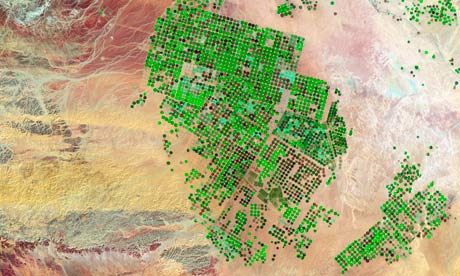
      For three decades, Saudi Arabia has been drilling for water from underground aquifers. Engineers and farmers have tapped hidden reserves of water to grow grains, fruit and vegetables in the desert of Wadi As-Sirhan Basin. Photograph: Landsat/Nasa

      Humanity’s unquenchable thirst for fresh water is driving up sea levels even faster than melting glaciers, according to new research. The massive impact of the global population‘s growing need for water on rising sea levels is revealed in a comprehensive assessment of all the ways in which people use water.

      Trillions of tonnes of water have been pumped up from deep underground reservoirs in every part of the world and then channelled into fields and pipes to keep communities fed and watered. The water then flows into the oceans, but far more quickly than the ancient aquifers are replenished by rains. The global tide would be rising even more quickly but for the fact that manmade reservoirs have, until now, held back the flow by storing huge amounts of water on land.

      “The water being taken from deep wells is geologically old – there is no replenishment and so it is a one way transfer into the ocean,” said sea level expert Prof Robert Nicholls, at the University of Southampton. “In the long run, I would still be more concerned about the impact of climate change, but this work shows that even if we stabilise the climate, we might still get sea level rise due to how we use water.” He said the sea level would rise 10 metres or more if all the world’s groundwater was pumped out, though he said removing every drop was unlikely because some aquifers contain salt water. The sea level is predicted to rise by 30-100cm by 2100, putting many coasts at risk, by increasing the number of storm surges that swamp cities.

      The new research was led by Yadu Pokhrel, at the University of Tokyo, and published in Nature Geoscience. “Our study is based on a state-of-the-art model which we have extensively validated in our previous works,” he said. “It suggests groundwater is a major contributor to the observed sea level rise.” The team’s results also neatly fill a gap scientists had identified between the rise in sea level observed by tide gauges and the contribution calculated to come from melting ice.

      The drawing of water from deep wells has caused the sea to rise by an average of a millimetre every year since 1961, the researchers concluded. The storing of freshwater in reservoirs has offset about 40% of that, but the scientists warn that this effect is diminishing.

      “Reservoir water storage has levelled off in recent years,” they write. “By contrast, the contribution of groundwater depletion has been increasing and may continue to do so in the future, which will heighten the concerns regarding the potential sea level rise in the 21st century.” Nicholls, who was not part of the research team, said there are a wide range of projections of future sea level. “But this work makes one worry about the uncertainty at the high end more,” he said.

      The researchers compared the contribution of groundwater withdrawal and reservoir storage to the more familiar causes of rising sea level: ice melted by global warming and the expansion of the ocean as it warms. The pumping out of groundwater is five times bigger in scale than the melting of the planet’s two great ice caps, in Greenland and Antarctica, and twice as great as both the melting of all other glaciers and ice or the thermal expansion of seawater.

      The scale of groundwater use is as vast as it is unsustainable: over the past half century 18 trillion tonnes of water has been removed from underground aquifers without being replaced. In some parts of the world, the stores of water have now been exhausted. Saudi Arabia, for example, was self-sufficient in wheat, grown in the desert using water from deep, fossil aquifers. Now, many of the aquifers have run dry and most wheat is imported, with all growing expected to end in 2016. In northern India, the level of the water table is dropping by 4cm every year.

      Pokhrel’s team also investigated the effect of rising temperatures on other ways in which water is stored on land. They found that the drying of soils and loss of snow added almost a tenth of a millimetre per year to sea level rise.

      Prof Jonathan Bamber, of the University of Bristol, said the washing of vast volumes of groundwater into the sea was a large factor, but did not appear to have accelerated over the past 50 years, despite the world population more than doubling in that time. In contrast, the melting of ice sheets and glaciers as global temperatures rise has accelerated over the past 20 years, he said: “So it is pretty clear to me that this will be the dominant contributor in the future.”

      The new work reveals the surprisingly large effect of deep water wells on the oceans, said Martin Vermeer, at Aalto University in Finland, but would not radically alter overall estimates of sea level rise by 2100. “It’s an incremental change, nothing revolutionary, assuming the result of this paper holds up. Science is never built upon a single result.”

  • Flooded Riverina towns still sodden and suffering

    Flooded Riverina towns still sodden and suffering

    Updated May 21, 2012 08:32:27

    More than two months after devastating floods swept through the Riverina, in southern New South Wales, some farmers and residents are still suffering.

    Several farms are still underwater and hundreds of families have been unable to return to their damaged homes.

    Many are waiting for insurance pay outs to repair their properties.

    Yenda farmer Mark Groat is one of those affected.

    After eight years of drought he got more water than he wished for. More than two months after the floods, parts of his farm are still underwater.

    “Oh, even local people are surprised there is still water around,” he said.

    Mr Groat has lost his rice crop and will not be able to plant wheat over the winter.

    It will be several months before he can even drive on the sodden paddock.

    The farm only received minor damage when the flood started in March, but the real problems came when water started coming up from blocked irrigation drains.

    “The fact it has been on so long is what we have to look at. That’s what’s done the damage, the length of time it’s been on,” he said.

    “So if they can look at getting it off a lot quicker, well that’d save us a lot.”

    Next door, fellow farmer Brad Taylor is surveying the damage to his cherry orchard.


    The flood waters destroyed 11,000 young cherry trees, worth $500,000.

    “It was devastating just to see it coming up day after day. It was just a feeling of helplessness,” he said.

    Mr Taylor says the damage to his property was also caused by water rising from the drains, several days after the peak of the flood.

    “It was that afternoon that water started coming out of the drainage system and continued to do so for a long time,” he said.

    A spokesman from Murrumbidgee irrigation declined to be interviewed, but released a statement saying the organisation would cooperate with any inquiry on how to improve planning and the response to the flood.

    More than 200 families have been unable to return to the damaged homes in the town of Yenda.

    Ninety-year-old resident Phyllis Mott says she is one of the lucky ones, but is still waiting for a payout from her insurance company.

    “At least I’m in my house, there’s a lot of poor unfortunates that are not in their house in Yenda,” she said.

    “They’re battling, and I know there are a lot more worse off than them but it doesn’t alter the fact that you’re in misery while you’re like this, when it shouldn’t be.

    “Why don’t they tell us whether they’re going to pay or not? But they won’t.”

    The new wing of the local pre-school opened only five weeks before the flood hit. It was not fully insured. Now, it’s damaged and unusable.

    Some locals believe the community would have been spared if floods gates outside the town had been opened to allow the water to flow away, instead of into residential areas.

    More than two months after floods spread across the Riverina, many people around Yenda want to know whether everything possible was done to protect their community.

    The long wait for insurance pay outs and repairs continues.

    Topics:floods, rice, irrigation, yenda-2681

    First posted May 21, 2012 07:58:31

  • Aussie life in a land of extremes

    Aussie life in a land of extremes

    1
    Weather hot

    Source: The Daily Telegraph

    Weather wet

    Source: The Daily Telegraph

    < Prev

    2 of 2

    Next >

    RAVAGED by drought and bushfires, drenched by floods and hammered by destructive storms – Australia’s recent weather patterns are a reminder how severe this wide brown land can be.

    And comprehensive analysis of world climate data has revealed just how tough Australian weather is compared to the rest of the world.

    According to the Weather Channel study, which looked at global rainfall, temperatures and serious events like cyclones and heatwaves, Australia is among the 10 most extreme countries on the planet for weather.

    Meteorologist Tom Saunders said Australia was the world’s number one hotspot for bushfires, while at the other end of the spectrum, it was also home to the world’s fifth-wettest place – Mt Bellenden Ker between Townsville and Cairns. The coastal mountain cops more than 8.3m of rain a year on average.

    Tropical Cyclone Monica, which thundered into the Queensland coast in 2006, was one of the top five most powerful cyclones or hurricanes ever to make landfall, generating winds of up to 285km/h.

    And the West Australian town of Marble Bar set a world record when it baked through temperatures of more than 37.8C for 160 consecutive days in 1923-24.

    “We are such a large country and we’re a country that spreads from the tropics into the mid-latitudes. That is the key – our size and our position,” Mr Saunders said.

    “Because of that, we get tropical severe weather but we also get the thunderstorms, tornadoes and bushfires.”

    The study found that overall, the US had the world’s most extreme weather due to its similarly large size and “astonishingly” variable conditions. “It has a tropical ocean on one side, the Gulf of Mexico and it’s got the cold continental region of the Canadian plains on the other side,” Mr Saunders said.

    “That’s what causes much of their severe weather, when the warm, moist air from the south clashes with the cold, dry air from the north.”

    Luckily for Australia, and unlike the US, most of our population is concentrated in the south-east, Mr Saunders said. “That means most of us don’t have to live with the deserts, the tropical cyclones and the monsoon rains … but we do get those bushfires.”

    Surprisingly, Australia did not figure in the world’s five driest locations, due to occasional storms that drenched the desert interior. Meteorologist Dick Whitaker said the South Australian outback town of Mulka was Australia’s driest place, recording just 103mm of rain a year.


  • Geoengineering experiment cancelled due to perceived conflict of interest

    Geoengineering experiment cancelled due to perceived conflict of interest

    Two scientists involved in Spice project to simulate the cooling effect of volcanoes had submitted patents for similar technology

    • guardian.co.uk, Wednesday 16 May 2012 14.13 BST
    • Comments (24)
    • Spice pipe and balloon experiment

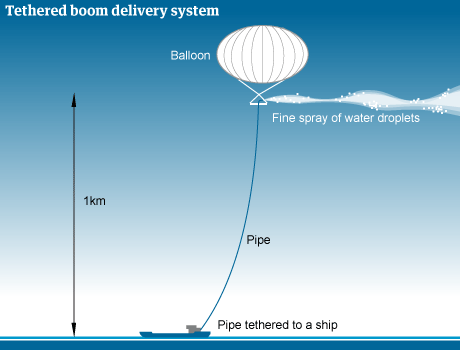
      The Spice experiment would have injected 150 litres of water into the atmosphere from a weather balloon via a 1km pipe tethered to a ship

      A controversial geoengineering experiment to simulate the cooling effect of volcanoes has been cancelled due to concern over a perceived conflict of interest with some of the researchers.

      The experiment would have injected 150 litres of water into the atmosphere from a weather balloon via a 1km pipe tethered to a ship as part of the Spice project (Stratospheric Particle Injection for Climate Engineering).

      Matthew Watson, a scientist at Bristol University and the principal investigator of Spice, told Nature magazine that two scientists involved in the project had not been initially forthcoming that they had submitted patents for technology similar to that used in the project before Spice was proposed.

      This revelation caused some concern among the scientists involved, leading to the decision to axe the field-test, though they decided the lab-based element of the project should continue. Watson said other concerns had been raised about the lack of government regulation of geoengineering projects.

      “This shows how commercial and financial interests can complicate the management of research on geoengineering, especially SRM technology, even if everyone agrees that it is safe. The project team have done the right thing, but this is an issue that needs to be explored in depth with stakeholders,” said John Shepherd, chair of the Royal Society’s geoengineering group.

      “It’s a shame that the balloon experiment won’t be done now, as it would be really interesting to know if this technology would work, and I am quite sceptical about it,” he added. “However, it was always an optional extra to the rest of the project, which is scientifically much more important.”

      Peter Cox, a professor of climate system dynamics at the University of Exeter, said in a statement: “It is regrettable that the field-trial aspect of Spice has now been cancelled, but it is vitally important that the remainder of the project, which is desk and lab based, should continue.”

      Scientists at Spice – run by the universities of Bristol, Cambridge, Edinburgh and Oxford – had hoped the particles could mitigate the effects of global warming by diffusing sunlight before it reached the earth. The project was controversial, with groups including Friends of the Earth and the Canadian-based ETC Group raising concerns over the long-term impacts.