Category: Water

The world’s fresh water supplies are almost fully exploited.Almost al, 97 per cent, of the world’s water is salt. Of the fresh water in the world, two thirds is locked up as ice and snow (the cryosphere – to you and me, kid!). Globally, three quarters of the water that is used is used by agriculture. India, China and the United States, use more fresh water than is available. The water level in those nation’s aquifers is falling as a result.The current food crisis has come about largely as a result as the shortfall in available water begins to impact on the cost of irrigation. 

  • India prays for rain as water wars break out

    India prays for rain as water wars break out


    The monsoon is late, the wells are running dry and in the teeming city of Bhopal, water supply is now a deadly issue. Gethin Chamberlain reports


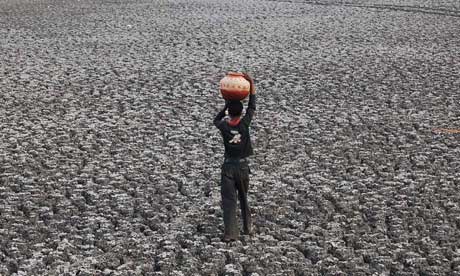
    A young Indian man walks across Upper Lake

    A young man walks across Bhopal’s Upper Lake, which has shrunk to an eighth of its original area. Photograph: STR/AFP/Getty Images


    It was a little after 8pm when the water started flowing through the pipe running beneath the dirt streets of Bhopal’s Sanjay Nagar slum. After days without a drop of water, the Malviya family were the first to reach the hole they had drilled in the pipe, filling what containers they had as quickly as they could. Within minutes, three of them were dead, hacked to death by angry neighbours who accused them of stealing water.


    In Bhopal, and across much of northern India, a late monsoon and the driest June for 83 years are exacerbating the effects of a widespread drought and setting neighbour against neighbour in a desperate fight for survival.


    India’s vast farming economy is on the verge of crisis. The lack of rain has hit northern areas most, but even in Mumbai, which has experienced heavy rainfall and flooding, authorities were forced to cut the water supply by 30% last week as levels in the lakes serving the city ran perilously low.


    Across the country, from Gujarat to Hyderabad, in Andhra Pradesh, the state that claims to be “the rice bowl of India”, special prayers have been held for more rain after cumulative monsoon season figures fell 43% below average.


    On Friday, India’s agriculture minister, Sharad Pawar, said the country was facing a drought-like situation that was a “matter for concern”, with serious problems developing in states such as Punjab, Uttar Pradesh and Bihar.


    In Bhopal, which bills itself as the City of Lakes, patience is already at breaking point. The largest lake, the 1,000-year-old, man-made Upper Lake, had reduced in size from 38 sq km to 5 sq km by the start of last week.


    The population of 1.8 million has been rationed to 30 minutes of water supply every other day since October. That became one day in three as the monsoon failed to materialise. In nearby Indore the ration is half an hour’s supply every seven days.


    The UN has warned for many years that water shortages will become one of the most pressing problems on the planet over the coming decades, with one report estimating that four billion people will be affected by 2050. What is happening in India, which has too many people in places where there is not enough water, is a foretaste of what is to come.


    In Bhopal, where 100,000 people rely solely on the water tankers that shuttle across the city, fights break out regularly. In the Pushpa Nagar slum, the arrival of the first tanker for two days prompted a frantic scramble, with men jostling women and children in their determination to get to the precious liquid first.


    Young men scrambled on to the back of the tanker, jamming green plastic pipes through the hole on the top, passing them down to their wives or mothers waiting on the ground to siphon the water off into whatever they had managed to find: old cooking oil containers were popular, but even paint pots were pressed into service. A few children crawled beneath the tanker in the hope of catching the spillage.


    In the Durga Dham slum, where the tanker stops about 100 metres away from a giant water tower built to provide a supply for a more upmarket area nearby, Chand Miya, the local committee chairman, watched a similar scene. There was not enough water to go around, he said. “In the last six years it has been raining much less. The population has increased, but the water supply is the same.”


    Every family needed 100 litres a day for drinking, cooking and washing, he said, and people had no idea when the tanker would come again.


    Not everyone gets a tanker delivery. The city has 380 registered slums, but there are numerous other shanties where people have to find their own methods. Some, like the Malviyas, tap into the main supply. Others cluster around the ventilation valves for the main pipelines that stick up out of the ground from place to place, trying to catch the small amounts of water leaking out. In the Balveer Nagar slum, 250 families have no supply at all. The women get up in the middle of the night to walk 2km to the nearest pumping station, where someone has removed a couple of bricks from the base to allow a steady flow of water to pour out.


    A few communities have received help from non-governmental organisations. In the Arjun Nagar slum, a borewell has been drilled down 115 metres by Water Aid to provide water for 100 families, each paying 40 rupees (50p) a month.


    Until the well was drilled, Shaheen Anjum, a mother of four, got up at 2.30am each day to fetch water, wheeling a bike with five or six containers strapped to it to the nearest public pipe in the hope of beating the queues. “Often we would get there and the water would not be running,” she said. “It was so tiring: the children were suffering and getting ill because they had to come too. The tankers used to come, but there were so many fights that the driver used to run away.”


    Water Aid is working in 17 of the city’s 380 registered slums, providing water and sanitation. “It’s not just Bhopal. This has been a drought year for many districts,” said Suresh Chandra Jaiswal, the technical officer. “Now it has reached a critical stage. We just don’t know any more how long the water will last.”


    Fifty years ago, Bhopal had a population of 100,000; today it is 1.8 million and rising. In a good year the city might get more than a metre of rain between July and September, but last year the figure was only 700mm.


    Neighbours of the Malviyas cluster around the hole in the street outside the house where Jeevan Malviya lived with his wife, Gyarasi, their son, Raju, 18, and their four other children. It was the evening of 13 May, said Sunita Bai, a female relative: a local man, Dinu, thought that the family had blocked the pipe to stop the water flowing further down the hill.


    He and a group of friends slapped Gyarasi, 35; Raju tried to stop him. Someone produced a sword and, a few minutes later, the Malviyas lay dying. “We were too afraid to do anything,” said a woman who gave her name as Shanno. “Dinu didn’t want them to take any water. He wanted it for himself.”


    Everyone stood around, looking down at the hole in the ground. The pipe is dry. “It is a terrible thing, that people should be fighting over water,” said Shanno.

  • Rees tries to take carbon credit

    Rees tries to take carbon credit   ( Source NSW Greens Media)

    “The bread and circuses approach to running the State has reached a new
    low with Premier Rees announcing a ban on bottled water in Government
    departments. As Minister for Water, Nathan Rees didn’t bat an eyelid
    when the community at Peat’s Ridge objected to Coca Cola/Amatil
    extracting 66 million litres of water from Mangrove Mountain. The
    company paid the NSW Goverment $200 for a water extraction licence and
    are now selling it in plastic bottles for more than $10 million a year.


    “We’ve sold a public asset, for a token amount and now the Premier
    has made a token gesture in response –  and it’s the public who has to
    pay for the mess, mostly through council rates. By jumping on the
    bandwagon being drawn by the sensible people of Bundanoon, Premier Rees
    is trying to score an environmental point – it would be funny if he
    wasn’t in such negative carbon credit,”
    “The Premier has responded – with about one minute’s thought –
    to the real public concern about the damage that drink bottles are doing
    to the environment and about the mountains of unnecessary waste.
    Australians spend roughly $385 million on 250 million litres of bottled
    water year and only a third of these get recycled. Every five bottles
    takes one litre of crude oil to make.”
    “Less than a month ago, both the Labor Government and the Opposition
    voted to oppose my Private Member’s Bill that would have given NSW a
    complete container recycling scheme – for all drink bottles and
    recyclable containers along the lines of South Australia’s scheme.”

    “The Government threw away a $33.8 million dollar income stream from
    the recycling market. They voted against reducing in fossil fuel
    consumption, substantially reducing rubbish on our streets, beaches and
    parks, slashing council rates, providing consumers with an easy
    incentive to recycle, and creating hundreds of green jobs.”


     “The Bill was a no-brainer for popular appeal and an easy fix for
    the environment. Consumers would get a 10 cent return on their
    containers. The Bundanoon ban shows that people are crying out for
    action on waste.”

    “We are five years away from the proposed NSW Waste Recovery target
    for a 66% increase in recycling by 2014. From 2002 -2008 in NSW it
    increased by only 2%. In South Australia the recycling rate is over 80%
    compared with the NSW rate of less than 40%.”
     
    “Premier Rees’ attention grabbing gesture makes a mockery of the
    people of Bundanoon who have taken decisive action against environmental
    degradation. As we can see from his recent actions, the Premier is not
    doing anything serious about water and waste or to curb the excesses of
    the bottling industry and their lobbyists.”

  • Buyback plan fails Murray-Darling river system

    Buyback plan fails Murray-Darling river system


    Siobhain Ryan and Asa Wahlquist | July 09, 2009


    Article from:  The Australian


    ALMOST half the water entitlements purchased under the national Murray-Darling rescue plan last financial year will never reach the distressed Murray system except in times of flood.


    New figures reveal the Rudd government made NSW’s Lachlan, Gwydir and Macquarie catchments the top targets for its big-spending buyback program in 2008-09, despite the fact that they all terminate in wetlands.


    About 182,000 of the 397,000 megalitres of water entitlements bought across the basin last financial year are now confined to catchments that rarely flow into the main Murray system, which has been devastated by drought and over-extraction.


    NSW Irrigators Council chief executive Andrew Gregson said there seemed no logic to Canberra’s pursuit of cheaper and less reliable water entitlements in unconnected catchment areas.


    “It’s reflective of the lack of a strategy,” he said. “What are you trying to achieve, therefore what are you trying to buy?”


    The controversial buyback program, worth $3.1 billion over 10 years, has been fast-tracked to claw back water for the thirsty environment.


    Storages across the Murray-Darling Basin are at just 11 per cent of capacity after nine heartbreakingly dry years.


    Inflows for 2008-09 were the third-lowest in 118 years of records, with the soil so parched even the runoff from heavy rains in the northern basin have failed to make it south.


    But the federal push has struck major resistance from the states, with NSW boycotting further sales to the commonwealth while Victoria’s 4per cent limit on the trading of water out of individual irrigation areas remains in place.


    South Australia is pushing ahead with a High Court challenge to the Victorian policy, further undermining Kevin Rudd’s promise to end the blame game on the Murray-Darling system.


    The barriers to trade have limited the purchase options, with the latest federal Water Department statistics showing many of the 2008-09 entitlements come from some of the basin’s least reliable water sources.


    The Lachlan, Gwydir and Macquarie purchases, for example, which cost taxpayers about $260 million in total, will deliver the government its full water entitlements only three to four years out of 10.


    By comparison, only a fifth of the entitlements bought by the commonwealth in 2008-09 were “high security”, giving it full flows for at least nine out of 10 years.


    And Australian Conservation Foundation healthy rivers campaigner Arlene Buchan said those reliability estimates were already out of date, because they failed to take account of climate change.


    “That’s really where the rubber hits the road – will the entitlements bought deliver real water to the environment in 20 years’ time?” she said.


    A spokeswoman for federal Water Minister Penny Wong yesterday defended the selections made in the buyback program, citing a landmark CSIRO audit of the basin which rated the Gwydir and Lachlan catchments as in poor and very poor health respectively.


    She said both included wetland sites that were recognised as nationally or internationally important and provided homes for threatened or migratory species.


    “The water acquired through the purchase program will be managed by the Commonwealth Environmental Water Holder and delivered to the sites that deliver the greatest environmental benefits at the time when allocations become available to these entitlements,” she said. But as of July 3, the Environmental Water Holder had only 64,000 megalitres at its disposal, about a sixth of the 2008-09 buyback total. Less than 10,000ML are understood to have been returned to the environment last financial year.


    The department gave no prices, sources or reliability data for more than a quarter of the entitlements bought in the year to June 30 because of privacy reasons, making it impossible to calculate the government’s total spending on the program.


    “The commonwealth … is saying they want an open, accountable and transparent (water) market but… are not providing information that’s open, accountable and transparent,” Mr Gregson said.

  • Banning the bottle puts Bundy on the map

    Banning the bottle puts Bundy on the map


    By Rebecca Bruce for AM


    Posted 2 hours 18 minutes ago
    Updated 1 hour 46 minutes ago


    Local businesses have promoted the plan.

    Local businesses have promoted the plan. (ABC News)


    The New South Wales Southern Highlands town of Bundanoon has voted overwhelmingly to ban the sale of bottled water, attracting attention from around the world.


    A community meeting last night took the unusual step, making it the first town in Australia, possibly the world, to ban the sale of bottled water.


    The Bundy on Tap campaign will see still bottled water replaced by reusable plastic bottles that can be bought, then filled up for free at water stations throughout the town.


    The campaign is the brainchild of Huw Kingston, who owns the bike shop in the town of 2,500 people. Mr Kingston says he is happy with decision but surprised by the overwhelming interest in his idea.


    After doing more than 70 media interviews yesterday, Mr Kingston was still fielding calls from the BBC, as well as New Zealand and Japanese media last night.


    “To have that international coverage certainly took me a little bit by surprise and I’m pretty amazed that I’m still able to talk,” he said.


    The locals are also stunned by their new-found fame.


    “To think that the media in London and in Japan are interested in this issue and that Bundanoon will be put on the map as such, I think that’s great,” one local said.


    “I’ve been watching it on the net and I was really surprised when it first started and it just kept on unravelling throughout the day,” another resident said. “It’s remarkable.”


    Idea catches on


    It’s not just the media that’s tapping into the idea. Hot on the news of the planned ban yesterday, NSW Premier Nathan Rees ordered all State Government departments and agencies to stop buying bottled water.


    “As a principle, we want to move away from bottled water because of the degradation to the environment that the discarded bottles cause,” he said.


    Last night, more than 350 people turned out to vote on Bundanoon’s proposal to ban the sale of pre-packaged bottled water by the end of the year.


    It was possibly the biggest event ever to be held in Bundanoon’s Memorial Hall.


    A representative of the bottled water lobby stood in front of the gathering to defend the industry.


    But only one local resident was brave enough to voice his opposition to the initiative.


    “There’s a far bigger health issue, which is the diabetes issue and if we’re taking away water at the point of sale that is full of sugar drinks I think we’re on the wrong track,” he said.


    But a show of hands made clear that Bundy locals were ready to ban the bottle.


    Huw Kingston says those looking to snap up a Bundanoon souvenir better hurry.


    “Anybody who wants to buy a souvenir bottle of packaged water in Bundanoon might want to come down here over the next couple of months,” he said.

  • Farmers have had it: Nationals

    Premier John
    Brumby’s decision to raise the four per cent cap on water trade and the
    downturn in the dairy industry has affected the number of people trying
    to sell water, Shadow Minister for Country Water Resources and Deputy
    Leader of The Nationals Peter Walsh said today.

    Mr Walsh has questioned Goulburn-Murray Water’s (G-MW’s) logic in
    stating last week that the real measure of producers wanting to exit
    irrigation was the number of farmers selling delivery shares as well as
    water shares.

    “The number of people applying to sell their water shares in
    northern Victoria has more than doubled since the Brumby Government
    announced it would lift the cap to allow the Commonwealth Government to
    purchase water,” Mr Walsh said.

    “The fact that producers are retaining their delivery share is not an indication that all is well in the sector.

    “G-MW is misreading the dynamics of the industry in an effort to put a positive spin on the numbers.

    “Producers are keeping their delivery shares because if they choose
    to sell them they will have to pay thousands of dollars in termination
    fees to exit the system.

    “It doesn’t make sense for people to fork out that kind of money
    when there’s a strong possibility the fees could be reduced or waived
    if the delivery infrastructure is rationalised as part of the Northern
    Victorian Irrigation Renewal Project (NVIRP).

    “It’s just good business sense for food producers to retain their
    delivery share until such time as NVIRP decides whether it wants to
    rationalise their channel. Then they might not be required to pay the
    termination fees.”

    Mr Walsh said the Brumby Government had to acknowledge the
    ramifications of its decision to remove restrictions on water trade.

    “The increase in applications to permanently sell water is an
    indication that more food producers are trying to exit the industry,”
    Mr Walsh said.

    “People are selling water because they are short of cash and they’re
    keeping their delivery shares because they can’t afford to pay
    termination fees.

    “The massive increase in those wanting to sell water only goes to show the Brumby Government made the wrong decision.

    “It has undermined confidence in irrigated food production to such
    an extent that many people now feel the only way forward is out,” Mr
    Walsh said.

  • NSW town pushed to ban bottled water

    NSW town pushed to ban bottled water


    By environment reporter Shane McLeod for AM


    Bottled water for SE Qld level 5 water restrictions.

    Vote tonight: Bundanoon is pondering a ban on bottled water (ABC News: Giulio Saggin)


    A town in the New South Wales southern highlands hopes to become the first community in Australia to ban the sale of bottled water.


    Bundanoon is probably best known for its annual Scottish cultural festival. But now the town of 2,500 people hopes to make a name for itself for another canny decision.


    Bundanoon businessman Huw Kingston suggested the ban after a company applied to pump water out of a local aquifer to supply the bottled market.


    “I put a little article – ‘Does Bundanoon have the bottle to go bottled water free?’ – in our local newsletter. I guess we have gone on from there,” he said.


    The suggestion won the support of local businesses.


    They are proposing to replace plastic bottles of water on their shop shelves with reusables and then offer directions to filtered water fountains that will be installed on the main street.


    Tonight that idea will be put to local residents at a community meeting.


    Mr Kingston believes there will be widespread support.


    “I think there is an overwhelming opposition to the marketing scam that is stilled bottled water,” he said.


    Around the world other cities have taxed bottled water – in some places, local officials have been banned from using taxpayers funds to buy it.


    Environmentalist Jon Dee from activist group Do Something believes Bundanoon could be the first town to ban it entirely.


    “Huge amounts of resources are used to extract, bottle and transport that bottled water, and much of the package ends up as litter or landfill,” he said.


    “So environmentally it makes no sense and that is what we are trying to do in Bundanoon, is show that a community can live without single use bottled water.”


    Mr Dee, who was behind the campaign that saw plastic bags banned in the Tasmanian town of Coles Bay, says other towns around the country would not find it hard to follow Bundanoon’s lead.


    “If Bundanoon can ban bottled water, well many other towns and communities around Australia will also consider their usage of bottled water,” he said.


    “And at the very least, if they don’t ban it then at least they will reduce their usage of it and in doing so reduce the half a billion dollars a year that Australians are spending on bottled water and not just save money but save the environment too.”


    Mr Kingston says visitors to Bundanoon will not be set upon if they are seen sipping water from a plastic bottle.


    “We are fairly civilised people down here. Nobody is going to get lynched for carrying a bottle of prepackaged water down the main street of Bundanoon,” he said.


    But he hopes the ban will make them think twice about how they quench their thirst.


    Tags: environment, conservation, recycling-and-waste-management, water, australia, nsw, bundanoon-2578