Category: Sustainable Settlement and Agriculture

The Generator is founded on the simple premise that we should leave the world in better condition than we found it. The news items in this category outline the attempts people have made to do this. They are mainly concerned with our food supply and settlement patterns. The impact that the human race has on the planet.

  • Putting a price on the rivers and rain diminishes us all

    Putting a price on the rivers and rain diminishes us all

    Payments for ‘ecosystem services’ look like the prelude to the greatest privatisation since enclosure

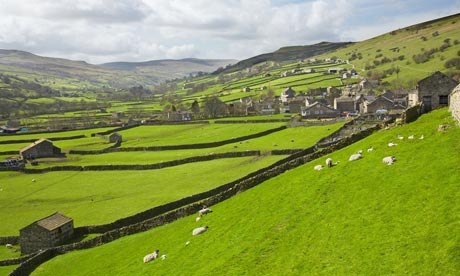
    Gunnerside village Swaledale Yorkshire Dales

    Our rivers and natural resources are to be valued and commodified, a move that will benefit only the rich, argues George Monbiot. Photograph: Alamy

    ‘The first man who, having enclosed a piece of ground, bethought himself of saying ‘This is mine’, and found people simple enough to believe him, was the real founder of civil society. From how many crimes, wars and murders, from how many horrors and misfortunes might not anyone have saved mankind, by pulling up the stakes, or filling up the ditch, and crying to his fellows, ‘Beware of listening to this impostor; you are undone if you once forget that the fruits of the earth belong to us all, and the earth itself to nobody’.”

    Jean Jacques Rousseau would recognise this moment. Now it is not the land his impostors are enclosing, but the rest of the natural world. In many countries, especially the United Kingdom, nature is being valued and commodified so that it can be exchanged for cash.

    The effort began in earnest under the last government. At a cost of £100,000, it commissioned a research company to produce a total annual price for England’s ecosystems. After taking the money, the company reported – with a certain understatement – that this exercise was “theoretically challenging to complete, and considered by some not to be a theoretically sound endeavour”. Some of the services provided by England’s ecosystems, it pointed out, “may in fact be infinite in value”.

    This rare flash of common sense did nothing to discourage the current government from seeking first to put a price on nature, then to create a market in its disposal. The UK now has a natural capital committee, an Ecosystem Markets Task Force and an inspiring new lexicon. We don’t call it nature any more: now the proper term is “natural capital”. Natural processes have become “ecosystem services”, as they exist only to serve us. Hills, forests and river catchments are now “green infrastructure”, while biodiversity and habitats are “asset classes” within an “ecosystem market”. All of them will be assigned a price, all of them will become exchangeable.

    The argument in favour of this approach is coherent and plausible. Business currently treats the natural world as if it is worth nothing. Pricing nature and incorporating that price into the cost of goods and services creates an economic incentive for its protection. It certainly appeals to both business and the self-hating state. The Ecosystem Markets Task Force speaks of “substantial potential growth in nature-related markets – in the order of billions of pounds globally”.

    Commodification, economic growth, financial abstractions, corporate power: aren’t these the processes driving the world’s environmental crisis? Now we are told that to save the biosphere we need more of them.

    Payments for ecosystem services look to me like the prelude to the greatest privatisation since Rousseau’s encloser first made an exclusive claim to the land. The government has already begun describing land owners as the “providers” of ecosystem services, as if they had created the rain and the hills and the rivers and the wildlife that inhabits them. They are to be paid for these services, either by the government or by “users”. It sounds like the plan for the NHS.

    Land ownership since the time of the first impostor has involved the gradual accumulation of exclusive rights, which were seized from commoners. Payments for ecosystem services extend this encroachment by appointing the landlord as the owner and instigator of the wildlife, the water flow, the carbon cycle, the natural processes that were previously deemed to belong to everyone and no one.

    But it doesn’t end there. Once a resource has been commodified, speculators and traders step in. The Ecosystem Markets Task Force now talks of “harnessing City financial expertise to assess the ways that these blended revenue streams and securitisations enhance the ROI [return on investment] of an environmental bond”. This gives you an idea of how far this process has gone – and of the gobbledegook it has begun to generate.

    Already the government is developing the market for trading wildlife, by experimenting with what it calls biodiversity offsets. If a quarry company wants to destroy a rare meadow, for example, it can buy absolution by paying someone to create another somewhere else. The government warns that these offsets should be used only to compensate for “genuinely unavoidable damage” and “must not become a licence to destroy”. But once the principle is established and the market is functioning, for how long do you reckon that line will hold? Nature, under this system, will become as fungible as everything else.

    Like other aspects of neoliberalism, the commodification of nature forestalls democratic choice. No longer will we be able to argue that an ecosystem or a landscape should be protected because it affords us wonder and delight; we’ll be told that its intrinsic value has already been calculated and, doubtless, that it turns out to be worth less than the other uses to which the land could be put. The market has spoken: end of debate.


    All those messy, subjective matters, the motivating forces of democracy, will be resolved in a column of figures. Governments won’t need to regulate; the market will make the decisions that politicians have ducked. But trade is a fickle master, and unresponsive to anyone except those with the money. The costing and sale of nature represents another transfer of power to corporations and the very rich.

    It diminishes us, it diminishes nature. By turning the natural world into a subsidiary of the corporate economy, it reasserts the biblical doctrine of dominion. It slices the biosphere into component commodities: already the government’s task force is talking of “unbundling” ecosystem services, a term borrowed from previous privatisations. This might make financial sense; it makes no ecological sense. The more we learn about the natural world, the more we discover that its functions cannot be safely disaggregated.

    Rarely will the money to be made by protecting nature match the money to be made by destroying it. Nature offers low rates of return by comparison to other investments. If we allow the discussion to shift from values to value – from love to greed – we cede the natural world to the forces wrecking it. Pull up the stakes, fill in the ditch, we’re being conned again.

    Twitter: @GeorgeMonbiot

  • Drought-stricken American corn should feed people, not cars

    Drought-stricken American corn should feed people, not cars

    It is wrong to use scarce corn crops in the US for ethanol, but at least higher food and gas prices may boost sustainable farming

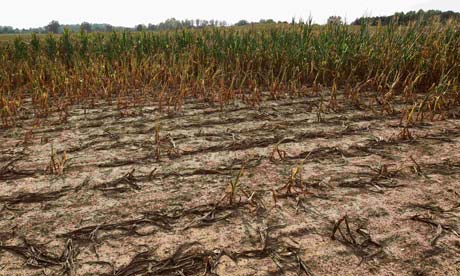
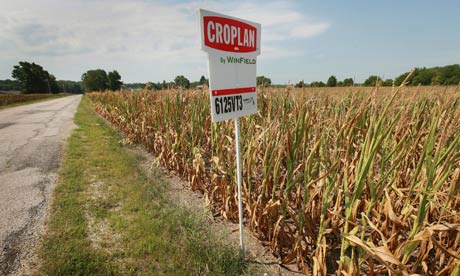
    Corn plants struggle to survive on a drought-stricken field in Oakland City, Indiana

    Corn plants struggle to survive in Indiana during the worst US drought in more than 50 years. Photograph: John Sommers Ii/Reuters

    The drought that has been parching the American midwest has brought growers to their knees. The United States Department of Agriculture (USDA) has officially stated that half of the nation’s corn crop is in poor or very poor condition. The cable news reports, with their panning scenes of acre upon acre of dead corn, are even worse. It looks like the setting of a post-apocalypse movie, not the breadbasket of a nation created by farmers. The few corn crops that are actually surviving are so rare that on Monday, prices sky rocketed to an all-time high of $8.20 a bushel, and counting.


    There’s a US government mandate that our unleaded fuel going into vehicles has to be approximately 13% ethanol. Regardless of supply, that currently remains the law. Which means if you are feeding hogs or steers, you’d better start stepping up to the bidding war for what remains – because the factories turning that same field corn into ethanol are not only buying it up, they are legally required to do so. And now a country lousy with corn is debating where to direct this year’s humble harvest: should the corn go into the SUV, or the burgers its passengers are waiting for?


    Livestock farmers and ranchers are fervently urging President Obama to stop allowing what little corn there is this season to be diverted into ethanol. I could not agree with them more. Not because I am worried about the availability or even the price of food, but because I find it inherently immoral to be turning edible calories poor people can’t afford into energy calories the wealthy can use to drive to the movies. Cars shouldn’t be eating better than your neighbours.


    It’s easy to get jaded when it comes to talking about food and farming in America. Corn and soy are the staples of modern conventional agriculture. They are a part of nearly every processed food (or the food’s packaging) in our fluorescent-lit aisles. But since corn is the ghostwriter behind the novel, prices will soar in places the public may not expect. Meat and milk, for example. If you are wondering why animals that eat grass are jumping up in price, you probably aren’t aware of how much corn is in your coffee creamer. A lot.

    At its heart and on paper, ethanol isn’t a horrible idea. But we all know that cheap oil is a thing of the past. There’s no doubt that alternative fuels should be utilised – but using food for fuel is an impossible idea for a sustainable future. It’s the acme of decadence and arrogance to think you can use the same crop that runs the food economy to run the motorised one as well.


    There is a silver lining: the chance for your local, sustainable farmers to step up to the plate and finally have a chance to compete with King Corn. If factory-farmed meat and dairy become significantly more expensive, farmers working with rotational grazing and other non-commercial methods of production might not only have the greener alternative, but the cheaper one. After all, a farm 30 minutes outside your city only has to deliver a handful of miles and used little inputs, if any, in their product. Will people start reaching out to sustainable farms as a financial choice instead of a value-based choice? I think they will. And when they taste their first bite of hand-kneaded hamburger on the grill, they may never go back. For the sake of our societal sanity – and for the animals whose welfare is far better on pasture than in a feedlot – I hope so.


    Perhaps the law will change, or even be revoked if the outcry is loud enough. If not, expect higher prices and a lot more veg stir fry than stroganoff. Perhaps then people will understand what the sustainable part in “sustainable farming” actually means. In the meantime, fill the ice box with T-bones and pray for rain.

  • Amazon deforestation falls again

    Amazon deforestation falls again

    Data from satellite images shows 23% reduction in deforestation from August 2011 to July 2012 against the previous year

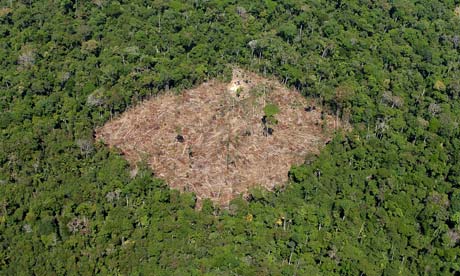
    A deforested area in southern Para state, Brazil - Amazon rainforest

    A deforested area in southern Para state, Brazil. Clearance rates in the Amazon have fallen by about three quarters since peak deforestation in 2004. Photograph: Jefferson Ruddy/AFP/Getty Images

    Deforestation in the Amazon rainforest has fallen again in the past 12 months, according to preliminary data published by Brazil‘s National Institute for Space Research.

    The reduction follows the passing of Brazil’s Forest Code in April, which green campaigners say weakened forest protection measurements, despite a partial veto by president Dilma Rouseff of the most controversial elements.

    Data from satellite images shows a 23% reduction in deforestation from August 2011 to July 2012 against the previous year, with 2,049 sq km being cleared compared with 2,679 sq km in the previous 12 months.

    The figures, published on Thursday, mark the continuation of a long-term trend that has seen clearance rates in the Amazon fall by about three quarters since peak deforestation in 2004.

    Brazil’s environment minister, Izabella Teixeria, said: “This is a great result, which makes us want to work even harder to tackle illegal deforestation.”

    But the figures from the Real Time Deforestation Detection System (Deter), may be revised upwards later after work by the separate Prodes project, which provides Brazil’s official annual deforestation figures. The Deter early warning system is relatively low resolution and can only detect deforestation larger than 25 hectares and can miss deforestation masked by cloud cover.

    Official figures published in June showed that annual deforestation was at a record low in the 12 months before 31 July 2011.

    The Brazilian government also announced that R$100m (£31m) from the country’s Amazon Fund will be given out in coming weeks to local projects that are shown to be maintaining the rainforest. Carlos Nobre, secretary for research and development policies and programmes at the ministry of science and technology, said: “Lasting reduction in deforestation requires more than enforcement and control.”

    Brazil also hopes to launch a new satellite in 2013 to help monitor clearing of the world’s largest rainforest, which is home to millions of species and is one of the world’s biggest stores of carbon.

    Greenpeace Brazil said in a statement that the new data showed that “it is possible to achieve zero deforestation in Brazil”.

  • Coral reef thriving in sediment-laden waters Posted: 31 Jul 2012 05:12 PM PDT

    ScienceDaily: Earth Science News


    Coral reef thriving in sediment-laden waters

    Posted: 31 Jul 2012 05:12 PM PDT

    Rapid rates of coral reef growth have been identified in sediment-laden marine environments, conditions previously believed to be detrimental to reef growth. A new study has established that Middle Reef – part of Australia’s iconic Great Barrier Reef – has grown more rapidly than many other reefs in areas with lower levels of sediment stress.

    Scientists probe link between magnetic polarity reversal and mantle processes

    Posted: 31 Jul 2012 06:47 AM PDT

    Scientists have discovered that variations in the long-term reversal rate of the Earth’s magnetic field may be caused by changes in heat flow from the Earth’s core into the base of the overlying mantle.
    You are subscribed to email updates fromScienceDaily: Earth Science News
    To stop receiving these emails, you may unsubscribe now.
    Email delivery powered by Go
  • Logging companies gain easy access to PNG’s forests, says Greenpeace

    Logging companies gain easy access to PNG’s forests, says Greenpeace

    Deforestation and land sales have blighted Papua New Guinea, but new prime minister ‘is progressive figure’, says Greenpeace

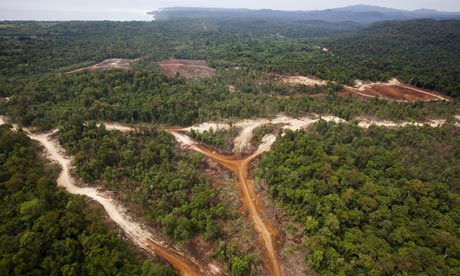
    MDG : Land grab in Papua New Guinea : logging and deforatation

    Roads to logging concessions in West Pomio, East New Britain province, Papua New Guinea. Photograph: Paul Hilton/Greenpeace

    More than 5m hectares (12.35m acres) of customary-owned land in resource-rich Papua New Guinea have been signed over to unrepresentative landowner companies and foreign-owned corporations for up to 99 years, according to a report by Greenpeace.


    Of the total 5.1m hectares covered by special agricultural and business leases (SABLs), 75%, or 3.9m hectares, are controlled by foreign-owned companies under 54 subleases or development agreements. Malaysian and Australian firms control at least 3m hectares through 32 SABLs.


    PNG has the world’s third largest tropical forest, but demand for its logs has led to extensive deforestation. A satellite study in 2008 said the forests of this south Pacific country were being chopped down so quickly that more than half of its trees could be lost by 2021.


    The 5.1m hectares of customary-owned land represent 11% of the country and more than 16% of accessible commercial forests. PNG log exports grew by almost a fifth in 2011, largely due to logging under SABLs. Since 2006, logging companies have exported more than 1.5 cubic metres of whole logs, netting $145m (£92m) for the mostly Malaysian companies involved. Almost all the logs were exported to China.


    The Greenpeace report, Up for Grabs, is highly critical of the previous government of Sir Michael Somare for allocating forests to industrial logging companies, which often occured against the wishes of people who live in PNG’s forests and customary landholders.


    “The previous Somare government continued this predatory relationship with customary landholders by actively facilitating the granting of SABLs with legislative amendments that enabled logging companies to gain easy access to customary-held forested land,” said Greenpeace.


    In May 2011, the PNG government announced a commission of inquiry into SABLs following international condemnation. The commission completed its inquiry in May this year, but will not be made public until it is tabled in parliament by the newly elected prime minister this year.


    Last week, PNG’s rival prime ministers ended a political feud that had left the country with two leaders for most of the past year. Somare, the elder statesman of South Pacific politics at 76 and the country’s first prime minister in 1975, recontested his seat despite being ill for much of last year. Peter O’Neill was voted in as prime minister after Somare was ruled ineligible due to his prolonged absence from parliament.


    Although O’Neill had the support of parliament, the supreme court twice ruled that Somare was the legitimate prime minister, leaving the country with rival leaders. Last week’s agreement means O’Neill is likely to head the new government and form a coalition with backing from Somare. O’Neill’s People’s National Congress party is expected to win most of the seats in parliament – 3,500 candidates stood for 100 seats. Votes are still being counted.


    Despite PNG’s mineral wealth, successive governments have been unable to deliver infrastructure or services to a country of 6.5 million people, with about 80% of the population living on subsistence village farming and small cash crops. The general elections were PNG’s eighth since independence from Australia in 1975.


    Greenpeace said O’Neill’s leadership could be a turning point in PNG’s land policy. “He is a progressive figure and is best placed to implement the findings of the commission of inquiry,” said Paul Winn, author of the report. “But he’s had to team up with Somare’s party, with vested interests, so he might find it difficult to implement the recommendations in full.” Winn said the commission had done a thorough job. “We believe it is a hard-hitting report, saying how elites have benefited from corruption.”


    The Greenpeace report said the single biggest issue highlighted during the commission’s inquiry was the lack of fair representation of customary landholders in agreeing to SABLs being granted over their land. The report pointed out that the Department of Lands and Physical Planning, the agency responsible for evaluating and granting SABL applications and registering subleases, was described by judicial authorities as grossly incompetent and entirely corrupt. In many cases, said Greenpeace, it was the corporations applying for logging or agricultural development that financed the government approval process.


    To address many of the underlying issues that led to PNG’s “land grab”, Winn said it was vital for the new government to seek international help – possibly from Norway, Japan and Australia – to develop a national land planning process to identify land to be used for development, conservation or tourism and to ensure that land use benefited all of the population.

  • US midwest drought worsens despite rains

    US midwest drought worsens despite rains

    The drought across the states that produce most of the country’s corn, soybeans and livestock has intensified, a report shows

    Indiana, drought, corn

    Corn plants struggle to survive in a drought-stricken farm field. Photograph: Scott Olson/Getty Images

    The most extensive drought in five decades intensified this week across the US midwest and plains states that produce most of the county’s corn, soybeans and livestock, a report from climate experts showed on Thursday.

    Almost 30% of the nine-state midwest was suffering extreme drought, nearly triple from the previous week, according to the US drought monitor for the week ending 24 July.

    Conditions in the midwest, which produces roughly three quarters of the corn and soybean crops in the world’s largest producer and exporter, worsened despite the first measurable rainfall in a month in some areas.

    More than 53% of the United States and Puerto Rico are in moderate drought or worse, a record-large amount for the fourth straight week in the drought monitor’s 12-year history.

    “The two-plus inches (of rain) from southern Wisconsin to northern Indiana was able to only maintain status quo. Most other areas were not as lucky,” said the drought monitor author Richard Heim of the National Climatic Data Centre.

    “Pasture, rangeland, and crop condition continued to deteriorate from the Colorado high plains to the Ohio and mid-Mississippi valleys, and from Oklahoma to the Dakotas,” he said.

    More than half of the country’s pastures have been rated poor or very poor by the US Agriculture Department, while the corn and soybean crops have wilted under scorching temperatures during their more vulnerable periods of pollination.

    A Reuters poll this week estimated the US corn yield at 130.8 bushels per acre, the lowest in 10 years.

    “This drought is two-pronged,” Fuchs said. “Not only the dryness but the heat is playing a big and important role. Even areas that have picked up rain are still suffering because of the heat.”

    Light showers overnight in the southwestern midwest were too little too late to prevent further losses in the crops, while heat of 38C or higher was forecast to continue into next week, Andy Karst, meteorologist for World Weather Inc, said on Thursday.