Category: Sustainable Settlement and Agriculture

The Generator is founded on the simple premise that we should leave the world in better condition than we found it. The news items in this category outline the attempts people have made to do this. They are mainly concerned with our food supply and settlement patterns. The impact that the human race has on the planet.

  • I won’t play games on reef: Burke

    I won’t play games on reef: Burke

    AAPJune 10, 2012, 10:20 am

    Environment Minister Tony Burke says he won’t play “pin the tail on the donkey” with the environment as the squabble over the Alpha coal mine with the Queensland government continues.

    The federal and Queensland governments have been warring for more than a week over the approval process for the $6.4 billion GVK-Hancock Coal mine, in central Queensland.

    The feud has prompted the federal government to ask Premier Campbell Newman to justify why it should continue the bilateral process for assessing mining projects, adopted to make approvals more efficient.

    Federal Environment Minister Tony Burke this week said he could not possibly sign off on the Queensland government’s conditional approval, calling it shambolic and dangerously deficient.

    Mr Burke said the Queensland government had cut corners in the process.

    “It’s not a game of pin the tail on the donkey where you blindfold yourself, put conditions there, and take the blind fold off in several years time to see whether or not it worked,” he told ABC TV on Sunday.

    “I can’t put conditions on unless the work has been down to assess what those conditions should be.”

    He not prepared to “guess the conditions” because the approval could be overturned by court action down the track.

    “That would be the worst outcome for investment and a ridiculous outcome for the environment,” he said.

    Mr Burke said the mine and rail link to the port could impact on the Great Barrier Reef.

    “The biggest impact we have on the Barrier Reef is run off from the land,” he said.

    “These rail works go all the way to the coast, you need to do significant earth works because you’re completely levelling it.”

    His preference is for the Queensland government to finish the job and in the future give the federal government more notice if it’s only going to do half the job.

    Mr Burke is confident the environmental approval process will be finalised by the end of the year when the companies will make their final investment decisions.

    Queensland has until June 20 to prove it is capable of working on a streamlined process.

  • Amazon deforestation at record low, data shows

    Amazon deforestation at record low, data shows

    Rate of illegal logging has fallen, but critics claim Brazil has weakened protection measures by revising Forest Code

    Damian blog : Amazon Deforestation

    Truck filled with ilegal wood in the vicinities of Anapu, Para, Brazil. In 2008, Brazil saw a record rate of deforestation in the Amazon – now it has fallen to its lowest level. Photograph: Paulo Fridman/Corbis

    Deforestation of the Amazon has fallen to its lowest levels since records began, according to data recently released by Brazil’s National Institute for Space Research.

    The boost for the environment comes a week after president Dilma Rousseff was criticised for weakening the forest protection measures widely credited for the improvement, and two weeks before Brazil hosts the Rio+20 Earth summit.

    Using satellite imagery, the institute said 6,418 sq km of Amazon forest was stripped in the 12 months before 31 July 2011 – the smallest area since annual measurements started in 1988.

    The data continues an encouraging trend. Since the peak deforestation year of 2004, the rates of clearance have fallen by almost 75%.

    “This reduction is impressive; it is the result of changes in society, but it also stems from the political decision to inspect, as well as from punitive action by government agencies,” Rousseff said.

    She was speaking at a ceremony on Tuesday to mark the opening of two new nature reserves: the 34,000-hectare (83,980 acres) Bom Jesus Biological Reserve in Paraná, and the 8,500-hectare (20,995 acres) Furna Feia National Park in Rio Grande do Norte.

    To mark World Environment Day, the Brazilian president also signed a number of other measures to expand existing parks, protect areas of biodiversity and recognise the land rights of indigenous communities.

    Rousseff said Brazil was “one of the most advanced countries” for sustainable development, but its impressive efforts have been undermined by new legislation that reduces requirements on farms created by illegal logging to reforest portions of cleared land.

    Under domestic and international pressure, Rousseff vetoed 12 of the most controversial sections of the revised Forest Code, but environmentalists are furious that many other changes will go through.

    The Brazilian government insists that the compromise was a realistic balance of agricultural and environmental priorities. Environment minister Izabella Teixeira says 81.2% of the country’s original forest remains – one of the highest levels in the world.

    But 10 former environment ministers have criticised the measures as a “retrograde step”. In an unusual cross-party collaboration, they jointly signed a letter opposing the change to a code that they described as “the single most relevant institutional basis for the protection afforded to forests and all the other forms of natural vegetation in Brazil.”

    Amazon Deforestation Amazon deforestation over the years

    Economic and technological factors have also contributed to the slowing of clearance rates. The rise in the value of the Brazilian currency and the fall of soya and beef prices in the wake of the 2008 global financial crisis eroded the incentive for land clearance for agricultural exports.

    Implementing regulations remains extremely difficult in the wild west-like frontiers of the Amazon and the interior forest regions. But enforcement has been strengthened by increasingly precise satellite monitoring by the National Institute for Research in the Amazon.

    This November, Brazil plans to launch a new satellite with a resolution of five metres, up from the current level of 250 metres. With close-to-real-time date, the central authorities are able to quickly notify federal police and environment officials about ongoing, illegal land clearance operations.

    The government has also responded rapidly and flexibly. After a two-month spurt of clear-cutting in Mato Grosso early last year, it established a task force to strengthen countermeasures and sent 700 inspectors to the region. This year, eight municipalities were added to the list of critical areas, bringing them under closer inspection.

    According to local media, the task force has apprehended 325 trucks, 72 bulldozers and 62,000 cubic metres of illegally cut timber and embargoed 79,500 hectares of land in the region.

    The environment ministry says further factors in the drop of deforestation are regularisation of land tenure, initiatives to encourage sustainable practices and the expansion of protected areas. According to the UN Global Biodiversity Outlook, Brazil accounts for nearly 75% of the 700,000 sq km of protected areas created around the world since 2003.

  • Barry O’Farrell’s big cash to build houses across NSW

    Barry O’Farrell’s big cash to build houses across NSW

    0
    Barry OFarrell

    Housing cash splash … Premier Barry O’Farrell. Source: The Daily Telegraph

    THE state’s lagging housing market will get a much-needed kick start, with the O’Farrell government extending stamp duty concessions to entice homebuyers.

    As the Big Four banks yesterday finally passed on interest rate cuts, Treasurer Mike Baird said he would provide developers with a $200 million budget sweetener to build properties in growth areas on Sydney‘s fringe.

    Stamp duty concessions for people who buy off-the-plan units or house-and-land packages will be extended and hundreds of millions of dollars will go towards an infrastructure fund to get homes built.

    Mr Baird is expected to announce in Tuesday’s state budget that an initial two-year scheme to axe stamp duty for people buying off-the-plan – up to $600,000 – will be extended indefinitely, with the stamp duty threshold lifted to at least $650,000.

    There is a trade-off. Homebuyers will receive concessions of only between 25 per cent and 50 per cent of stamp duty. The new home concession had been due to expire on June 30.

    It can also be revealed that about $200 million will flow into a special fund to encourage developers to build homes in the northwest and southwest growth centres of Sydney.

    The move is part of attempts to get the economy moving through the property market.

    Government sources confirmed the money would fund road and sewage infrastructure, rather than requiring that developers fund the work.

    To help pay for the scheme, the government will cut 10,000 public service jobs, lift speeding fine revenue by $12.5 billion and leave $2.4 billion aside to fund a major road, such as the M5 duplication.

    Mr Baird has signalled a deficit of $826 million for 2012-13 followed by three surpluses. There will be a small deficit in 2011-12.

    In 2010, the previous state Labor government announced the stamp duty concession for all off-the-plan apartments.

    In his last budget, Mr Baird axed the concession for other first-home buyers, but kept it for those buying new homes, and raised the threshold to those properties worth up to $835,000.

    The Property Council has been lobbying the O’Farrell government to retain the off-the-plan and house-and-land package concession as well as lift the threshold.


  • Rio+ 20 Earth summit could collapse, WWF warns

    Rio+ 20 Earth summit could collapse, WWF warns

    Countries fail to agree on draft text for sustainable development goals and definition of key objectives including green economy

    • guardian.co.uk, Wednesday 6 June 2012 14.10 BST
    • Rio+20 : logo at Security Control Centre

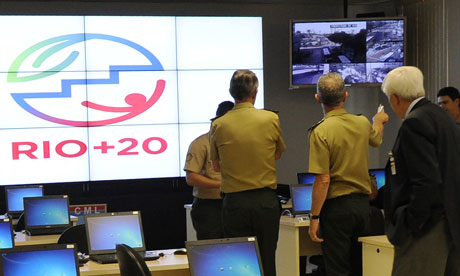
      Rio+20 Earth summit aims to bring together 120 countries to set a new path on sustainable development but there are deep divisions. Photograph: Vanderlei Almeida/AFP/Getty Images

      The Rio+ 20 Earth summit could collapse after countries failed to agree on acceptable language just two weeks before 120 world leaders arrive at the biggest UN summit ever organised, WWF warned on Wednesday.

      An extra week given over to the UN’s preparatory negotiations in New York fell into disarray over the weekend as talks aimed to bring countries together to set a new path for sustainable development splintered into 19 separate dialogues with major internal disagreements on the processes to be followed.

      “We are facing two likely scenarios – an agreement so weak it is meaningless, or complete collapse. Neither of these options would give the world what it needs. Country positions are still too entrenched and too far apart to provide a meaningful draft agreement for approval by an expected 120 heads of state”, said WWF director general Jim Leape.

      Countries are not being asked by the UN to legally commit themselves to anything, but only to sign up to an aspirational “roadmap” contained in a document called “the future we want” and to a commitment to the so-called ‘green economy’ of jobs generated from industries such as renewable energy and energy efficiency. It is hoped that they will also agree to introduce by 2015 a set of sustainable development goals (SDGs) similar in ambition to the millennium development goals which covered areas like HIV reduction and clean water provision. The SDGs could cover areas such as energy, water and food.

      However, in a repeat of battles played out in global climate and trade talks, they have fought bitterly over every comma and phrase in the prepartory meetings and in particular are still deeply divided over the definition and scope of the phrase “green economy”. They are now expected to take several years to identify, formulate and agree on the goals.

      According to both WWF and Malaysia-based NGO Third World Network, the most recent draft text put forward in New York was a “significant weakening” of previous drafts, particularly in the areas of valuing natural wealth and ocean protection.

      The best that is now likely to come from Rio is a process aimed to achieve agreement over many years, and a series of eye-catching initiatives proposed by individual countries, UN bodies and large businesses often working together. These include actions to make transport more sustainable, reduce hunger, improve the health of oceans, and to provide electricity for everyone in the world.

      Definition of the concept and principles guiding the “green economy” have proved the hardest to reach because what is decided at Rio could favour or limit the development of some countries. The EU and other rich countries want all countries to agree to remodel their economies to manage resources more efficiently, develop renewable and low carbon energy, and reduce pollution.

      But G77 countries have argued that while the goal is acceptable, they risk being at a competitive disadvantage in the race for future global markets and are suspicious that the green economy is a pretense for rich countries to erect “green” trade barriers on developing country exports.

      They further argue that if they are to sign up to the “green economy”, there should be commitments by rich countries to new finance and technology transfer agreements – something so far unacceptable to the US and EU.

      Many environment and development NGOs are also fearful of the green economy proposals, which they believe will encourage countries to put monetary value on all nature, reducing forest and ocean protection to markets and profits and undermining principles of ecological justice and collective wellbeing.

      “Instead of putting a price on nature we must recognise that Nature is not a thing or mere supplier of resources. What we need is to forge a new system of development based on the principles of collective wellbeing, social and environmental justice and the satisfaction of the basic necessities of all”, said Pablo Solon, former Bolivian ambassador to the UN and now director of Bangkok-based NGO Focus on the Global South .

      “We cannot keep promoting such destructive model of development that does not acknowledge the planetary limits of economic growth”, he said.

      Divisions between the countries are now thought to be as deep as any seen in the long-running and separate climate negotiations. Many developing countries are said to be distraught that the US is consistently trying to bury the principles guiding sustainable development agreed after fierce struggles at the Rio earth summit in 1992 and its follow-up meeting in Johannesburg in 2002.

      “We are in real danger of going backwards. [The US] wants to reject principles including national sovereignty, the right to development, common but differentiated responsibilities and the obligation not to cause environmental harm”, said one observer.

      Despite the differences, UN leaders remained upbeat. “I sense a real dialogue – a real willingness to find common ground,” said Rio+20 Secretary-General Sha Zukang. “This spirit is encouraging, and we must carry it to Rio.”

      Kim Sook, ambassador of the Republic of Korea and co-chair of the preparatory committee said that before the negotiations, only 6% of the text had been agreed upon. Now, that number has jumped to more than 20%, with many additional paragraphs “close to agreement”.

  • Burke takes control of Alpha reef mine study

    Burke takes control of Alpha reef mine study

    Updated June 07, 2012 17:30:29

    The Federal Government will take over the environmental assessment of Queensland’s Alpha Coal Project after a tug-of-war with the State Government.

    Queensland and the Commonwealth have been at loggerheads over environmental approval for the $6 billion Galilee Basin mine.

    The state had completed its assessment, but Federal Environment Minister Tony Burke said it was incomplete and asked for more information.

    Mr Burke today met with Queensland Deputy Premier Jeff Seeney and the Environment Minister Andrew Powell to try to break the impasse.

    Mr Burke says his department will complete the assessment process, and there will be negotiations in coming days to try to avoid a repeat of this stand-off.

    He had previously threatened to scrap a bilateral agreement with the state on environmental approvals, but he now says he is willing to consider amendments.

    The state and federal governments had been working together on a single environmental approval process for the project, but earlier this week Mr Burke said Queensland had not upheld its end of the deal.

    He said the Queensland approval process had been “hopeless” and fell “abysmally short” of what is required under the bilateral agreement.

    In a letter to Queensland Premier Campbell Newman, Prime Minister Julia Gillard wrote that any “breach of this agreement is unacceptable to the Commonwealth”.

    “I am particularly concerned that Queensland’s decision has immediately put at risk community and business confidence in the ability of Queensland to work with the Commonwealth,” she wrote.

    “The Commonwealth will, as a result, work directly with Alpha Coal to complete the assessment process and resolve any remaining uncertainties for the project.”

    Mr Newman hit back, accusing Mr Burke of politicking.

    Mr Newman later told ABC Local Radio that he would be happy for the Commonwealth to take over the approval process if necessary.

    “I don’t care particularly how it’s done, he [Tony Burke] can actually approve the project as far as I’m concerned, but approve it he must, subject to conditions,” Mr Newman said.

    The Alpha Coal Project’s location in the Galilee Basin means it could have an impact on the health of the Great Barrier Reef.

    The proposal includes a 495-kilometre railway line to Abbot Point near Bowen, north of Mackay.

    The project would create an estimated 3,500 construction jobs and 1,000 operational positions – and inject about $1 billion into Queensland’s economy each year.

    Topics:federal—state-issues, industry, mining-industry, environmental-impact, environment, mining-environmental-issues, government-and-politics, states-and-territories, gladstone-4680, australia, qld

    First posted June 07, 2012 15:45:20

  • Wallflowers of the Earth system

    Wallflowers of the Earth system

    Posted: 03 Jun 2012 04:16 PM PDT

    In cities, the presence of algae, lichens, and mosses is not considered desirable and they are often removed from roofs and walls. It is, however, totally unfair to consider these cryptogamic covers, as the flat growths are referred to in scientific terms, just a nuisance. Scientists have discovered that these mostly inconspicuous looking growths take up huge amounts of atmospheric carbon dioxide and nitrogen and fix it at the earth’s surface. Cryptogamic covers are responsible for about half of the naturally occurring nitrogen fixation on land and they take up as much carbon dioxide as is released yearly from biomass burning. These new findings will help to improve global flux calculations and climate models, in which up to now the carbon and nitrogen balance of the cryptogamic covers have been neglected.
    You are subscribed to email updates from ScienceDaily: Earth Science News
    To stop receiving these emails, you may unsubscribe now.
    Email delivery powered by Google
    Google Inc., 20 West Kinzie, Chicago IL USA 60610