Category: Sustainable Settlement and Agriculture

The Generator is founded on the simple premise that we should leave the world in better condition than we found it. The news items in this category outline the attempts people have made to do this. They are mainly concerned with our food supply and settlement patterns. The impact that the human race has on the planet.

  • Mounting credit card bills drive bankruptcy boom in western suburbs

    Mounting credit card bills drive bankruptcy boom in western suburbs

    Nicole Hasham

    April 11, 2012

    MOUNT DRUITT, Campbelltown and Liverpool have emerged as Sydney’s bankruptcy hot spots as families succumb to mounting credit card debt and chronic unemployment.

    The three suburbs topped a list compiled by the federal agency Insolvency and Trustee Service Australia, which revealed the NSW postcodes most vulnerable to bankruptcy last financial year.

    The 2770 postcode – Mount Druitt, Minchinbury and surrounds – was the worst affected, with 163 bankruptcy declarations.

    In the Campbelltown area postcode of 2560, 146 debtors slipped into the red, closely followed by 144 in the Liverpool-Casula postcode 2170.

    The central coast postcodes of 2259, 2250 and 2261, which centre on Lake Munmorah, Gosford and The Entrance, rounded out the top six with 100 or more bankruptcies each.

    It is the first time ITSA has published personal insolvency activity by postcode. The data is not adjusted for the variation in population between postcodes.

    Sydney’s well-heeled suburbs were not immune to financial distress. In the wealthy 2088 postcode, which includes Mosman and Spit Junction, 22 debtors filed for bankruptcy. It was closely followed by 19 in the 2030 postcode of Dover Heights and Vaucluse.

    The Mount Druitt MP, Richard Amery, said high unemployment, coupled with a large number of single-parent families, meant residents in his low-income electorate were financially vulnerable.

    “Whilst it’s an area where real estate values are moderate, you can still overcommit yourself and … [many] people see bankruptcy as the only way out of the debt spiral,” he said. Poor financial education was also to blame, he said. “A lot of people leave school unequipped to handle finance, they [don’t know] the implications of buying all your furniture on an 18 per cent credit card or a 25 per cent department store credit arrangement.”

    Rachael Witton, a director of the financial services company Debt Rescue, said bankruptcy statistics captured only a small proportion of those in debt stress.

    “[They] are just the ones who are taking action. A far greater number of people are in denial,” she said. “We are meeting people who haven’t opened mail for 12 months – it’s just too much to get their head around, they don’t know where to start.”

    Relationship breakdown and unemployment were the common thread in many bankruptcies, but this summer’s natural disasters would prove too much for others, Ms Witton said.

    “In the Riverina … we’ll find inquiries will peak for another month or two yet. People are struggling day-to-day, then something else just tips them over the edge,” she said.

    Read more: http://www.smh.com.au/money/mounting-credit-card-bills-drive-bankruptcy-boom-in-western-suburbs-20120410-1wn1f.html#ixzz1rgmU3FHl

  • Gunns delays return to trade

    Gunns delays return to trade

    ABCApril 10, 2012, 9:55 am

    The Tasmanian timber producer Gunns has extended its month-long trading halt as it continues negotiations on a $400 million capital raising plan.

    The company has told the stock market that it will provide another update on the plan next Monday.

    The capital raising comes after the Richard Chandler Corporation last month scrapped its $150 million bid to take up to 40 per cent of Gunns.

  • Big spending fails to boost infrastructure

    Big spending fails to boost infrastructure

    Matt Wade

    April 10, 2012

    NSW Premier Barry O'Farrell.

    Pledge to reduce the infrastructure “backlog” … Premier Barry O’Farrell. Photo: Lee Besford

    INFRASTRUCTURE spending in NSW has more than doubled in the past five years, defying the conventional wisdom that underfunding is responsible for gridlocked roads and overcrowded trains.

    But even as two separate studies debunk public perceptions and political claims about inadequate capital spending, their authors say the state’s infrastructure woes, at least in part, reflect the inefficient allocation of that money.

    Appointed by the Premier, Barry O’Farrell, to conduct an exhaustive audit of the state’s finances, the former Treasury secretary Michael Lambert could not find any evidence of underinvestment in infrastructure during the past 15 years.

    The audit says that in the 10 years to 2010-11, the total capital program grew at an average rate of 12 per cent a year.

    Between 2005-06 and 2008-09 the growth rate was a healthy 17.6 per cent a year.

    “There is no evidence of underspending on infrastructure in NSW, based on total private and public sector expenditure trends and comparing the state with other jurisdictions,” Mr Lambert found.

    In a separate analysis, the University of Sydney economist Russell Ross found that, after adjusting for inflation, capital works expenditure more than doubled between 2005-06 and 2010-11 in real terms.

    Mr Lambert’s investigation shows that public- and private-sector infrastructure spending rose markedly as a proportion of final demand – a measure of the state’s economic output – during the past decade.

    Infrastructure spending as a share of final demand varied between 1.5 per cent and 2 per cent for most of the 1990s and early 2000s but then rose steadily to more than 3 per cent by 2010.

    “The Labor years were … a period of high spending on capital works,” Associate Professor Ross said.

    The findings suggest poor planning, not a lack of spending, stoked voter resentment about infrastructure.

    Mr Lambert and Associate Professor Ross raise questions about the management of infrastructure spending during the past decade. Mr Lambert found the large transport infrastructure program had “not been assembled through a disciplined capital planning and appraisal process”.

    Associate Professor Ross said Labor’s infrastructure spending was often “inefficient”, although it was difficult to tell how much was wasted.

    “A lot of exploratory work that doesn’t end up going anywhere is included in the capital works budget,” he said. “It’s not as if a billion dollars spent on capital works actually results in a billion dollars’ worth of new infrastructure.”

    One example was the CBD metro line, which cost more than $400 million in compensation and administration costs before being axed.

    Michael Egan, the treasurer from 1995 to 2005, said infrastructure investment under the Carr and subsequent Labor governments was higher than under any previous NSW government.

    But he believed most voters were unaware of many big government projects such as Labor’s Rail Clearways Program, which he said was “probably the most important capital spending” on Sydney’s rail system for half a century or more.

    “I’m sure that if people don’t regularly see something happening, they assume nothing is happening,” he said.

    The O’Farrell government has pledged to reduce the infrastructure “backlog”.

    But the findings by Associate Professor Ross and Mr Lambert underscore how difficult it will be to fulfil voter hopes for a dramatic improvement.

    “To bring infrastructure up to scratch it’s going to involve almost a quantum leap in spending, and no government is going to be able to do that easily in Australia,” Associate Professor Ross said.

    Read more: http://www.smh.com.au/nsw/big-spending-fails-to-boost-infrastructure-20120409-1wl67.html#ixzz1racYZkg3

  • New forage plant prepares farmers for climate change

    ScienceDaily: Severe Weather News


    New forage plant prepares farmers for climate changes

    Posted: 04 Apr 2012 07:29 AM PDT

    Plant researchers have developed a new type of the corn-like crop sorghum, which may become very significant for food supplies in drought-prone areas. Unlike the conventional drought-resistant sorghum plant, which is an important crop in Africa, China and the USA, this new type does not form toxic cyanide when exposed to long-term drought.
    You are subscribed to email updates from ScienceDaily: Severe Weather News
    To stop receiving these emails, you may unsubscribe now.
    Email delivery powered by Google
    Google Inc., 20 West Kinzie, Chicago IL USA 60610
  • Fair Work may table HSU report

    Fair Work may table HSU report

    Updated April 05, 2012 09:15:08

    Sorry, this video cannot be played. You may need to install the latest version of Adobe Flash

    Video: Liberal Senator George Brandis joins Lateline(Lateline)

    Fair Work Australia may indicate as early as today whether it will show a Senate committee its report into the troubled Health Services Union (HSU), making the document public.

    Amid the controversy surrounding the document, the Australian Council of Trade Unions (ACTU) will meet today to determine whether the HSU should be suspended from its ranks.

    Yesterday Chris Craigie, the Commonwealth Director of Public Prosecutions (DPP), revealed a further investigation is required before he can decide whether any of the four people named in the Fair Work report should be prosecuted.

    He says the DPP is not an investigation agency, instead assessing matters for prosecution.

    Mr Craigie says Fair Work Australia’s investigation was not a criminal investigation or a brief of evidence, but nonetheless he will examine the report to decide what should happen next.

    The man at the centre of the controversy, former HSU boss and current Labor MP Craig Thomson, has always maintained his innocence in the face of allegations he used a union credit card to pay for prostitutes.

    Prime Minister Julia Gillard has backed Mr Thomson, saying she has seen nothing to alter her statements of confidence in him.

    But that has not stopped the Opposition hammering the Government and Fair Work Australia over the decision to keep the report under wraps.

    The outcome threatens to topple the fragile minority Government if Mr Thomson is forced from his seat.

    Coalition workplace relations spokesman Senator Eric Abetz today continued the Opposition’s attack on the issue.

    “We know that they’ve refused to make Freedom of Information requests available until appeals to the Information Commissioner were held,” he told AM.

    “But now that a bipartisan committee of the Parliament has requested that of Fair Work Australia I would invite them to cooperate just for this once,”

    Fair Work’s summary of its investigation does not name anyone or detail any of the 181 breaches.

    Opposition Leader Tony Abbott says the issue has reached an unacceptable impasse, and wants Fair Work Australia to change its report immediately.

    “Fair Work Australia needs to ensure that the material it has given to the DPP is useful and if in its current form it is not useful, it needs to ensure that the investigation is converted into a brief of evidence that the DPP can use and it must happen now,” he said.

    “If it can’t happen or if it doesn’t happen, the public will come inevitably to the conclusion that there is some kind of protection racket operating here.”

    Ongoing process

    However, Workplace Relations Minister Bill Shorten denies the issue is at a dead end and says the process is ongoing.

    “What they have actually said is that whilst they are not a criminal investigative body, effectively they are lawyers not policemen, they are going to examine the material to see what should next happen with it,” Mr Shorten said.

    “So I don’t think the matter is not going anywhere. I think the DPP said they are going to look at it and determine what to do next.”

    Meanwhile, the ACTU says it wants to distance itself from the allegations lapping around the union Mr Thomson once led, and is set to suspend the HSU when it meets today.

    The HSU’s acting national president, Chris Brown, says he will do what he can to convince the ACTU not to follow through with its threat.

    “Our members have already been through a lot, and for them to be punished even further by our own union movement is extremely disappointing,” he said.

    “We’ll be doing everything that we can to try and convince those people on the national executive that will be voting on this that this is a silly course of action to take.”

    But HSU national secretary Kathy Jackson says the ACTU’s threat shows total ignorance of the changes the HSU has put in place.

    Ms Jackson says she will use today’s meeting to seek support from the executive to call on Fair Work Australia to release the full HSU report.

    Topics:unions, alp, federal-government, government-and-politics, australia

    First posted April 05, 2012 09:10:54

  • Shifting foundations threaten to undermine China’s cities

    Shifting foundations threaten to undermine China’s cities

    Urban growth and depletion of groundwater blamed for land subsidence in Shanghai and elsewhere

    • Guardian Weekly, Tuesday 3 April 2012 13.59 BST
    • Article history
    • China financial district

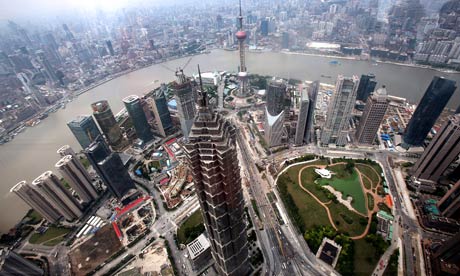
      Sinking feeling … a view from the the Shanghai World Financial Centre in 2008. The 492-metre tower will be dwarfed by the 632-metre Shanghai Tower, due for completion in 2014. Photograph: STR/Getty

      A crack in the tarmac on a road in the middle of the Pudong business district told Shanghai residents that the subsoil of their city was shifting. It was not so much the size of the rift – about eight metres long and only a few centimetres across – more its location that caused concern. It was at the foot of the Shanghai Tower project.

      Due for completion in 2014, the tower will stand 632 metres high, and is just next to two other giants, the World Financial Centre and Jinmao Tower, rising, respectively, 492 and 420 metres into the air.

      The appearance of cracks in the ground and the publication of photographs on blogs have fuelled questions in recent weeks. “The surface cracks, which were caused by a usual settlement of the foundation ditch, are in a controlled and safe state,” the Shanghai Tower Construction and Development Company said in a statement to the China Daily.

      The problem of subsidence in Chinese cities is nevertheless very real. “The pressure exerted by skyscrapers is a minor cause,” says Li Qinfen, a researcher at the Shanghai Institute of Geological Survey. Excessive pumping of groundwater to service new urban developments is the key factor.

      The crack in the road has rekindled an old story, which claims that Shanghai is gradually sinking. The centre of China’s business capital has subsided by 2.6 metres since 1921, when the first surveys were carried out. The city stands on the Yangtze river delta, which rests on a layer of sediment, consisting mainly of clay and about 300 metres thick. After studying data from various surveys Dr Jin-Chun Chai, a professor at Saga University in Japan, concluded in a scientific journal: “The field data shows that there is a strong correlation between the rate of net groundwater pumping and the rate of land subsidence.”

      Shanghai’s average annual subsidence from 1921 to 1949 was 2.5cm, according to official data. With increasing depletion of groundwater reserves the rate rose to 10cm a year in 1957-61. From 1966 onwards measures to restrict underground pumping slowed this trend. But in the 1980s, as the economy was opened up, water depletion and subsidence resumed, according to Li.

      Last October, a hole appeared suddenly on a street near the main railway station. Then on 9 March, a 7km stretch of high-speed rail line collapsed in Hubei province. The line was due to open to passenger traffic in May and trials were already under way. A director of the provincial railway construction bureau, Wang Zujian, blamed the “unique local geological structure”.

      According to a recent study by the Institute of Geology and Geophysics, 50 fast-expanding cities are affected by this type of subsidence, mainly due to excessive use of groundwater. The rise in demand is due to people migrating to the cities, to changing patterns of consumption and industrial growth.

      Since the People’s Republic was established in 1949, 79,000 sq km of land has subsided by more than 20cm, above all on the north China plain, in the central mining provinces (Shanxi and Shaanxi), and on the Yangtze delta, according to the authorities. A plan presented in February by the land and resources ministry aims to halt subsidence in all three critical areas by 2015 by limiting water withdrawal. The plan will be applied to the whole country in 2020.

      Shanghai – doomed, according to some observers, to suffer a similar fate to Atlantis – has in fact already taken action to reverse the trend, injecting about 60,000 tonnes of water a year into its aquifers, according to the city council.

      This story originally appeared in Le Monde