Category: News

Add your news
You can add news from your networks or groups through the website by becoming an author. Simply register as a member of the Generator, and then email Giovanni asking to become an author. He will then work with you to integrate your content into the site as effectively as possible.
Listen to the Generator News online

 
The Generator news service publishes articles on sustainable development, agriculture and energy as well as observations on current affairs. The news service is used on the weekly radio show, The Generator, as well as by a number of monthly and quarterly magazines. A podcast of the Generator news is also available.
As well as Giovanni’s articles it picks up the most pertinent articles from a range of other news services. You can publish the news feed on your website using RSS, free of charge.
 

  • Two degrees of warming closer than you may think | It’s time to ‘Do the math’ again

    2 of 23

    Two degrees of warming closer than you may think | It’s time to ‘Do the math’ again

    Inbox
    x

    Neville Gillmore <nevilleg729@gmail.com>

    Jun 7 (5 days ago)

    to me

    23 August 2014

    Dangerous climate change: Myths and reality (2)

    Second in a 3-part series | Part 1 | Part 3

    by David Spratt
    Download report (16 pages)

    Myth 3: Big tipping points are unlikely before 2°C

    Tipping points, often an expression of non-linear events, are difficult to project. But if it is sometimes hard to see tipping points coming, it is also too late to be wise after the fact. Estimated tipping points around or below ~1.5ºC include: 

    • West Antarctic Ice Sheet: Current conditions affecting the West Antarctic Ice Sheet are sufficient to drive between 1.2 and 4 metres of sea rise, and these glaciers are now in “unstoppable” meltdown at global average warming of just 0.8ºC (NASA, 2014A; Rignot, Mouginot et al., 2014; Joughin, Smith et al., 2014). 

    • Loss of summer Arctic sea-ice: Because climate models generally have been poor at dealing with Arctic sea-ice retreat (see summary of literature at Spratt, 2013), expert elicitations play a key role in considering whether the Arctic has passed a very significant and “dangerous” tipping point, including Steffen (quoted by Cubby, 2012), Livinia and Lenton (2013), UWA (2012), Serreze (quoted by Romm, 2012), Wadhams (2012, and quoted by Vidal, 2012), Maslowski, Kinney et al. (2012) and Laxton (quoted by McKie, 2012). Duarte, Lenton et al. (2012) find that: “Warming of the Arctic region is proceeding at three times the global average, and a new ‘Arctic rapid change’ climate pattern has been observed in the past decade.” Reductions in the sea-ice cover are believed to be the largest contributor toward Arctic amplification. Maslowski, Kinney et al. (2012) note that: “a warming Arctic climate appears to affect the rate of melt of the Greenland ice sheet, Northern Hemisphere permafrost sea-level rise, and global climate change”. It is worth noting that one month of sea-ice-free summer conditions in the Arctic each year would add approx. 0.2°C to global warming (Hudson, 2011), an event that though credible in the next few decades is not taken into account in any carbon budget modelling. 
    • Greenland Ice Sheet (GIS): Current-generation climate models are not yet all that helpful on GIS. They have a poor understanding of the processes involved, and acceleration, retreat and thinning of outlet glaciers are not represented (Maslowski, Kinney et al., 2012). Estimated tipping point for GIS is +1.6ºC with an uncertainty range of +0.8 to +3.2ºC (Robinson, Calov et al., 2012). A recent study finds that deep canyons will contribute to more rapid GIS deglaciation (NASA, 2014B; Morlighem, Rignot et al., 2014). Contrary to previous studies, that estimated it would take centuries to millennia for new climates to increase the temperature deep within ice sheets such as GIS, the influence of melt water means warming can occur within decades and produce rapid accelerations (Phillips, Rajaram et al., 2013; University of Colorado Boulder, 2013). As well, “rapid iceberg discharge is possible in regions where highly crevassed glaciers are grounded deep beneath sea level, indicating portions of Greenland and Antarctica that may be vulnerable to rapid ice loss through catastrophic disintegration” (Basis and Jacobs 2013). Informally, many leading cryosphere scientists say the GIS has passed its tipping point, “is already lost” and similar sentiments (pers. com.). With Arctic amplification of around three times average global warming, it is hard to conceive that GIS deglaciation will other than continue to accelerate as reflectivity declines, and late-summer ocean conditions become ice-free. In 2012, then NASA climate science chief James Hansen told Bloomberg that: “Our greatest concern is that loss of Arctic sea ice creates a grave threat of passing two other tipping points – the potential instability of the Greenland ice sheet and methane hydrates… These latter two tipping points would have consequences that are practically irreversible on time scales of relevance to humanity” (Morales, 2012).  
    • Coral reefs: “Preserving more than 10 per cent of coral reefs worldwide would require limiting warming to below +1.5°C (atmosphere–ocean general circulation models (AOGCMs) range: 1.3–1.8°C) relative to pre-industrial levels” (Frieler, Meinshausen et al., 2013). At 10 per cent, the reefs would be remnant, and the ecosystems as we know them today would be a historical footnote. Data suggests the area of reef systems has already been reduced by half around the world.  
    • Permafrost:  In February 2013, scientists using radiometric dating techniques on Russian cave formations to measure melting rates warned that a 1.5ºC global rise in temperature compared to pre-industrial was enough to start a general permafrost melt. Vaks, Gutareva et al. (2013) found that “global climates only slightly warmer than today are sufficient to thaw extensive regions of permafrost.” Vaks says that: “1.5ºC appears to be something of a tipping point”. In May 2013, Brigham-Grette, Melles et al., (2013) published evidence from Lake El’gygytgyn, in north-east Arctic Russia, showing that 3.6–3.4 million years ago, summer mid-Pliocene temperatures locally were ~8°C warmer than today, when CO2 was ~400 ppm (a similar level to today). This is highly significant because researchers say the tipping point for large-scale permafrost carbon loss is around +8ºC to 10ºC regional temperature increase (Bitz, Ridley et al, 2009). As well, research from Ballantyne, Axford et al. (2013) finds that during the Pliocene epoch, when CO2 levels were ~400 ppm, Arctic surface temperatures were 15-20°C warmer than today’s surface temperatures. Soon to be published work by Shakhova and Semiletov, as a follow-up to their 2013 paper on shallow-water, sea-floor sediment cores on the East Siberian Arctic Shelf, finds the ocean floor permafrost layer at “thaw point” temperature and “slushy” (pers. com.), suggesting vulnerability of the underlying methane hydrate stability zone, in the area where vast new methane plumes in the ocean are being observed in the 2014 northern summer (Papadopoulou, 2014).
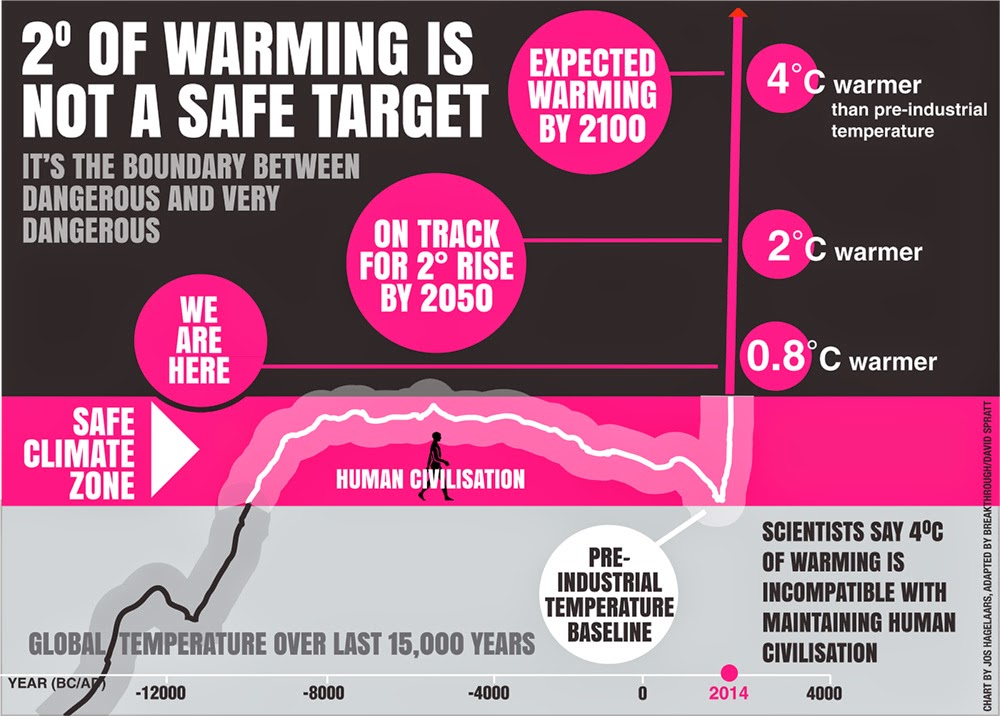
    Figure 2: 2°C of warming is not a safe target. The temperature reconstruction of Shakun, Clark et al. (2012) and Marcott, Shakun et al. (2013) is combined with the instrumental period data from HadCRUT4 and model average of IPCC projections for the A1B scenario up to 2100.

    In summary, there is a very high risk that further significant tipping points will be passed before warming reaches 2°C. Some of these are irreversible on time scales of centuries to a millenia.

    Myth 4: We should mitigate for 2°C, but plan to adapt to 4°C

    The failure of international climate negotiations and insufficient national efforts have led many negotiators and commentators to conclude that warming will not be held to 2ºC and much higher warming is likely. This has resulted in a policy approach of still trying to reduce emissions (mitigate) for 2ºC, whilst also planning to adapt to 4ºC of warming.

    World Bank (2012) and Price Waterhouse Coopers (2012) reports complement a range of research that suggests the world is presently heading for 4ºC or more of warming this century. Global average warming of 4ºC means around 6°C of warming over land, and perhaps 7–8°C at the extremes. IEA Chief Economist Fatih Birol says that emission trends are “perfectly in line with a temperature increase of 6°C, which would have devastating consequences for the planet” (Rose, 2012).
    The notion that we can reasonably adapt to 4°C is ill-founded because:

    • Climate researcher Rachel Warren says that: “In… a 4°C world, the limits for human adaptation are likely to be exceeded in many parts of the world, while the limits for adaptation for natural systems would largely be exceeded throughout the world. Hence, the ecosystem services upon which human livelihoods depend would not be preserved. Even though some studies have suggested that adaptation in some areas might still be feasible for human systems, such assessments have generally not taken into account lost ecosystem services” (Warren, 2010).
    • Professor Neil Adger says: “Thinking through the implications of 4°C of warming shows that the impacts are so significant that the only real adaptation strategy is to avoid that at all cost because of the pain and suffering that is going to cost… There is no science on how we are going to adapt to 4°C warming. It is actually pretty alarming” (Randerson, 2008).
    • At 4°C hotter, the world would be warmer than during any part of the period in which modern humans evolved, and the rate of climate change would be faster than any previously experienced by humans. The world’s sixth mass extinction would be in full swing. In the oceans, acidification would have rendered many calcium-shelled organisms such as coral and many at the base of the ocean food chain artifacts of history. Ocean ecosystems and food chains would collapse (literature surveyed by Spratt, 2011).
    • Warming of 4ºC is sufficient to melt the polar ice sheets and produce 70 metres of sea-level rise over a longer period of time (Hansen, Sato et al., 2013).
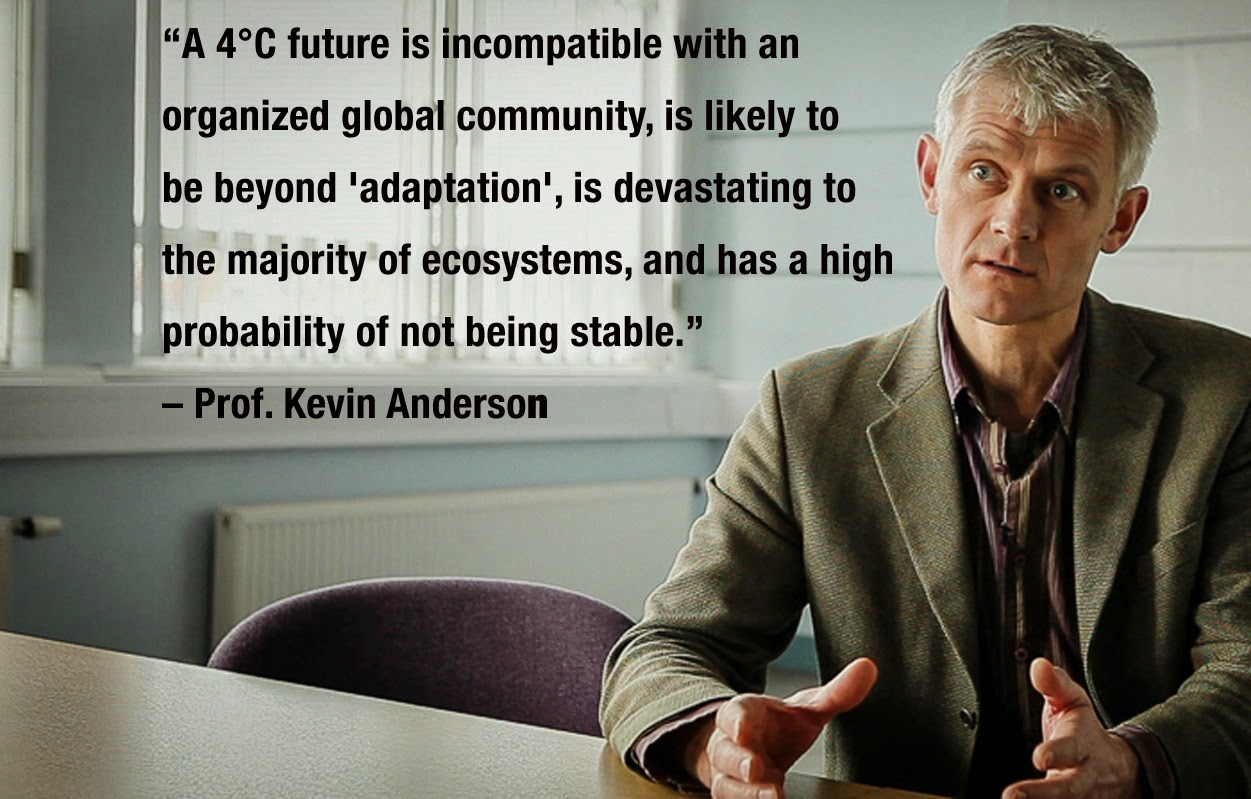
    • Prof. Kevin Anderson (2011) says there is a widespread view amongst scientists that “a 4°C future is incompatible with an organised global community, is likely to be beyond ‘adaptation’, is devastating to the majority of ecosystems and has a high probability of not being stable”.

    One question remains: if the world has practically speaking given up on holding to 2°C and it is not possible for human civilization to survive in a 4°C warmer world, what’s the plan? Some have suggested that in fact we have a substantial “carbon budget” available for the 2°C target…

    Myth 5: We have a substantial carbon budget left for 2°C

    The carbon budget has come to public prominence in recent years, including in the IPCC’s Fifth Assessment Report in 2013, as being the difference between the total allowable greenhouse gas emissions for 2°C of warming, and the amount already emitted or spent.
    But this is not as simple as it seems, because 2°C means different things to different people:

    • The 2°C cap: A cap is an upper boundary, not to be exceeded. This is implicit in international agreements such as the Copenhagen Accord and Cancun Agreements which aim to “hold the increase in global average temperature below 2°C, and to take action to meet this objective consistent with science and on the basis of equity” and the position of the European Commission in 2007, to “ensure that global average temperatures do not exceed preindustrial levels by more than 2°C” and to “adopt the necessary domestic measures… to ensure” this is the case (emphasis added). This language implies a very low probability of exceeding the target. This is consistent with the approach taken in catastrophic risk management, where the risk of failure must be very small (Dunlop, 2011). Climate change with its non-linear events, tipping points and irreversible events – such as mass extinctions, destruction of ecosystems, the loss of large ice sheets and the triggering of large-scale releases of greenhouse gases from carbon stores such as permafrost and methane clathrates – contains many possibilities for catastrophic failure.
    • The 2°C target: A target can be overshot; in common parlance, we may “miss the target”. This is the language employed for the carbon budget, where misses are part of the target calculations. The IPCC gives carbon budgets only for 33%, 50% and 66% chances of keeping to 2°C (IPCC, 2013).  Higher probabilities of achieving the target were not reported. The most stringent — at 66% — has a one-in-three chance of exceeding the target, and a range of outcomes from 1°C to 3.1°C (with 95% confidence).
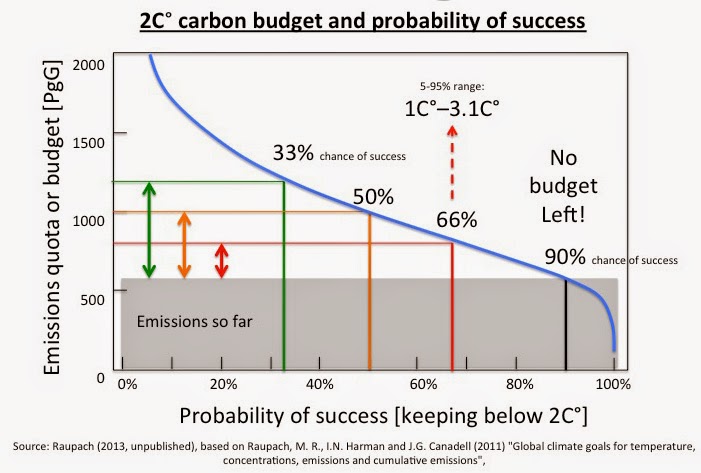
    Figure 3: The carbon budget and probability of success. The budget (vertical axis) is related to risk of failure (overshooting 
the 2°C) (horizontal axis) along the blue curve.  Emissions to date are indicated by grey box, leaving the available budget as 
the distance between the blue curve and grey box. As chance of not exceeding the target increases from 33% (green) to 50% (orange) to 66% (red), the budget decreases. At 90% chance of not exceeding the target (black), no carbon budget remains.

    With this distinction between “cap” and “target” in mind:

    • For the 2°C cap, and a risk-averse (low probability of less than 10%) approach of not exceeding the target, there is no carbon budget left for the 2°C target: “…the combination of a 2°C warming target with high probability of success is now unreachable” using the current suite of policy measures, because the budget has expired (Raupach, Harman et al., 2011; Raupach, 2013). See Figure 3. “[T]o provide a 93 per cent mid-value probability of not exceeding 2°C, the concentration would need to be stabilized at, or below, 350 ppmv CO2e, i.e. below current levels”  (Anderson and Bows, 2008).If some reasonably optimistic assumptions are made about deforestation and food-related emissions (halving per unit of production) for the rest of the century, then most emission reduction scenarios are incompatible with holding warming to 2°C, even with a high 50% probability of exceeding the target, and there is no budget left for fossil fuel emissions  (Anderson and Bows, 2008).
    • If we make some optimistic assumptions about how soon emissions peak and decline in the developing world (non-Annex 1 nations), there is no carbon budget available for developed nations (Annex 1 countries) (Anderson and Bows, 2011).
    • Accounting for the possible release of methane from melting permafrost and ocean sediment implies a substantially lower budget, but this was not done (IPCC 2013).

    The idea of a carbon budget and “allowable” emissions is dangerous, according to climate scientist Ken Caldeira:

    There are no such things as an ‘allowable carbon dioxide (CO2) emissions’. There are only ‘damaging CO2 emissions’ or ‘dangerous CO2 emissions’. Every CO2 emission causes additional damage and creates additional risk. Causing additional damage and creating additional risk with our CO2 emissions should not be allowed. If you look at how our politicians operate, if you tell them you have a budget of XYZ, they will spend XYZ. Politicians will reason: ‘If we’re not over budget, what’s to stop us to spending? Let the guys down the road deal with it when the budget has been exceeded.’ The CO2 emissions budget framing is a recipe for delaying concrete action now. (Caldeira, quoted by Romm, 2013B)

    Finally, we need to remember that the current level of greenhouse gases is already enough for more than 2°C of warming, though some gases such as methane are relatively short-lived in the atmosphere. Ramanthan and Feng (2008) calculated that the observed increase in the concentration of greenhouse gases (GHGs) since the pre-industrial era has most likely committed the world to a warming of 2.4°C (within a range of +1.4°C to +4.3°C) above the pre-industrial surface temperatures.

    Note: References available at PDF download

  • URGENT: we need to stop this Bill now

    URGENT: we need to stop this Bill now

    Inbox
    x

    Tammy, Amnesty International Australia <actioncentre@amnesty.org.au> Unsubscribe

    5:04 PM (8 minutes ago)

    to me
    The Western Australian Government is on the verge of passing a bill that will see another 60 kids locked up each year. Join me and tell the WA Government kids don’t belong behind bars.


    Dear Neville


    I’m a proud Nigena woman from Derby, in the Kimberley of Western Australia and a lawyer. During my time as a lawyer I’ve watched too many Indigenous kids get locked up- only to spiral into a life of crime and disadvantage.

    Right now the Western Australian parliament is debating a bill that is likely to see at least another 60 kids locked up each year. It’s already passed the lower house. Prison time for kids should never be compulsory. Will you sign the petition and call for WA’s Attorney General to scrap mandatory sentences for kids?

    Everyone has a right to be treated equally. But when an Indigenous child is 52 times more likely to be locked up than a non-Aboriginal child we know the law is not being applied equally.


    This campaign is about real solutions, led and delivered by Aboriginal people. If kids are given a chance instead of being locked up their lives can be turned around. That’s why I’m asking you to join me in signing this petition.


    I remember speaking with Sarah* from the Fitzroy Valley in WA. Her parents split when she was about 10. After this she grew up without a mother, moving between the homes of various family members. She smoked, she drank, and when she was 16 she assaulted someone. Sarah was lucky – after the assault she was steered away from trouble when the Aboriginal-led Yiriman Project took her out on country with women Elders.

    She is now employed at a local Aboriginal organisation and is planning to start her own business. Sarah says that her future is promising because of her involvement as a teenager with the Yiriman Project women’s program.

    There are courageous efforts in many communities where Indigenous people are exploring innovative approaches to dealing with inherited trauma and injustice.


    Mandatory sentencing will lock more kids up and prevent judges from sending them to programs like Yiriman. Will you stand up for kids’ access to these programs and a better life?


    While we must work on this issue right now, we’re also calling for long-term change. We’ll ask government to invest in long-term strategies and solutions like the Yiriman Project led by Indigenous people and our communities.


    We need people like you to support Aboriginal people and our solutions. We need you to stand beside us and tell government that we can’t wait any longer. Together we need to hold government to account because we can’t wait another 20 years for a solution.


    I hope you will join us,


    Tammy Solonec

    Indigenous Rights Manager

    Amnesty International Australia


    P.s. Please join me in signing the petition to the Attorney General. We can and must do better for our kids.


  • Greetings from Wall St. GET UP

    Click here to enable desktop notifications for Gmail.   Learn more  Hide
    More

    1 of 28

    Greetings from Wall St

    Inbox
    x

    *


    9:58 AM (12 minutes ago)

    to me
    Below is an update from Adrian Burragubba, on behalf of the Wangan and Jagalingou people — Traditional Owners of land in Queensland where multi-billion dollar company Adani wants to build their Carmichael coal mine.

    Hi NEVILLE,

    Our fight to defend our rights and culture and protect our ancestral lands and waters is now a truly international one. I’m writing to you from Washington DC after our meeting with the US Government’s Export Import Bank, ExIm. Yesterday we met with some of the world’s biggest banks on Wall Street.

    Before I continue, I want to thank everyone who made a donation to our efforts. It is thanks to your generosity that we are able to take our fight to the world.

    We have met with senior executives from Goldman Sachs, Citi and the Bank of America where I called on them to rule out funding the Carmichael mine. We Wangan and Jagalinogu people have never given our free, prior and informed consent to the Carmichael mine. To fund the mine would be a clear breach of the principles they are signatory to, and a violation of our rights.

    The meetings were positive and respectful, and we have asked the banks to confirm to us that they will recognise and uphold our rights; to acknowledge that we have not given our consent to the mine proceeding, that ‘no means no’; and to rule out finance for this destructive project.

    But maybe our biggest challenge is what’s coming next. Next week, we will meet with UK bank Standard Chartered — the only bank to have supported Adani Mining’s project so far.

    Adani has already said that Standard Chartered has promised it $680 million to build the mine, and is helping Adani find other banks to lend billions more. But only a couple of weeks ago, the bank softened its position, promising not to fund the mine until it had consulted with stakeholders.

    Well, we’re on our way from Queensland, via the US and Canada, to London to meet them.

    In the lead up to the meeting we want Standard Chartered to be under as much pressure as possible. Can you please help us out by asking Standard Chartered to respect our rights and to rule out funding the project?

    Click here to tweet Standard Chartered
    Click here to write on Standard Chartered’s Facebook wall

    Flooding Standard Chartered’s social media channels is the best way you can make a difference from the other side of the world. But if you don’t have Facebook or Twitter you can email Investor.Relations@sc.com

    As soon as we meet the bank I’ll send out another update about how we’re going, and share some footage of our journey so far.

    Thank you again for helping us to make this happen. You’ve helped us get here, and we will do everything in our powers to stop this mine, defend our rights and culture and protect our ancestral lands and waters.

    Sincerely,

    Adrian Burragubba, on behalf of the Wangan and Jagalingou Family Council

  • Coastal Residents and the effects of Sea Level Rise

    We are seeing coastal Councils introducing planning laws to combat

    Sea Level Rise. Residents are objecting to these laws that may prevent

    development on land threatened with inundation also land already

    developed. Residents are faced with capital losses through no fault

    of their own. This arises from negative attitudes by Governments both

    Federal and State. There is a refusal to accept Scientific reports warning

    of coastal sea level coastal inundation.

    We can expect bitter fights between between councils and residents.

    Councils are trying to protect residents interests

  • Stop CSG in our water catchments

    Click here to enable desktop notifications for Gmail.   Learn more  Hide
    More

    1 of 31

    Stop CSG in our water catchments

    Inbox
    x

    Holly, Land Water Future <campaign@landwaterfuture.org.au>

    5:56 PM (1 hour ago)

    to me
    - -

    Right now the NSW government is deciding whether to renew AGL’s massive coal seam gas exploration licence over our drinking water catchments, but we don’t get a say. Let’s change that.

    Neville —

    Thanks to the tireless efforts of communities across NSW, the area of our state covered by coal seam gas licences has dramatically decreased in the last year. But there are still areas where coal seam gas remains a very active threat — including over our drinking water catchments.

    Did you know even when CSG licences expire, they remain active until they are either withdrawn by the company or renewed or cancelled by the government? Right now the NSW government is in the process of deciding whether to renew expired coal seam gas licences. But we don’t get to have a say, and we want that to change.One of the coal seam gas licences up for renewal is the controversial PEL 2 held by AGL. PEL 2 is massive. It stretches from the Southern Highlands and the Illawarra in the south, across south west suburban Sydney, and then extends north to the Central Coast. We’ve created a timeline with everything you need to know about PEL 2, take a look.

    AGL’s PEL 2 CSG licence covers Warragamba Dam, Avon Dam, Nepean Dam, Wingecarribee Reservoir, Fitzroy Falls Reservoir, Cordeaux Dam, Cataract Dam, Woronora Dam, and Mangrove Creek Dam — these water catchments provide drinking water to millions of people

    The government is currently waiting to hear from AGL about why PEL 2 should be renewed. But it forgot to ask us what we think.

    Tell Resources Minister Anthony Roberts you’d like to have a say about this coal seam gas renewal.

    Let’s show everyone how unfair the coal seam gas renewal process currently is. AGL gets a say and we don’t. That’s just not on. Please forward this email to your networks and share the petition on Facebook and Twitter.

    Holly and the Land, Water, Future team

  • Hockey explains why poor people don’t have homes GET UP

    More

    1 of 32

    Hockey explains why poor people don’t have homes

    Inbox
    x

    Mark – GetUp!

    4:24 PM (59 minutes ago)

    to me

    Dear NEVILLE,

    Get a good job that pays good money.

    This is Mr Hockey’s bizarre advice to millions of frustrated first home buyers priced out of a skyrocketing housing market.[1] Well, we’ve got some advice for Mr Hockey: why don’t you address one of the root causes of housing affordability – negative gearing.

    Negative gearing forces everyday Aussie home buyers to compete with investors armed with generous tax breaks looking to buy their second or third property. It reduces home ownership and locks many out of the housing market, increasing the gap between the haves and have-nots.

    Do we want to live in a country where young Australians will never own their own homes?

    Fortunately, there are growing calls for sensible reform that would both protect existing investors and open up opportunities for first home buyers – and our politicians are listening. The Greens released a negative gearing policy just this week, and Labor Party insiders say public support for change could see the ALP adopt a position of reform at their National Conference next month.

    Click here to ramp up the calls for negative gearing reform so more Australians can afford their first home – without having a six figure salary.

    On ABC’s AM program this morning, Mr Hockey said to his critics, “Let’s not play the man, let’s actually deal with the policy“.[2] Right on, Mr Hockey – let’s!

    Mr Hockey says the big problem in housing is the shortage of supply. So he should love The Australia Institute‘s policy, funded by GetUp members, that restricts future negative gearing to new housing construction. This would drive investment into new houses, increasing supply and creating more jobs, and a new poll shows it’s the approach most Australians prefer.[3]

    And just to ward off any scare campaigns: any reforms to negative gearing would be introduced gradually, grandfathering existing investors and protecting them from sudden policy changes.

    There’s consensus among housing experts and economists that negative gearing is one policy area driving unaffordable housing in Australia. Moreover, The Australia Institute has also shown that a massive $4.2B in negative gearing tax breaks per year go to the top 10% of income earners – those who need them least.[4] It’s high time we saw Government leadership to make housing more affordable for all Australians.

    Click here to sign the petition calling on our political leaders to reform negative gearing as a real solution to housing unaffordability.

    Last week, Prime Minister Abbott said that as a home owner (he has one of those “good” jobs) he hopes house prices will keep rising. But if house prices kept rising for another 40 years the way they have for the past 25, a median-price Melbourne house will cost upwards of $5 million.[5] That’s clearly unsustainable.

    The thing about bubbles is that they eventually burst. If we don’t take some heat out of the property market now, we could see a crash that would devastate homeowners and investors alike – with dire implications for the Australian economy.

    That’s why there’s growing consensus – from the Chief Economist at Bank of America Merrill Lynch to the Australian Council of Social Services – that negative gearing needs to be looked at.[6, 7] In one fell swoop we could have a fairer budget that saves the bottom line billions and makes housing more affordable, especially for younger Australians trying to buy their first home.

    Together, we can help ensure young Australians are able to realise their dreams of one day owning their own home: https://www.getup.org.au/negative-gearing

    Thanks for all you do,
    Mark, Nat, Evan, Daney and Georgina, for the GetUp team

    PS – Treasurer Hockey could get back in touch with reality by seeking out advice from the nurses, teachers, firefighters and police officers saving for a home, while they serve our communities. These are good jobs – arguably the greatest jobs – but jobs that don’t always pay the kind of wages that cover a mortgage in out-of-control property markets. Will you join the calls for real solutions to housing unaffordability such as negative gearing reform? https://www.getup.org.au/negative-gearing

    References
    [1] ‘Get a good job’: Joe Hockey accused of insenstivity over advice to first home buyers, ABC Online, 9 June 2015.
    [2] Joe Hockey defends housing comments, accuses critics of ‘playing the man’, ABC AM, 10 June 2015.
    [3] Joe Hockey’s housing clanger is another sign of a government that is out of touch, SMH Online, 9 June 2015.
    [4] It’s the Revenue Stupid: Ideas for a Brighter Budget, The Australia Institute, May 2015.
    [5] Abbott happy to blow air into housig bubble, The Age, 9 June 2015.
    [6] Negative gearing ‘undermines’ the tax system, Sky News, 24 April 2015.
    [7] ACOSS launches push to restrict negative gearing, ABC Online, 16 April 2015.