Category: News

Add your news
You can add news from your networks or groups through the website by becoming an author. Simply register as a member of the Generator, and then email Giovanni asking to become an author. He will then work with you to integrate your content into the site as effectively as possible.
Listen to the Generator News online

 
The Generator news service publishes articles on sustainable development, agriculture and energy as well as observations on current affairs. The news service is used on the weekly radio show, The Generator, as well as by a number of monthly and quarterly magazines. A podcast of the Generator news is also available.
As well as Giovanni’s articles it picks up the most pertinent articles from a range of other news services. You can publish the news feed on your website using RSS, free of charge.
 

  • Australian class actions set to rise

    Professional services organization the Goal Group has predicted that the number of securities class actions in Australia was about to rise significantly, after they opened their first Australian office in Melbourne.

    This comes after Maurice Blackburn announced their class action against each of the big banks over credit card charges.

    Andreas Costi predicted last week that securities class actions, which had been averaging 11 a year, would rise to approximately 20 following the entrant of a new and aggressive specialist law firm ACA.

    Goal has estimated that more than $31.5 billion of withholding tax is deducted globally each year and that its products and services facilitate the recovery of about $11.5 billion of that. However, there is still about $10.6 billion left unclaimed by its rightful owners.

    The Goal global class action service supports corporates and institutions such as superannuation funds, fund managers and custodians that have suffered financial loss from owning shares in a company where there has been mismanagement or unlawful behaviour.

    Goal, which started life in 1989 in the UK as an investment technology company, is now one of the world’s major providers of securities class action outsourcing services and global withholding tax reclamation services.

  • Southbank best retail and food destination in Queensland

    Southbank from the airSouthbank made history last week when it received top honour of 2014 Retail Property of the Year at the Property Council of Australia (Qld) Awards making it the first time a ‘precinct’ has won the coveted title.

    It was also the first entrant to receive a perfect score as winner of the Excellence in Marketing Award and then took out the Excellence in Food Retailing Award.

    The much-loved destination, which draws over 10 million visitors annually nudged out some of the State’s largest retail centres and dining districts to score its award-winning trifecta.

    CEO of South Bank Corporation Jeff Weigh was delighted with the three accolades and was grateful to the PCA for recognising the precinct’s overall retail offer, diverse dining options and excellence in marketing.

    “We are extremely proud of our leasing and marketing efforts over the past few years as we work to maintain our position at the forefront of the State’s retail, dining and leisure scene.

    “The Retail Property of the Year award is one of the most prestigious honours for excellence in the retail sector, recognising outstanding overall achievement for a property or precinct. The accolade was awarded to the retail property that achieved the highest average aggregate out of the three award categories.

    “Our innovative South Bank Concierge marketing campaign scored a perfect score of 100 points from the judging panel based on our ability to tap into the 61,000-plus conference delegates visiting the destination annually.

    “The Excellence in Food Retailing Award cements our dominance of the Brisbane food scene and key points-of-difference including the choice of over 28 restaurants, cafes and bars that line both Little Stanley and Grey Streets,” Weigh added.

    “Our re-launch campaign of Little Stanley Street in late 2013 generated immediate results and has proven to be our most successful brand marketing and retail sales campaign to date.”

    Queensland executive director of the Property Council, Kathy Mac Dermott said the Queensland Retail Property Awards recognise excellence in retail properties and precincts throughout Queensland in the areas of marketing, design, food and presentation.

    “In 2014, 68 finalists were recognised throughout the State, representing properties and precincts in a range of size categories.

    “South Bank’s achievement marks the first time a precinct has won Retail Property of the Year…and our congratulations go to all finalists and winners on their fantastic achievements,” Mac Dermott said.

    South Bank is also gearing up to welcome a further 3,500 to 4,000 people who will live and work in the vicinity following Anthony John Group’s announcement in April it will build its second Emporium Hotel; together with a new commercial precinct housing the global headquarters of Flight Centre at the southern end of Grey Street.

    It will also be a key destination when Brisbane hosts the G20 Leaders Summit in November 2014.

  • Red Bull Flying Bach – Winners announced

    Red Bull Flying Bach returns to Australia and will be back in New South Wales and Victoria, and debuting in Queensland, Western Australia and South Australia in September and October.

    Best explained as classical music meets urban dance moves. Breakdancing choreographed to Bach’s composition of the ‘Well-Tempered Calvier’, which dates back to 1722.

    Watch the videos below to see what Red Bull Flying Bach is all about.

    Red Bull Flying Bach 2014 will be showing at QPAC in Brisbane September 24-26.

    Westender’s Red Bull Flying Bach 2014 Contest Winners

    Westender wants to congratulate the six lucky winners of this contest, thank you all for participating!

    Winners have been notified by email.

    More info about Red Bull Flying Bach 2014

    Red Bull Flying Bach 2014 Australian tour dates:
    • State Theatre, Sydney: 4 shows, 9-12 September
    • Crown Theatre, Perth: 4 shows, 17-20 September
    • QPAC, Brisbane: 3 shows, 24-26 September
    • Arts Centre, Melbourne: 4 shows, 1-4 October
    • Festival Theatre, Adelaide: 3 shows, 7-9 October

    Ticket information:
    Tickets are on sale now, prices starting from $89: www.redbullflyingbach.com

    Social Media
    Twitter: www.twitter.com/RedBullAU #FlyingBachAU #GivesYouWings
    Instagram: www.instagram.com/RedBullAU #FlyingBachAU #GivesYouWings
    Facebook: www.facebook.com/redbull

  • Business tune-up for Small Business Week

    Tony Curl
    Tony Curl presenting at Brisbane’s Entertainment Centre

    Leadership, Life and Style is hosting an event to inspire and build business as part of 2014 Queensland Small Business Week. 2014 Queensland Small Business Week from 1-6 September is a Queensland Government initiative supporting and celebrating the important role of small business in the Queensland economy.

    The event, a Business Tune-Up Workshop will be held at Norman Hotel, 102 Ipswich Road, Wooloongabba on 1st September at 6pm.

    Tony Curl, Founder of Leadership, Life and Style said the focus of 2014 Queensland Small Business Week was to help small business to have a big future.

    “Our event is designed to provide information that will inspire business owners and contacts that will help them build their business,” Tony said.

    “Small business is vital to Queensland’s economy, representing approximately 95 percent of all Queensland businesses and employing almost half of the state’s private sector workforce.

    “2014 Queensland Small Business Week is being delivered by the Department of Tourism, Major Events, Small Business and the Commonwealth Games.”

    The event by Leadership, Life and Style is one of a host being delivered by business, industry and government as part of the statewide celebrations.

    Tony said the event, “Business Tune-Up” was a workshop designed to provide greater understanding in financial understanding, team engagement and customer retention for the business owner. It’s open to business owners interested in:

    • gaining a better understanding of business support available

    • gaining new ideas and inspiration

    • gaining an insight into growing your business, networking and business trends

    • improving your business management capability.

    To book for the event and for more information on 2014 Queensland Small Business Week visitwww.business.qld.gov.au/smallbusinessweek

  • Solar economics: Not even Tony Abbott can kill rooftop PV By Giles Parkinson on 12 May 2014

    Solar economics: Not even Tony Abbott can kill rooftop PV

    By on 12 May 2014
    Print Friendly


    AAP/Alan Porritt

    As Prime Minister Tony Abbott continues his assault on the nation’s clean energy programs and incentives, one technology that could emerge relatively unscathed (in the medium to long term) is the market for rooftop solar PV – much to the frustration of the incumbent utilities that are pushing the government to try to lock the country into the business models and technologies of the past.

    One of the biggest fears of the Australian solar industry is that the government’s review of the renewable energy target will result in an abrupt cancelling of the federal incentives that support the rooftop solar industry. They say that this could cause the loss of thousands of jobs, and the collapse of many businesses, as customers reassess their short-term commitment to rooftop solar. The industry says that solar will be targeted – despite its political risks – because it is a bigger threat to incumbent utilities than large-scale wind or solar projects.

    The contrast with the political rhetoric in Australia and that of the US – where President Barack Obama has re-installed rooftop solar on the rooftop of the White House (it was removed by Ronald Reagan), and gotten major retail brands to commit to install nearly 1GW of solar – could not be any different.

    There are strong arguments to keep solar incentives – as Alan Pears points out today – including that their removal will simply penalise those less wealthy or in less solar-rich regions, and will serve to protect only coal and gas-fired generators. And it will cause huge disruption to a growing industry.

    But a new analysis by investment bank UBS suggests while a dumping of the solar support mechanisms could slow down the uptake of rooftop solar in the short term in Australia, the impact would not be permanent. Indeed, as its study shows – and as some of the more progressive minds in the energy industry now readily admit – the continued fall in the cost of solar means that over the medium term there is not much the utilities or the government can do to stop growth of rooftop solar PV.

    The UBS report notes that the uptake of rooftop solar PV in Australia – around 3.2GW now sits on more than 1.1 million rooftops – has been consistent in trend terms despite the changes in policy – underpinned by a combination of rapidly rising delivered electricity costs (the network), and firstly by high feed in tariffs and then with falling technology costs.

    UBS policy solar

    Indeed, because of its extraordinarily high retail electricity prices, Australia was one of the first countries in the world to reach what is known as “socket parity” – where the cost of rooftop solar undercuts the cost of grid-sourced electricity.

    The small scale component of the renewable energy target currently accounts for around 29 per cent of the up-front cost of solar panels – although there are variations across different states, as this graph below shows.

    ubs solar capital costs

    But the UBS analysis shows that even with the carbon price repealed, and solar incentives cancelled, rooftop solar still looks compelling to households. That’s because solar power used in the house avoids buying electricity from the grid at a cost of at least $260/MWh and the cost of installing solar is much lower than that.

    UBS subsidies

    Much of the cost is determined by assessing the “discount rate” – roughly equivalent to the time value of money. UBS says if 10 per cent is a reasonable discount rate then rooftop solar presently needs a price of around $140 MWh with subsidy and about $180 MWh with no subsidy to cover its cost of capital.

    (In the US it could be argued that 6 per cent is a reasonable cost of capital, UBS says, but notes that Australia’s cost of capital – like so many other costs – is higher than other countries. If the discount rate is lowered to 7.5 per cent, it reduces the costs in Australia to $100/MWh with subsidy and around $140 with no subsidy).

    “Therefore, if the household can use the solar electricity in the house, it is from a financial point of view a no-brainer decision,” UBS writes.

    “Equally if the solar power is sold back to the grid it’s an equal no-brainer, but of a reverse outcome. From this perspective solar is just a financial arbitrage. Grid delivered electricity relies on the grid delivering “cheap” electricity produced 100s and even 1000s of km away from the point of consumption. Solar costs much more at the generation level but the unit cost of a 1 kW system bears little difference from a 1 GW system, and so it’s perfectly economical to install on the roof of the house and arbitrage away the wires and poles cost.”

    The question is, if the government does remove the remaining solar incentives, what will happen to demand? This graph below provides an indication.
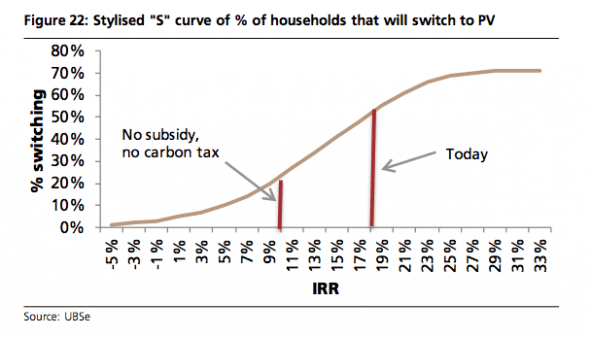
    ubs s curve solar

    According to the UBS data, the current IRR (internal rate of return) is currently around 18 per cent. If this were to continue, something like 50 per cent of households would likely adopt rooftop solar PV. The removal of the SRES would likely drop that IRR to below 10 per cent, a return that would likely mean only around 20 per cent of the market switches.

    “As with any other market though, the marginal new customer may require a higher incentive,” UBS says. “Some people will switch even if there were a net cost because of environmental reasons. Some households and businesses won’t or will be unable to switch at all. In between sit a group that will switch if the financial incentive is sufficient.”

    So UBS estimates – that even with all subsidies removed and a low, and voluntary, feed in tariff in place in some states – the market for rooftop solar will likely remain around 400-500 MW per year. This would be made up of around 100 MW commercial (while expecting this component to grow) and around 300-400 MW of household rooftop PV. It should be noted that for large users of 100MWh or more, the cost of solar makes sense at $140/MWh or less – and PV is about there now ex-subsidy.

    UBS estimates that around 37 per cent of a typical household’s daily electricity consumption occurs when the solar system is operating (see graph below). Therefor, if the household wants to avoid exporting any power to the grid, then the PV system needs to be sized so that peak output is roughly equal to average hourly household consumption.

    “Our numbers suggest that for a household consuming 8 MWh per year (20 kWh per day) the solar system “should” be around 1.5 kW. That’s less than half the average size of new installations today.”

    ubs solar consumption

    UBS says that given a sufficient incentive, households can shift part of their power consumption around during the day, or even within a week.

    “Fridges, typically the largest single source of consumption, obviously have to be on constantly – but washing machines, clothes dryers, swimming pool pumps, solar hot water heating etc. can all have their time of consumption shifted relatively easily. For households not receiving an FIT, there will be a preference to use equipment during the day when solar represents the low cost option.”

    Ultimately, this leads into the question of storage. As we noted in our report on Friday, that could become cost competitive quickly, to the point that the average Australian household may not have to pay more if they disconnect entirely from the grid, as soon as 2018.

    That’s a prospect which is causing enormous disquiet among utilities – scrapping schemes such as the RET, and institutions such as the Clean Energy Finance Corp and the Australian Renewable Energy Agency are just a crude attempt at buying the incumbents more time.

  • Daily update: Tony Abbott still determined to kill renewable energy target

    1 of 1
    Why this ad?
    Shocking New ATO Ruleswww.pursuitofhappiness.com.au – Find out how to stop the govt. from stealing your life savings

    Daily update: Tony Abbott still determined to kill renewable energy target

    Inbox
    x

    Renew Economy editor@reneweconomy.com.au via mail79.wdc01.mcdlv.net

    1:24 PM (59 minutes ago)

    to me
    Abbott still determined to kill RET, Silex, ARENA pull funds for big fish solar project; RET repeal amounts to economic vandalism; RET cut would hit budget; Courts worldwide reject anti-wind experts and their evidence; Oz Technology competition finalists announced; G20 has crucial role in preventing future energy crisis; and a clean energy miracle – my challenge to Bill Gates.
    Is this email not displaying correctly?
    View it in your browser.
    RenewEconomy Daily News
    The Parkinson Report
    A new report from AFR underlines the determination of the Abbott government to kill renewable energy in Australia. This comes as a new report says coal and gas generators will pocket an extra $10bn in profits if the RET is scrapped.
    Silex dumps proposal for 100MW concentrated solar power plant in Mildura, citing uncertainty over RET as one factor. It will now look overseas.
    The Government’s own independent Review Panel finding that the RET helps to reduce power bills for electricity consumers over the medium term.
    Reducing the RET would cost the federal budget about $680 million more to meet Australia’s target of 5% emissions reduction by 2020.
    The EPI just published a full report of my research into anti-wind court cases in the USA, Canada, the British Isles, Australia and New Zealand.
    14 of Australia’s best emerging technology companies have been named as Finalists for the 2014 Australian Technologies Competition.
    The set of rules that govern world energy markets have not kept pace with the transformations in energy markets that are now happening ever more rapidly.
    There are only a few people in the world that could actually generate a true clean energy miracle and Bill Gates is one of them.