Category: News

Add your news
You can add news from your networks or groups through the website by becoming an author. Simply register as a member of the Generator, and then email Giovanni asking to become an author. He will then work with you to integrate your content into the site as effectively as possible.
Listen to the Generator News online

 
The Generator news service publishes articles on sustainable development, agriculture and energy as well as observations on current affairs. The news service is used on the weekly radio show, The Generator, as well as by a number of monthly and quarterly magazines. A podcast of the Generator news is also available.
As well as Giovanni’s articles it picks up the most pertinent articles from a range of other news services. You can publish the news feed on your website using RSS, free of charge.
 

  • US passes Monsanto Bill

    Known as the King amendment the agribusiness company Monsanto is lobbying hard to prevent state governments from being able to legislate over the use of their genetically modified seeds and controversial products such as RoundUp.

    Some commentators have called it the Monsanto protection act but the Guardian newspaper also points to its impact on the social fabric of America. Elements of the farm bill, as it stands, will cut food stamps to the poor and the previously incarcerated, thus increasing poverty and possibly crime; add to the growing obesity crisis by encouraging chemical sugar substitutes; and support factory farming at the expense of sustainable food production with abusive crop subsidies.

    A March against Monsanto will take place in Brisbane’s King George Square at 2pm tomorrow afternoon.

    Â

    Â

  • From the Antarctic Ocean Alliance Team:

    Dear INGA,

    Thank you for Joining The Watch and showing your support for protecting Antarctica’s marine environment. Thanks to you our campaign to save Antarctica’s waters has momentum with over 190,000 global citizens joining you in becoming part of The Watch  – but we need to do more.

    The body that regulates Antarctica’s waters, the Commission for the Conservation of Antarctic Marine Living Resources (CCAMLR), has a crucial meeting coming up in July in Germany. This is our chance to send them a strong message they can’t ignore, that we support the protection of these unique and vital marine environments.

    We need as many people as possible to support Antarctic marine protection and to send that message to CCAMLR, we need 300,000 signatures by July.

    Thanks to you, we already have over 190,000

    Can you help us reach our goal?

    Antarctic waters make up almost 10% of the world’s seas and are some of the most pristine left on earth. They are home to almost 10,000 unique and diverse species including penguins, Weddell seals, albatross and Antarctic toothfish. But unlike Antarctica’s land these waters are not protected.

    Together we can change this.

    Please forward this email to five friends who you think will care about this issue, ask them to Join The Watch with you and help us ensure these waters are protected as a legacy for future generations.

    With your support we can save this precious and truly unique part of the world.

    Thank you again INGA for being part of The Watch to protect the Antarctica’s ocean.

    From the Antarctic Ocean Alliance Team: Steve, Blair, Grigory, Geoff, Donna, Ricardo, Amanda, Cary and Emily

    Edit your subscription | Unsubscribe

  • Nationals take landslide win in Northern Tablelands by-election

    Nationals take landslide win in Northern Tablelands by-election

    Updated 9 hours 31 minutes ago

    Nationals candidate Adam Marshall has taken a landslide victory in the by-election for the NSW seat of the Northern Tablelands, which was previously held by independent Richard Torbay.

    Figures on Saturday night showed Mr Marshall had more than 60 per cent of the vote.

    Independent Jim Maher won 14 per cent of the vote, while just under 10 per cent voted for Labor’s candidate, Herman Beyersdorf.

    The result gives the O’Farrell Government a 70th seat in the Legislative Assembly.

    View coverage of the by-election on Antony Green’s election website.

    The by-election came after Mr Torbay’s spectacular fall from grace earlier this year after 14 years in politics.

    He was referred to the Independent Commission Against Corruption and was disendorsed as the Nationals candidate in the federal seat of New England, where he had hoped to topple sitting independent MP Tony Windsor.

    ABC election analyst Anthony Green says the strong result for the Nationals will spark speculation about Barnaby Joyce’s chances of beating Mr Windsor during the federal election in September.

    Mr Joyce gave up his Queensland Senate seat to run for the Nationals in New England.

    “Clearly this is a very strong National vote and the party will be hoping to repeat the vote with Barnaby Joyce in New England at the Federal election in September,” Green wrote on his election blog.

    “However, New England also includes Windsor’s home base in Tamworth, and Windsor is clearly a more formidable opponent than either Jim Maher or Herman Beyersdorf at the by-election.

    “Even Windsor’s biggest haters would have to concede that point. Tony Windsor was not on the ballot paper, so a direct transfer of these results to a federal election is not valid.

    “However, it is a terrible result for the state Labor Party, not even making double figures.

    “In part, this is because of Jim Maher being on the ballot paper, but there must be some teeth gnashing over this result by both the state and federal Labor parties.”

    Mr Marshall first entered politics at the age of 19 when he was elected to the Gunnedah Council in 2004.

    At 28, Mr Marshall will be the youngest member of the state parliament.

    Earlier on Saturday, former LNP heavyweight Barry O’Sullivan was selected to replace Mr Joyce in the Senate.

    Topics: elections, government-and-politics, nationals, political-parties, armidale-2350, nsw, australia

    First posted Sat May 25, 2013 9:45pm AEST

  • Climate change will be slower than thought, study shows – or does it?

    Climate change will be slower than thought, study shows – or does it?

    New climate study just one step to understanding future climate change, but Australia is already feeling the heat

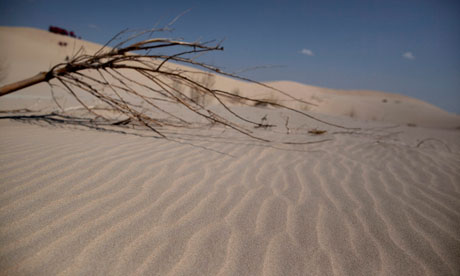
    Hacked climate emails : Desertification in China

    A new study suggests global warming might not occur quite so quickly as other studies have suggested it would. Photograph: How Hwee Young/EPA

    For anyone who loves to eat chocolate, drink lots of lovely espresso coffee or quaff plentiful amounts of red wine, there’s much comfort to be sought from scientific studies.

    You can pick the studies saying you’ll live long and prosper from your chosen potions and ignore the caveats or contradictory warnings. You might also forget to check back to see if any follow-up studies were done that might spoil your fun.

    Essentially, you fall foul of what’s known as “single-study syndrome” – you make a decision based on one scientific study, which is most likely just one step in the process of understanding a particular problem.

    When it comes to understanding the impact of human emissions on the climate, thousands of studies published over decades (over which time probably many bars of chocolate and coffee were consumed) are what builds understanding.

    And so we come to new research published in the journal Nature Geoscience suggesting global warming might not occur quite so quickly as other studies have suggested it would.

    New Scientist magazine said the study could mean the world had a “second chance” to avoid dangerous climate change. The BBC reported how the study had concluded that the rate of global warming would “lead to lower temperature rises in the short term”. The Sydney Morning Herald also reported that the study “could” mean global warning might be slower in the short term.

    So what did the research actually say? The study looked at two things and put numbers to them.

    Transient Climate Response (TCR) looks at the likely globally averaged warming we’ll see at the point when the amount of carbon dioxide in the atmosphere is double what it was at the start of the industrial revolution.

    Based on what’s been happening to the planet in the most recent decade, the study finds that at the point when CO2 in the atmosphere doubles, global warming could be as low as 0.9C and as high as 2.0C but will most likely be 1.3C. This best estimate is very slightly lower than previous estimates of 1.6C and 1.4C.

    The 2007 United Nations Intergovernmental Panel on Climate Change Report said TCR was “very likely larger than 1C and very unlikely greater than 3C”.

    Given the world has already warmed by about 1C, it looks as though we can already discount the lower end of this estimate. For example, the recent study carried out by the Berkley Earth Surface Temperature Study found the world had warmed by 0.9C since 1950.

    The Nature Geoscience study also looks at what’s called Equilibrium Climate Sensitivity (ECS) – the global warming you would expect if you applied a sharp pull on the handbrake to completely hold the amount of carbon dioxide in the atmosphere once it gets to double what it was. You then wait a century or three for the climate system to settle (think of the time needed to ice sheets and heat to move through and out of the oceans).

    On this, the paper says the best estimate is 2.0C but with a range as low as 1.2C and as high as 3.9C. On all the findings, the study’s authors make the point that:

    … caution is required in interpreting any short period, especially a recent one for which details of forcing and energy storage inventories are still relatively unsettled: both could make significant changes to the energy budget.

    In other words, this isn’t the end of it. Like many other studies on climate change, this study needs to be carefully interpreted.

    It comes as human emissions have managed to raise the level of CO2 in the atmosphere to its highest point in several million years – a time when sea levels were a few metres higher than today.

    To use a drinking analogy, the findings come with a round of caveat chasers and bowls of bar snacks filled with uncertainties.

    For example, the Nature Geosciences study uses a new IPCC scenario on emissions (known as RCP4.5) that presumes the world will take some decisive action on climate change. This might happen, but it might not.

    Will the major and emerging economies continue to pour CO2 into the atmosphere at the rate they’ve been doing recently? Will that rate increase or level off? How will methane emissions from melting permafrost or increases in agriculture change the picture? Could the recent rapid decline in Arctic sea create a tipping point?

    I asked Professor Steven Sherwood, a director of the University of New South Wales Climate Change Research Centre, for his view on the study and how it fits into the broader climate issue.

    It’s one of many studies each year offering new evidence that favours either a higher or lower estimate of future global warming.  The revision it proposes is pretty small, and the method used is not that accurate due to observational limitations and natural variations in the system.  So it’s one more piece of evidence for the scientific community to consider, but hardly affects the big picture.

    The study concerns what we call the “transient climate response” or TCR, which is based on a hypothetical scenario.  The actual warming would be much larger than the TCR for a couple of reasons.  First, burning all available coal and other fuels will at least triple or quadruple the amount of carbon dioxide in the atmosphere, but the TCR only includes a doubling.  Second, it doesn’t count the effects of other greenhouse gases like methane, which are likely to rise in the future due to agriculture and other human activities, and currently increase the impact of CO2 by about 50%.

    The way global warming is typically quantified and communicated tends not to convey how much more serious it becomes over the longer term.  When you reach a doubling of CO2, unless you stop emitting the next day, global warming will blow past the “transient climate response.”  By the 22nd or 23rd century you’ll have global warming equal to the TCR several times over.

    But here, in my view, are the real kickers in this debate. TCR, ECS and even the global average figure for warming are yardsticks that scientists use to understand how human emissions are going to change the climate system.

    They don’t relate to how climate change impacts people, businesses, economies, communities and ecosystems. They also tend to feed a presumption that the climate will change smoothly.

    In Australia – and arguably elsewhere – what really worries the population are floods, extreme heat, sea level rise, droughts, super storms and the loss of habitats and species.

    You can imagine how a community ravaged by a bushfire or farmers standing over heat-stressed crops might react when you tell them a study has just found that TCR might only be 1.3C instead of 1.6C. It would go down like a vat of Shiraz at an Alcoholics Anonymous meeting.

    Australia is already seeing record-breaking events set against the background of a global average warming of about 0.8C where CO2 in the atmosphere is now at 400 ppm.

    The last Australian summer, for example, delivered an unprecedented heat wave covering vast swathes of the continent.  The heat sparked hundreds of bushfires and destroyed homes and businesses

    During the heat wave, 46.9 per cent of the continent recorded maximum temperatures of 45C or more. A special statement from the Bureau of Meteorology summarising the remarkable nature of the heat wave said:

    The area-averaged temperature for Australia as a whole exceeded 39C on seven consecutive days from 2–8 January; the longest such period previously recorded was four days in December 1972. There have only been 21 days in 102 years of records where the national area-averaged maximum temperature has exceeded 39C; eight in 2013 (2–8 January and 11 January), seven in 1972–73, and only six in all other events combined.

    Prof Roger Jones, of Victoria University’s Centre for Strategic Economic Studies, is a co-ordinating lead author on the next Intergovernmental Panel on Climate Change report in the working group looking at climate change impacts and adaptations.

    He says regional and global climates do not respond smoothly to changes in emissions but instead respond with jerkier “step changes”. He argued the Nature Geoscience study of short-term warming was “not one that is anywhere near appropriately framed to draw policy conclusions from”.

    A recent study led by Jones and published by Australia’s National Climate Change Adaptation Research Facility looked at some of the impacts Australia is already experiencing under a changing climate. He said:

    Our analysis of recent changes of extremes in Australia shows this non-linearity. We have had a couple of periods of rapid changes in extremes and these have been statistically significant. That changes your exposure to risk quite quickly.

    The heatwave this year shows that the heatwave of 2009 was not just an outlier, as some suggested. In south-east Australia, the summer extremes we are getting now are roughly equivalent to what the major Garnaut Review and other studies projected we would get by 2030.

    There are two things you can almost guarantee in relation to the Nature Geoscience-published study about likely short-term global warming.

    First, there will be another study that will settle on different numbers.

    Second, the consequences of burning fossil fuels will continue to play out in the real world, giving us more to worry about than eating chocolate and sipping drinks derived from single-origin organically grown arabica beans.

  • Active or ‘Extremely Active’ Atlantic Hurricane Season Predicted for 2013

    Active or ‘Extremely Active’ Atlantic Hurricane Season Predicted for 2013

    May 24, 2013 — In its 2013 Atlantic hurricane season outlook issued today, NOAA’s Climate Prediction Center is forecasting an active or extremely active season this year.


    Share This:

    For the six-month hurricane season, which begins June 1, NOAA’s Atlantic Hurricane Season Outlook says there is a 70 percent likelihood of 13 to 20 named storms (winds of 39 mph or higher), of which 7 to 11 could become hurricanes (winds of 74 mph or higher), including 3 to 6 major hurricanes (Category 3, 4 or 5; winds of 111 mph or higher).

    These ranges are well above the seasonal average of 12 named storms, 6 hurricanes and 3 major hurricanes.

    “With the devastation of Sandy fresh in our minds, and another active season predicted, everyone at NOAA is committed to providing life-saving forecasts in the face of these storms and ensuring that Americans are prepared and ready ahead of time.” said Kathryn Sullivan, Ph.D., NOAA acting administrator. “As we saw first-hand with Sandy, it’s important to remember that tropical storm and hurricane impacts are not limited to the coastline. Strong winds, torrential rain, flooding, and tornadoes often threaten inland areas far from where the storm first makes landfall.”

    Three climate factors that strongly control Atlantic hurricane activity are expected to come together to produce an active or extremely active 2013 hurricane season. These are:

    • A continuation of the atmospheric climate pattern, which includes a strong west African monsoon, that is responsible for the ongoing era of high activity for Atlantic hurricanes that began in 1995;
    • Warmer-than-average water temperatures in the tropical Atlantic Ocean and Caribbean Sea; and
    • El Niño is not expected to develop and suppress hurricane formation.

    “This year, oceanic and atmospheric conditions in the Atlantic basin are expected to produce more and stronger hurricanes,” said Gerry Bell, Ph.D., lead seasonal hurricane forecaster with NOAA’s Climate Prediction Center. “These conditions include weaker wind shear, warmer Atlantic waters and conducive winds patterns coming from Africa.”

    NOAA’s seasonal hurricane outlook is not a hurricane landfall forecast; it does not predict how many storms will hit land or where a storm will strike. Forecasts for individual storms and their impacts will be provided throughout the season by NOAA’s National Hurricane Center.

    New for this hurricane season are improvements to forecast models, data gathering, and the National Hurricane Center communication procedure for post-tropical cyclones. In July, NOAA plans to bring online a new supercomputer that will run an upgraded Hurricane Weather Research and Forecasting (HWRF) model that provides significantly enhanced depiction of storm structure and improved storm intensity forecast guidance.

    Also this year, Doppler radar data will be transmitted in real time from NOAA’s Hurricane Hunter aircraft. This will help forecasters better analyze rapidly evolving storm conditions, and these data could further improve the HWRF model forecasts by 10 to 15 percent.

    The National Weather Service has also made changes to allow for hurricane warnings to remain in effect, or to be newly issued, for storms like Sandy that have become post-tropical. This flexibility allows forecasters to provide a continuous flow of forecast and warning information for evolving or continuing threats.

    Share this story on Facebook, Twitter, and Google:
  • RAILS launches refugee guide

    The guide is a comprehensive, easy-to-use resource for refugees, legal professionals and community organisation volunteers. The guide is widely used by refugees and those acting on their behalf. RAILS originally produced this Guide in 2011 but the recent changes to refugee family reunion that emerged from the Report of the Expert Panel on Asylum Seekers in 2012 meant that the guide required updating.

    The book was launched by Hon Shayne Neumann MP, Parliamentary Secretary to the Attorney-General.

    The Refugee and Immigration Legal Service (RAILS) is a Queensland-based, independent community legal service which provides free legal advice, assistance and, representation and community education to disadvantaged migrants, refugees and other disadvantaged people.

    Â

    Â

    Â