Category: News

Add your news
You can add news from your networks or groups through the website by becoming an author. Simply register as a member of the Generator, and then email Giovanni asking to become an author. He will then work with you to integrate your content into the site as effectively as possible.
Listen to the Generator News online

 
The Generator news service publishes articles on sustainable development, agriculture and energy as well as observations on current affairs. The news service is used on the weekly radio show, The Generator, as well as by a number of monthly and quarterly magazines. A podcast of the Generator news is also available.
As well as Giovanni’s articles it picks up the most pertinent articles from a range of other news services. You can publish the news feed on your website using RSS, free of charge.
 

  • A win for people power

    Premier Campbell Newman and his Transport Minister, Scott Emerson, have announced that Lord Mayor Graham Quirk must also sign off on the bus routes to be axed in Brisbane.

    Councillor for the Gabba Ward Helen Abrahams has welcomed the move, saying: “This announcement aims to flush out the position of the Lord Mayor.”

    ” The Lord Mayor has talked vaguely in the Council chamber about many discussions and “doing certain things … to encourage people to get out there and to find out what these changes mean for them” and “continual representation on behalf of the people” but he has fallen short of condemning Premier Newman’s cuts to 25% of bus routes in Brisbane.”

    Helen Abrahams says the Lord Mayor must now act and start a genuine consultation process on what bus services residents want for our Brisbane. “He should organise public meetings so people can have a say and extend the consultation period to three months,” says Helen.

    “I will certainly be holding meetings with inner south residents if the Lord Mayor doesn’t,” said Helen Abrahams.

    “Judging from the number of signatures on petitions being handed into my office, residents want to and deserve to have a meaningful say.”

    Â

    Â

    Â

  • Trannie fish? What next?

    What’s going on in the Northland waters near Minnesota? Well, scientists and other experts aren’t quite sure – yet.

    Not just one type but almost all kinds of fish, to include some of the most popular gaming fish like bass and walleye, are changing.

    What – wait. Changing? Yes, and at least one local news team has been documenting these changes since 2002, when concerns were first emerging. A decade later, “scientists are beginning to call it a significant threat,” the Northlands Newscenter reported in February.

    “Walleye cakes, walleye bites, walleye sandwich…it’s a popular delicacy in restaurants around the northland,” the Newscenter said. “It’s also a multi-million dollar industry, attracting hundreds of thousands of anglers to the Northland’s beautiful lakes year round.”

    Feminization of male fish

    While many area residents and not a few visitors to the area take the industry for granted in believing that the waters can be fished forever, scientists have discovered a major threat to the abilities of many kinds of fish to reproduce.

    “Changes in, for example, the external characteristics of males where they start to resemble females,” Dr. Gary Ankley of the U.S. EPA Lab in Duluth, Minn., told the Newscenter.

    Dr. Pat Schoff added, of the Natural Resources Research Institute at the University of Minnesota-Duluth: “The small mouth bass and large mouth are sensitive to fish feminization. We’re seeing lots of symptoms in these species.”

    How can fish actually change genders? Scientists aren’t sure but they do know that it is a frightening phenomenon that is happening all over the world. Studies show thus far that a feminized male fish can suffer a reproductive disability of at least 76 percent and more; the more researchers look into this, the more they are finding fish that cannot reproduce at all.

    The phenomenon has “actually caused some fish populations to go extinct,” said Ankley.

    Some of the leading scientific research examining the problem is taking place in Duluth, at UMD’s NRRI, and also at an Environmental Protection Agency lab there. Scientists believe chemicals are behind the fish gender transformation.

    “There’s only a few labs in the world that can do this very effectively when we deal with these very potent chemicals,” Ankley said. “There’s a number of chemicals that can act as what we call estrogens.”

    Scientists and environmentalists note that there are literally thousands of chemicals that make it into the nation’s streams, rivers and other waterways every day. They include medications, agricultural run-off and other substances that carry very powerful estrogens scientists believe may be altering fish genders.

    “We can see everything from testicular tissue that is growing like an ovary. Or some fish have one teste and one ovary,” said Schoff.

    “The male testes actually has eggs in it,” Ankley added.

    5,000-8,000 different medications could be altering environment

    Researchers know when they expose fish in the lab to such powerful estrogen compounds they will see nearly complete transformations from one gender to another, and that such transformation is dramatically harming fish populations.

    “There’s lower rates of reproduction or even no reproduction,” Dr. Schoff said.

    Scientists say they aren’t sure what other substances and chemicals, besides estrogen, might be contributing to the gender transformations in nature.

    “It turns out there are chemicals that can mimic natural estrogens and when you expose males to these chemicals they can start to achieve these female characteristics,” Ankley said. “There’s probably 5,000 to 8,000 different medications that are used and could enter the environment.”

    They say even substances as common as Ibuprofen might be contributing to the problem as well.

    Republised from: http://www.naturalnews.com/039573_fish_gender_bender_chemicals.html

    Sources:
    http://www.npr.org/templates/story/story.php?storyId=6160974
    http://www.northlandsnewscenter.com
    http://www.npr.org/templates/story/story.php?storyId=112888785

    Â

    Â

  • The First Date for a Half-Senate Election is 3 August (ANTONY GREEN)

    March 24, 2013
    The First Date for a Half-Senate Election is 3 August

    Leader of Opposition Business Christopher Pyne was this morning referring to a half-Senate election in July, though it was unclear whether he was referring to a campaign or an election date.

    However, let me add some clarity. There can be an election campaign in July, but it is clear from the Electoral Act and past High Court interpretations of the Constitution that the first possible polling date for a half-Senate election is Saturday 3 August.

    This all stems from the second paragraph of Section 13 of the Constitution. It reads

    The election to fill vacant places shall be made within one year before the places are to become vacant.

    Paragraph three in Section 13, defining when the terms of Senators begin, makes reference to “day of his election”, but paragraph two above refers only to “election”.

    The High Court stated in its judgment on Vardon v O’Loghlin [1907] that “The term ‘election’ in that section does not mean the day of nomination or the polling day alone, but comprises the whole proceedings from the issue of the writ to the valid return.”

    On that interpretation by the High Court, the writ for a half-Senate election cannot be issued before 1 July, and the Commonwealth Electoral Act then makes Saturday 3 August the first possible polling date for a half-Senate election.

    Writs for a House election can be issued up to 58 days ahead of polling day, which means about 7 June ahead of a possible 3 August election, but the half-Senate election writs would have to wait for 1 July.

    The Opposition is proposing to table a no-confidence motion when the House of Representatives resumes in May. This will be the first no-confidence motion moved by the Opposition in this term, previous attempts actually being attempts to suspend standing orders to allow an immediate censure or no-confidence motion. It would be hard for the government not to take on this motion for debate. Accepting the motion for debate would invoke standing orders allowing members more time to speak.

    If this motion passed, it would create a conundrum. The Prime Minister would have to visit the Governor-General and offer advice. That advice could be for an early election, but having lost confidence, the Governor-General would not have to accept the advice.

    So what could happen? The Prime Minister could resign in favour of another Labor Leader who would then have to prove they have the confidence of the House.

    Alternatively, the Independents could choose to switch sides and back an Abbott government for the balance of the current term. Presumably that would be until the first chance of a half-Senate election on 3 August.

    I think the most likely outcome of losing a confidence vote is an early House election, along with the four Territory Senators. A separate half-Senate election would then have to be held between 3 August 2013 and late May 2014.

    As I wrote last year, the half-Senate date problem means that it may no longer be in the interests of the Coalition to have an early election.

    However, to maintain the pressure on the government, the Opposition must continue to call for an early election, to continue with its position that the nation is best served by bringing an end to the current parliament and government as soon as possible.

    But the defeat of the government in May and an early election would bring on a change of government at a new House election but leave the current Senate in place, apart from the four Territory Senators. The new government would then have to face at the very least a half-Senate election by the end of May 2014.

    However, there would be one advantage for the Coalition in an early election. It would reset the clock on double dissolutions. The new government would find itself with almost a year to engineer a doube dissolution trigger. And with no half-Senate election being held, there would no Senators in waiting to complicate when a double dissolution trigger could be used.

    Posted by Antony Green on March 24, 2013 at 10:55 AM in Election Date Speculation, Federal Politics and Governments | Permalink

  • Kevin let his “mates” takes the fall»

    Inside Labor’s leadership meltdown

    Linda Silmalis and Samantha Maiden
    The Sunday Telegraph
    March 24, 201312:00AM

    Increase Text Size
    Decrease Text Size
    Print
    Email
    Share

    1

    Julia Gillard in question time on Thursday, just before the spill that never was. Source: The Sunday Telegraph

    “UNDERSTAND the thunderbolt that occurred,” Kevin Rudd says of the moment Simon Crean went on national television to demand the Prime Minister call a leadership spill.

    It was about 1pm, Thursday, March 21, the moment Rudd insists that Crean “spontaneously combusted”.

    In the Mural Hall of parliament, Crean, a former Labor leader, fronted the cameras to reveal that he had visited the Prime Minister in her office and told her to stand down.

    Crean had championed and mentored Julia Gillard during the Beazley years. Now, he sought to terminate her prime ministership.

    But Rudd insists he had no idea what Crean was about to “tap” the Prime Minister, the method used in 1991 to rip down Bob Hawke.

    “Nobody knew he was going out,” Rudd tells Agenda. “Between 1.30pm and 3.30pm, you are trying to work out which way is up.”

    Recommended Coverage

    .

    Attacks just cheap shots by cowards»

    JULIA Gillard, in the midst of reaping a whirlwind she never should have created, is a mightily impressive woman.
    .

    .

    Julia’s betrayed the sisterhood»

    JULIA Gillard plays the sex card to her own advantage, and then cries foul, writes Miranda Devine.
    .

    .

    Kevin let his “mates” takes the fall»

    Kevin Rudd’s phantom challenge must surely go down in Australian political history as one of the most shameful acts of cowardice, says Samantha Maiden
    .

    .

    Tony’s twist»

    PETER van Onselen’s backroom knowldege from the wonderful world of federal politics.
    .

    .

    Challenge was a Ruddy shambles»

    JULIA Gillard and Kevin Rudd supporters both need to wise up to exactly what happened on Thursday, and why it happened.
    ..

    Privately, some Rudd supporters are calling Crean “The Unabomber”.

    But the truth is more complex.

    For his part, Crean is disgusted. The Rudd plotters were disorganised, he says, and their candidate gutless.

    “Chris Bowen was urging me on Thursday morning to bring it on quickly,” Crean tells Agenda.

    “They seek to blame me now? They’re good,” he chuckles. “I got involved with what I believed to be the best interests of the Labor Party.”

    Rudd and Crean were an unlikely leadership duo. After all, it was Crean who helped precipitate the premature 2012 leadership spill when he lashed out on radio at Rudd’s failings.

    But, behind the scenes, Crean had been bagging Gillard over how she ran cabinet before the 2012 leadership ballot, and enthusiastically resumed transmission after she won. Gillard was flawed, he argued, and her fortunes would only improve if she listened to him.

    Crean had been encouraged to run as deputy Labor leader by cabinet ministers Martin Ferguson and Chris Bowen. He was supposed to spark the leadership coup but went rogue on the timing. When he visited the Prime Minister, effectively telegraphing his punches, he didn’t tell the Rudd camp. Then he held his press conference despite Rudd’s entreaties to check with him first.

    Crean and Rudd had held face-to-face talks twice in the lead-up to the foiled leadership spill. The first meeting was late last week, the second on Tuesday night. At that meeting, Crean again told Rudd he wanted the job as his deputy.

    With Bowen as a witness, Rudd insists he told him he could not deliver him the job. “It was completely initiated by Simon,” Rudd says. “And I did not support it.”

    Anthony Albanese, one of the few Rudd backers not to quit the front bench, was on a promise to become his deputy, Rudd insists. “Look mate, I can’t do that,” Rudd told Crean. But Joel Fitzgibbon and Bowen decided to back Crean as deputy prime minister. What they didn’t appear to have done was tell Rudd.

    “Albo released them from any agreement to install him a deputy,” a Rudd camp insider says. Albanese’s view was that if push came to shove in a ballot, he could beat Crean, but he wasn’t prepared to play an instigator’s role, as Crean ultimately did.

    On Thursday, after Question Time, Albanese advised Rudd he did not have the numbers. “This is madness,” he told Rudd.

    The party whip Joel Fitzgibbon admits the numbers were finely balanced, the Rudd backers had 47 or 46 votes in the ALP caucus, close to a majority, but not enough.

    Crean argued Rudd could not be resurrected unless he promised to change. Rudd needed to be a different, more inclusive leader and the Victorian argued he was an insurance policy, just the deputy, to ensure that that happened.

    Rudd admits he sent Crean a frantic text message on Thursday morning after hearing he had fronted the Prime Minister in her office the night before.

    Rudd’s text message was sent at 9.20am on Thursday. It read: “Gidday, Simon. I’m told you saw the PM last night. If that’s so and if it in any way touches the leadership, and if you are making any public comments, please give me a call beforehand. My position is as before. All the best, Kevin.”

    Rudd’s message was that his public declaration that he would not challenge had not changed. Only a clear majority would get him over the line to be “drafted”.

    But Crean never called Rudd back. Instead he called his press conference and went bananas. All of his pent up frustration with Gillard and Wayne Swan’s leadership and the lack of trust in cabinet processes tumbled out.

    “People have got to believe we have conviction, that we believe in what we stand for, there is a coherence of message and we are determined to pursue it,” Crean said.

    “I get so many people in frustration to me saying, ‘We are not going to allow that man (Tony Abbott) to lead this country are we?’ We’ve got to change it. I hope this circuit-breaker does this.”

    During the confrontation with the PM the night before, Crean told Gillard her excuses about Labor’s dire poll numbers were about destabilisation. Leaking was a cop out. “You need to look at your own performance,” he said.

    Victorians Kim Carr and Martin Ferguson, who lost their ministry jobs over the coup, insist Crean acted with honour, a reluctant conscript to giving the Labor Party the best chance at the next election.

    “Simon Crean did a very courageous thing but no one followed him,” Senator Carr says.

    Ferguson, a respected party veteran, quit his post not under the threat of sacking but despair over Labor. He urged the party to dump the class-warfare rhetoric embraced by Swan and Gillard’s British communications guru John McTernan.

    Defending himself against allegations he chickened out, Rudd insists that it was his own supporters who insisted he should not run.

    “I gathered my key friends and ministerial colleagues together … after Simon Crean’s statement and I asked for their views,” Rudd said on Friday. “I asked Chris Bowen for his views. I asked Anthony Albanese for his views. I asked Joel Fitzgibbon for his view, Richard Marles, Alan Griffin, as well as Kim Carr.

    “And the truth is this, I asked them: ‘What are the prospects for us obtaining a significant majority?’ Their collective response was zero.

    “Each of them said to me, ‘Kevin, I believe you should not run because it would divide the party’.”

    In the bloody wreckage that followed, three cabinet ministers, a minister, three party whips and a parliamentary secretary – all Rudd backers – were sacked or resigned.

    Some younger ministers had their fingers burned. Home Affairs Minister Jason Clare and SA Left powerbroker Mark Butler were both accused of secretly switching to Rudd before changing back. In a Facebook update on Friday night, Labor MP Laurie Ferguson accused Albanese and Butler of being “gutless wonders” for not quitting too.

    NSW secretary Sam Dastyari was in the Rudd plot up to his knees. “Kevin was never going to challenge. Some members of his camp got over-excited, including Sam Dastyari,” one source close to Rudd says. For his part, Dastyari now describes claims he tried to bind the NSW Right to Rudd as “bulls**t”.

    It didn’t seem the Right needed much urging, however.

    Some in the Rudd camp were still at it over the weekend, insisting Gillard’s take-no-prisoners approach to terminating Rudd backers was not backed by Swan.

    “Swan was trying to restrain her from doing all this. But she is on a jihad. A serious jihad,” one MP said.

    Another claim was that Swan had been “planted” in Bill Shorten’s office during the leadership rumbles to babysit the Gillard-backer Shorten to make sure he didn’t stray. “Shorten is the biggest double- dealer in history,” one Rudd camp insider snipes.

    But Shorten was doing the numbers for Gillard. He was one of the cabinet ministers dropping in on the secret council of war to sandbag Gillard’s leadership.

    The location was Communications Minister Stephen Conroy’s office. In the midst of presiding over the bungled media reforms, the Victorian powerbroker was hosting frequent talks with Gillard’s numbers men office. In the midst of presiding over the bungled media reforms, the Victorian powerbroker was hosting frequent talks with Gillard’s numbers men Senator Don Farrell, SA powerbroker, Brendan O’Connor and Craig Emerson. Shorten and another “faceless man” of the 2010 coup, David Feeney, popped in to help.

    The Prime Minister herself is businesslike, suggesting there was no great celebration after the ballot.

    “How I felt was determined,” Gillard tells Agenda. “We’re moving on.”

    As the challenge without a challenger unfolded on Thursday, Fitzgibbon, the party whip, had other coup management problems.

    Dick Adams, the giant Tasmanian MP, was AWOL. Fitzgibbon had pleaded with him to stick around for the ballot but Adams had instead boarded a plane to a parliamentary conference in Ecuador. Some in the Rudd camp claim there was also a demand that Crean “show us the numbers”. They wanted Crean to send in the MPs he claimed to control in terms of votes so that they could “see the whites of their eyes”.

    It was this delegation of Crean supporters that the Rudd plotters were waiting for before they wanted Crean to detonate.

    But the Crean numbers never turned up. When Fitzgibbon heard that Crean had done a press conference anyway, he admits he couldn’t believe it.

    “Oh mate, I thought. About what?” Fitzgibbon says.

    And when Rudd was handed a note on Thursday afternoon advising him of the Crean explosion, Rudd was aghast.

    “What the f*** is going on!” Rudd asked his supporters.

    It was a good question.
  • German institute pulls out of Canadian tar sands project

    German institute pulls out of Canadian tar sands project

    Helmholtz Association of German Research Centres drops out of research into tar sands impact over fears of reputational impact
    Share933

    inShare.3
    Email

    Arthur Neslen for EurActiv, part of the Guardian Environment Network

    guardian.co.uk, Wednesday 20 March 2013 16.24 GMT

    Jump to comments (28)

    One of Syncrude Canada Ltd’s tailing ponds at a tar sands development in Alberta, Canada Photograph: Veronique de Viguerie/Getty Images

    Germany’s largest and most prestigious research institute has pulled out of a Canadian government-funded CAN$25 million research project into sustainable solutions to tar sands pollution, citing fears for its environmental reputation.

    As many as 20 scientists at the world-famous Helmholtz Association of German Research Centres have ceased involvement in the Helmholtz Alberta Initiative (HAI), after a moratorium on contacts was declared last month.

    “It was seen as a risk for our reputation,” Professor Frank Messner, Helmholtz UFZ’s head of staff said over the phone from his offices in Leipzig.

    “As an environmental research centre we have an independent role as an honest broker and doing research in this constellation could have had reputational problems for us, especially after Canada’s withdrawal from the Kyoto Protocol,” he said.

    The HAI had been tasked with upgrading bitumen and lignite coal to reduce energy consumption, and finding ways to deal with overspill from the tar sands industry such as ‘tail ponds’- toxic lakes that now cover up to 176 square kilometers of Alberta.

    But in reply to a written question from the German socialist MP Frank Schwabe, a statement from the country’s education and research ministry on February 20 said that a moratorium had been imposed on collaboration, pending an independent assessment into its environmental bona fides which will conclude in June.

    “The assessment evaluates whether a project conforms to sustainability principles,” Thomas Rachel, the education and research minister said.

    “The purpose of the procedure is to ensure that sustainability criteria are being adhered to and that the research carried out as part of HAI can contribute significantly to the improvement of sustainability outcomes.”

    The suspension of research ties follows intense debate within Germany’s scientific and political communities, and will not go unnoticed in Ottawa.

    “It’s a clear signal that Canada’s energy and climate policy is not accepted by the international community, especially Germany,” Messner said.

    The EU is inching forward plans to assign fuel from the controversial tar sands a high-polluting tag under its Fuel Quality Directive, which mandates a 6% decarbonisation of Europe’s transport fuels by 2020, as measured against a 2010 baseline.

    Canada has the world’s third largest crude reserves – after Venezuela and Saudi Arabia – overwhelmingly in the form of tar sands.

    Mining the sands currently involves the use of huge amounts of water and chemical solvents to extract oil from bitumen, a viscous substance found in sand and clay. The extra energy required by the process of steam injection, strip mining – removing large stretches of overlying soil – and refining is a turbo-booster to CO2 emissions.

    Canada’s tar sands deposits contain twice the amount of carbon dioxide emitted by global oil use in human history, according to James Hansen, the head of NASA’s Goddard Institute for Space Studies.

    “If Canada proceeds, and we do nothing, it will be game over for the climate,” Hansen famously wrote. It would elevate global temperatures to levels not seen since the Pliocene era, more than 2.5 million years ago, he added.

    Environmentalists say that by 2020, a planned expansion in Alberta’s tar sands operation would sprawl to an area the size of Austria, the Netherlands and Switzerland combined.

    Europe imports very little of the unconventional fuel but Canada fears that an EU ruling will influence other markets, such as the US and China and that has set the scene for a lobbyist Punch and Judy, in which science has often been used as a stick.

    A 2011 report commissioned by the EU from Adam Brandt, an Assistant Professor at Stanford University, found that the lifecycle emissions of fuel from tar sands – also known as oil sands – were between 12-40% higher than conventional crude, with the most likely barrel being 22% more carbon intensive.

    Brandt wrote that tar sands were “significantly different enough from conventional oil emissions that regulatory frameworks should address this discrepancy with pathway-specific emissions factors that distinguish between oil sands and conventional oil processes.”

    That led the Alberta Petroleum Marketing Commission to task a rival paper to Jacobs Consultancy, which found that output from better-performing tar sands was “within 12% of the upper range of carbon intensity for diesel from representative crude oils refined Europe.”

    On paper, this should still be enough to have it assigned a high-polluting default value, albeit by slightly less than the 107 grams of CO2 per megajoule – compared to 87.5g for conventional crude – in the EU’s Fuel Quality Directive.

    But Canada’s interpretation has been different.

    Speaking at a press briefing in Brussels in January, Alberta’s environment minister Diana McQueen told journalists: “We look at the Jacobs study and they said that the oil sands should not be discriminated against and be taken out of that basket [of conventional crudes].”

    Canada says it is being discriminated against because emissions from its tar sands operations are more transparent and better-reported than other unconventional fuel sources such as shale gas.

    “We ask why the oil sands from Alberta would be singled out and unfairly targeted, especially if the intent is truly about climate change and reducing emissions in the EU,” McQueen said.

    Canada has previously threatened to launch a suit against the EU at the World Trade Organisation if it proceeds with the Fuel Quality Directive as planned, and has raised the issue in the context of a planned $20 billion EU-Canada Free Trade Agreement.

    Within Canada though, it is often climate scientists that say they are being persecuted against.

    An atmosphere of patriotism has been stirred around tar sands by a massive PR campaign involving advertisements on national TV and in cinemas.

    Environmental and climate science budgets have been axed, and one of the world’s top Arctic research stations for monitoring global warming has been closed.

    Hundreds of scientists have lost their jobs, and those that remain have been forbidden from talking to the media without a government minder present.

    As such, environmentalists welcomed the pushback from Germany. “A number of high level EU decision makers have stated that the Canadian lobbying effort goes beyond what is considered acceptable,” Darek Urbaniak of Friends of the Earth told EurActiv.

    “The fact that a renowned scientific institute from Germany has decided to pull out of cooperation with Alberta is a further blow to this strategy.”
    Share

    inShare.

  • Shanghai’s sow-strewn water supply not a health hazard? Pigs might die

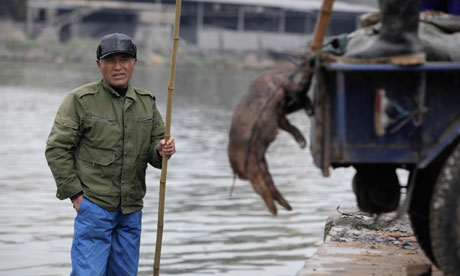
    Dead pigs are removed from a Shanghai river

    Apocalypse sow … 16,000 dead pigs have been recovered from rivers supplying water to Shanghai, China’s most populous city. Photograph: AP

    Not a very happy World Water Day for the people of Shanghai. In the past two weeks, the number of dead pigs recovered from rivers that supply water to the great financial centre has risen to more than 16,000. The authorities say there is no risk to health, but no one has much confidence in that appraisal. Contaminated water is now one of the greatest causes of illness in China.

    (more…)