Category: News

Add your news
You can add news from your networks or groups through the website by becoming an author. Simply register as a member of the Generator, and then email Giovanni asking to become an author. He will then work with you to integrate your content into the site as effectively as possible.
Listen to the Generator News online

 
The Generator news service publishes articles on sustainable development, agriculture and energy as well as observations on current affairs. The news service is used on the weekly radio show, The Generator, as well as by a number of monthly and quarterly magazines. A podcast of the Generator news is also available.
As well as Giovanni’s articles it picks up the most pertinent articles from a range of other news services. You can publish the news feed on your website using RSS, free of charge.
 

  • Foreign investment costs Aust millions

    Foreign investment costs Aust millions

    AAPNovember 28, 2012, 9:08 pm

    Taxpayers are losing up to hundreds of millions of dollars of Commonwealth tax revenue from foreign investment in domestic agriculture, a senate committee says.

    The Rural and Regional Affairs and Transport References Committee published its interim report on the tax arrangements for foreign investment in agriculture and the limitations of the Foreign Acquisitions and Takeovers Act 1975.

    Committee chair NSW Liberal senator Bill Heffernan said the report into the Foreign Investment Review Board (FIRB) national interest test raised serious concerns of potential huge revenue loss under the current legislation.

    “The evidence heard by the inquiry points to hundreds of millions of dollars of Commonwealth revenue being potentially lost through the current vagaries of present tax laws, coupled with the inadequacy of an out of date Foreign Acquisitions and Takeovers Act 1975,” Senator Heffernan said in a statement on Wednesday.

    “This report touches on a much bigger issue which governments across the world must tackle the redefining of sovereignty and the impact on our national interest.”

    The committee made six recommendations.

    These included the government undertake a review of tax arrangements for foreign investors in agriculture to prevent tax revenue leakage.

    Other recommendations included a review of local tax laws which provide exemptions for `not-for-profit’ activities for foreign entities and taxation laws to be reviewed to boost incentives for Australian investment in agriculture so local companies were not at a disadvantage to foreign entities.

    Also, a review of the Foreign Acquisitions & Takeovers Act 1975 to include a definition of `rural land’ and `urban land’ and for FIRB to effectively review foreign investment in Australia.

    Concerns about foreign investment were raised following the sale of Queensland cotton farm, Cubbie Station, to a joint Chinese-Japanese consortium in late August.

  • Update about “Stop Coal Seam Gas in the World Heritage Greater Blue Mountains Area”

    Update about “Stop Coal Seam Gas in the World Heritage Greater Blue Mountains Area”

    Inbox
    x

    Dr Kellie Leigh mail@change.org
    10:00 PM (43 minutes ago)

    to me
    Images are not displayed. Display images below – Always display images from mail@change.org

    This message is from Dr Kellie Leigh who started the petition “Stop Coal Seam Gas in the World Heritage Greater Blue Mountains Area,” which you signed on Change.org.


    A promising step forward in the campaign.

    This week the Blue Mountains City Council unanimously passed a motion to protect the Greater Blue Mountains Area from Coal Seam Gas mining. Liberal Mayor, Daniel Myles, even promised to ‘man the barricades’ should the need arise. Due to increasing pressure, and education about this frightening industry, the protest is gaining support.

    Sadly, as evidenced by the past, Council support does not guarantee that the CSG plans will be stopped at the State Government level. Please use this good news and solid backing from our local representatives to spread the word and increase support; try get just five of your friends to sign and share this petition. Every person can make a difference, you already have.

    Thank you for your support.
    https://www.change.org/en-AU/petitions/state-government-of-nsw-stop-coal-seam-gas-in-the-world-heritage-greater-blue-mountains-area?share_id=oszeaKCPPd&utm_campaign=mailto_link&utm_medium=email&utm_source=share_petition


    View the petition View and reply to this message online

    Unsubscribe from updates about this petition

  • First evidence of ocean acidification affecting live marine creatures in the Southern Ocean

    First evidence of ocean acidification affecting live marine creatures in the Southern Ocean

    Posted: 26 Nov 2012 08:09 AM PST

    The shells of marine snails — known as pteropods — living in the seas around Antarctica are being dissolved by ocean acidification, according to a new study. These tiny animals are a valuable food source for fish and birds and play an important role in the oceanic carbon cycle.

  • UN report into permafrost thaw

    UN report into permafrost thaw

    38 page  pdf report prepared by the UN explining the scientific reports on Permafrost Melt

    for lay people to understand.

  • Pesticide is killing Barrier Reef: WWF

    Pesticide is killing Barrier Reef: WWF

    AAPNovember 28, 2012, 5:45 pm

    A environmental group says Australia’s refusal to ban a toxic pesticide is placing the health of residents and the Great Barrier Reef at risk.

    WWF says the decision by the Australian Pesticides and Veterinary Medicines Authority (APVMA) on Wednesday to reduce the levels of diuron which can be used doesn’t go far enough.

    Diuron is classified by the US Environmental Protection Agency as a likely carcinogen and has been linked to coral bleaching and the death of seagrass on the Great Barrier Reef, according to WWF.

    Spokesman Nick Heath says the pesticide is so toxic, one gram in four Olympic-sized swimming pools would be enough to damage seagrass.

    “The APVMA has again failed to protect the Great Barrier Reef,” he said in a statement.

    “We call on the minister and the prime minister to intervene and give the APVMA stronger powers and an obligation to ban these dangerous chemicals.”

  • China planning ‘huge fracking industry’

    China planning ‘huge fracking industry’

    Chinese plans to expand fracking for shale gas prompt fears over local water and international climate impacts

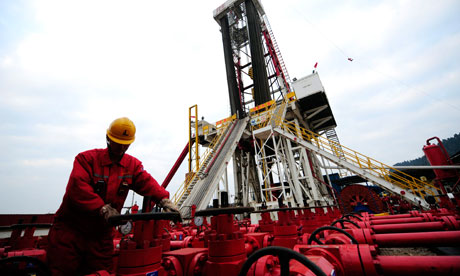
    Shale gas in China : natural gas appraisal well of Sinopec in Langzhong county, Sichuan

    A worker performs a routine check to the valves at a natural gas appraisal well of Sinopec in Langzhong county, Sichuan province, March 1, 2011. Photograph: Stringer /Reuters

    China is ratcheting up its fracking ambitions with virtually no regard for groundwater protection or other environmental safety measures, according to a new investigation by the independent publication Caixin. The report points to an 24 October white paper on energy development released by China’s top cabinet which “calls for ramping up the industry and pumping 6.5 billion cubic meters of natural gas from underground shale formations by 2015.”

    “The model for China’s anticipated success is the US shale gas sector,” the article states. “Geologists estimate the nation’s recoverable reserves at about 25 trillion cubic meters, on par with the United States.”

    Fracking has particular appeal in China because it provides an alternative to burning coal, which currently supplies about 70 percent of the nation’s consumed energy. Because natural gas can generate electricity at half the greenhouse gas emissions of coal, some see it as a way to reduce China’s carbon footprint.

    But fracking isn’t without environmental problems, as I and my colleagues at Mother Jones have reported before. And Caixin‘s review of government documents as well as interviews with industry sources, government officials, and environmental advocates reveal that fracking’s risks have not come under public scrutiny the way they have in the US, “much less addressed by the [Chinese] government or controlled via environmental laws.”

    If fracking takes off in China as planned, it will likely exacerbate the nation’s existing water crisis. “Most of the nation’s shale gas lies in areas plagued by water shortages,” the report says. With about 20 percent of the world’s population and only 6 percent of the world’s water resources, China is one of the least water-secure countries in the world. Its water shortages are made worse by pollution: According to the Ministry of Water Resources about 40 percent of China’s rivers were so polluted they were deemed unfit for drinking, while about 300 million rural residents lack access to safe drinking water each year.

    In order to reach the government’s annual shale gas production goal of 6.5 billion cubic meters by 2015, as many as 1,380 wells will need to be drilled across the country, requiring up to 13.8 million cubic meters of water, an industry source told Caixin. China’s industrial sector already consumes about 35 billion cubic meters of water a year. That amount of water would fill about 14 million Olympic-size swimming pools.

    There’s also serious risk of water contamination, as seen in the US fracking experience. Multiple studies in recent years including those by the EPA, Pennsylvania, and Duke University have concluded that shale gas drilling releases methane which can contaminate nearby water supplies. A 2009 ProPublica investigation found methane contamination from fracking was widespread in Colorado, Ohio, and Pennsylvania. But as Caixin reports, “there would be no legal reason to limit methane emissions at a shale gas well because China’s pollution standards do not cover methane.” One Ministry of Environmental Protection source told the publication that writing a new standard into law would take three years, “which helps explain why the State Council’s decision to fast-track the nation’s fledgling shale gas industry is making a lot of people nervous.”

    Groundwater in 57 percent of China’s 660 cities have already been significantly polluted, according to the Ministry of Environmental Protection.

    An unidentified source at China’s Ministry of Land Resources told Caixin that as shale gas development accelerates the government will likely introduce specific environmental policies to address fracking, such as groundwater protection. But these are not likely to be legally binding, an industry source told the publication.

    Perhaps a bigger concern is that China’s main energy and economic planning agencies, including the Ministry of Land Resources, seem to view fracking’s environmental risks as minimal or inflated:

    The MLR geological department source said, for example, that China’s shale gas is at least 3,000 meters and sometimes 4,000 meters underground—significantly deeper than aquifers, and separated from underground water by impermeable rock.

    Other industry sources argue that fracking fluids, which are mainly comprised of water and sand, break down naturally over a short time. And chemical additives make up less than 0.5 percent of what’s injected, they say.

    Similarly upbeat arguments against environmental fretting can be found in the government’s development plan for the period ending in 2015. It was jointly issued by four agencies including the National Development and Reform Commission and National Energy Bureau.

    Meanwhile, Caixin reported that one test fracking operation in Shaanxi Province—a major coal region in China’s dry North—recently “went awry, forcing local officials to temporarily cut a nearby city’s water supply.”

    Commercial fracking operations in China have not yet started, according to Caixin‘s report, but some Chinese companies have drilled test wells, and the government has begun selling chunks of designated fracking territory. In its latest round of auctioning shale-gas exploration blocks, for example, the Ministry of Land Resources awarded two blocks to Sinopec and Henan Coal Seam Gas Development and Utilization Co, in deals worth an estimated $128.5 million.

    Foreign companies including Royal Dutch Shell are also showing interest in China’s fracking plans. Shell announced earlier this month that it had shale gas agreements with three major Chinese oil companies. Caixin also reported in September that Shell was in talks with one company about a shale gas joint venture. ExxonMobil, BP, Chevron, and France-based Total are also working to form shale gas partnerships with Chinese oil and gas companies, according to an August National Geographic report.